CPT code 36600: Arterial puncture billing guide
CPT code 36600: definition and procedure overview CPT code 36600 is classified u...

Last Updated: Oct 15, 2026
E3520 is the CCSD code for microlaryngoscopy/laryngoscopy +/- biopsy, excision of lesion, polyp or cyst. The "+/-" means "with or without," so an inspection-only scope, a biopsy, and the removal of a polyp or cyst all report as E3520.
UK private medical insurers use the code to classify and reimburse the procedure. It sits in section 5.7.0, Larynx and Trachea, within chapter 5.0.0, Ear, Nose & Throat.
Let Pabau's smart automation suggest the right codes, reduce claim denials, and keep your practice compliant—effortlessly.
Automate repetitive tasks and focus on what matters most—your patients.
Reduce coding errors and ensure compliance with the latest regulations.
Clean claims, fewer denials, and faster reimbursements.
Powerful insights and reporting to help your practice thrive.
HIPAA compliant SOC 2 certified GDPR-compliant Trusted by 4,000+ clinics worldwide

E3520 covers microlaryngoscopy or laryngoscopy with or without biopsy, or excision of a laryngeal lesion, polyp, or cyst.
The “+/-” in the descriptor means an inspection-only scope also falls under E3520, so there is no separate diagnostic E35xx code to pick.
Phonomicrosurgery (E3450), laser surgery to the vocal cord (E3410), and endoscopic cordectomy (E3400) are the codes most easily confused with E3520.
Most UK private insurers require pre-authorization before the procedure, and proceeding without it commonly results in claim rejection.
Pabau, the practice software we build, keeps the operative note, pre-authorization reference, and claim status together, so each E3520 claim goes out complete.
CCSD code E3520 is the Clinical Coding and Schedule Development (CCSD) code for “Microlaryngoscopy/laryngoscopy +/- biopsy, excision of lesion, polyp or cyst.” The “+/-” means “with or without.” So E3520 is the code for the scope itself, whether or not tissue is taken or removed.
In practice, that gives one code for the whole range of endoscopic larynx work under this descriptor. An inspection-only microlaryngoscopy, a biopsy of a suspicious lesion, and the removal of a polyp or cyst all report as E3520.
The CCSD schedule is used by UK private medical insurers, including Bupa, AXA Health, Vitality, and Aviva, to classify and reimburse procedures. E3520 sits in section 5.7.0, Larynx and Trachea, within chapter 5.0.0, Ear, Nose & Throat. Each neighboring larynx procedure has its own page among our CCSD code guides.
The descriptor has changed over time. CCSD records show the narrative was revised in July 2018 from “+/- endoscopic excision of lesion of larynx” to the current wording. In that same month, a separate phonomicrosurgery code, E3450, was added.
Microlaryngoscopy is a direct endoscopic procedure performed under general anesthesia. The patient lies supine with the neck extended. A rigid laryngoscope is passed through the mouth and suspended from a chest support, which frees both of the surgeon’s hands.
The surgeon then works under an operating microscope or a telescope, using fine microlaryngeal instruments. The steps below are the ones an operative note usually records.
Steps four and five are optional under E3520. They still shape the note, because they show the insurer exactly what was done in theater.
E3520 fits when an ENT surgeon needs a direct look at the larynx under anesthesia, with or without taking tissue. That includes assessing a lesion seen at an outpatient visit, sampling it for diagnosis, or removing it.
Common indications, with the ICD-10 diagnosis codes often submitted alongside the CCSD claim:
The diagnosis code on the claim should reflect the pre-operative indication or the histology result. Choose it for clinical accuracy, never because it makes the procedure easier to approve.
The larynx and trachea section has several codes that involve a microlaryngoscopy. The question is whether a more specific code describes the procedure better than E3520 does.
Two of these overlap with E3520 on the surface. E3450 and E3410 can both describe removing a vocal cord lesion under a microscope. Where the cord itself is removed rather than a lesion on it, E3400 applies instead. The deciding detail is usually the technique the surgeon records, so the checks below run in note order.
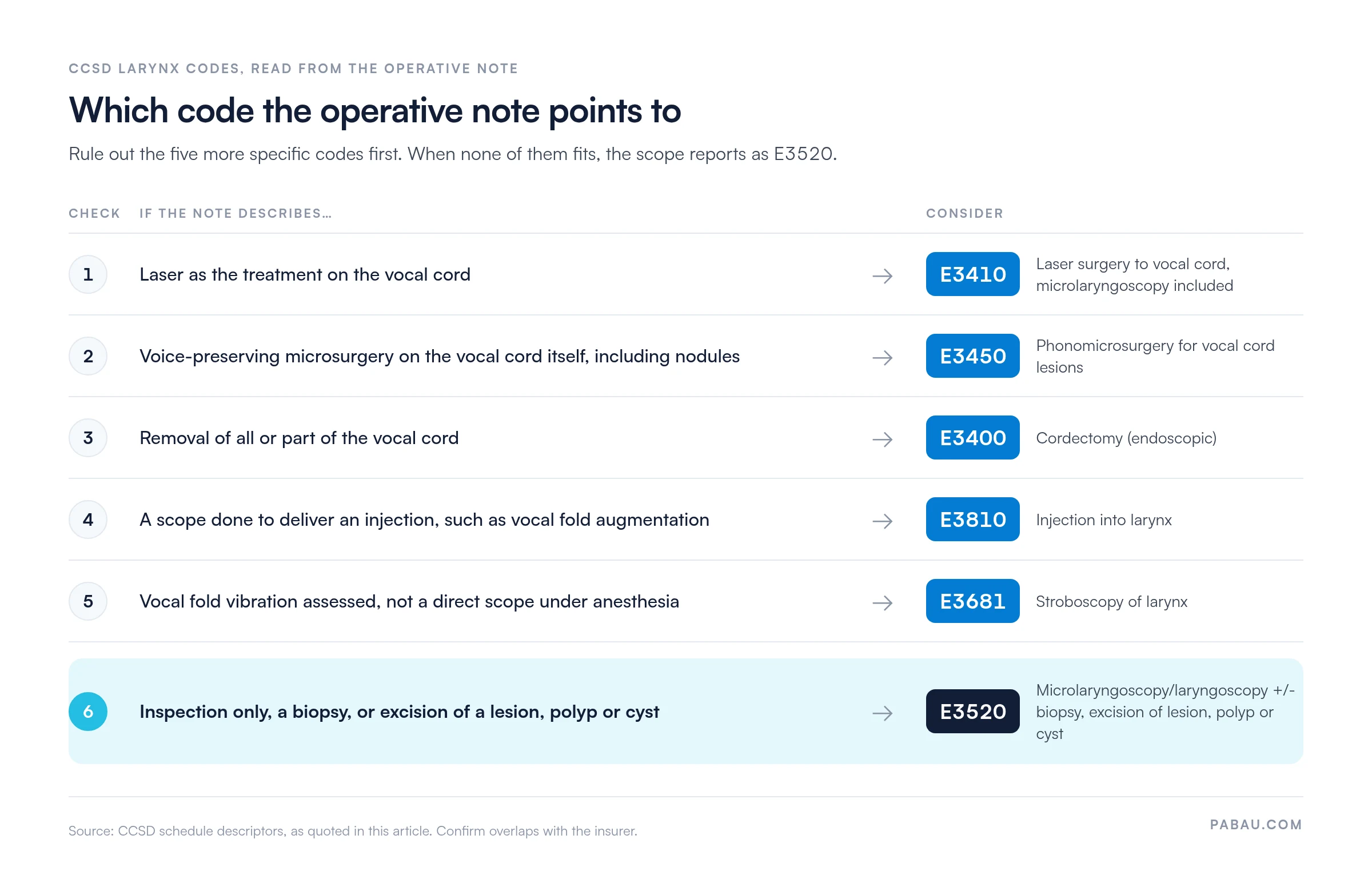
Where a lesion sits on the vocal cord and the note describes phonomicrosurgery or laser surgery, check whether E3450 or E3410 fits better than E3520. Insurers interpret the overlap differently, so confirm with the insurer’s coding team before you submit.
The operative note is the main document behind an E3520 claim. An incomplete note is a common reason a correctly coded claim is queried on audit. A structured note template helps make sure no required field is missed when the note is written.
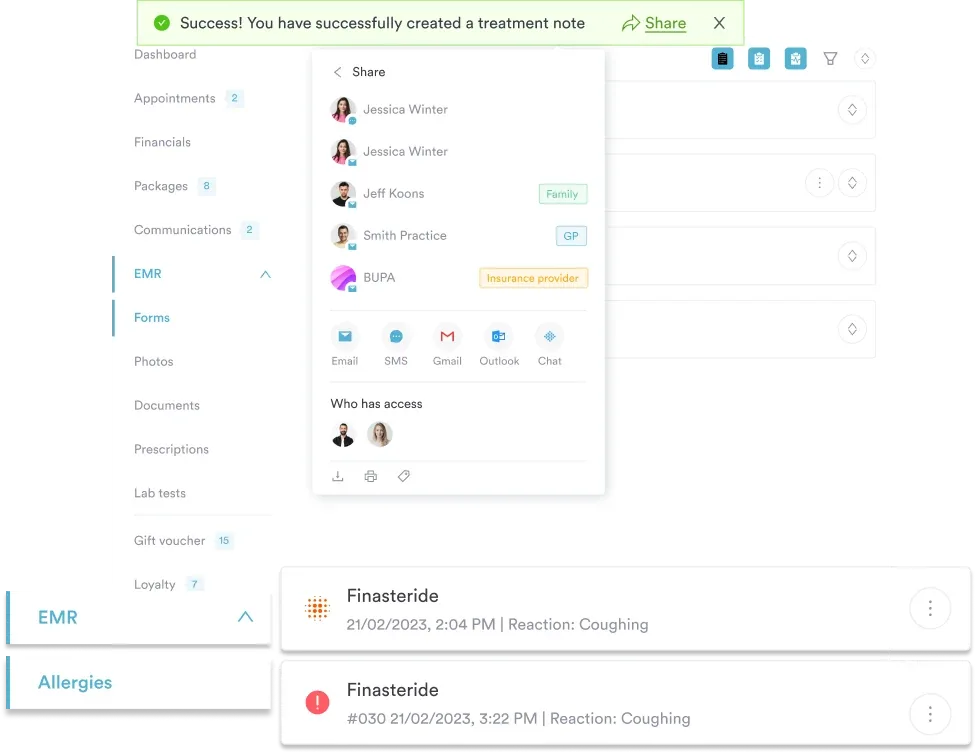
These elements support an E3520 claim:
An inspection-only scope still supports E3520. The note just needs to show that a direct laryngoscopy was done and what it found. A note that names the technique but records no findings invites a query.
Most major UK private medical insurers require pre-authorization before an elective E3520 procedure. Going ahead without it usually leads to rejection. Appeals on clinical urgency tend to succeed only where the urgency was documented at the time.
Pre-authorization for E3520 is typically required by these insurers:
A pre-authorization request usually needs the referral letter and any outpatient flexible laryngoscopy findings. It also needs the proposed diagnosis codes and the CCSD code being requested. Requirements change, so confirm the current pathway with each insurer at the time of booking.
E3520 denials follow a few predictable patterns. Most can be prevented with confirmed pre-authorization, a complete note, and a careful check against the more specific larynx codes.
E3520 is sometimes done in the same anesthetic session as other ENT or airway procedures. Whether both codes are payable depends on the insurer’s schedule and on whether the second procedure is clinically separate.
When several procedures share one session, the operative note should sequence them, each with its own indication and findings. Insurers auditing multi-procedure claims look for that separation.
There is no fixed national price for E3520. Each insurer sets its own fee against the CCSD code, and many surgeon fees depend on individual recognition agreements.
Hospital facility fees for theater time, consumables, and day-case admission are billed separately by the hospital. In UK private practice, the surgeon, hospital, and anesthetist fees go out as separate invoices.
Practical billing mechanics for E3520 claims:
Claims software for surgeons that supports CCSD codes cuts manual entry errors. It also lets staff track claim status across insurers from one dashboard.
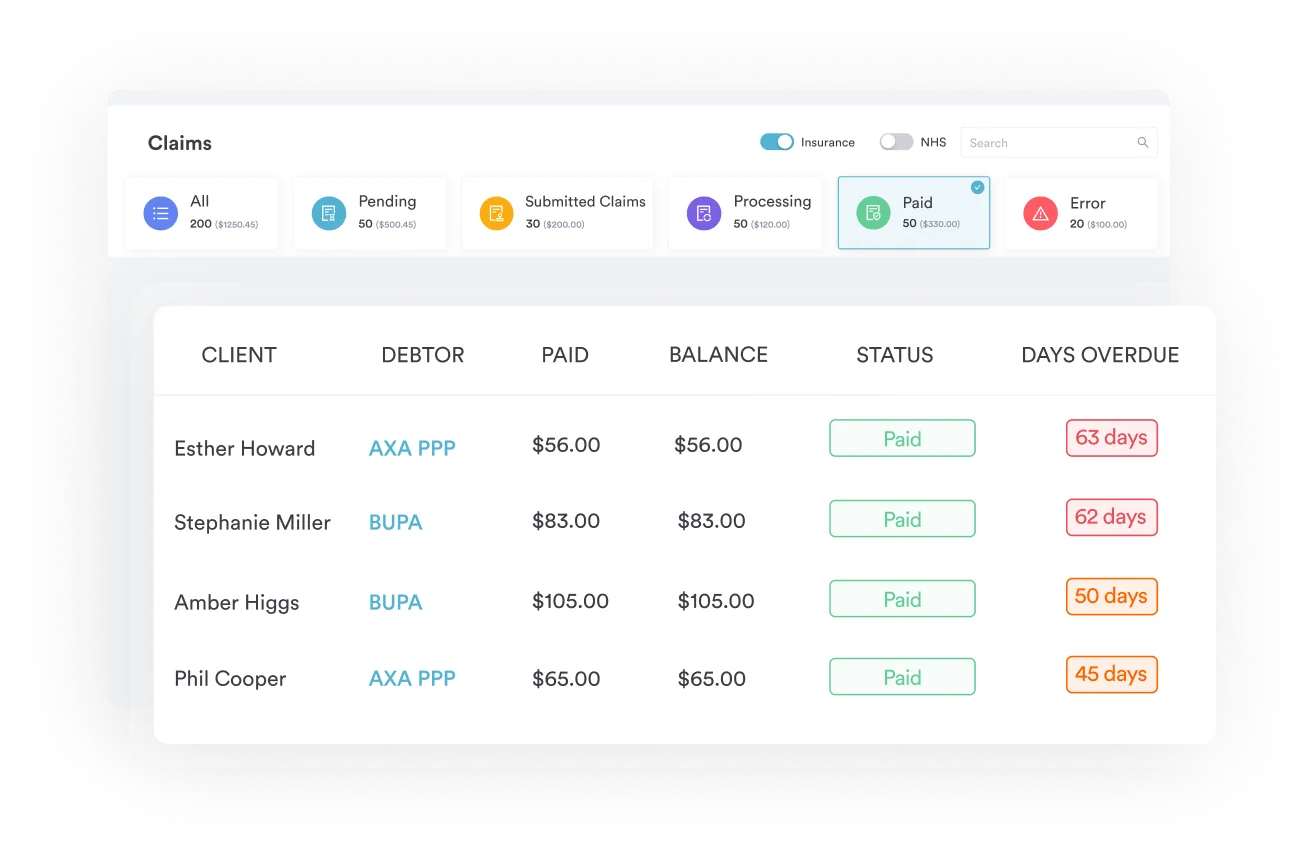
Before submitting an E3520 claim, check three things. The pre-authorization reference is on the claim, the operative note is complete and signed, and the ICD-10 code matches the indication recorded at booking.
Many ENT practices still keep the operative note in one system, the pre-authorization reference in an email, and the claim in an insurer portal. Each handoff is a chance for a detail to go missing.
Pabau brings those steps into one patient record. Surgeons write the operative note in structured digital forms, and staff log the pre-authorization reference against the booking. The claim is then raised and tracked from the same place.
The result is fewer claims sent back for a missing reference or an unsigned note. Your team spends less time chasing insurers and more time on patient care.

Pabau helps private ENT and surgical practices capture operative notes, manage pre-authorization, and track CCSD claims in one system. See how it supports UK private practice billing.

Because the E3520 descriptor reads “+/-“, one code covers the scope whether the surgeon inspects, samples, or removes. The choice that needs care is whether a more specific code, such as E3450 or E3410, describes the work better.
That choice rests on the operative note. Record the technique, the findings, and any tissue taken, then confirm pre-authorization before the list. Those two habits head off the queries that most often delay E3520 payment.
Book a demo to see how Pabau keeps operative notes, pre-authorization, and CCSD claims together for private ENT practices.

Need a reference for all Bupa CCSD procedure codes? Bupa CCSD codes guide covers the full Bupa CCSD schedule, submission process, and recognition requirements for private surgeons.
Was the lesion treated with a laser? CCSD code E3410 explains laser surgery to the vocal cord, where the microlaryngoscopy is already part of the descriptor.
Did the surgeon remove part of the vocal cord? CCSD code E3400 covers endoscopic cordectomy and the documentation that separates it from lesion excision.
Was the scope done to inject the larynx? CCSD code E3810 covers injection into the larynx, such as vocal fold augmentation.
Want to reduce claim rejection rates across your practice? Claims management software in Pabau tracks CCSD submissions, flags incomplete documentation, and monitors insurer reimbursements in one place.
CCSD code E3520 covers microlaryngoscopy or laryngoscopy with or without biopsy, or excision of a laryngeal lesion, polyp, or cyst. The “+/-” in the descriptor means “with or without.” So an inspection-only scope, a biopsy, and an excision all report as E3520.
Yes. The descriptor reads “+/- biopsy, excision of lesion, polyp or cyst,” so a direct laryngoscopy with no tissue taken still falls under E3520. The CCSD schedule has no separate diagnostic E35xx code. The operative note should still record the technique and the findings.
Microlaryngoscopy uses a suspension laryngoscope and an operating microscope, which allows two-handed work. Direct laryngoscopy uses a rigid laryngoscope without the microscope. Both fall under E3520, because the descriptor names “microlaryngoscopy/laryngoscopy.” The operative note should state which technique was used.
E3450 covers phonomicrosurgery for vocal cord lesions, nodules, polyps, or cysts. It may fit better when the surgeon performs voice-preserving microsurgery on the vocal cord itself. Insurers read the overlap differently, so confirm with the insurer’s coding team before you submit.
Where laser surgery to the vocal cord is the treatment, E3410 describes it, and its descriptor already includes the microlaryngoscopy. Where a lesion is removed with cold instruments, E3520 or E3450 is more likely to apply. Confirm the insurer’s interpretation before you submit.
No, E3520 does not include anesthesia. The surgeon claims E3520 for the operative procedure, and the anesthetist submits a separate CCSD anesthesia code. Hospital facility fees are also billed separately by the private hospital.
Yes, in most cases. Bupa, AXA Health, Vitality, and Aviva typically require pre-authorization for elective theater procedures, including E3520. The request usually needs a referral letter, the clinical indication, and the proposed CCSD and ICD-10 codes.
The most common reasons are missing pre-authorization and a diagnosis code that does not match the referral. An operative note with no technique or findings is another. Claims can also be queried where E3450 or E3410 describes the work more precisely.