

CCSD code G5100: Bypass of duodenum billing guide
CCSD code G5100 bills a bypass that leaves the duodenum in place CCSD code G5100...

Last Updated: Oct 16, 2026
E1220 is the CCSD code for the Caldwell-Luc procedure, an open operation on the maxillary sinus. The surgeon reaches the sinus through an incision inside the upper lip and a bone window in the canine fossa. UK private medical insurers accept it for chronic maxillary sinusitis, antral cysts and polyps, and foreign bodies in the sinus.
The code sits in section 5.5 Nasal sinuses of Chapter 5 (Ear, nose and throat) and is graded Intermediate. Antral washout is E1310, intranasal antrostomy is E1330 and flap closure of an oro-antral fistula is E1350. The operative note's description of the approach decides which one applies.
Let Pabau's smart automation suggest the right codes, reduce claim denials, and keep your practice compliant—effortlessly.
Automate repetitive tasks and focus on what matters most—your patients.
Reduce coding errors and ensure compliance with the latest regulations.
Clean claims, fewer denials, and faster reimbursements.
Powerful insights and reporting to help your practice thrive.
HIPAA compliant SOC 2 certified GDPR-compliant Trusted by 4,000+ clinics worldwide

CCSD Code E1220 covers the Caldwell-Luc procedure, an open approach to the maxillary sinus through the canine fossa.
E1220 is graded Intermediate in section 5.5 Nasal sinuses of Chapter 5 (Ear, nose and throat), not Major.
Its closest neighbours are E1310 antral washout, E1330 intranasal antrostomy, E1350 oro-antral fistula closure and the two FESS codes, E1260 (image-guided) and E1432.
The operative note must record the sublabial incision and canine fossa bone window, because that open access is what separates E1220 from its neighbours.
Claims management software helps practices attach the operative note and authorisation number to the treatment record before the claim goes out.
CCSD Code E1220 is the procedure code for the Caldwell-Luc procedure, also called a radical antrostomy. It is set by the Clinical Coding & Schedule Development Group (CCSD), the body behind the procedure codes that UK private medical insurers use.
CCSD members include Bupa, AXA Health, Aviva and Vitality, and most other UK insurers bill against the same schedule. E1220 sits in Chapter 5 (Ear, nose and throat), section 5.5 Nasal sinuses, and is graded Intermediate. Billing guides for the other CCSD codes follow the same format.
The descriptor is narrow. E1220 covers the open Caldwell-Luc approach only. Antral washout, intranasal antrostomy, flap closure of an oro-antral fistula and endoscopic sinus surgery each have their own section 5.5 code.
The Caldwell-Luc procedure opens the maxillary sinus through an incision in the upper buccal sulcus. The surgeon then enters the sinus through a bone window in the canine fossa of the anterior maxillary wall.
ENT surgeons and oral and maxillofacial surgeons both perform it, usually under general anaesthetic. When a consultant anaesthetist is involved, they bill separately under the same code against the schedule’s anaesthetist fee.
The operative sequence typically follows these steps:
Record each step in the operative note. A note that reads only “Caldwell-Luc performed” leaves the insurer unable to check the code.
Insurers look for clinical necessity in the pre-operative records. Typical indications include the following, and the referral letter and operative note should name the one that applies:
No diagnosis guarantees approval on its own. Each insurer applies its own policy terms, so check the indication against the patient’s cover before surgery.
Section 5.5 holds every maxillary, frontal and sphenoid sinus code in the ENT chapter. Each code has its own descriptor and complexity grade, and the grade drives the fee.
The fees below come from the Freedom Health Insurance Elite schedule of fees, Chapter 5, dated 1 October 2026. They show how one insurer prices the section. Other insurers publish their own fees for E1220, so check the schedule that applies to the patient’s policy.
Fee figures change with each schedule edition. For a wider view of the codes, see the Bupa CCSD procedure codes guide or the CCSD Technical Guide.
Five section 5.5 codes are often mixed up with E1220. Each treats the maxillary sinus or its surroundings, but through a different route and with a different scope.
The deciding test is simple. Was there a sublabial incision and a bone window through the canine fossa? If not, the procedure is not E1220. The chart below maps each route an operative note can record to its code.
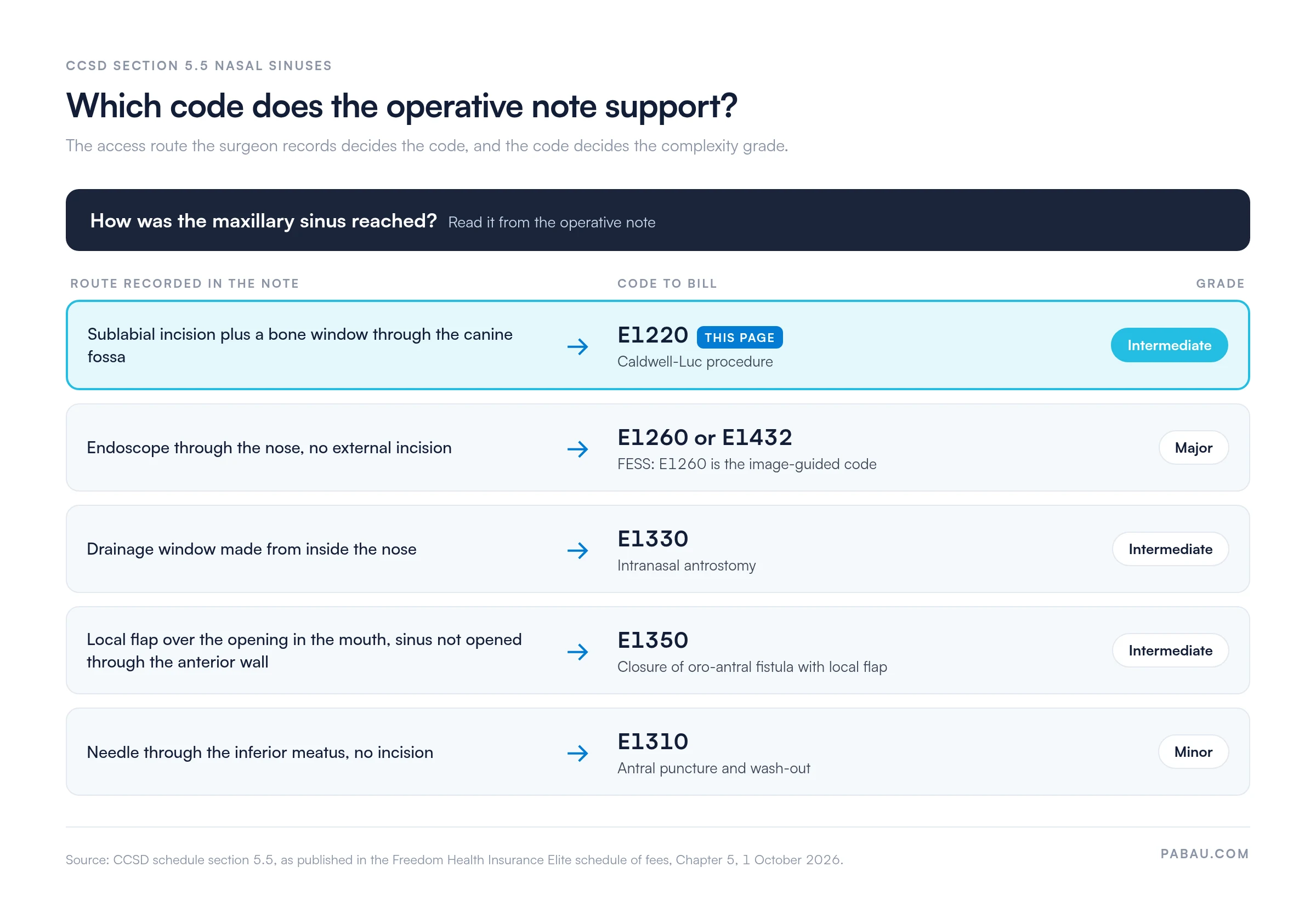
Where the note describes an endoscopic approach, the billing guides for E1260 and E1432 set out what each FESS code needs on file.
Each document in the claim package answers a question the insurer may ask. A missing document slows payment, and chasing records after discharge takes far longer than collecting them on the day.
A complete E1220 package usually includes:
UK private medical insurers generally expect the patient to get authorisation before planned surgery. The insurer then issues an authorisation number for the episode of care.
Rules differ by insurer and by policy, so treat the points below as a checklist rather than a guarantee:
Record the authorisation number, the date it was given and the name of the person who gave it. Keep all three on the patient record so they are ready if the claim is ever queried.
Most E1220 denials trace back to a small set of problems. Checking for them before submission is quicker than appealing afterwards.
Run every E1220 claim through a pre-submission checklist built on these five points before it goes to the insurer.
Billing E1220 with another code for the same session can be legitimate. It carries unbundling risk when the note does not keep each procedure separate.
Insurers also publish their own bundling notes. Freedom’s Chapter 5 guidance says FESS includes antrostomy, polyp removal and turbinate reduction, which should not be charged as extra procedures.
Practices that use the Bupa procedure codes fee schedule should also check Bupa’s current guidance on same-day procedures. Where the rules are unclear, ask the insurer in writing and keep the reply.
When you bill E1220 with another code for the same session, write a separate section of the operative note for each procedure. An insurer can only accept two procedures if the note shows two.
An E1220 claim depends on several documents: the imaging report, the referral letter, the operative note, the anaesthetic record and the authorisation number. In many practices those sit in different systems, and the claim waits while someone collects them.
Pabau, our practice management and billing platform, keeps those documents on the patient’s treatment record. Its claims management software lets the practice attach each supporting document to the episode, alongside its CCSD code.
The result is a claim that leaves the practice complete, with the evidence an insurer may ask for already on file.

Pabau helps practices attach operative notes, authorisation numbers and anaesthetic records to each treatment record, so every E1220 claim goes out complete.

E1220 pays at the Intermediate grade, so the claim stands or falls on whether the operative note proves the open approach. Most coding errors on this procedure come from confusing it with E1310, E1330, E1350 or the FESS codes E1260 and E1432.
Confirm the code before surgery, record the authorisation number, and have the surgeon describe the canine fossa access in the note. With those three in place, the insurer can check the code against the note without coming back to you. Book a demo to see how Pabau keeps CCSD claims and their supporting documents together for private practices.

Looking for a broader CCSD reference? Bupa CCSD procedure codes explains how the CCSD schedule works for claims to Bupa and other UK insurers.
Checking how fees are set? Bupa procedure codes fee schedule explains how Bupa sets reimbursement for each CCSD code.
Billing other ENT procedures? CCSD code E3400 covers endoscopic cordectomy from Chapter 5 of the same schedule.
Coding other section 5.5 procedures? CCSD code E1240 covers vidian neurectomy, a Major code from the same section.
CCSD Code E1220 is the code for the Caldwell-Luc procedure. It opens the maxillary sinus through a sublabial incision and a bone window in the canine fossa. It sits in Chapter 5 (Ear, nose and throat), section 5.5 Nasal sinuses, and is graded Intermediate.
No. An antral washout is a needle puncture and irrigation through the inferior meatus, with no incision and no bone window. It has its own code, E1310, graded Minor. Billing a washout as E1220 is upcoding.
UK private medical insurers generally expect authorisation before planned surgery, and E1220 is planned surgery. Check the patient’s policy before the operation date, and put the authorisation number on every invoice for the episode.
E1220 is an open procedure through the mouth and the canine fossa, graded Intermediate. FESS is endoscopic and graded Major, coded E1260 (image-guided) or E1432. All three codes sit in CCSD section 5.5, so the operative note decides which one applies.
ENT surgeons and oral and maxillofacial surgeons both perform the Caldwell-Luc procedure. Each insurer sets its own rules on which specialists it recognises, so check the consultant’s recognition with the patient’s insurer.
If the sinus was opened through the canine fossa, E1220 covers that work. E1350 covers flap closure of the fistula. Bill both only where the insurer allows it and the note describes two distinct procedures.



