CCSD code E2940: Partial laryngectomy billing guide
CCSD code E2940: what the code covers CCSD code E2940 is the procedure code for ...

Last Updated: Oct 15, 2026
E0420 is the CCSD code for reduction turbinates of nose (trim, radical excision). It covers surgery that cuts away or removes enlarged nasal turbinates to relieve chronic nasal obstruction.
The Clinical Coding and Schedule Development (CCSD) schedule is used by UK private medical insurers such as Bupa, AXA Health, Aviva and Vitality. Claims usually reach them through Healthcode. CCSD lists E0420 as an unacceptable combination with septoplasty and FESS codes.
Let Pabau's smart automation suggest the right codes, reduce claim denials, and keep your practice compliant—effortlessly.
Automate repetitive tasks and focus on what matters most—your patients.
Reduce coding errors and ensure compliance with the latest regulations.
Clean claims, fewer denials, and faster reimbursements.
Powerful insights and reporting to help your practice thrive.
HIPAA compliant SOC 2 certified GDPR-compliant Trusted by 4,000+ clinics worldwide

CCSD code E0420 covers surgical reduction of the nasal turbinates by trim or radical excision, both billed under the one code.
Laser, diathermy and out-fracture reduction belong to E0412, so an E0420 operative note must show that the surgeon cut tissue away.
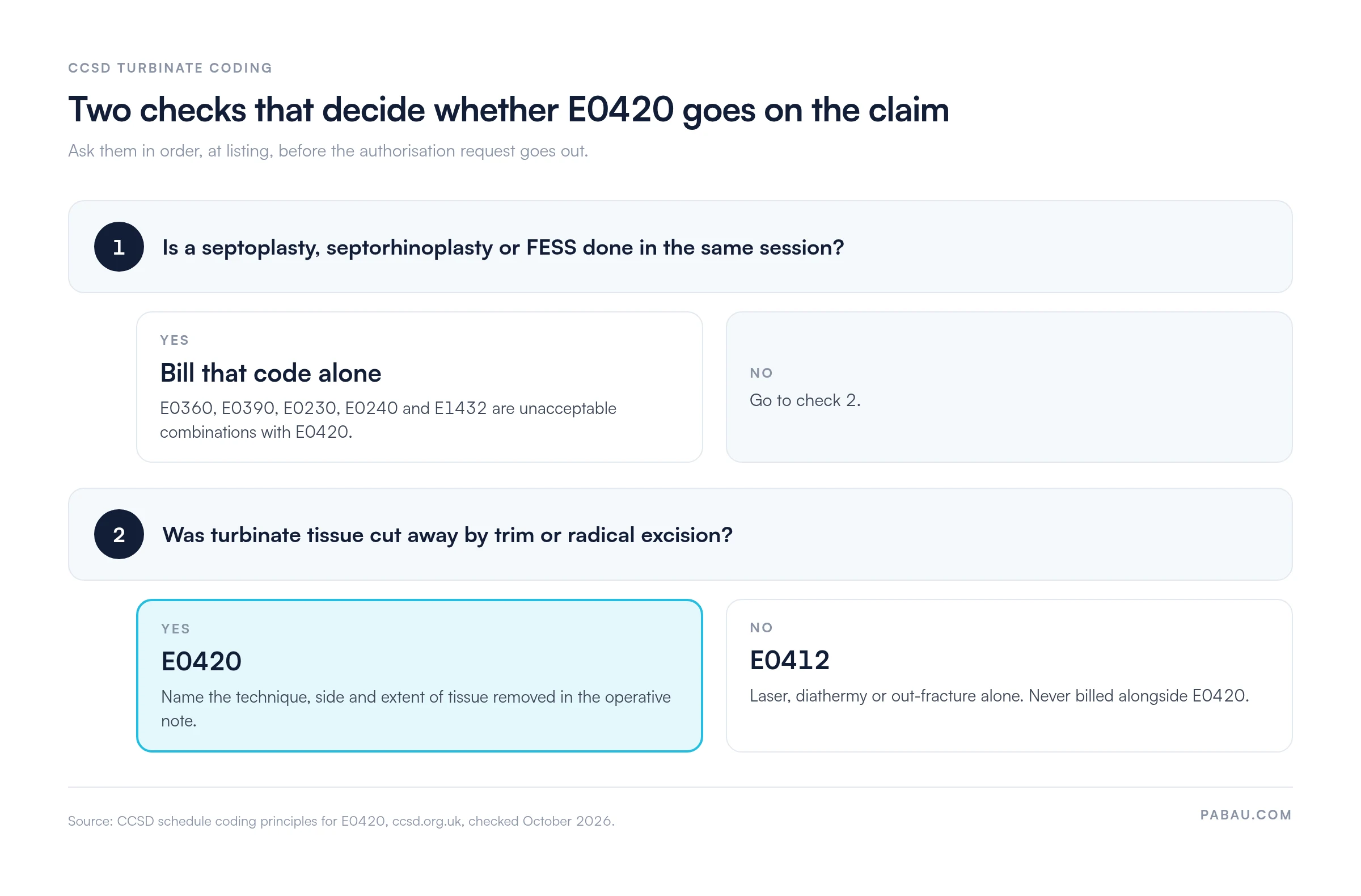
CCSD lists E0230, E0240, E0360, E0390, E0412, E0440 and E1432 as unacceptable combinations with E0420. As a result, it never shares a claim with septal or sinus surgery.
J34.3 (hypertrophy of nasal turbinates) in WHO ICD-10 is the diagnosis that most directly supports an E0420 claim.
CCSD sets codes and coding rules only, so fees, complexity bands and authorisation steps come from each UK insurer.
CCSD code E0420 is the Clinical Coding and Schedule Development code for reduction turbinates of nose (trim, radical excision). It sits in section 5.4.0, Nose and Nasal Cavity, of the CCSD schedule, under CCSD reference Fe.058.
The CCSD Group maintains the schedule for UK private healthcare. Insurers such as Bupa, AXA Health, Aviva and Vitality use it to name procedures on surgeons’ and hospitals’ bills. In addition, most of those bills reach the insurer online through Healthcode.
ENT surgeons and rhinologists are the main users. One E0420 covers both the trim and the radical excision technique, so the technique shapes the operative note rather than the code choice.
The code used to read excision of turbinate of nose (and bilateral). However, CCSD later changed the descriptor to the current trim and radical excision wording.
The inferior turbinate is a bony shelf lined with mucosa that runs along the side wall of the nose. When it enlarges (hypertrophies), it narrows the airway. As a result, patients get chronic nasal obstruction, mouth breathing and disturbed sleep.
Surgery reduces the bulk of the turbinate to restore airflow. E0420 is usually a day-case operation under general or local anaesthesia, and it covers two techniques:
Medical treatment usually comes first, with topical nasal corticosteroids, antihistamines where allergy plays a part, and saline irrigation. Therefore, record the trial and its outcome, because an insurer may ask why the patient needed surgery.
No. Trim and radical excision both bill under E0420, because the descriptor names both techniques. The code changes only for reduction without excision, since laser, diathermy and out-fracture belong to E0412.
The operative note should name the technique, state the side or sides treated, and describe how much tissue the surgeon removed. Otherwise, a note that only mentions turbinate surgery leaves the insurer to guess which code applies.
CCSD codes the procedure, while you record the diagnosis in WHO ICD-10 (5th edition). Insurers may ask for it when they approve the surgery or review the claim.
In fact, J34.3 is the closest match for most E0420 cases. Therefore, use the same code in the pre-operative assessment and the operative note so the two records agree.
Some nose and sinus codes either include turbinate work or reduce the turbinates by another method. In fact, the CCSD coding principles for E0420 list each code below as an unacceptable combination with it. Our CCSD code guides cover some of them in more depth.
Septorhinoplasty codes E0230 and E0240 sit on the same list, because their descriptors also include attention to turbinates. When turbinate work happens during one of these operations, that code already covers it, so you do not add E0420.
Check the live schedule before you bill, because CCSD code records sit behind a log-in on ccsd.org.uk. In addition, Bupa publishes its own code search. Pabau’s guide to Bupa’s CCSD procedure codes explains how the schedule works.
Before listing a patient for septoplasty or FESS, check whether the surgeon also plans turbinate reduction. If so, the main code already includes the turbinates, so the estimate and authorisation request should carry that code alone.
No. CCSD lists E0420 as an unacceptable combination with septoplasty (E0360) and extracorporeal septoplasty (E0390). The same applies to E1432, the bilateral FESS code. The E0360 and E1432 descriptors already name the turbinates, so adding E0420 would bill that work twice.
The same rule applies to E0412 and E0440. For example, a surgeon who trims one turbinate and diathermies the other in one session cannot add E0412 to E0420 on the same claim.
E0420 covers turbinate reduction on its own, with no septal or sinus surgery in the same session. Therefore, if the patient also needs a septoplasty, plan and approve the episode under the septoplasty code from the start. The two checks below settle the code at listing.
Insurers can request operative records when they review an E0420 claim. A complete record covers five points:
Therefore, digital forms and note templates that ask for technique, side and treatment history make an incomplete record less likely to reach the insurer.
Each UK insurer sets its own rules for authorising planned surgery, and the details vary by policy. Therefore, check with the patient’s insurer before the surgery date and record any reference it issues.
An authorisation request goes more smoothly when it carries the same facts as the later claim:
Store the authorisation reference in the patient record so it travels with the invoice. In addition, a shared checklist in your authorisation workflow keeps that step visible to the whole team.
There is no national fee for CCSD code E0420. The CCSD Group states that it does not determine classifications, reimbursement or fees, so each insurer applies its own.
Insurers publish fee schedules or benefit limits for the consultants they recognise, and some band procedures by complexity. Most of these schedules sit behind a provider log-in, so check the current figure with each insurer.
E0420 claims run into trouble for a few common reasons:
Submucosal diathermy reduces turbinate volume with a probe that the surgeon places beneath the mucosa. Controlled heat scars the tissue so it shrinks, and the surgeon cuts no tissue away. Therefore, that technique codes to E0412, alongside laser reduction and out-fracture.
E0420 needs tissue removed by trim or excision. Billing E0420 for diathermy overstates the procedure, while billing E0412 for a turbinectomy understates it. In short, the technique that the operative note names decides the code.
In fact, most E0420 problems start before the claim, with a missing authorisation reference or a vague note. Pabau, the practice management platform we build for private practices, keeps the clinical record, booking and invoice in one patient file.
Its claims management software pulls the details already on the patient record into a pre-filled claim. It then submits the claim to the insurer through Healthcode and tracks its status, so the team can see which claims need attention.
The coding decision stays with your team. Pabau sends the codes and references you record, so a complete record before theatre is what keeps the claim clean.

Pabau keeps operative notes, authorisation references and invoices in one patient record, then submits and tracks insurer claims through Healthcode. See how it fits your ENT practice.

E0420 is the right code when the surgeon cuts turbinate tissue away and performs no septal, septorhinoplasty or sinus surgery in the same session. When the surgeon performs one of those, its own code already includes the turbinates, so E0420 drops off the claim.
In short, the work that protects the claim happens before theatre. Agree the code at listing, obtain the insurer’s authorisation, and make sure the operative note names the technique and side. That takes a few extra minutes per case, far less than an appeal.
Book a demo to see how Pabau keeps E0420 notes, authorisation references and Healthcode claims together for your ENT practice.

Want to understand the wider CCSD framework? Bupa CCSD codes guide explains how the CCSD schedule is structured and how Bupa applies it to surgical claims.
Treating adhesions after nasal surgery? CCSD code E0440 covers division of turbinate adhesions and how it differs from turbinate reduction.
Planning sinus surgery as well? CCSD code E1432 explains bilateral FESS billing, which already includes attention to the turbinates.
Want fewer queried insurer claims? Claims management software shows how Pabau submits and tracks insurer claims through Healthcode.
Coding a septorhinoplasty instead? CCSD code E0230 covers septorhinoplasty with graft or implant after trauma or tumour excision, turbinate work included.
CCSD code E0420 covers reduction of the nasal turbinates by trim or radical excision. Both techniques bill under the one code. Laser, diathermy and out-fracture reduction use E0412 instead.
A trim cuts away part of the turbinate bone or mucosa while keeping most of the lining. Radical excision removes the turbinate partly or completely, bone and mucosa included. Both bill under E0420, and the operative note should name the technique used.
Authorisation rules are set by each UK insurer and vary by policy. Check with the patient’s insurer before the operation, and record any authorisation reference it issues in the patient file.
No. CCSD lists E0420 as an unacceptable combination with septoplasty E0360 and extracorporeal septoplasty E0390. The septoplasty descriptor already includes attention to turbinates, so the septoplasty code covers the turbinate work.
E0420 needs turbinate tissue to be cut or excised. Submucosal diathermy shrinks the turbinate with heat beneath the mucosa and removes no tissue, so it codes to E0412. The two codes cannot be billed together.
J34.3, hypertrophy of nasal turbinates, is the closest WHO ICD-10 match. J30 rhinitis codes or J31.0 chronic rhinitis can be added where documented. Use the same diagnosis across the referral, authorisation request and operative note.