ICD-10 code S52.024K: Nondisplaced olecranon nonunion
ICD-10 code S52.024K covers a right olecranon fracture that won’t heal ICD...

Last Updated: Oct 16, 2026
Billable Code Specific Code
M95.0 is the billable ICD-10-CM code for acquired deformity of nose.
Most claim denials on M95.0 come from two errors. One is submitting without a documented etiology when the deformity supports a rhinoplasty procedure. The other is assuming J34.2 (deviated nasal septum) cannot accompany it, when the Excludes2 note allows both codes on the same claim.
Let Pabau's smart automation suggest the right codes, reduce claim denials, and keep your practice compliant—effortlessly.
Automate repetitive tasks and focus on what matters most—your patients.
Reduce coding errors and ensure compliance with the latest regulations.
Clean claims, fewer denials, and faster reimbursements.
Powerful insights and reporting to help your practice thrive.
HIPAA compliant SOC 2 certified GDPR-compliant Trusted by 4,000+ clinics worldwide

M95.0 is a billable ICD-10-CM code for acquired, non-congenital nasal deformity, valid for 2026 submissions.
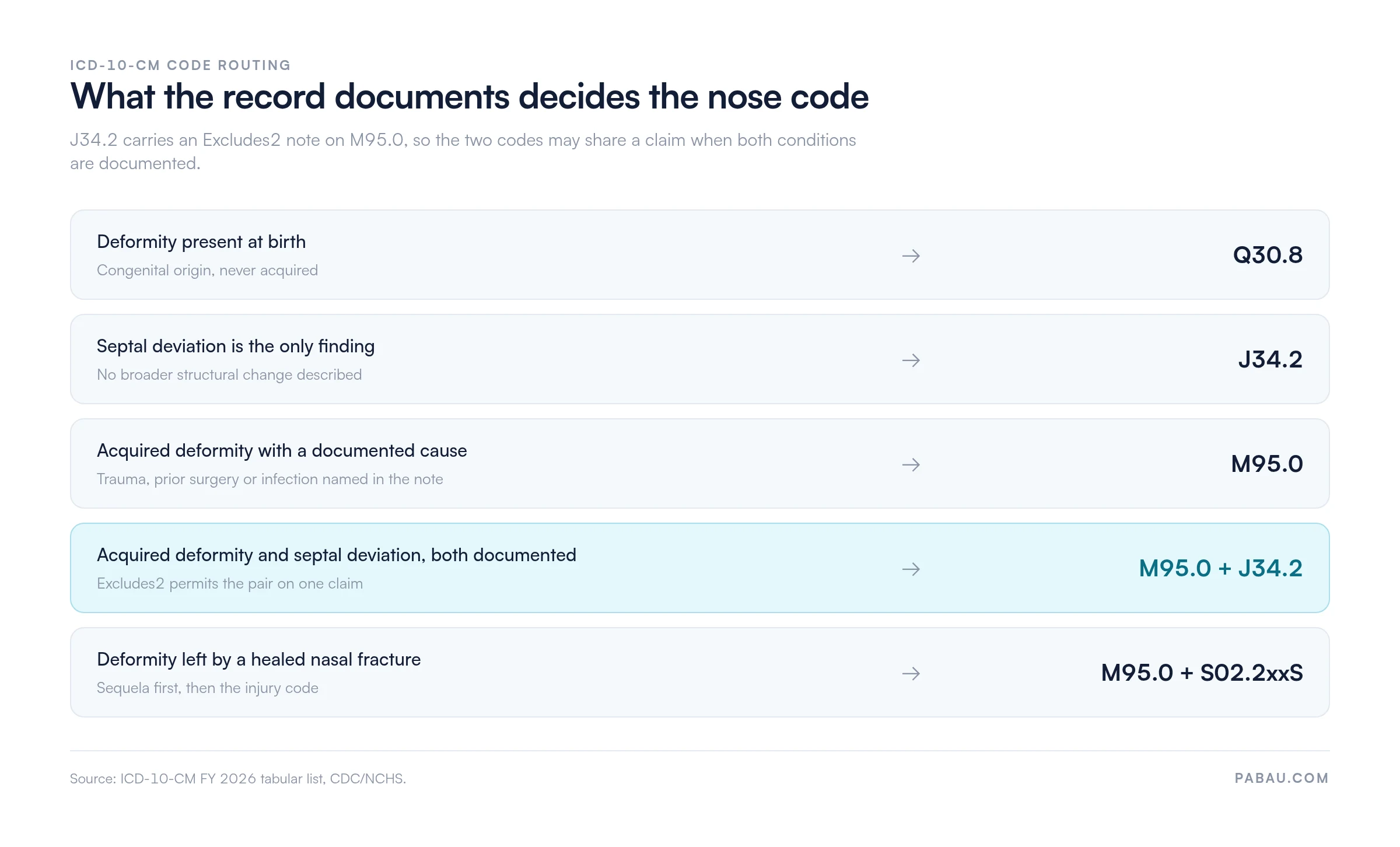
J34.2 (deviated nasal septum) is an Excludes2 note on M95.0, so both codes can be reported together when documented.
M95.0 supports rhinoplasty CPT codes 30400-30450, but medical necessity still needs documented functional impairment.
Pabau’s claims management software embeds ICD-10 code lookup and Claim.MD clearinghouse integration to reduce M95.0 denials.
ICD-10 Code M95.0 is the specific, billable subcode for acquired deformity of the nose. It sits within the M95 category, Other acquired deformities of the musculoskeletal system and connective tissue. The parent code M95 is non-billable, so M95.0 is the code to submit on a claim. Per the CDC/NCHS ICD-10-CM tool, M95.0 carries no non-billable notation and needs no 7th character extension.
The code belongs to Chapter 13, Diseases of the musculoskeletal system and connective tissue (M00-M99). Within that chapter it sits in the block M95-M95, Other disorders of the musculoskeletal system and connective tissue. Chapter placement matters because coders sometimes search Chapter 10 for nasal conditions. That lands them on respiratory J-codes, which do not describe structural deformities of acquired origin.
Clinical presentations captured by M95.0 include:
Congenital nasal deformities are excluded and coded instead under Q30-Q30.9. Confirming the acquired-versus-congenital distinction is the first documentation step before M95.0 is assigned.
The official ICD-10-CM tabular for M95.0 carries instructional notes that affect claim validity. The one coders misread most often is the Excludes2 note covering J34.2.
Excludes2 means the listed condition is not part of M95.0, though a patient can have both at once. Per the CMS ICD-10-CM guidelines, an Excludes2 note allows the two codes on the same claim where the record documents each one. The Excludes2 note at M95.0 covers:
Congenital nasal deformities (Q30.8 and related Q30 codes) are not included under M95.0. The differentiator is onset. Present at birth means a congenital Q-code, while a deformity that developed after birth through trauma, surgery, or infection means M95.0. Payers routinely flag the mix-up during automated claim edits.
Four codes are regularly confused with M95.0. The table below shows each code, its descriptor, and the single most important differentiator. Refer to the AAPC ICD-10-CM lookup to verify current descriptor alignment before finalizing any claim.
The M95.1 confusion turns up often in ENT and facial plastic billing. Coders search “acquired deformity” in the M95 category, then select M95.0 when the chart actually describes an auricular hematoma. Always confirm the anatomical site before submitting.
Which code, or which pair of codes, belongs on the claim follows from what the note documents. The panel below routes the five scenarios this article covers.
Three clinical scenarios account for most M95.0 submissions. Each follows a specific coding logic that the medical record must support.
When a nasal fracture has healed but left a residual deformity, the fracture is in its sequela phase. Per the ICD-10-CM Official Guidelines (Section I.C.19.a), sequela coding lists the sequela condition first, then the causative injury code with the 7th character “S”. For a resolved nasal fracture, assign M95.0 as the principal diagnosis and add S02.2xxS as a secondary code. Do not use the active fracture code S02.2xxA once the fracture has healed.
Saddle nose is a collapse of the nasal bridge following septal surgery, cocaine use, or granulomatous infection. The ICD-10-CM Alphabetic Index routes it to M95.0 under “Deformity, nose, acquired”. The chart must document the causative event, because payers treat saddle nose without an etiology as an unsubstantiated diagnosis. Record that etiology as a secondary code where one applies.
When M95.0 supports a rhinoplasty procedure, the record must also document functional impairment. M95.0 alone rarely satisfies medical necessity for surgical payers. The note should capture airway obstruction, breathing difficulty, or epistaxis linked to the structural deformity. A secondary code such as J34.89 for functional compromise strengthens the claim where the deformity has a measurable airway impact.
Run a claim scrub before submission on any M95.0 claim paired with a rhinoplasty CPT. Check the Excludes2 relationship with J34.2, and report that code only when septal deviation is separately documented. Verify the etiology appears in the HPI, and confirm the functional impairment code is present where the procedure is reconstructive rather than cosmetic.
M95.0 is the standard diagnosis pairing for functional and reconstructive rhinoplasty. It supports the CPT codes surgeons bill when correcting acquired nasal deformities, including CPT code 30420 for a primary rhinoplasty with major septal repair.
The cosmetic-versus-reconstructive distinction drives payer coverage decisions, not CPT code selection alone. M95.0 supports the reconstructive argument where the documentation establishes an acquired etiology and a functional consequence. Without both, most payers reclassify the procedure as cosmetic and deny the claim. Confirm CPT descriptors for the current year in the AMA CPT manual, since they are updated annually.
Documentation is what separates a clean M95.0 claim from a denial. CMS guidance and commercial payer local coverage determinations (LCDs) for nasal reconstruction agree on what the record needs. These elements should be present before M95.0 is assigned.
Structured note templates prompt for etiology, functional findings, and prior treatment at the point of care. Practices that build those prompts into the documentation workflow catch problems before claims go out, rather than during a denial audit.
M95.0 denials follow predictable patterns. Five reasons account for most of them, and each arrives on the remittance as one of the standard denial codes.
Billing teams that track M95.0 denial reasons by payer can spot patterns specific to individual plans and prepare appeal templates in advance. Using claims management software that validates ICD-10 codes at submission lowers first-pass denial rates without a separate review step.
Most practices find an M95.0 problem only after the remittance arrives. The coder assigns the code, the claim goes out, and a missing etiology or an unsupported J34.2 pairing surfaces as a denial weeks later. By then the chart is closed and the provider has moved on.
Practice management software like Pabau moves that check to the point of documentation. The ICD-10 lookup sits inside the note, so your coder picks M95.0 against its official descriptor rather than from memory. The Claim.MD integration then routes the claim through a clearinghouse serving 4,000-plus US payers. Pre-submission edits run there, before the payer’s adjudication queue sees the claim.
For a rhinoplasty practice, the diagnosis pointer, the etiology note, and the supporting codes are all in place while the chart is still open. Fewer claims come back, and the ones that do come back with a reason the billing team can act on.


Pabau’s ICD-10 lookup puts the official M95.0 descriptor and its Excludes2 note in front of your coder. The Claim.MD connection then runs pre-submission edits on every rhinoplasty claim.

M95.0 is valid for FY 2026 with no descriptor change, no new instructional notes, and no effective-date revision from the prior year. The CMS ICD-10-CM 2026 tabular release confirms the code remains active. Check the current-year tabular each October 1, because the M95 category occasionally picks up instructional note revisions even when its subcodes are unchanged.
The ICD-10-CM Alphabetic Index continues to route “Deformity, nose, acquired” to M95.0, and “Saddle nose” to M95.0 as well. Check the index entry for post-traumatic nasal deformity too. Its sequela routing through S02.2xxS occasionally changes between fiscal years.
M95.0 is a straightforward billable code when the documentation does its job. That means a confirmed acquired etiology, physical examination findings, and functional impairment notation on surgical claims. Whether J34.2 belongs on the claim turns on what the chart records, since the Excludes2 note permits the pair. That question and a missing etiology account for most denials on this code.
Build the etiology prompt into the note template first, because that single change removes the most common reason these claims come back. Book a demo to see how Pabau surfaces ICD-10 validation and clearinghouse edits at the point of claim creation.

Need guidance on denial code patterns across claim types? Denial codes in medical billing covers the CARC and RARC codes that appear on M95.0 and rhinoplasty claim remittances.
Want to understand how clearinghouse validation reduces first-pass denials? How the Claim.MD clearinghouse works explains the pre-submission edit process and payer enrollment workflow.
Looking for end-to-end revenue cycle context? What is revenue cycle management covers the full billing workflow from patient encounter to payment posting.
Not sure what a payer counts as a clean claim? Clean claim requirements sets out the fields and attachments that get a claim paid on first submission.
New to the workflow behind these codes? What is medical billing walks through each step a claim takes, from coding to remittance.
ICD-10 Code M95.0 is the billable diagnosis code for acquired deformity of nose. The term means a structural nasal abnormality that developed after birth, through trauma, surgery, or infection, rather than a congenital condition. It belongs to Chapter 13 (musculoskeletal and connective tissue diseases), within the M95 category.
Yes. M95.0 is a valid, billable ICD-10-CM code for FY 2026, requiring no 7th character extension. The parent code M95 is non-billable; M95.0 is the specific subcode to submit on a claim.
Yes. Saddle nose deformity is indexed to M95.0 in the ICD-10-CM Alphabetic Index under “Deformity, nose, acquired.” The medical record must document the causative event (prior septal surgery, infection, or other acquired etiology) to substantiate the code.
The medical record must include the provider’s documented etiology (trauma, prior surgery, or infection) and physical examination findings describing the deformity. For surgical claims, it must also note functional impairment such as airway obstruction. Photographic documentation is required by most surgical payers. Prior conservative treatment should also be noted when payers require it.