HCPCS code Q4154: Biovance billing, Medicare rate and denial guide
HCPCS code Q4154: definition and code details HCPCS code Q4154 is a Level II cod...

Last Updated: Oct 6, 2026
CCSD code E0380 is the procedure code for nasal septum cauterisation (unilateral or bilateral). It sits in Chapter 5 of the CCSD schedule, Ear, nose and throat, under the nose and nasal cavity section. One E0380 covers one side or both, so the code goes on the claim once.
Septal cautery is a short procedure, usually done under local anesthetic to stop recurrent nosebleeds. Claims tend to come back for two reasons. Either the note misses the indication, or E0380 sits beside a code it can't be billed with, such as septoplasty. Record why, where, how and what was found, and the claim carries its own evidence.
Let Pabau's smart automation suggest the right codes, reduce claim denials, and keep your practice compliant—effortlessly.
Automate repetitive tasks and focus on what matters most—your patients.
Reduce coding errors and ensure compliance with the latest regulations.
Clean claims, fewer denials, and faster reimbursements.
Powerful insights and reporting to help your practice thrive.
HIPAA compliant SOC 2 certified GDPR-compliant Trusted by 4,000+ clinics worldwide

CCSD code E0380 is the ENT procedure code for nasal septum cauterisation, on one side or both.
One E0380 covers a bilateral cautery, so the code never goes on the claim twice.
E0380 cannot be billed with nine septal and nasal-surgery codes, including septoplasty (E0360) and submucous resection (E0310).
Record the indication, side, method and findings, because a bare procedure line invites insurer queries.
Confirm the patient’s cover first, since septal cautery often happens during an outpatient visit.
CCSD code E0380 is the procedure code for nasal septum cauterisation. The official descriptor reads “Nasal septum cauterisation (and bilateral)”. It sits in Chapter 5 of the CCSD schedule, Ear, nose and throat. Within that chapter, it falls under nose and nasal cavity (5.4.0).
The bracketed wording matters for billing. It means one E0380 covers a cautery on one side or on both sides. A bilateral procedure is still a single line on the claim.
The descriptor does not name a technique. Chemical cautery with silver nitrate and electrocautery are both common ways to seal a septal vessel. Still, note the method in the record. An insurer query will ask what was done.
Most septal cautery treats recurrent anterior nosebleeds. The bleeding usually starts in Little’s area, a cluster of small vessels at the front of the septum. Sealing a prominent vessel there lowers the chance of another bleed.
The procedure is short and usually done under local anesthetic. As a result, it often happens at an outpatient appointment rather than on an operating list.
For the claim, the clinical note should answer four questions:
A septal cautery claim follows the same path as other UK private claims. The steps below show where each piece of evidence enters.
The Clinical Coding and Schedule Development Group sets the codes and their descriptors. Its members are Aviva, AXA Health, Bupa and VitalityHealth. Fees are a separate matter, so check what the patient’s insurer pays for E0380.
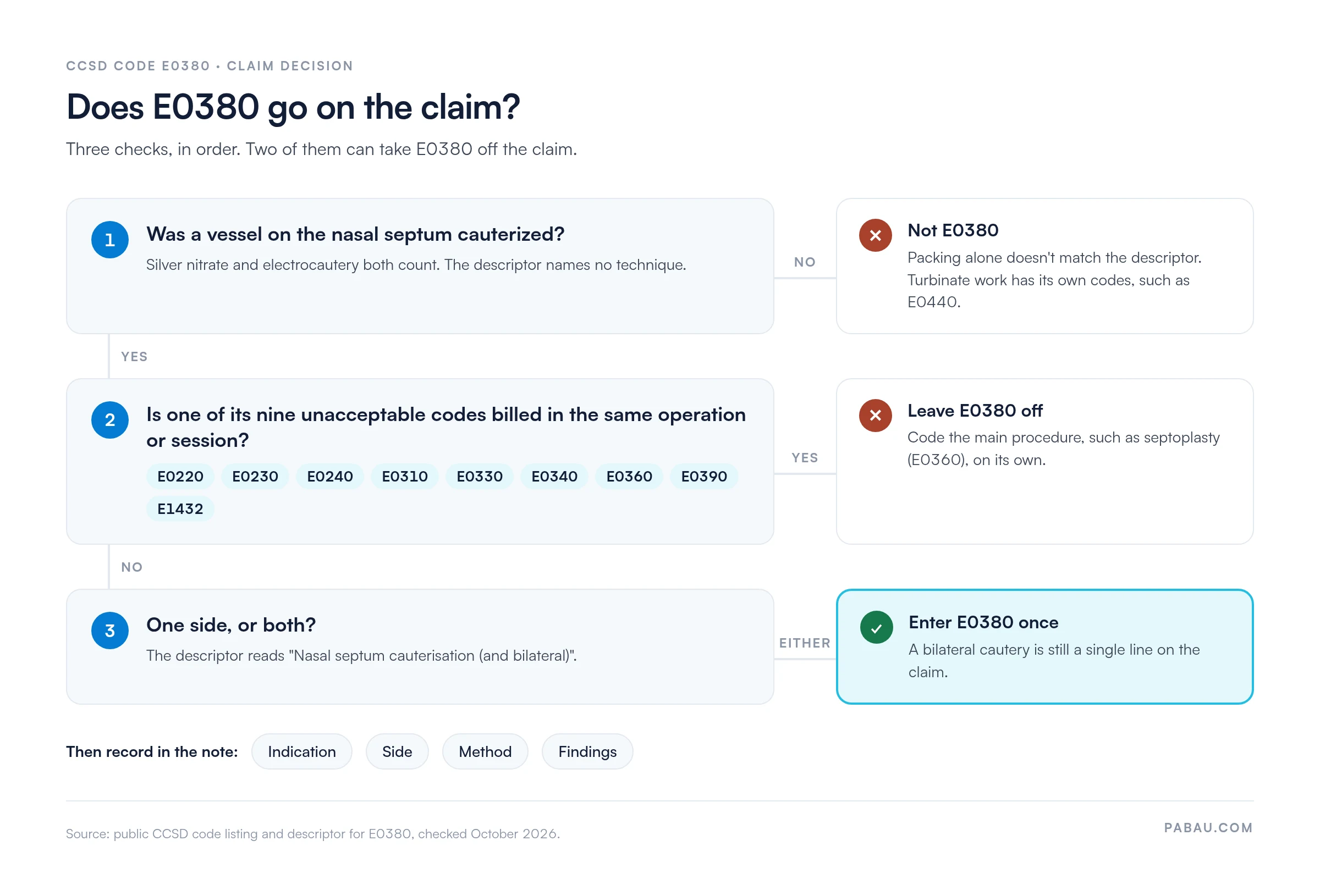
The CCSD listing for E0380 names nine unacceptable combinations. These codes cannot be billed alongside E0380 in the same operation or session. Most of them are larger septal or nasal operations.
The rule is simple to apply. A cautery done during a septal operation, or in the same session, is not billed on its own. Code the main procedure and leave E0380 off. The flow below shows each point where E0380 stays on or comes off the claim.
Source: the public CCSD code listing for E0380, checked October 2026.
The case below follows a fictional patient through each coding decision.
A 34-year-old patient sees an ENT consultant after weeks of recurrent nosebleeds. Examination shows prominent vessels in Little’s area on both sides. The consultant cauterizes both sides with silver nitrate during the visit.
The note records the bleeding history, the findings, both sides treated and the method. The coder enters E0380 once. A second E0380 for the other side would duplicate the claim line.
Three months later, the same patient has a septoplasty for nasal obstruction. Suppose the surgeon also cauterizes a vessel during that operation. E0380 is not added, because E0360 is on its unacceptable list.
Run through this list before the claim leaves the practice. Each line maps to a common reason for a query.
Returned septal cautery claims tend to trace back to a short list of errors. Each one is easy to prevent once the team knows to look for it.
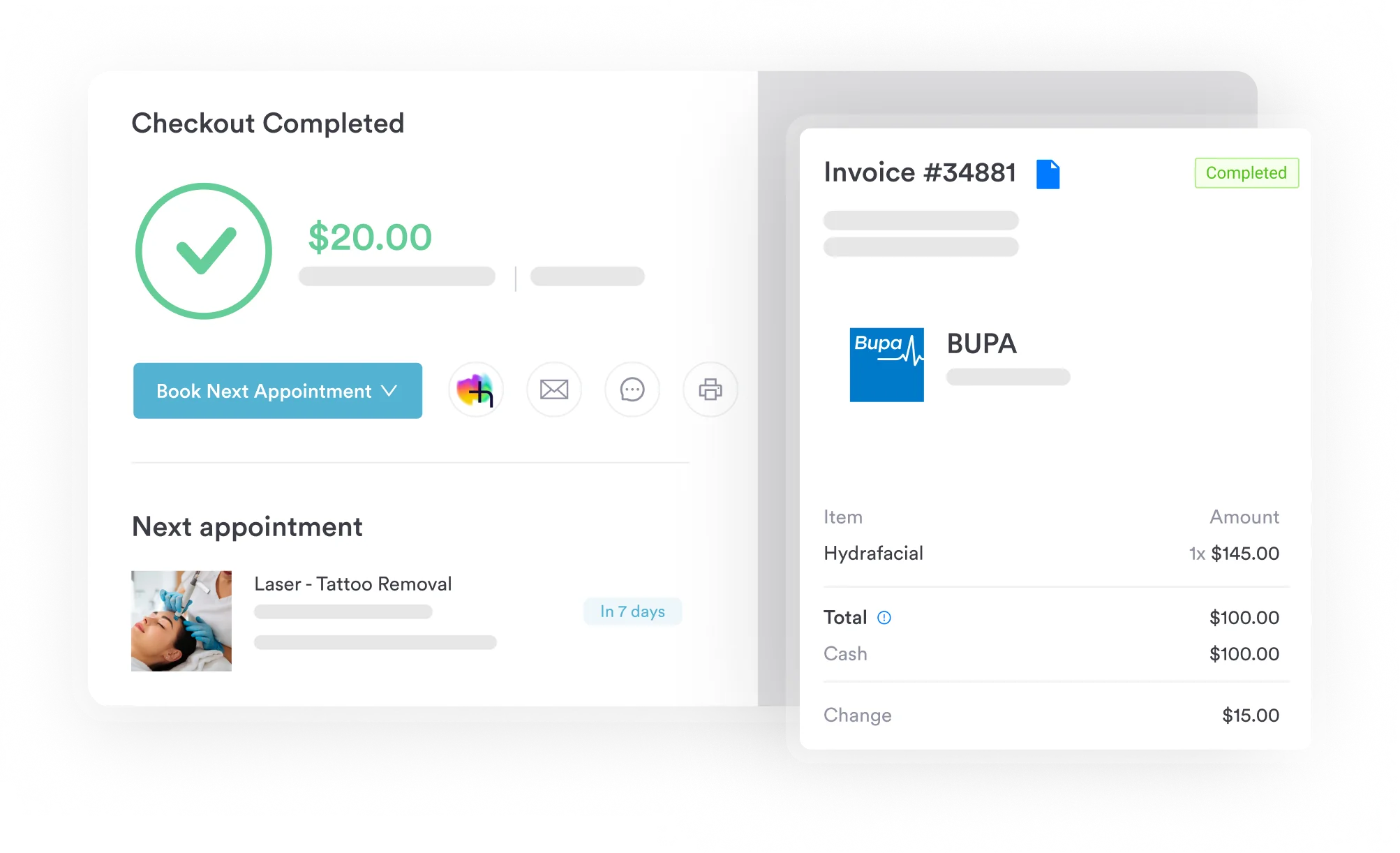
Septal cautery claims often fail on admin. The note sits in one system, the invoice in another, and the authorization reference in an inbox.
Pabau, the practice management platform we build, keeps those pieces on one patient record. Through its Healthcode integration, your team submits CCSD-coded claims straight from that record. Required fields such as membership numbers and authorization codes are checked before the claim can be sent.
Claim status and payments are then tracked in the same place. That way, the team can see which E0380 claims are still outstanding. Its claims management software also pre-fills claim details from the record, which cuts rekeying errors.
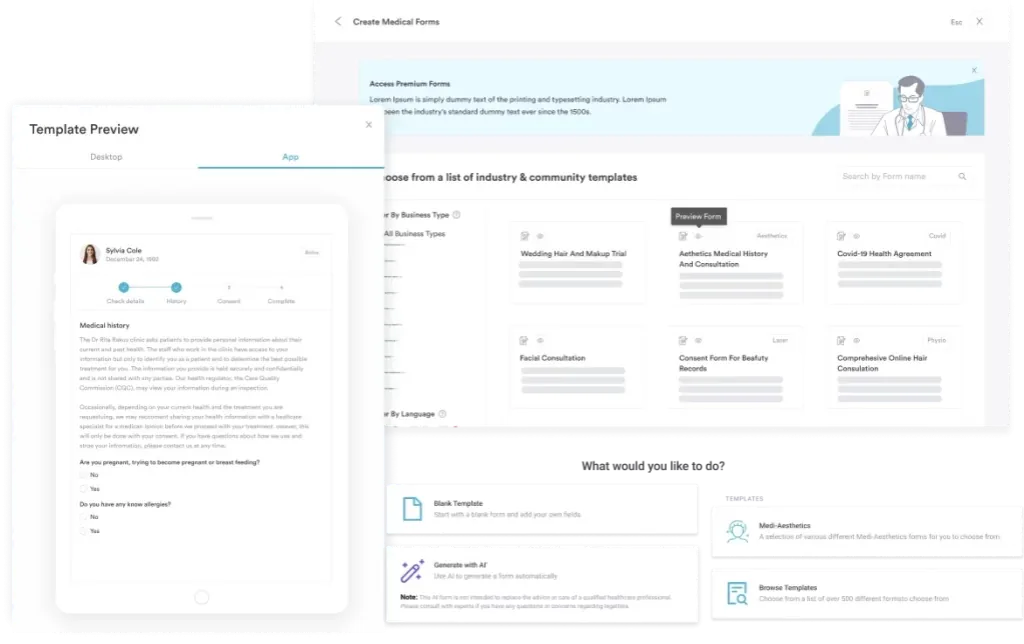
The form builder helps with the note itself. A septal cautery template can prompt for the indication, side, method and findings at the point of care.

Pabau keeps the clinical note, invoice and authorization reference on one patient record and submits CCSD-coded claims through Healthcode. Your team then tracks each claim until it is paid.

E0380 is a small code with a narrow job. It describes sealing a bleeding vessel on the septum, on one side or both.
Most of the risk sits around the code rather than in it. Bill it once, keep it away from septal operations, and write down why the cautery was needed. Get those three right and the claim leaves the practice clean.
If your team still chases notes and authorization numbers across systems, start there. Book a demo to see how Pabau keeps ENT claims and records together.

Coding the septal operation instead? CCSD code E0310 covers submucous resection of the nasal septum and its documentation.
Billing a septorhinoplasty after trauma? CCSD code E0230 explains the graft and implant septorhinoplasty code.
Working on the turbinates? CCSD code E0440 covers division of adhesions of turbinate of nose.
Submitting to Bupa? Bupa CCSD codes walks through how Bupa uses the CCSD schedule.
New to CCSD coding? CCSD codes explained covers how the schedule is built and maintained.
No. E0380 describes cautery of the nasal septum only. Turbinate procedures have their own codes in the same nose and nasal cavity section.
No. The E0380 descriptor does not name a technique, so silver nitrate and electrocautery use the same code. Record the method in the note anyway, because insurers may ask what was done.
The Clinical Coding and Schedule Development Group sets the codes and descriptors. Its members are Aviva, AXA Health, Bupa and VitalityHealth. Each insurer decides what it pays, so check fees with the patient’s insurer.
No. E0380 describes cautery of the septum. Packing without cautery is a different intervention, so it should not be billed under this code.
No. E0380 sits in Chapter 5 of the CCSD schedule, Ear, nose and throat.