CPT code 89342: Annual embryo storage billing guide
What is CPT code 89342? CPT code 89342 describes storage of embryo(s), per year,...

Last Updated: Oct 27, 2026
A6711 is the CCSD code for cubital tunnel release (open) bilateral (without transposition). It covers open decompression of the ulnar nerve at both elbows in one procedure, with each nerve left in its groove.
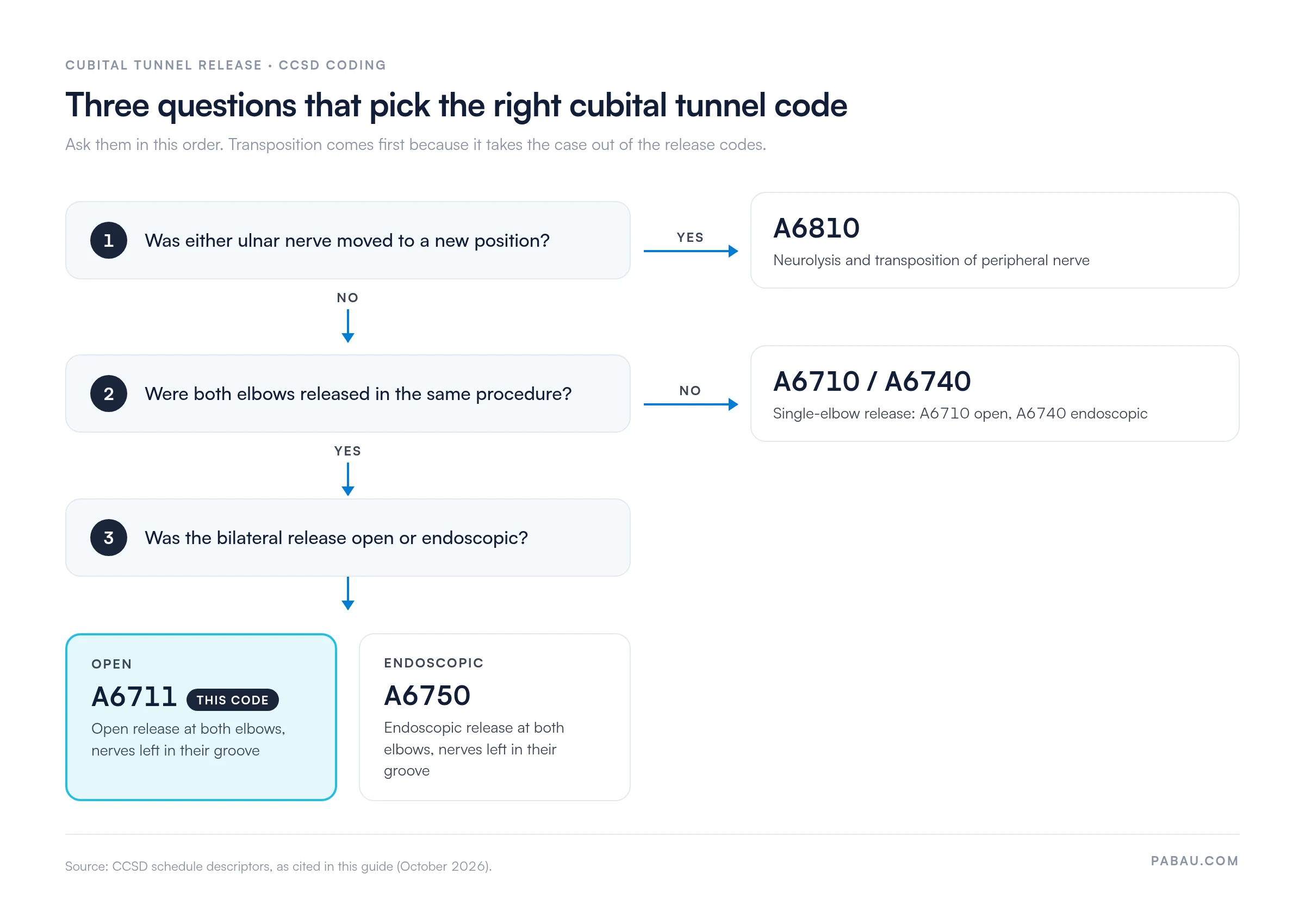
All three qualifiers must hold. A bilateral endoscopic release is A6750, a single-elbow open release is A6710, and a release that moves the nerve is A6810. A6711 sits in chapter 3 of the CCSD schedule, under peripheral nerves.
Let Pabau's smart automation suggest the right codes, reduce claim denials, and keep your practice compliant—effortlessly.
Automate repetitive tasks and focus on what matters most—your patients.
Reduce coding errors and ensure compliance with the latest regulations.
Clean claims, fewer denials, and faster reimbursements.
Powerful insights and reporting to help your practice thrive.
HIPAA compliant SOC 2 certified GDPR-compliant Trusted by 4,000+ clinics worldwide

CCSD code A6711 covers open cubital tunnel release on both elbows, with each ulnar nerve left in its groove.
A bilateral endoscopic release is A6750, not A6711. The approach named in the operative note decides between the two codes.
Bill A6711 once for a same-session bilateral release. Separate admissions are usually coded with the single-elbow code for each elbow, so confirm with the insurer.
If either nerve is moved to a new position, the procedure is A6810, neurolysis and transposition of peripheral nerve.
Pair A6711 with WHO ICD-10 G56.2, lesion of ulnar nerve, and record both sides in the operative note.
CCSD code A6711 is the UK private insurance procedure code for cubital tunnel release (open) bilateral (without transposition). It covers open decompression of the ulnar nerve at both elbows, with each nerve left in its groove.
If the surgeon used an endoscope, the correct code is A6750, the bilateral endoscopic release. A single-elbow release is A6710 when open and A6740 when endoscopic.
A6711 sits in chapter 3 of the CCSD schedule, spine, spinal cord and peripheral nerves, under peripheral nerves. CCSD added it to the schedule on July 20, 2012.
The descriptor carries three qualifiers, and all three must hold:
CCSD stands for Clinical Coding and Schedule Development. Its schedule is the coding framework UK private medical insurers such as Bupa, AXA Health and Aviva use to identify procedures on claims. Our CCSD code library covers neighboring procedures in the same schedule.
A6711 and A6750 both describe a release of the ulnar nerve at both elbows without transposition. The surgical approach is the only difference, and it decides which code goes on the claim.
If a reference you use describes A6711 as including endoscopic release, check it against the current schedule. CCSD lists the bilateral endoscopic release separately, as A6750.
Before you code a bilateral cubital tunnel release, find the word “open” or “endoscopic” in the operative note. If the note names neither, query the surgeon before submission rather than guessing between A6711 and A6750.
Ask about transposition first, because it takes the procedure out of the release codes altogether. The number of sides and the approach then narrow the choice to one code, as the decision tree below shows.
Cubital tunnel release treats compression of the ulnar nerve where it passes through the cubital tunnel at the inner elbow. Patients typically report numbness and tingling in the ring and little fingers, with grip weakness.
Advanced cases show wasting of the small muscles of the hand. Surgery is indicated when conservative care, such as activity modification, elbow padding and splinting, has not resolved symptoms.
In an open release, the surgeon makes an incision over the inner elbow and divides Osborne’s ligament and any constricting fascial bands. The nerve stays in its groove. Under A6711, the same open release is done on both elbows during one procedure.
Some patients have the two elbows treated in separate admissions instead. Each admission is then usually coded with the single-elbow code for that elbow (A6710 open, A6740 endoscopic). Confirm with the insurer before you bill.
The most serious miscoding risk for A6711 is a transposition billed as a release. The two operations carry different CCSD codes: A6711 for the bilateral open release and A6810 for neurolysis and transposition of peripheral nerve.
When you review the operative note, look for an explicit statement that the nerve was left in situ. If the note describes anterior repositioning in any form, A6711 does not apply.
A6711 already means both elbows, so a same-session bilateral open release is billed as one line under one code. Listing A6711 twice, or adding a unilateral code for the second elbow, double-counts the second side.
Confirm fees and pre-authorization with the patient’s insurer before surgery. Bupa, AXA Health, Aviva and Vitality each publish their own procedure fee schedules.
Several CCSD codes sit close to A6711. Choose by nerve position, number of sides and approach, then check the anatomy.
For insurer-level detail on other procedure codes, see the Bupa CCSD codes guide. Check every code number against the edition of the schedule current on the date of surgery.
UK private insurers expect an ICD-10 diagnosis code with every CCSD procedure code. For A6711, the supporting code is G56.2, lesion of ulnar nerve, in the WHO ICD-10 used in the UK.
WHO ICD-10 has no left, right or bilateral subdivisions under G56.2. Record laterality in the operative note and the consultant letter instead. Codes with an extra character for laterality belong to the US ICD-10-CM, not the WHO edition.
A nonspecific polyneuropathy code such as G62.9 does not describe a focal ulnar nerve lesion, so it does not support the procedure.
The operative note has to confirm each element of the A6711 descriptor. If the note is silent on the approach, either side or nerve position, the insurer cannot match the claim to the code.
A structured digital form for the operative note puts these elements on every note, instead of relying on dictation.
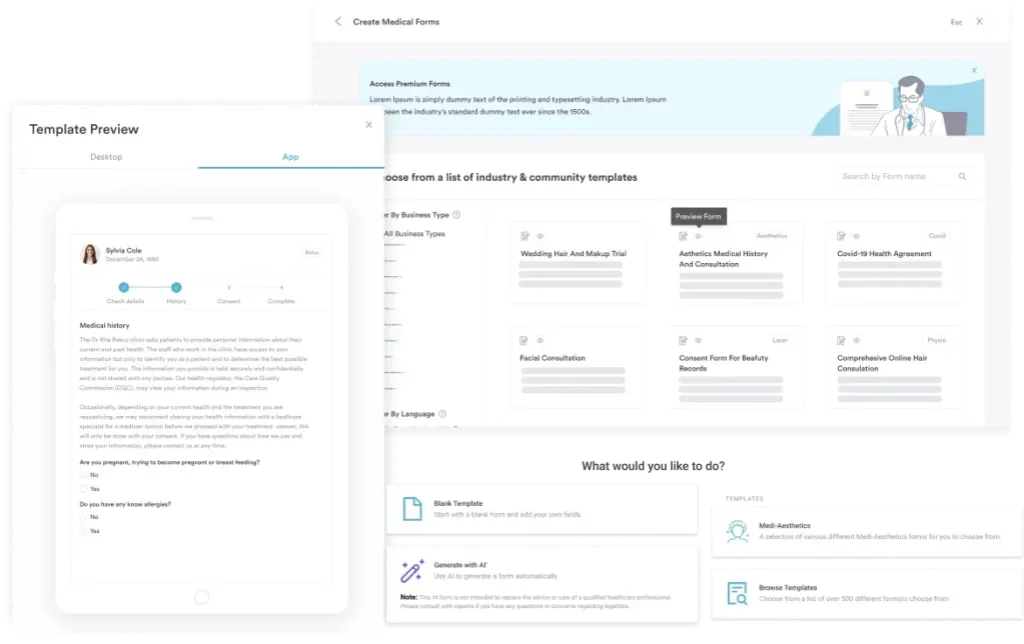
A compliant A6711 operative note covers each of the following:
Check pre-authorization with the patient’s insurer before you book the surgery. A request for A6711 typically includes:
Record the authorization number in the patient file and quote it on the claim.
A6711 claims are denied for a predictable set of reasons. Each one has a fix you can build into the billing workflow.
Run four checks before an A6711 claim goes out. The operative note says “open” for both elbows and confirms neither nerve was transposed. The diagnosis code is G56.2. The pre-authorization number is attached, and A6711 appears once on the claim.
A6711 claims fail on detail. The approach, both sides and nerve position all have to agree between the operative note and the claim. When a secretary codes from a dictated note, one missing word sends the claim back.
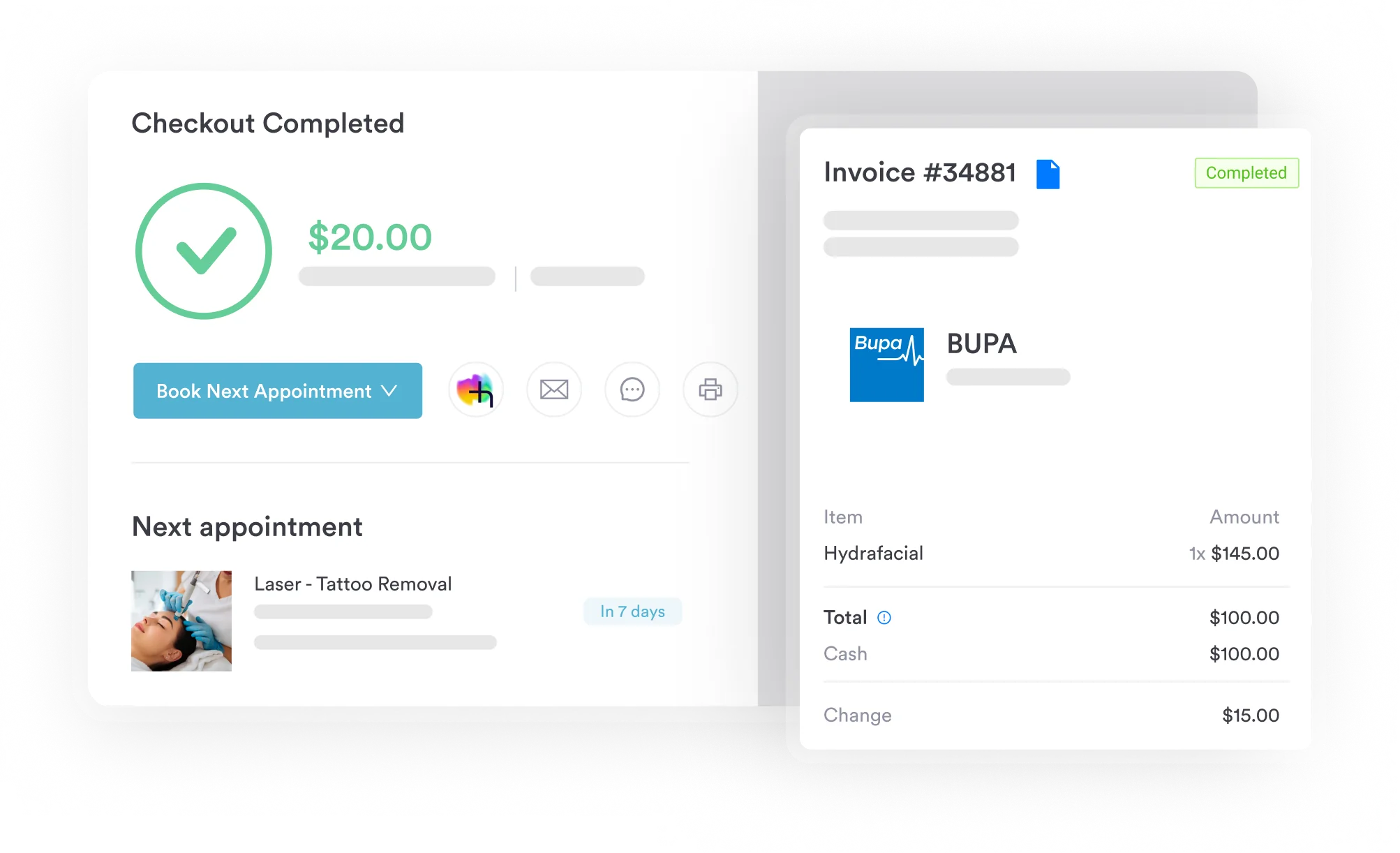
Pabau, the practice management and billing platform we build, keeps the operative note and the claim on the same patient record. Its claims management software stores CCSD procedure codes and attaches the pre-authorization number to the claim line.
Note templates built in Pabau’s form builder prompt the surgeon to record the approach and nerve position on every case. Coders then have the words they need to choose between A6711, A6750 and A6810.
For the wider process, see how medical billing workflows connect documentation, coding and submission.

Pabau keeps operative notes, CCSD codes and pre-authorization numbers on one patient record. Your team checks each A6711 claim against the note before it reaches the insurer.

A6711 is a narrow code. It fits only an open release, on both elbows, in one procedure, with neither nerve moved. An endoscopic note points to A6750, and a transposition points to A6810.
The safest fix sits upstream of billing. When the operative note template forces the surgeon to state the approach and nerve position, the right code follows from the note. Book a demo to see how Pabau links operative notes to CCSD claims for surgical practices.

Only one elbow released through an open incision? CCSD code A6710 covers open cubital tunnel release without transposition on a single elbow.
Billing a single-elbow endoscopic release? CCSD code A6740 covers endoscopic cubital tunnel release without transposition, with its own documentation checklist.
Did the surgeon move the nerve? CCSD code A6810 explains how to bill neurolysis and transposition of a peripheral nerve.
Coding carpal tunnel surgery as well? CCSD code A6530 covers endoscopic carpal tunnel release at the wrist.
A6711 covers open cubital tunnel release on both elbows without ulnar nerve transposition. A single-elbow release, an endoscopic release or a transposition each takes a different code.
One line. A6711 already describes both elbows, so a same-session bilateral release is billed once. When the elbows are released in separate admissions, each is usually coded with the single-elbow code for that elbow (A6710 open, A6740 endoscopic). Confirm with the insurer.
No. A6711 is the open bilateral release. A bilateral endoscopic release is A6750, and a single-elbow endoscopic release is A6740.
A release under A6711 leaves the ulnar nerve in its groove and divides only the constricting tissue. A transposition moves the nerve to a new position and is coded A6810.
G56.2, lesion of ulnar nerve, in the WHO ICD-10 used for UK claims. That edition has no laterality subcodes under G56.2, so record both sides in the operative note.
Common causes include an endoscopic release or a transposition billed as A6711, or the code billed twice. Others are a nonspecific diagnosis code, a missing pre-authorization number, or an incomplete operative note.
A6710 is the open single-elbow release and A6740 the endoscopic single-elbow release. A6750 covers bilateral endoscopic release, and A6810 covers neurolysis and transposition. Carpal tunnel release sits in the separate A65 series.