HCPCS Code G0163: Skilled nursing observation and assessment
What is HCPCS Code G0163? HCPCS Code G0163 is a deleted Level II code for skille...

Last Updated: Oct 15, 2026
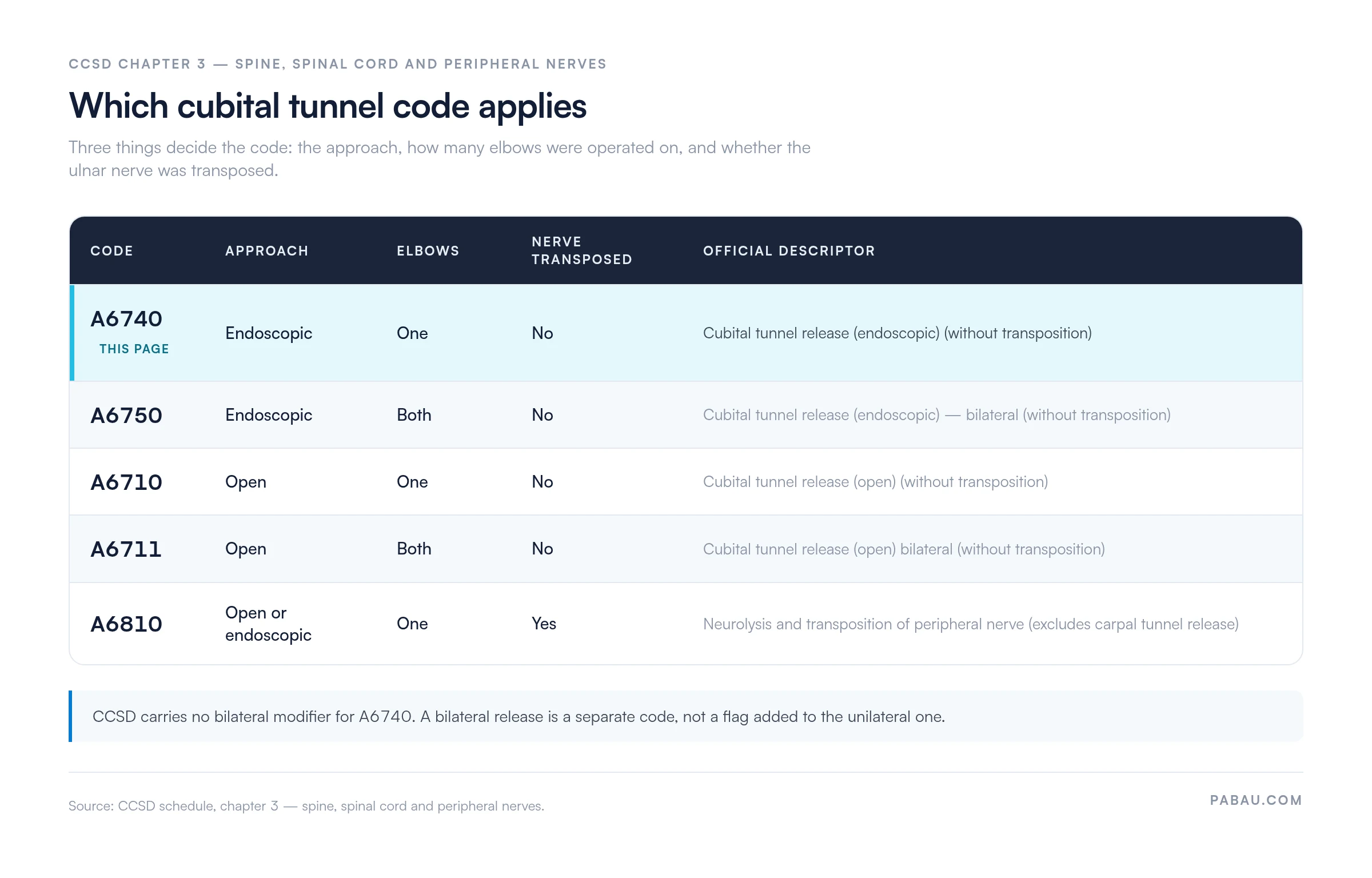
A6740 is the CCSD code for cubital tunnel release (endoscopic) (without transposition). It covers decompression of the ulnar nerve at the elbow through an endoscope, with the nerve left in its anatomical groove.
Both qualifiers in the descriptor are binding. An open release without transposition is A6710, a bilateral endoscopic release is A6750, and any procedure that moves the nerve anteriorly is A6810. The code sits in chapter 3 of the CCSD schedule at intermediate complexity.
Let Pabau's smart automation suggest the right codes, reduce claim denials, and keep your practice compliant—effortlessly.
Automate repetitive tasks and focus on what matters most—your patients.
Reduce coding errors and ensure compliance with the latest regulations.
Clean claims, fewer denials, and faster reimbursements.
Powerful insights and reporting to help your practice thrive.
HIPAA compliant SOC 2 certified GDPR-compliant Trusted by 4,000+ clinics worldwide

CCSD code A6740 covers endoscopic cubital tunnel release without transposition of the ulnar nerve at the elbow.
If the ulnar nerve was transposed, A6810 applies instead and a claim for A6740 will be denied.
Bilateral endoscopic release has its own code, A6750, because CCSD carries no bilateral modifier for A6740.
Most UK private medical insurers want nerve conduction study evidence before approving A6740, so confirm requirements with each insurer.
Operative notes must confirm the endoscopic approach, the structures released, and that no transposition was performed.
CCSD code A6740 is the billing code for endoscopic cubital tunnel release. The procedure decompresses the ulnar nerve at the elbow and leaves it in its anatomical groove. The Committee of Common Standards in Documentation (CCSD) maintains the schedule that major UK private medical insurers use to process procedure claims.
You can search each insurer’s fee schedule through Bupa’s code search and the official CCSD schedule. For the wider chapter structure behind this code, the Bupa CCSD codes guide sets out how the schedule is organised.
The official CCSD descriptor for A6740 is: Cubital tunnel release (endoscopic) (without transposition). Both qualifiers in brackets are binding. The approach must be endoscopic, and the surgeon must not have transposed the nerve. If either condition fails, a different CCSD code applies.
Endoscopic cubital tunnel release is a minimally invasive operation to decompress the ulnar nerve where it passes through the cubital tunnel at the medial elbow. The endoscopic approach disturbs less soft tissue than an open release. In suitable candidates it achieves the same decompression. Coders have to confirm the approach from the operative note, so each stage of the operation matters.
The operative sequence for a standard endoscopic release runs as follows:
The nerve is not moved. If the surgeon relocates the ulnar nerve anteriorly during the same operation, A6810 applies instead of A6740.
Cubital tunnel syndrome is compression of the ulnar nerve at the elbow. Patients report numbness or tingling in the ring and little fingers. Moderate to severe cases add intrinsic muscle weakness and loss of grip strength.
Surgeons recommend surgery when symptoms persist after a structured course of conservative management. That usually means three to six months of splinting, activity modification, and nerve-gliding exercises.
The clinical pathway matters to coders for two reasons. It sets the ICD-10 diagnosis codes that pair with A6740, and it sets the evidence insurers want at pre-authorisation. The standard workup includes:
Diagnosis code selection is the clinician’s responsibility. Present the options above as a reference, and confirm the pairing with the operating surgeon before the claim goes out. Our ICD-10 code reference sets out how these diagnosis codes are structured.
Three CCSD codes cover ulnar nerve surgery at the elbow, and they separate on two axes. The first is the surgical approach, endoscopic or open. The second is whether the surgeon transposed the nerve. Confusing the three is the commonest coding error on these claims, and insurers audit it because the fees differ.
A bilateral procedure gets a discrete CCSD code instead of a modifier, and that holds beyond the elbow. Open release of both carpal tunnels in one operation is CCSD code A6580.
A useful rule: read the operative note and find the word “transposition”. Where it appears as a completed surgical act, the correct code is A6810, whatever the approach. Where the surgeon never moved the nerve, the approach and the side decide between A6740, A6710, and A6750. The map below runs those checks in the order a coder makes them.
The bundling rules decide what A6740 covers on its own, and what needs a code of its own.
Included within A6740:
Excluded from A6740, because each needs its own code:
A6740 decompresses the ulnar nerve and leaves it intact. Dividing a peripheral nerve to treat a painful neuroma is a different operation, coded A6030.
Every element of the operative note must be in place before a claim for A6740 goes out. Incomplete notes are the second most common reason for denial, after the wrong code. The Information Commissioner’s Office enforces UK GDPR obligations for operative records and billing data.
The operative note must record each of the following to support A6740:
The pre-operative record must also carry the nerve conduction study (NCS) or EMG report confirming ulnar nerve slowing at the elbow. Insurers treat that report as primary evidence of medical necessity. The CQC holds registered independent hospitals to record-keeping standards that require these documents to stay available for audit.
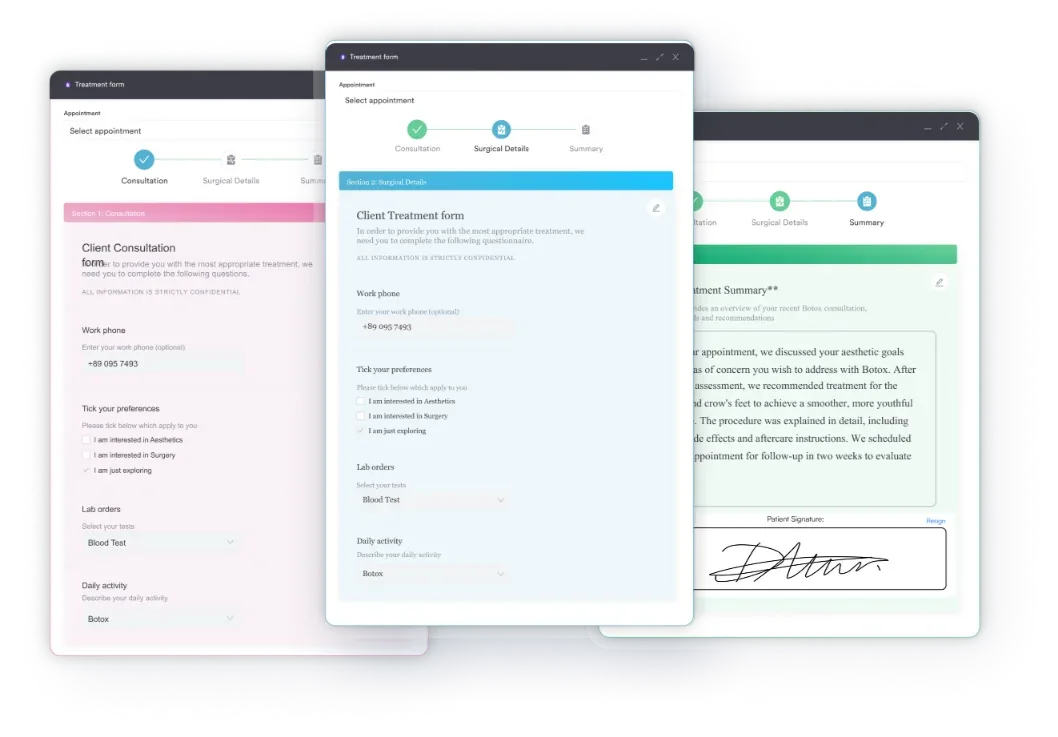
Build a documentation checklist for A6740 that the theatre team completes during the operation. Seven items cover every audit point: approach, portal site, structures divided, no-transposition statement, nerve condition, laterality, and NCS reference. A checklist that travels with the patient from booking to theatre cuts incomplete notes at billing time.
Pre-authorisation for A6740 must be in place before surgery. Most UK private medical insurers treat cubital tunnel release as a procedure needing prior approval. Insurers reject a claim sent without a valid approval number outright, however well the note reads.
The pre-authorisation process typically follows these steps across the major insurers:
Insurer portals carry their own rules and fee amounts, and insurers revise both annually. Aviva’s practitioner hub, Vitality’s fee finder, and AXA Health’s provider forms are the starting points. Always confirm current fees and coverage conditions with the insurer before quoting the patient.
A6740 denials cluster around a handful of predictable errors. The table below pairs each denial reason with the corrective action.
A6740 covers the operating surgeon’s fee for the endoscopic release of one elbow. Other components of the same episode need their own CCSD codes.
Fee amounts for A6740 and its related codes sit in the current CCSD schedule, and insurers revise them annually. Do not carry a prior-year figure into a quote without checking it against the current schedule first.
Entering A6740 correctly in a CCSD-enabled billing system keeps the claim in the format Healthcode needs for electronic processing. Trouble starts when staff log the code one way in the clinical record and another way in the billing system. Claims like that fail at the gateway rather than at the insurer.
A typical billing workflow for A6740 runs through these steps:
Practice management software like Pabau handles that sequence in one place. Pabau’s medical claims management tools store CCSD procedure codes and attach the approval number to the claim line. The insurer invoice comes off the same patient record. Your billing team enters each code once, so fewer A6740 claims come back for correction.
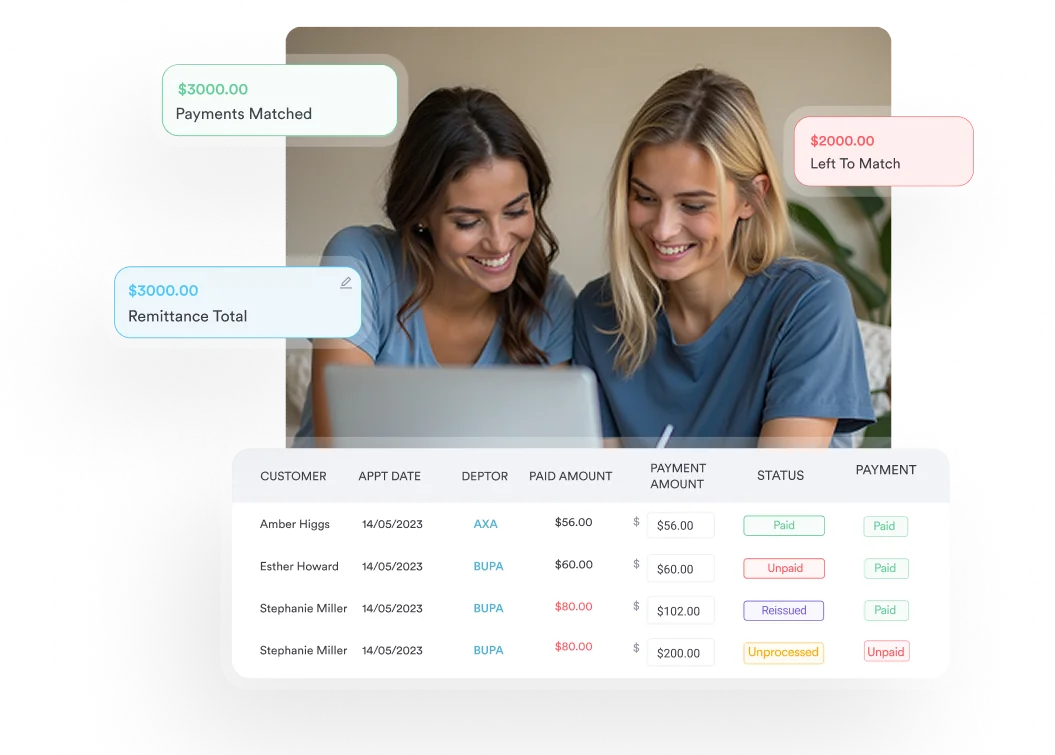

Pabau supports CCSD procedure code entry, insurer invoicing, pre-authorisation tracking, and Healthcode-compatible claim submissions for UK private orthopaedic practices. See how it works for your team.

A6740 is a narrow code. It covers an endoscopic approach, in situ decompression of one ulnar nerve, and no transposition. Move away from any of those conditions and a different CCSD code takes over, whether that is A6710, A6750, or A6810.
Four failure points account for most rejections. They are the wrong code, a missing approval number, absent NCS evidence, and a note that does not confirm the approach. Catch all four before submission and the claim usually clears first time.
The trade-off worth remembering is that the billing stage catches none of this. Theatre catches it, in the wording of the note. Keeping CCSD codes, approval numbers, and claim status in one system means your team enters each code once. Book a demo to see how Pabau handles private insurer billing for orthopaedic and upper limb procedures.

Billing other CCSD orthopaedic codes? Bupa CCSD codes sets out how the schedule’s chapters are organised for private musculoskeletal billing.
Checking what an insurer actually pays? Bupa procedure codes and fee schedule explains how fee bands are set and where to look up a current amount.
Working through a rejected claim? Denial codes in medical billing maps the common rejection reasons and the fix for each one.
CCSD code A6740 covers endoscopic cubital tunnel release without transposition of the ulnar nerve. The code includes portal setup, endoscopic visualisation, and division of the arcuate ligament and any compressing FCU bands. It also covers in situ decompression of the ulnar nerve at the elbow. It does not cover open approaches or any procedure that relocates the ulnar nerve anteriorly.
No. A6740 and A6810 describe mutually exclusive procedures for the same elbow, one without transposition and one with it. Only one of them can be clinically correct for a single elbow. Billing both on the same claim for the same elbow would be a coding error, and the insurer would reject or audit it.
The common reasons are a wrong code, a missing approval number, and absent NCS or EMG evidence. Wrong-code denials usually come from confusing A6740 with A6710 or A6810. The fourth reason is a note that does not confirm the endoscopic approach or the absence of transposition. A checklist used before sending the claim prevents all four.
Use A6750, the CCSD code for bilateral endoscopic cubital tunnel release without transposition. CCSD carries no bilateral modifier to add to A6740. The bilateral procedure is a separate code rather than a variation on the unilateral one, and the open bilateral equivalent is A6711.