

CCSD code G5100: Bypass of duodenum billing guide
CCSD code G5100 bills a bypass that leaves the duodenum in place CCSD code G5100...

Last Updated: Oct 16, 2026
A1220 is the CCSD code for creation of ventriculovascular anastomosis. The procedure connects a brain ventricle to a blood vessel, usually the right atrium or superior vena cava. Excess cerebrospinal fluid then drains into the circulation.
UK private medical insurers such as Bupa and AXA Health use A1220 for the initial creation of the shunt, most often to manage hydrocephalus. Revising or removing an existing shunt, or placing a shunt to the peritoneum or pleura, takes a different A12 code.
Let Pabau's smart automation suggest the right codes, reduce claim denials, and keep your practice compliant—effortlessly.
Automate repetitive tasks and focus on what matters most—your patients.
Reduce coding errors and ensure compliance with the latest regulations.
Clean claims, fewer denials, and faster reimbursements.
Powerful insights and reporting to help your practice thrive.
HIPAA compliant SOC 2 certified GDPR-compliant Trusted by 4,000+ clinics worldwide

CCSD code A1220 covers the creation of a new ventriculovascular anastomosis, not shunts to the peritoneum or pleura, which carry separate codes.
Most major UK private medical insurers require prior authorization before the procedure goes ahead.
An incomplete operative note is the most common trigger for A1220 denials, so the note must name the surgeon, technique, and post-operative plan.
Claims management software like Pabau helps private practices build, submit, and track CCSD claims with the documentation payers check first.
CCSD code A1220 is the official procedure code for creation of a ventriculovascular anastomosis. It sits in the CCSD Schedule of Procedures, the standard code set UK private medical insurers use.
Its full descriptor is “Creation of ventriculovascular anastomosis.” It applies when a surgeon creates a connection between a cerebral ventricle and a blood vessel to divert cerebrospinal fluid (CSF). Surgeons typically choose this route as an alternative to a peritoneal or pleural shunt.
A1220 is a complex surgical code, so it doesn’t fit simpler ventricular drainage procedures. The CCSD Schedule is maintained by the Clinical Coding and Schedule Development (CCSD) Group. Private hospitals and independent practitioners use CCSD codes to invoice insurers, while NHS-funded procedures use a separate tariff.
If you’re billing a ventriculovascular anastomosis performed in a UK private hospital, A1220 is the correct procedure code. Neighboring neurosurgical procedures each have their own entry in our CCSD codes library.
A ventriculovascular anastomosis is a neurosurgical procedure in which a catheter connects a brain ventricle directly to a blood vessel. Excess cerebrospinal fluid then drains into the circulation rather than the abdomen or chest. Surgeons perform it when ventriculoperitoneal or ventriculopleural shunting is contraindicated or has failed.
The procedure is most commonly used to manage hydrocephalus. The vascular target is typically the superior vena cava or right atrium (the ventriculoatrial route), though anatomy and technique vary by patient and surgeon.
For billing staff, the key distinction is that A1220 covers the creation of the connection itself. Revision or removal of an existing device, or placement of a purely peritoneal shunt, falls under different CCSD codes.
Coders pairing A1220 with an ICD-10 diagnosis code must reflect the clinical indication documented in the patient’s notes. The most common indications include:
Always code the underlying condition alongside the procedure. Payers review the ICD-10 pairing as a medical necessity check. If the diagnosis code doesn’t clinically justify a ventriculovascular approach, expect the claim to be queried or denied. The NHS Classifications Browser at classbrowser.nhs.uk provides the UK edition of ICD-10 for accurate code selection.
Billing A1220 correctly takes six steps, completed in order. Skipping any one of them is the most common route to a delayed or denied payment.
Prior authorization (pre-auth) is formal approval from a private medical insurer before a procedure is carried out. A1220 is a complex, high-cost neurovascular procedure, so most UK private medical insurers require it. Check the requirement with your specific payer before scheduling.
Pre-authorization requirements change, so confirm the current position for A1220 with your payer before the procedure date. If a procedure goes ahead without the required authorization, the insurer can decline the claim entirely. The patient is then liable for the full surgical fee.
An incomplete operative note is the leading cause of A1220 claim denials across UK private medical insurers. Payers treat the operative note as proof that the billed procedure was performed as described. A note that carries every required element avoids the queries and information requests that can delay payment by weeks.
Every operative note submitted with an A1220 claim should include:
Store operative notes securely, in line with UK GDPR requirements for patient records. Digital storage with access logging is strongly recommended for private hospitals handling CCSD claim audits. Digital operative note templates make sure every mandatory field is completed before the note is finalized.
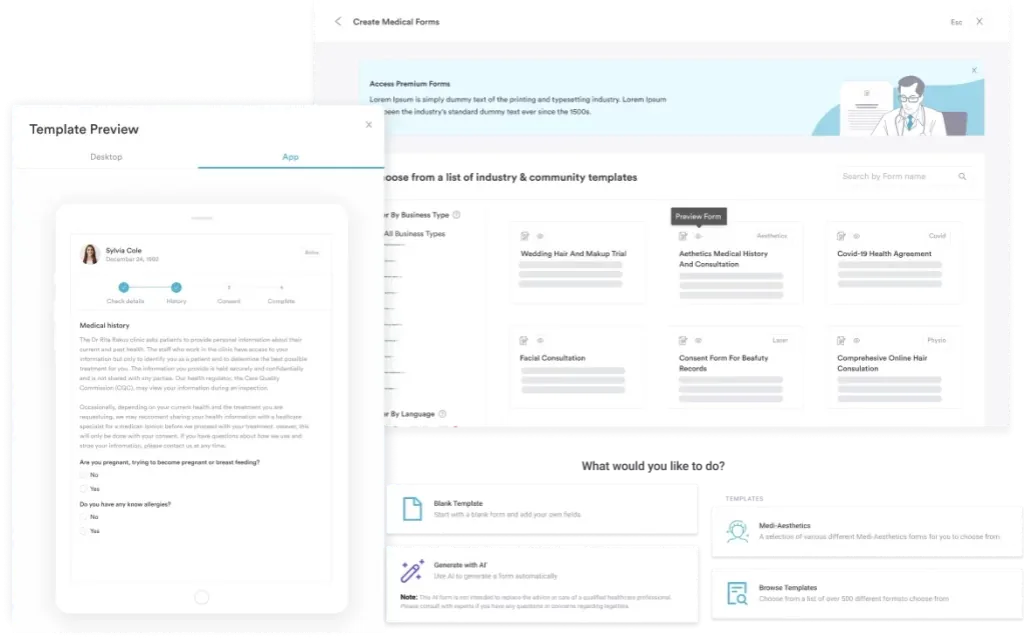
Build a pre-submission checklist for A1220 claims: authorization reference, ICD-10 diagnosis code, and an operative note with all nine mandatory elements. Run every claim through the checklist before submission. The fields most often missing are the surgeon’s GMC number and the ICD-10 code. Leave out either one and a payer query can add two to four weeks to payment time.
The A12xx range covers several neurosurgical CSF diversion and shunt procedures. Selecting the wrong code is a common error that results in claim rejection or recoupment. Two questions settle most code-selection calls, and the table below the diagram sets out the adjacent descriptors.
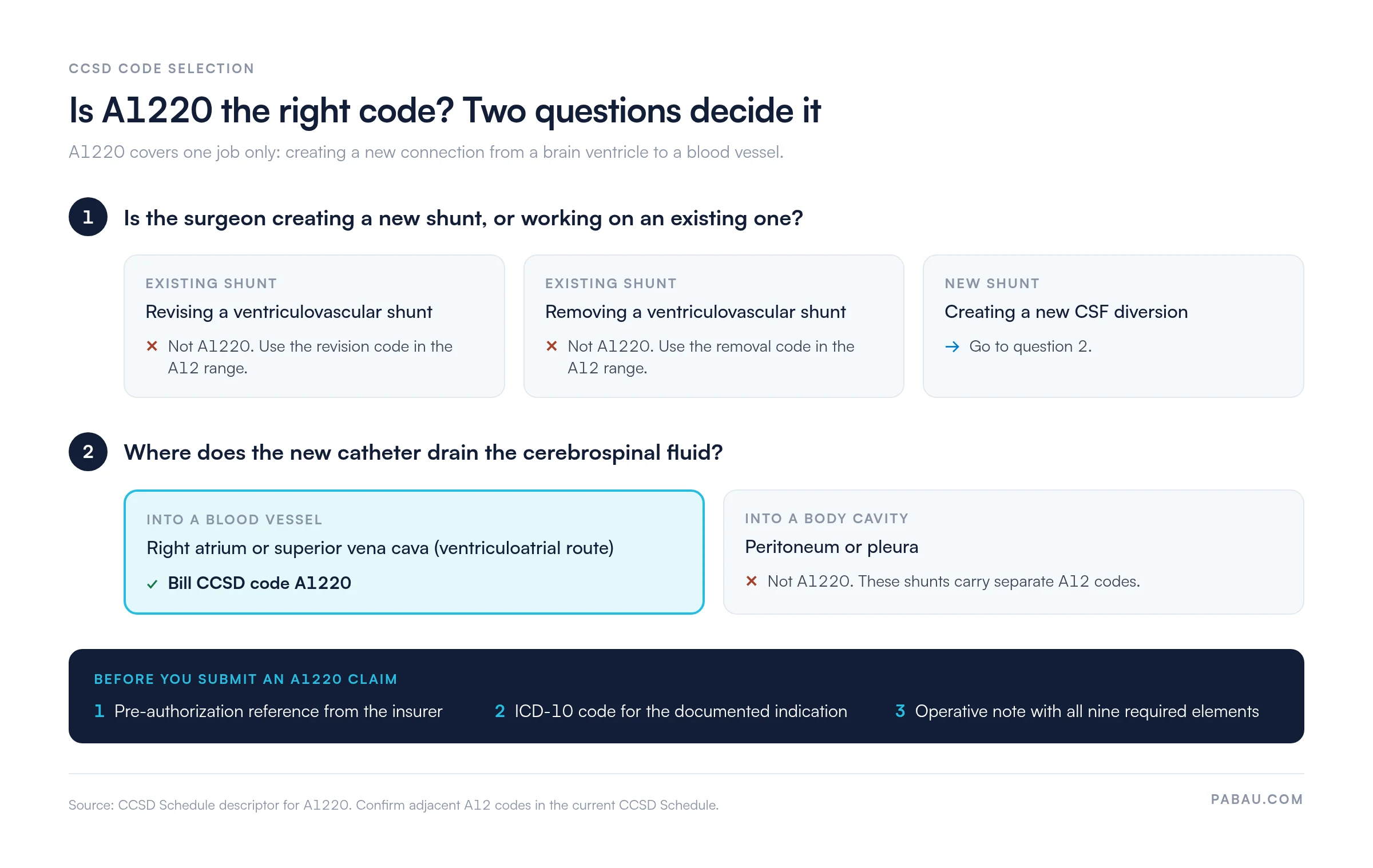
Where the catheter drains into the abdomen rather than a vessel, the procedure is a ventriculoperitoneal shunt. Creation of that shunt is billed under CCSD code A1240 instead. A subcutaneous reservoir implanted for repeated CSF access, rather than to divert fluid, falls under A1250.
Verify adjacent code descriptors against the current CCSD Schedule of Procedures rather than relying on memory or older reference guides. The Schedule is updated periodically, so confirm exact A12xx descriptors before use. The Bupa code search portal provides a searchable view of accepted CCSD codes.
CCSD modifier codes adjust the base procedure fee to reflect specific circumstances. For A1220, the modifiers most likely to apply are:
Anesthesia codes are billed separately by the anesthetist using CCSD anesthetic codes, so they aren’t add-ons to A1220 itself. Always confirm applicable modifiers against the CCSD technical guide, which sets out the rules for modifier application and fee adjustment percentages.
Under CCSD bundling rules, certain services are integral to the primary procedure and can’t be billed as separate codes on the same claim. For A1220, billing teams must not separately charge for these components:
Unbundling occurs when components included in A1220 are claimed as separate procedure codes. Payers routinely audit for this pattern, and the consequence is a recoupment request to recover fees already paid.
The CCSD technical guide is the authoritative source for bundling rules, so consult it before billing any concurrent procedure separately. If a separate and distinct procedure was performed in the same operative session, document it clearly in the operative note. Then apply the CCSD multiple procedure rules rather than billing both at full rate.
Most A1220 claims that fail at first submission fail for one of six reasons:
A structured pre-submission review catches these errors before the claim reaches the payer. Check authorization status, code selection, and documentation completeness on every claim. It’s the most effective single step for cutting first-time denials.
Most UK private medical insurers accept formal written appeals for denied CCSD claims. A well-structured appeal frequently overturns a denial where the clinical justification is sound. The process below applies to Bupa, AXA Health, and most other major UK private medical insurance (PMI) payers. Appeal deadlines and formats vary, so verify the current rules with your payer before submitting.
The CCSD Schedule of Procedures publishes a relative value or base unit for each procedure code. The reimbursement a practitioner receives is set by their individual contract with the insurer.
Some insurers publish a recognition fee schedule, but individual contracted rates are generally confidential. So two consultants performing A1220 at the same hospital may receive different amounts.
Your contracted rate for A1220 is in your recognition letter from the insurer or your payer’s provider portal. Your payer relationship manager can also confirm it. These sources answer most fee queries:
Never bill above your contracted fee for A1220 without prior written agreement from the insurer. Billing above the schedule rate is a common reason for recoupment, even after the claim has been paid.
Audit your recognized fee for CCSD code A1220 with each insurer at least once a year. Contracted rates are renegotiated periodically, and a stale figure risks recoupment if you bill above the updated schedule. Keep a copy of every recognition letter on file.
On a manual workflow, an A1220 claim passes through several hands. The authorization reference sits in an email, and the operative note sits in a document on someone’s desktop. Then someone keys the claim into the insurer’s portal by hand. Each handoff is a chance for a GMC number or an ICD-10 code to drop out.
Practice management software like Pabau keeps the authorization reference, the operative note, and the invoice on the same patient record. Digital forms give each of the nine operative note elements its own field, and missing fields are flagged before the claim goes out.
Once the claim is submitted, you track its status from a single dashboard. Payer queries get answered from the same record, with the authorization and the note already attached.

Pabau helps UK private practices build, submit, and track CCSD procedure claims. Capture operative documentation digitally, flag missing fields before submission, and monitor claim status from a single dashboard.

A1220 is one of the easier CCSD codes to identify and one of the easier ones to get denied. If the surgeon created a new connection from a ventricle to a blood vessel, the code is settled. What decides payment is the paperwork around it.
Set up the pre-submission check before the next case comes through. Confirm pre-authorization, pair the right ICD-10 code, and send a complete operative note with every claim. Practices that make those three checks routine should see far fewer payer queries and appeals.
Book a demo to see how Pabau keeps CCSD authorizations, operative notes, and claims on one patient record.

Need to understand how Bupa codes CCSD procedures? Bupa CCSD code submission guide explains how Bupa maps CCSD procedure codes to its accepted code list and fee schedule.
Looking for Bupa fee schedule data by procedure? Bupa procedure codes fee schedule provides a reference guide for contracted procedure fees in UK private practice.
Billing other cranial neurosurgery? CCSD code A3300 explains how to bill implantation of a neurostimulator to a cranial nerve.
Looking up a neighboring procedure? CCSD codes library lists the CCSD procedure codes Pabau covers, each with its own billing guide.
CCSD code A1220 covers the surgical creation of a ventriculovascular anastomosis. A neurosurgeon connects a brain ventricle to a blood vessel, typically the right atrium or superior vena cava, to divert excess cerebrospinal fluid. It does not cover revision or removal of an existing shunt, which are coded separately under adjacent A12xx codes.
A1220 is a standard CCSD Schedule code, accepted by all major UK private medical insurers that use the CCSD system. These include Bupa, AXA Health, Aviva, Vitality Health, WPA, Allianz Care, Cigna, and Healix. Always confirm code acceptance and any payer-specific billing rules through your insurer’s provider portal before submitting a claim.
Yes, both Bupa and AXA Health require prior authorization for complex surgical procedures, including A1220, in almost all circumstances. Apply through your insurer’s provider portal before the procedure date. Without a valid authorization reference, the payer can decline the claim in full, leaving the patient liable for the fee.
The operative note is the critical document. It must include patient identifiers, the procedure date and location, and the surgeon’s and anesthetist’s names and GMC numbers. It also needs the ICD-10 diagnosis code and clinical indication, a description of the anastomosis technique, and the procedure duration. Close it with the intraoperative findings and the post-operative plan. A claim submitted without a fully completed operative note is highly likely to be queried or denied.
The most common reasons are missing or expired pre-authorization and an incomplete operative note, typically a missing GMC number or ICD-10 code. Claims also fail when the ICD-10 diagnosis doesn’t justify the vascular route or bundled components are billed separately. A fee above the contracted rate is another common trigger. Each denial reason needs different evidence for a successful appeal.
Yes. Under CCSD bundling rules, three components are bundled into A1220 and can’t be billed separately. They are ventricular catheter insertion as part of the anastomosis, intraoperative imaging used solely to guide the procedure, and routine wound closure. Billing any of them as separate CCSD codes alongside A1220 is unbundling and can result in claim recoupment. Consult the CCSD technical guide for a full list of bundled components.



