

Pabau Engage inbox

Pabau Engage is here: every patient conversation in one inbox.

Learn more
CCSD Code

CCSD code A1700 – Ventricular endoscopic brain surgery


Code Definition

A1700 is the CCSD code for therapeutic endoscopic operations on ventricle of brain (including examination and biopsy of lesion). It covers procedures such as endoscopic third ventriculostomy, septostomy and intraventricular cyst fenestration, performed through a neuroendoscope via a burr hole.

Examination and biopsy in the same session are included, so they are never coded separately. Shunt and ventricular puncture codes cannot be billed with A1700 in the same session.

Group
2 Brain, cranium and other intracranial organs
Category
Brain
Subcategory
A17 Therapeutic endoscopic operations on ventricle of brain
Billable
No
Code also known as
endoscopic third ventriculostomy, ETV billing, neuroendoscopy billing, brain ventricle endoscopy, ventricular endoscopy
Save time. Improve accuracy. Get paid faster.
Automate coding with Pabau

Let Pabau's smart automation suggest the right codes, reduce claim denials, and keep your practice compliant—effortlessly.

  • AI-powered code suggestions
  • Real-time compliance checks
  • Faster claims, fewer denials
Why practices choose Pabau
Save hours every week

Automate repetitive tasks and focus on what matters most—your patients.

Improve accuracy

Reduce coding errors and ensure compliance with the latest regulations.

Get paid faster

Clean claims, fewer denials, and faster reimbursements.

Grow with confidence

Powerful insights and reporting to help your practice thrive.

HIPAA compliant SOC 2 certified GDPR-compliant Trusted by 4,000+ clinics worldwide

Key takeaways

Key takeaways

CCSD Code A1700 covers therapeutic endoscopic operations on the brain ventricle, most often endoscopic third ventriculostomy (ETV) for obstructive hydrocephalus.

Examination and biopsy of a lesion in the same session are included in A1700, so billing a separate biopsy code is an unbundling error.

The published fee schedule lists A1220, A1240, A1300, A1301, A1430 and A2080 as unacceptable combinations with A1700 in the same session.

Most UK private insurers require pre-authorisation, and a missing authorisation is the most common non-clinical reason for denial.

Pabau, the practice management platform we build, checks that membership numbers and authorisation codes are in place before a claim goes to Healthcode.

CCSD Code A1700: definition and clinical scope

The CCSD schedule defines CCSD Code A1700 as Therapeutic endoscopic operations on ventricle of brain (including examination and biopsy of lesion). CCSD stands for Clinical Coding and Schedule Development. The code sits in the Brain chapter of the schedule, which UK private medical insurers use for procedural billing and ccsd.org.uk administers independently.

Three elements distinguish A1700 from adjacent neurosurgery codes. First, the approach must be endoscopic, with no open craniotomy. Second, the operative site must be the ventricular system, not the spinal canal or other brain structures. Third, the code requires a therapeutic endoscopic operation, and it includes examination and biopsy from the same session.

The clause “including examination and biopsy of lesion” means A1700 bundles a biopsy taken during the same operative session. You need no extra CCSD code for it, and insurers often reject a separate biopsy code billed alongside A1700 as unbundling.

What procedures does A1700 cover?

A1700 captures the following operative procedures performed endoscopically within the cerebral ventricular system:

  • Endoscopic third ventriculostomy (ETV): Perforation of the floor of the third ventricle to bypass obstruction at the cerebral aqueduct. Teams submit this procedure under A1700 most often, mainly for obstructive hydrocephalus and aqueductal stenosis.
  • Endoscopic septostomy: Fenestration of the septum pellucidum to equalise pressure between lateral ventricles.
  • Intraventricular tumour or cyst biopsy: Endoscopic biopsy of a lesion within the ventricular system. Typical targets are colloid cysts of the third ventricle, choroid plexus papillomata and intraventricular metastases.
  • Cyst fenestration: Opening of an intraventricular cyst to allow cerebrospinal fluid drainage, performed endoscopically under direct vision.
  • Ventricular examination with therapeutic intent: Ventriculoscopy combined with a therapeutic manoeuvre such as coagulation of a bleeding point or removal of a clot.

A single A1700 claim captures all of the above when you perform them in the same operative session. Bill the anaesthetic component separately under the relevant CCSD anaesthetic code.

How surgeons perform the procedure

Understanding the operative steps helps billing teams identify which elements of the operative note must be present to support the A1700 claim. The procedure follows these stages:

  1. Patient positioning and neuronavigation setup: The surgeon positions the patient supine or lateral. The team sets up image-guided neuronavigation if the ventricular anatomy is complex or the target lesion is small.
  2. Burr hole creation: The surgeon makes a single burr hole in the skull, usually in the right frontal region for lateral ventricular access. They adjust its position for third ventricular targets.
  3. Endoscope insertion: The surgeon advances a rigid neuroendoscope (usually 6 mm diameter) through the burr hole into the lateral ventricle and views the ventricular anatomy, choroid plexus, and foramen of Monro.
  4. Therapeutic manoeuvre: For ETV, the surgeon advances the endoscope into the third ventricle and perforates the floor with a balloon catheter or bipolar coagulation. For biopsy, the surgeon introduces forceps under direct endoscopic vision and takes tissue from the lesion.
  5. Haemostasis and closure: The surgeon controls any bleeding under endoscopic vision, withdraws the endoscope, seals the burr hole, and closes the wound in layers.

The operative note must document each stage. Notes that trigger denial most often omit the ventricle(s) accessed or the exact therapeutic manoeuvre. They also leave out whether the surgeon took a biopsy, and from which site.

Clinical indications and ICD-10 codes supporting A1700

Every A1700 claim requires a supporting ICD-10 diagnosis code that justifies the endoscopic ventricular approach. The table below lists the primary indications and their corresponding ICD-10 codes, using the WHO edition that UK insurers expect.

Clinical indicationICD-10 codeNotes
Obstructive (non-communicating) hydrocephalusG91.1Most common indication for ETV; include imaging evidence in notes
Hydrocephalus, unspecifiedG91.9Use only if the obstructive/communicating distinction cannot be documented
Colloid cyst of third ventricleG93.0Cerebral cysts. Some coders use D33.0 instead when histology shows a benign neoplasm.
Benign neoplasm of brain, supratentorialD33.0For choroid plexus papilloma or other benign intraventricular tumour
Aqueductal stenosisQ03.0Congenital cause of obstructive hydrocephalus; common in paediatric cases
Secondary malignant neoplasm of brain and cerebral meningesC79.3Where endoscopic biopsy targets an intraventricular metastatic lesion

Verify all ICD-10 codes against the current NHS Classifications Browser before submission, as code descriptors change each year. Diagnosis codes that do not match the clinical narrative in the operative note are a common payer rejection trigger.

A1700 sits within the Brain chapter of the CCSD schedule, in group A17. Knowing the adjacent codes prevents miscoding when you use a different approach or target, and our CCSD code reference covers the rest of the schedule.

CCSD codeDescriptor (abbreviated)Use instead of A1700 when…
A1700Therapeutic endoscopic operations on ventricle of brainThis is the target code; use for all endoscopic ventricular therapeutic procedures
A1240Creation of ventriculoperitoneal shuntThe surgeon creates a shunt instead of an endoscopic ventriculostomy. You cannot bill it with A1700 in the same session.
A0200Excision of lesion of tissue of brain (open approach)The surgeon excises a brain lesion through an open approach, not endoscopically
A0310Stereotactic biopsy of lesion or tissue of brainFrame-based or frameless stereotactic biopsy without endoscopic ventricular access

Consult the CCSD technical guide (October 2025) for the full Brain chapter, including current fee units and unbundling rules.

Pro Tip

Check the CCSD schedule group before coding any neurosurgery claim. A1700 sits in group A17, therapeutic endoscopic operations on ventricle of brain. If the operative note describes an open approach or a non-ventricular target, a different code applies, and insurers often reject A1700 as a procedure mismatch.

What A1700 excludes

A1700 does not cover every brain or neurosurgical endoscopy. The following sit outside the code or clash with it:

  • Open craniotomy for ventricular access: If the surgeon accesses the ventricle via a craniotomy rather than a burr hole endoscope, code the open procedure instead.
  • External ventricular drain (EVD) insertion only: Placing a drainage catheter without a therapeutic endoscopic manoeuvre does not satisfy the descriptor.
  • Endoscopic procedures on spinal canal: Spinal endoscopy has its own CCSD chapter. A1700 covers only the cerebral ventricular system.
  • Shunt and ventricular puncture codes: The published fee schedule lists A1220, A1240, A1300, A1301, A1430 and A2080 as unacceptable combinations with A1700. You cannot bill any of them in the same session.
  • Anaesthesia: Always bill the anaesthetic component separately under the relevant CCSD anaesthetic code, because A1700 does not bundle it.
  • Separate biopsy code: Do not add a standalone biopsy code alongside A1700 when the surgeon performs a biopsy during the same endoscopic session. The descriptor includes it.

Those combination rules catch practices out because a shunt procedure looks like a natural companion to endoscopic ventricular surgery. Removing a shunt under A1430 in the same session as an ETV, for example, falls outside what you can claim alongside A1700. The panel below sets out what one A1700 claim includes and what must stay off it.
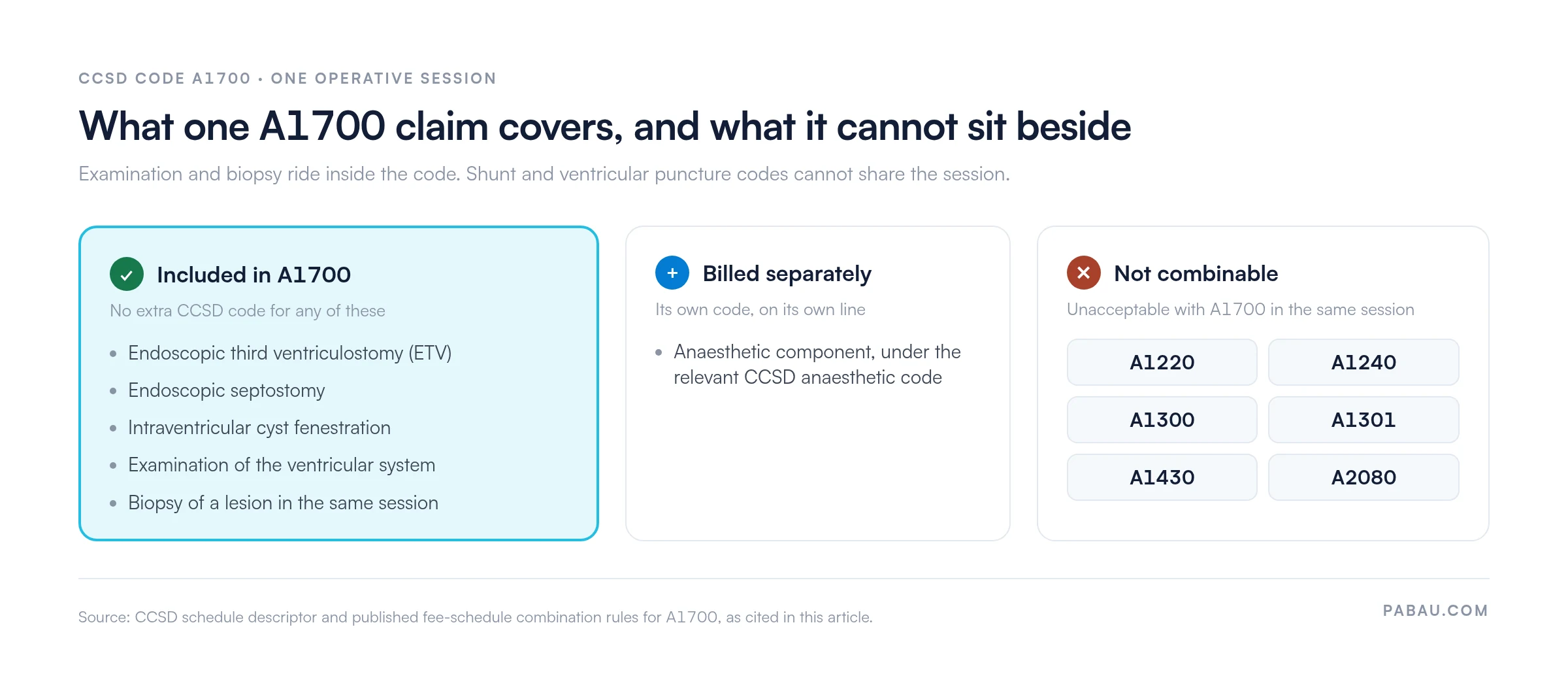
Three-panel chart for CCSD code A1700.
One A1700 claim carries the whole endoscopic session, while the anaesthetic is coded separately and six shunt or puncture codes stay off it. Based on the CCSD descriptor and published fee-schedule rules.

Documentation requirements for A1700

Thin operative notes are the primary driver of A1700 claim denials. An operative note for an endoscopic ventricular procedure must contain each of the following to withstand payer scrutiny:

  • Clinical indication: The reason for endoscopic approach documented explicitly (e.g. “obstructive hydrocephalus secondary to aqueductal stenosis on MRI dated [date]”).
  • Endoscope specification: Type, diameter, and manufacturer of the neuroendoscope used.
  • Ventricle(s) accessed: State which ventricle(s) the surgeon entered (lateral, third, fourth) and the access route (e.g. right frontal burr hole).
  • Therapeutic manoeuvre: Describe the exact procedure performed, with anatomical detail. For example, “perforation of the floor of the third ventricle between the mammillary bodies and infundibulum using balloon catheter inflated to 4 mm”.
  • Biopsy documentation: State whether the surgeon took a biopsy, the site within the ventricle, the number of passes, and the tissue sent for histology. If the surgeon took no biopsy, record “no biopsy obtained”.
  • Neuronavigation: Record whether the team used image-guided neuronavigation, which system, and that they confirmed registration pre-operatively.
  • Intraoperative findings: Describe ventricular anatomy, CSF appearance, any incidental findings.
  • Complications: Note any intraoperative events or confirm “no complications”.
  • Consultant GMC number: The responsible consultant’s GMC registration number must appear on the claim form, and insurers often reject claims where it is missing.

Pre-authorisation requirements by UK insurer

UK private insurers generally require pre-authorisation for elective neurosurgical procedures, including CCSD Code A1700. Practices should verify requirements directly with each insurer, as policies change. The following reflects typical requirements as of 2026, sourced from published provider guidance:

  • Bupa: Pre-authorisation required for all elective inpatient neurosurgery. Clinical evidence usually required includes relevant MRI or CT imaging, MDT outcome note or consultant letter confirming surgical plan, and the proposed CCSD code. Check the Bupa code search portal to confirm current A1700 authorisation status before submission. Our guide to Bupa CCSD codes covers its submission requirements.
  • AXA Health: Pre-authorisation required before any elective surgical admission. Submit via the AXA provider portal with supporting imaging and a letter of medical necessity from the consultant.
  • Aviva: Pre-authorisation required for inpatient procedures. The Aviva fee schedule lists applicable CCSD codes; confirm the patient’s policy covers A1700 before proceeding.
  • Vitality Health: Use the Vitality fee finder to check whether A1700 is pre-authorised under the patient’s policy level. Vitality applies a tiered fee structure to CCSD neurosurgery codes.
  • Healix: As a third-party administrator, Healix follows its own CCSD-based fee schedule with specific unbundling rules. Confirm pre-authorisation requirements through their provider portal before the procedure date.

Failing to obtain authorisation before the procedure is the most common non-clinical reason for A1700 denial. Insurers rarely grant retrospective authorisation requests, which may leave the patient liable for the full surgical fee.

Pre-authorisation tracking belongs on the admission checklist for every elective neurosurgical case, so the reference is on file before the patient reaches theatre.

Common billing errors and denial reasons

A1700 claims fail for a predictable set of reasons, and most are preventable with a structured check before submission. Pabau’s claims management helps by confirming that membership numbers and authorisation codes are in place each time a claim is sent.
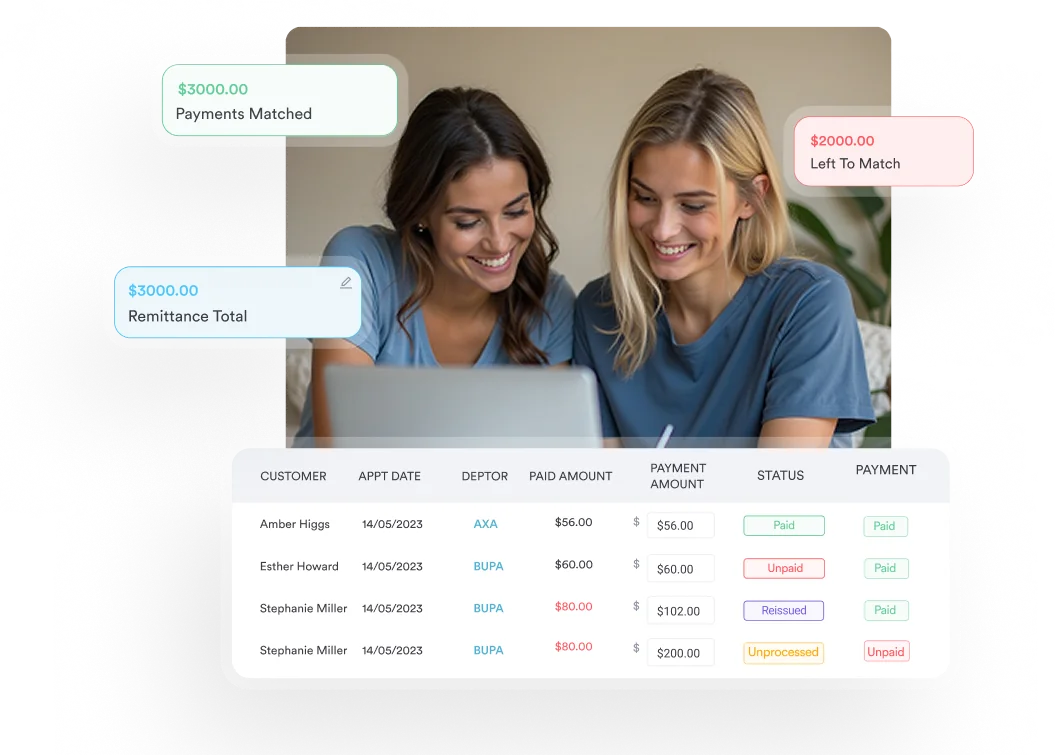
Pabau billing screen listing Bupa and AXA insurer claims
Pabau’s insurer claims view shows each claim’s payment status, so an unpaid or reissued A1700 claim stands out for follow-up.
Denial reasonRoot causeRemediation
No pre-authorisation referenceAuth obtained verbally but not recorded on the claimRecord auth reference number at time of approval; attach to claim before submission
Diagnosis code mismatchICD-10 code does not match the operative indication documented in notesCross-check the ICD-10 code against the clinical indication in the operative note before submission
Thin operative noteMissing ventricle accessed, therapeutic manoeuvre detail, or biopsy statusUse a structured operative note template covering all required elements before dictation is finalised
Unbundling errorBiopsy billed as a separate code alongside A1700Remove the standalone biopsy code; A1700 includes the biopsy when the surgeon takes it in the same session
Wrong consultant GMC numberGMC number of operating surgeon differs from recognised provider on insurer recordsConfirm GMC number matches insurer’s recognised provider database before claim submission
Procedure coded as open rather than endoscopicA craniotomy code selected instead of A1700 due to confusion over approachVerify the operative approach in the note before code selection; endoscopic burr hole = A1700, craniotomy = different code

Pro Tip

Before submitting any A1700 claim, check six items. Confirm the pre-authorisation reference, an ICD-10 code that matches the indication, a finalised operative note and the consultant’s GMC number. Then make sure no standalone biopsy code and no same-session shunt or ventricular puncture code sit on the claim.

How Pabau keeps A1700 claims complete before they reach Healthcode

Neurosurgical secretaries often hold the authorisation reference in an email, the diagnosis in a clinic letter and the operative note in a dictation queue. Building an A1700 claim then means copying details between systems, which is where references go missing.

Pabau keeps the patient’s insurer, membership number and authorisation code on the patient record. Each time you send a claim, Pabau runs validation checks in the background to confirm the details insurers need are in place. The claim then goes directly to Healthcode, with no double entry.

Every claim moves through the same stages: pending, submitted, processing, paid or error. When the insurer pays, you record the payment against the right invoice, so outstanding A1700 claims stay visible. If you are still choosing a system, our comparison of UK medical billing software sets the options side by side.

Reduce A1700 claim denials before they happen

Pabau checks that membership numbers and authorisation codes are in place, then sends CCSD claims to Healthcode and tracks each one to payment. See how it works for your practice.

Pabau claims management workflow for CCSD code submission

Conclusion

CCSD Code A1700 bundles the examination, the therapeutic manoeuvre and any same-session biopsy into one claim. Coding it well comes down to discipline around that session. Bill one code for the endoscopic work, keep shunt and puncture codes off it, and make the operative note name the ventricle and the manoeuvre.

The costliest A1700 denials come from administration, such as a missing authorisation reference or an unbundled biopsy. Secure the authorisation before you book the operating list, and keep the reference where the claim can find it. Book a demo to see how Pabau checks authorisation codes and membership numbers before each A1700 claim goes to Healthcode.

Continue your research

Continue your research

Need guidance on CCSD coding for Bupa submissions? Bupa CCSD procedure codes covers how the CCSD schedule works with Bupa’s provider portal, including code validation and fee schedule guidance.

Removing a shunt rather than bypassing the blockage? CCSD code A1430 explains how shunt removal is coded and why it cannot share a session with A1700.

Checking what Bupa pays for a procedure? The Bupa fee schedule guide shows how procedure codes map to Bupa benefit maximums.

Choosing billing software for private insurer claims? Best medical billing software in the UK compares the systems UK practices use to send claims.

Frequently asked questions about CCSD Code A1700

What does CCSD Code A1700 cover?

CCSD Code A1700 is the UK private healthcare billing code for therapeutic endoscopic operations on the ventricle of the brain. It includes examination of the ventricular system and biopsy of any lesion during the same session. It captures endoscopic third ventriculostomy, intraventricular cyst fenestration and ventricular tumour biopsy performed through a neuroendoscope inserted via a burr hole.

Does a ventricular biopsy performed during the same endoscopy session need a separate CCSD code?

No. The A1700 descriptor explicitly includes “examination and biopsy of lesion”, so the code bundles a biopsy taken during the same operative session. A standalone biopsy code billed alongside A1700 is an unbundling error that UK private insurers often reject.

Does CCSD A1700 require prior authorisation from private insurers?

Yes, in most cases. Bupa, AXA Health, Aviva and Vitality Health usually require pre-authorisation for elective inpatient neurosurgical procedures, including A1700. Obtain the authorisation and attach its reference number to the claim before submission. Insurers rarely approve retrospective authorisation requests.

Is anaesthesia included in CCSD Code A1700?

No. Bill the anaesthetic component separately under the relevant CCSD anaesthetic code. A1700 covers only the therapeutic operative component performed by the neurosurgeon.


Avatar photo
Despina Petrushevska
Content Writer

Despina Petrushevska is a content writer covering aesthetics, dermatology, and clinic operations, known for making detailed clinical concepts clear and engaging. Outside of work, she enjoys photography, weekend getaways, and finding inspiration in everyday experiences.
×

