

CCSD code G5100: Bypass of duodenum billing guide
CCSD code G5100 bills a bypass that leaves the duodenum in place CCSD code G5100...

Last Updated: Oct 16, 2026
20230 is the CCSD code for an impedance audiogram, the objective middle ear assessment used across UK and Irish private practice. The code covers the complete test, which combines tympanometry with acoustic reflex threshold testing.
20230 sits in CCSD Chapter 1, covering investigations, simple procedures and consultation codes. One unit is billed whether one ear or both are assessed, and laterality still has to be recorded in the clinical notes.
Let Pabau's smart automation suggest the right codes, reduce claim denials, and keep your practice compliant—effortlessly.
Automate repetitive tasks and focus on what matters most—your patients.
Reduce coding errors and ensure compliance with the latest regulations.
Clean claims, fewer denials, and faster reimbursements.
Powerful insights and reporting to help your practice thrive.
HIPAA compliant SOC 2 certified GDPR-compliant Trusted by 4,000+ clinics worldwide

CCSD code 20230 covers the full impedance audiogram, which combines tympanometry with acoustic reflex threshold testing.
20230 sits in CCSD Chapter 1, among the investigations and simple procedures, not in the audiology diagnostic chapter.
Documentation must record tympanogram type, acoustic reflex results, laterality, the clinical indication, and the performing clinician.
Pre-authorization from the patient’s insurer is usually required before billing 20230, and submitting without it is the leading cause of rejection.
Practice management software like Pabau keeps CCSD documentation and claim submission on one patient record, so fewer claims come back rejected.
CCSD code 20230 covers an impedance audiogram, the standard middle ear assessment in UK private practice. It is a five-digit numeric code, which places it in CCSD Chapter 1, covering investigations, simple procedures and consultation codes. The audiology diagnostic chapter is a separate part of the schedule and uses letter-prefixed codes.
The schedule is maintained by the Clinical Coding and Schedule Development Group, the body behind the procedure codes UK and Irish insurers use. One unit of 20230 covers the test whether one ear or both are assessed. Laterality still has to be documented in the clinical record.
Impedance audiometry assesses the mechanical properties of the middle ear rather than the patient’s subjective hearing ability. It is distinct from pure tone audiometry (CCSD code 20210), which tests hearing thresholds across frequencies. The two tests answer different clinical questions and are billed under separate codes. They may be performed in the same session when clinically indicated.
20230 is one entry in a schedule that runs to several thousand codes. Another Chapter 1 investigation, CCSD code 20150, covers a whole patch testing series as one claim rather than one per reading. Our overview of UK private billing codes explains how the chapters are organized and where to look up a code you do not recognize.
An impedance audiogram measures the acoustic immittance of the middle ear using a calibrated tympanometer. The procedure has two core subcomponents. They are performed in sequence and together make up the complete test billed under 20230.
Tympanometry is the primary measurement within an impedance audiogram. A probe tip is placed in the ear canal to create an airtight seal. Air pressure is then varied systematically while a low-frequency tone is delivered. The instrument records how well the tympanic membrane moves at each pressure point, producing a tympanogram trace.
Tympanogram type indicates middle ear status:
The tympanogram trace has to be retained in the patient record. Documenting the type and the peak pressure value supports the clinical indication and satisfies insurer documentation requirements for the claim.
Acoustic reflex testing measures contraction of the stapedius muscle in response to a loud sound stimulus. The probe delivers tones at varying intensities to find the acoustic reflex threshold, the lowest intensity that triggers the stapedial reflex. Acoustic reflex decay testing assesses whether the reflex is sustained over time.
Reflex results help differentiate conductive from sensorineural pathology. An absent reflex at expected levels alongside a Type A tympanogram may suggest ossicular discontinuity or a retrocochlear lesion.
A present reflex with a Type B tympanogram would be inconsistent and warrants clinical review. These findings form part of the result documented to support the 20230 claim.
An impedance audiogram is performed to evaluate middle ear function when clinical signs suggest a conductive hearing problem, middle ear pathology, or eustachian tube disorder. It provides objective data that pure tone audiometry alone cannot supply. Referrals to private audiology practices for this test usually come from GPs and ENT surgeons.
ENT surgeons may request the test as part of a full hearing workup alongside pure tone audiometry (CCSD 20210). Both codes are billed separately there, because each assesses a different aspect of auditory function.
Selecting the correct CCSD code means distinguishing 20230 from the audiology codes next to it. Using the wrong one is among the most common causes of claim rejection in private audiology billing.
Never substitute 20230 for 20210 when only a pure tone audiogram was performed, or the other way round. Insurers cross-reference the code against the clinical notes.
A claim whose documented procedure does not match the submitted code is rejected. For Bupa-specific audiology rules, see our reference on Bupa CCSD codes.
Each billed item needs its own line, and that holds for the appointment too. When the audiogram is performed at a follow-up outpatient consultation, that attendance is coded separately under 20310.
A structured billing workflow reduces rejections and speeds up reimbursement. Follow these steps each time 20230 goes to a private medical insurer. Practices running private practice claims software can automate several of them.
Check whether the patient’s policy requires the audiologist to hold specific insurer recognition before booking the appointment. Bupa, AXA Health, and Aviva all operate recognition schemes. Submitting 20230 under an unrecognized clinician number is a quick path to rejection.
Complete documentation does two jobs. It supports the clinical record, and it satisfies insurer audit requirements. Thin notes are the second most common cause of rejection for this code, after a missing pre-authorization.
The minimum documentation set for each impedance audiogram includes:
Adult clinical records should be kept for a minimum of eight years after the last entry. That figure comes from the NHS Records Management Code of Practice and professional retention guidance, not from UK GDPR.
UK GDPR sets no fixed retention period of its own. It asks you to justify how long you hold a record and why. Records for minors are held longer, so check your own policy against current guidance before you rely on it.
Bilateral billing rules for 20230 are not standardized across insurers, so confirm the position with each one before you submit. Some UK private medical insurers treat bilateral impedance audiometry as a single billable unit. Others accept bilateral testing at a higher fee, or ask for two line items with left and right specified.
Because these rules are payer-specific and change with each annual schedule update, check the provider manual or call provider relations. Laterality must be documented clearly in the notes whatever the insurer’s position.
All major UK private medical insurers use the CCSD schedule for audiology billing. Each applies its own pre-authorization rules, referral requirements, and documentation standards. The table below summarizes publicly available guidance. Always verify current requirements on the insurer’s provider portal before you submit, because policies change.
Irish private insurers, including VHI, also use the CCSD schedule. Pre-authorization and referral requirements follow similar principles to the UK. Verify them on the relevant Irish provider portal before submitting claims for Irish-based patients.
Claim rejections for impedance audiometry follow predictable patterns. Practices that review rejected claims by category, then fix the workflow step behind each one, see denial rates fall over time.
Each of these reasons has one check attached to it, and the check almost always sits earlier in the workflow than the rejection does.
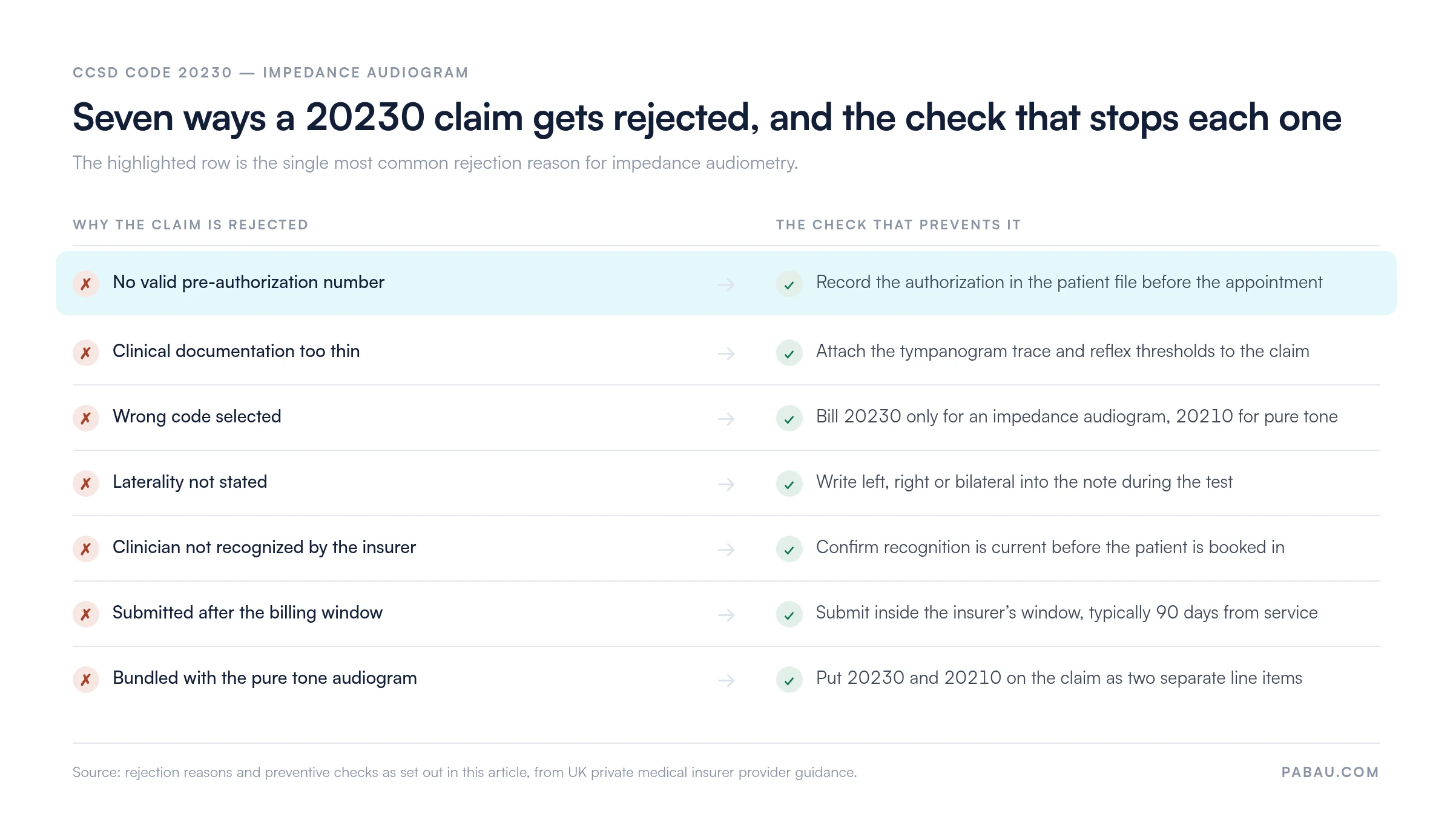
A pre-submission checklist applied to every impedance audiogram appointment removes most avoidable rejections. The steps below address each of the denial reasons above.
Run a monthly audit of rejected 20230 claims and sort each rejection by reason. Three or more rejections for the same reason mean the workflow is producing them. Change the step responsible, then audit again next month.
Most private audiology practices run 20230 billing across three places. The tympanometer prints the trace, the clinical notes sit in one system, and the invoice is raised in another. Every handover between them is a chance to lose the authorization number or the laterality line.
Practice management software like Pabau keeps those steps on one patient record. The clinician records tympanogram type, reflex thresholds and laterality on a structured form during the appointment. The pre-authorization reference sits on the same record, so it is there when the invoice is raised.
Pabau then builds the claim against the code you selected, with the audiometry report attached. Reporting shows which claims came back rejected and why, so you can repair the step that caused it instead of re-checking every file by hand.

Pabau helps private audiology and ENT practices manage CCSD code documentation, patient records, and claim submissions in one place, so fewer claims come back rejected.

Billing 20230 accurately is mostly a sequencing problem. The authorization has to exist before the test. The trace and reflex results have to be written during it. The claim then has to go out inside the insurer’s window.
A practice that keeps missing on one of those three steps rarely has a coding problem. It has a workflow that lets a step happen late. Sorting a month of rejections by reason will tell you which step that is, usually in an afternoon.
Fix the sequence and the code looks after itself. Book a demo to see how Pabau keeps CCSD documentation, pre-authorization records and claim submission on one patient file.

Billing an impedance audiogram performed alongside another procedure? CCSD code 20240 covers the companion code and when it applies instead of 20230.
Want fewer claims coming back from UK insurers? Medical billing compliance sets out the record-keeping and submission standards that keep private claims clean.
CCSD code 20230 covers an impedance audiogram, the complete objective assessment of middle ear function using an acoustic immittance meter. The code covers tympanometry, which measures middle ear pressure and compliance, and acoustic reflex threshold testing. It does not include pure tone audiometry, which is billed separately under CCSD code 20210.
Tympanometry is the primary subcomponent of an impedance audiogram but not the complete test. CCSD code 20230 covers the full impedance audiogram, which includes both tympanometry and acoustic reflex threshold testing. Billing 20230 on the basis of tympanometry alone, without performing and documenting acoustic reflex testing, may be queried by insurers on audit.
CCSD code 20210, the pure tone audiogram, is the most commonly co-billed code when a full hearing assessment happens in the same session. Each code is submitted as a separate line item on the claim. Always confirm with the patient’s insurer that both codes are covered under their policy. Check that pre-authorization is in place for every planned procedure before the appointment.
The minimum set is the tympanogram trace with peak pressure and compliance values. You also record the classification as Type A, B or C, acoustic reflex thresholds for each ear, laterality, and the clinical indication. The clinician’s name and recognition number, the equipment used, and the date of service complete the set. Missing any of these raises the risk of rejection on audit.
The most common reasons are a missing pre-authorization, thin clinical documentation, and the wrong code selected. Laterality left out of the record and late submission beyond the insurer’s billing window follow close behind. An unrecognized clinician number is also frequent, because recognition must be renewed annually with most UK private medical insurers.
CCSD code 20230, the impedance audiogram, tests middle ear mechanics objectively using air pressure changes and reflex stimuli. No patient response is required. CCSD code 20210, the pure tone audiogram, tests hearing thresholds subjectively, requiring the patient to respond to tones across a frequency range. The two tests assess different aspects of the auditory system and are never interchangeable.



