CPT Code 92588: Comprehensive otoacoustic emissions testing
CPT code 92588: official descriptor and quick reference CPT code 92588 is the Am...

Last Updated: Oct 7, 2026
C5910 is the CCSD code for iridocyclectomy, the en bloc surgical resection of the iris and ciliary body as a single specimen. UK private insurers use it to bill this globe-conserving operation, most often for iris or ciliary body melanoma that crosses the iris root.
The code sits in the Iris and anterior chamber section of the CCSD Eye and orbital contents chapter. Assignment turns on the operative note naming both structures, because iris-only excision takes a different code.
Let Pabau's smart automation suggest the right codes, reduce claim denials, and keep your practice compliant—effortlessly.
Automate repetitive tasks and focus on what matters most—your patients.
Reduce coding errors and ensure compliance with the latest regulations.
Clean claims, fewer denials, and faster reimbursements.
Powerful insights and reporting to help your practice thrive.
HIPAA compliant SOC 2 certified GDPR-compliant Trusted by 4,000+ clinics worldwide

CCSD Code C5910 describes iridocyclectomy, the en bloc resection of the iris and ciliary body, which is distinct from iridectomy (iris only).
Primary indications are iris melanoma, ciliary body melanoma and benign anterior uveal tumours that need surgical excision.
UK private insurers generally expect prior authorisation for C5910, so verify each insurer’s current rules before the procedure date.
Pabau, the practice management platform we build, stores operative notes against the patient record and sends claims to Healthcode from the same system.
CCSD Code C5910 is the Clinical Coding and Schedule Development (CCSD) code for iridocyclectomy. That is the surgical removal of the iris and ciliary body together, in a single en bloc resection.
The code sits in the CCSD Eye and orbital contents chapter, under the Iris and anterior chamber section. UK private insurers including Bupa, AXA Health, Aviva, Vitality and WPA use CCSD codes for procedure billing.
NHS billing uses OPCS-4 procedure codes instead. UK private practice relies on the CCSD schedule for procedure-based invoicing, most of it submitted electronically through Healthcode.
The descriptor “iridocyclectomy” is precise and cannot be interchanged with adjacent codes. C5910 covers the combined removal of iris and ciliary body tissue. Most UK insurers will query a code mismatch if C5910 is billed for iris-only excision. The same applies when the ciliary body alone is the target.
Iridocyclectomy is a specialised intraocular procedure performed under general or local anaesthesia in a sterile theatre environment. The surgeon makes a limbal incision at the junction of the cornea and sclera. The affected iris and ciliary body tissue is then resected as a single specimen, preserving the surrounding ocular structures where possible.
The excised tissue is submitted to histopathology as a matter of routine oncological practice.
The key anatomical structures involved are:
Because the procedure requires intraocular entry and resection of two anatomically distinct structures, it carries a higher complexity classification than simple iridectomy. Insurer fee schedules band C5910 above simple iridectomy for that reason. It is also why insurers apply stricter pre-authorisation requirements to this code than to more straightforward anterior segment procedures.
The principal indications for iridocyclectomy, and therefore for billing CCSD Code C5910, are anterior uveal tumours involving both the iris and ciliary body. Coding C5910 for a procedure performed on a lesion confined to the iris alone is a miscoding error. The following indications are generally covered:
Iris trauma has its own codes in the same section of the schedule. C6410 covers repair of a prolapsed iris, and C6450 covers removal of a foreign body from the iris.
Uveal melanoma is classified as a rare cancer in the UK. Its surgical management needs oncology MDT documentation confirming the treatment plan. Most UK insurers request that documentation in the prior authorisation package for C5910 claims.
Understanding the scope of C5910 prevents both undercoding and unbundling errors. The code is designed to capture the primary surgical act: en bloc resection of the iris and ciliary body. It does not bundle every co-procedure that may occur in the same operative episode.
A corneal graft or vitrectomy in the same episode goes on the Healthcode claim as a separate line, with its own CCSD code. The operative note should explain why each one was clinically necessary. Insurers such as Healix publish fee schedules and billing guidance, so check the applicable rules before submission.
Selecting the correct code from the CCSD Eye and orbital contents chapter means knowing how iridocyclectomy differs from procedurally similar operations. Miscoding C5910 as a simpler code, or the reverse, is a frequent trigger for insurer queries on eye surgery claims. The list of Bupa CCSD codes is a useful starting reference for the chapter structure.
Our CCSD code guides then break down individual neighbouring codes.
The iridectomy versus iridocyclectomy distinction is the most clinically significant. An operative note that says “iris resection” without stating ciliary body involvement will prompt insurer review. From that note alone, the payer cannot tell whether C5910 or the simpler iridectomy code was appropriate.
Before coding C5910, confirm the operative note explicitly names both the iris and the ciliary body as resected structures. If the note only mentions ‘iris excision’ or ‘iridectomy’, request an addendum from the surgeon before submitting the claim. Insurers applying medical review to C5910 will scrutinise this distinction immediately.
Incomplete operative documentation is the primary reason C5910 claims are delayed or rejected. Because iridocyclectomy is a high-complexity, oncology-adjacent procedure, insurers apply closer scrutiny to the supporting records than they do for routine ophthalmic surgery. Structured digital operative documentation reduces the risk of omitting the fields that trigger insurer queries.
The operative note must include all of the following:
Alongside the operative note, keep copies of the pre-operative imaging, such as slit-lamp photographs, UBM or anterior segment OCT. Also retain the oncology or MDT referral letter and the insurer’s prior authorisation confirmation number. These should be held in the patient record and submitted alongside the claim when the payer’s submission process permits attachments.
UK private insurers generally require prior authorisation for high-complexity surgical procedures, and iridocyclectomy typically falls within that category. Verify current requirements with each insurer before scheduling the procedure. Policy year changes can affect which codes are subject to mandatory pre-authorisation.
Billing for any complex private procedure without first understanding the authorisation process is a recurring source of non-payment in UK private practice.
As a general pattern across the main UK payers, the information typically required for a C5910 pre-authorisation request includes:
Specific timelines for authorisation decisions vary by insurer. Bupa, AXA Health, Aviva, Vitality, and WPA each maintain their own authorisation portals and processing windows. The Vitality fee finder and the Aviva fee schedule both let practitioners check the current fee position for specific CCSD codes. Check any linked authorisation requirements there before contacting the authorisation team.
Claims submitted without a valid authorisation reference number are typically rejected outright. They then need re-submission after retrospective authorisation, which most insurers permit only in genuine emergencies.
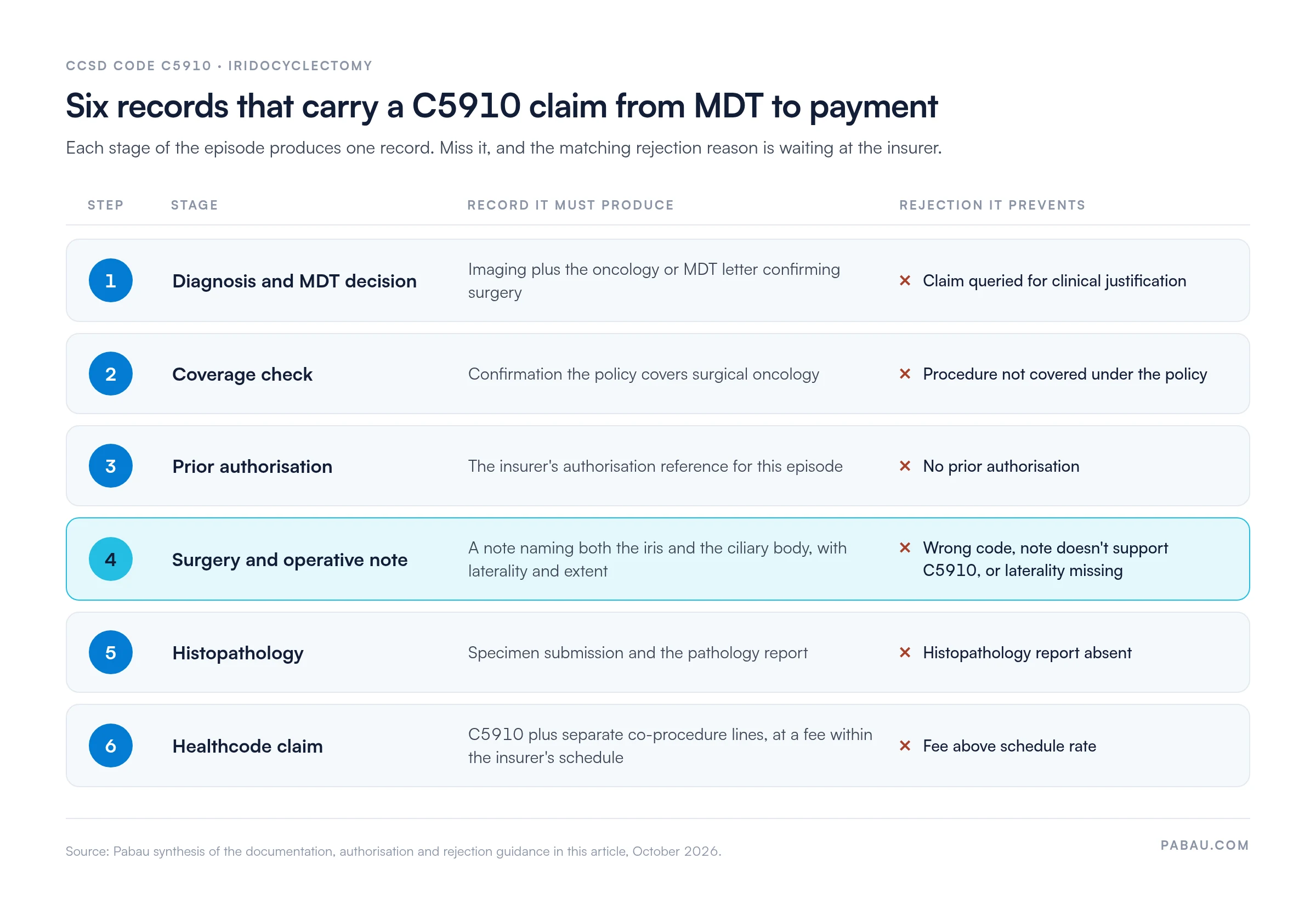
C5910 claim rejections follow predictable patterns. Most can be prevented by addressing the root cause before submission rather than during appeal.
Each rejection reason traces back to one stage of the episode, and to the record that stage should have produced.
Healthcode is the primary electronic billing platform for UK private healthcare. Most major insurers, including Bupa, AXA Health, and Aviva, accept and prefer Healthcode submissions over paper invoices. Submitting CCSD Code C5910 correctly through Healthcode requires attention to several fields that are frequently completed incorrectly for complex surgical codes.
On many C5910 episodes, the operative note lives in one system and the pathology report arrives by email. The claim is then keyed into Healthcode by hand. Each hand-off is a chance to drop the laterality, the authorisation number or the ciliary body wording that insurers check first.
Pabau’s claims management software keeps those pieces together. Operative notes, histopathology reports and imaging are stored against the patient record. Claims go to Healthcode without leaving Pabau, so billing data isn’t re-keyed between systems.
Your team can read the note against the claim before it leaves, so a missing ciliary body reference is caught before the insurer sees it. The Bupa fee schedule helps you check the current fee position for C5910 before you invoice.

Pabau keeps operative notes, pathology reports and Healthcode claim submission in one system. Your team can check every C5910 claim against its note before it goes out.

Most of the work on a C5910 claim happens before surgery and before coding. Get the authorisation reference ahead of the theatre date, and read the operative note for both structures before anyone selects a code.
Catching a missing ciliary body reference costs the surgeon a short addendum. Finding it in a rejection costs weeks of correspondence on one of the highest-value eye codes in the schedule.
Book a demo to see how Pabau keeps operative notes and Healthcode claims together for private eye surgery practices.

Managing other complex CCSD procedure codes? Bupa CCSD procedure codes and billing rules provides a structured reference across the CCSD chapters, including Eye and orbital contents.
Repairing iris trauma rather than removing a tumour? CCSD Code C6410: Repair of prolapsed iris covers the documentation and insurer submission for iris prolapse repair.
Removing a foreign body from the iris? CCSD code C6450: Removal of foreign body from iris explains how to code and bill the procedure.
Want to reduce billing admin across the practice? Pabau claims management software shows how Healthcode claim submission works alongside the patient record.
CCSD Code C5910 is used to bill for iridocyclectomy: the surgical en bloc removal of the iris and ciliary body in UK private healthcare. It applies to anterior uveal tumours that need both structures excised. Examples include iris melanoma with ciliary body extension and ciliary body melanoma with anterior spread.
Iridocyclectomy removes both the iris and the ciliary body in a single en bloc resection. Iridectomy removes only iris tissue, leaving the ciliary body intact. They are distinct procedures with distinct CCSD codes. Billing C5910 for an iridectomy will trigger an insurer query or rejection. So will coding the simpler iridectomy code when the ciliary body was also resected.
Yes, for most UK private insurers. Iridocyclectomy is classified as a high-complexity surgical procedure and typically requires pre-authorisation before the procedure takes place. Specific requirements vary by insurer and policy year. Verify current rules directly with Bupa, AXA Health, Aviva, Vitality, WPA or the relevant payer before scheduling surgery.
Yes. Anaesthesia is billed separately by the anaesthetist using the appropriate CCSD anaesthesia code. Histopathology, corneal graft, and vitrectomy are each separately billable when clinically performed in the same operative episode. List each as a distinct line item on the Healthcode claim, with the operative note documenting the clinical justification for each additional procedure.