

HCPCS code E0198: Water pressure pad billing guide
HCPCS code E0198 is a water pad for a standard mattress HCPCS code E0198 is the ...

Last Updated: Oct 13, 2026
A5580 is the CCSD code for CSF infusion studies, a diagnostic test of cerebrospinal fluid dynamics. Saline is infused into the intrathecal space while CSF pressure is recorded continuously, which gives the outflow resistance (Rout) value.
Claims are denied most often for three reasons. Billers mistake A5580 for a simple lumbar puncture code, submit it without a continuous pressure recording, or route it through the wrong specialty.
Let Pabau's smart automation suggest the right codes, reduce claim denials, and keep your practice compliant—effortlessly.
Automate repetitive tasks and focus on what matters most—your patients.
Reduce coding errors and ensure compliance with the latest regulations.
Clean claims, fewer denials, and faster reimbursements.
Powerful insights and reporting to help your practice thrive.
HIPAA compliant SOC 2 certified GDPR-compliant Trusted by 4,000+ clinics worldwide

CCSD Code A5580 covers CSF infusion studies — a specialist test measuring CSF outflow resistance, distinct from a standard lumbar puncture or ICP monitoring code.
Valid clinical indications include suspected normal pressure hydrocephalus, communicating hydrocephalus assessment, and investigation of idiopathic intracranial hypertension.
Documentation must include a procedure report, continuous pressure waveform recording, infusion resistance (Rout) value, and the treating clinician’s GMC registration details.
Pabau’s digital forms and clinical record tools help neurology and neurosurgery teams capture the structured documentation that private insurers require for A5580 claims.
CCSD Code A5580 is the official billing code within the CCSD schedule for cerebrospinal fluid infusion studies.
The procedure involves controlled infusion of saline into the intrathecal (subarachnoid) space via lumbar puncture, with simultaneous measurement of the resulting pressure changes. The data generated allows clinicians to calculate CSF outflow resistance, a figure no standard image or passive lumbar pressure reading can produce.
The CCSD schedule is maintained by the Clinical Coding and Schedule Development (Group). It underpins billing across UK private medical insurers including Bupa, AXA Health, Vitality, Aviva, and WPA.
A5580 is a procedural code, so it covers the technical component of the infusion study itself. It does not cover the preceding consultation or any separately reportable monitoring session. Teams that log codes in claims software for practices should attach A5580 to the procedure date, not the outpatient appointment date.
Verify the current descriptor and schedule grouping against the CCSD technical guide (October 2025) before submitting, as code groupings are updated periodically.
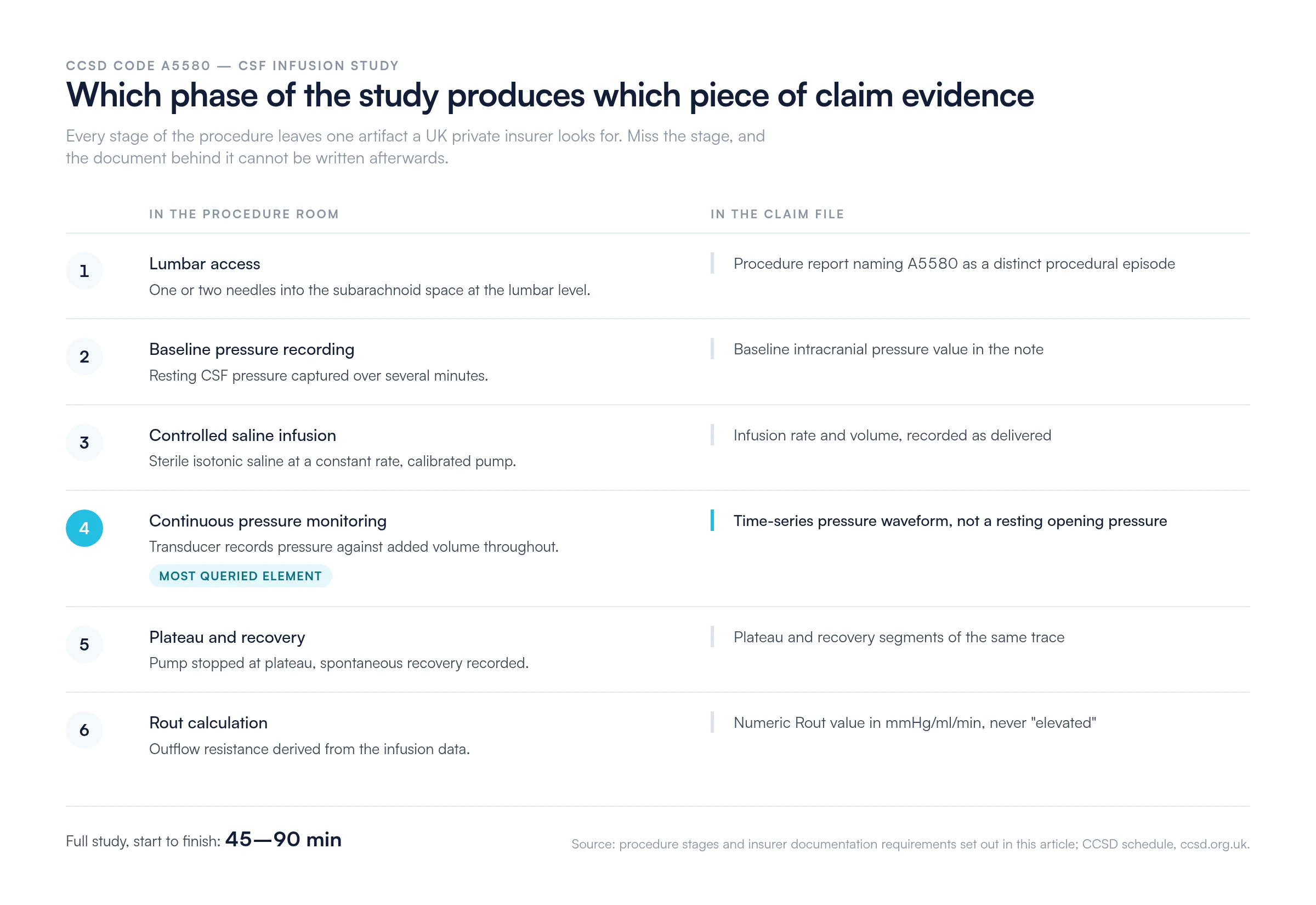
A CSF infusion study is a controlled diagnostic procedure performed under sterile conditions by a neurosurgeon or neurologist with appropriate training. Understanding the clinical steps helps billing teams verify that the procedural documentation is complete before submission.
The full study typically runs 45 to 90 minutes. It requires specialist equipment, a trained operator, and a monitoring setup capable of continuous waveform capture. A procedure note documenting all six phases above is the minimum clinical record required to support an A5580 claim. Each phase also leaves behind one document or value the insurer will look for.
CCSD Code A5580 is appropriate when a clinician needs to quantify CSF outflow resistance to reach or confirm a diagnosis. The following indications are established in neurological and neurosurgical practice. Every claim should still be supported by an explicit statement of the clinical rationale in the procedure notes.
The referring physician’s letter should document which indication applies. Insurers routinely query A5580 claims where the indication is recorded only as “hydrocephalus” without clinical context. The same imaging finding may be managed conservatively rather than with an invasive pressure study.
Billing CCSD Code A5580 correctly requires the right code, the right specialty, and the right supporting claim structure. The steps below reflect standard CCSD billing practice for UK private insurers.
Practices handling several insurer relationships benefit from a single system that stores pre-authorization references, procedure dates, and submitted codes together. Keeping the billing record beside the clinical note removes the manual cross-checking that causes submission delays.
Incomplete documentation is the leading reason CSF infusion study claims are queried or refused. The table below shows what each major UK private insurer category expects, along with the clinical element it relates to.
Structured digital forms let neurosurgery and neurology teams capture each element at the point of care rather than reconstructing records afterwards. A form that mirrors insurer requirements field by field is worth building once and reusing for every A5580 claim.
CCSD Code A5580 covers the CSF infusion study itself. Several adjacent codes may be appropriate when additional distinct clinical events occur during the same admission or on separate dates. The table below lists codes commonly associated with the same clinical pathway.
Important: Co-billing rules differ between insurers. Always confirm the current unbundling policy with each insurer before submitting. The Healix fee schedule provides specific unbundling guidance for complex neurology procedures.
Verify actual code descriptors and eligibility against the current CCSD schedule at ccsd.org.uk. The codes marked “illustrative” above show the logical billing boundaries. The live CCSD schedule holds the definitive descriptors. Our CCSD codes index lists the procedure-code pages we maintain across the schedule.
Certain mistakes appear repeatedly in A5580 claims across UK private practices. Most are avoidable with a pre-submission checklist.
That first error gets easier to avoid once the lumbar puncture code has a name. The CCSD schedule lists lumbar puncture (including spinal manometry) under A5530. Keep it off an A5580 invoice unless the tap happened on a different date.
Before submitting any A5580 claim, run a three-point check. Confirm the pre-authorization reference is recorded and the pressure waveform trace is attached to the patient record. Then check that the specialty code matches the treating clinician’s registered specialty. Most A5580 queries from UK private insurers trace back to one of those three checks being skipped.
Building these checks into a standard pre-submission workflow reduces repeat errors. A written checklist that billing staff work through before any claim leaves the practice catches most of them at source.
Major UK private medical insurers generally recognize CSF infusion studies as a covered neurological investigation when the clinical indication is clearly documented. Coverage terms and pre-authorization requirements vary by policy, so treat none of the statements below as a guarantee of reimbursement.
When requesting pre-authorization, give the insurer the CCSD code (A5580) and the suspected diagnosis. Add the treating clinician’s name and GMC number, plus the planned procedure date. Insurers may also ask for a brief clinical summary or the referring clinician’s letter.
In many private neurology practices, the evidence for one A5580 claim sits in three places. The procedure note is in the clinical system and the pressure trace is on the monitoring device. The authorization reference is usually in somebody’s inbox. Billing staff chase all three before they can submit.
Practice management software like Pabau keeps them together. The procedure note, the uploaded waveform, the Rout value and the authorization reference attach to the same patient record. The whole claim file then opens in one click.
Custom clinical forms let a neurosurgery team build an A5580 template that mirrors the insurer’s checklist, field by field. Staff complete it during the study rather than reconstructing it a week later. Invoices are raised against the same record, so the procedure date on the claim matches the date in the notes.

Pabau connects clinical notes, digital forms, and invoicing, so your neurology or neurosurgery team can open one record and find the whole A5580 claim file.

A5580 claims are settled on the strength of the monitoring record. A procedure note describes the study, while the waveform trace and the numeric Rout value prove it took place. That evidence is what an insurer’s reviewer opens first.
So the work that decides the outcome happens in the procedure room rather than the billing office. Capture the trace, write the Rout figure down, name the diagnostic question, and record the authorization reference on the day. A practice that captures all four consistently spends far less time answering queries.
Getting there takes a record system where the note, the trace and the authorization reference live together. Book a demo to see how Pabau assembles a complete CCSD claim file as the study happens.

List Item #1
List Item #2
CCSD Code A5580 is the UK private healthcare billing code for cerebrospinal fluid infusion studies. The study measures CSF outflow resistance (Rout) to investigate normal pressure hydrocephalus, communicating hydrocephalus, and idiopathic intracranial hypertension.
Bill A5580 under a neurosurgery or neurology specialty designation, and obtain pre-authorization from the patient’s insurer before the procedure. Record the authorization reference, then submit a procedure report carrying the continuous pressure waveform and the Rout value. Fee amounts vary by insurer, so check the relevant CCSD-based fee schedule before invoicing.
Six elements are required. Insurers expect a procedure report, a continuous pressure waveform recording, and a numeric outflow resistance (Rout) value. They also want a clear statement of clinical indication, the treating clinician’s GMC registration number, and the pre-authorization reference. Submitting only an outpatient letter or a resting pressure reading is insufficient.
Yes, but only when genuinely separate clinical events occur. A5580 includes the lumbar access performed as part of the infusion study. A separate lumbar puncture code should not be co-billed for the same procedure date. A continuous ICP monitoring code may be separately reportable if an overnight monitoring session occurs as a distinct episode. Always check the current unbundling rules in the CCSD technical guide and the relevant insurer’s fee schedule before co-billing.
Major UK private medical insurers generally recognize CSF infusion studies as a covered neurological investigation. That includes Bupa, AXA Health, Vitality, Aviva, and WPA, though coverage depends on the individual policy. Obtain an authorization reference before the procedure date, and confirm with the insurer that A5580 is recognized under the patient’s policy.
A CSF infusion study (CCSD Code A5580) adds controlled volumes of fluid into the intrathecal space to measure outflow resistance. The result is a diagnostic pressure profile used to evaluate hydrocephalus and ICP disorders. CSF drainage, by contrast, removes fluid to reduce intracranial pressure, either therapeutically or as a high-volume tap test in NPH assessment. The two procedures have different clinical purposes and are billed under different CCSD codes.



