CPT Code 92588: Comprehensive otoacoustic emissions testing
CPT code 92588: official descriptor and quick reference CPT code 92588 is the Am...

Last Updated: Oct 7, 2026
C6012 is the CCSD code for canaloplasty (of Schlemm’s Canal with microcatheter) combined with phacoemulsification of lens with implant “Phaco-Canaloplasty”, including topical or local anaesthetic. It covers both operations under one surgeon fee when they are performed on the same eye at the same sitting.
The code applies only when the operative note confirms microcatheter cannulation of Schlemm’s canal. Canaloplasty alone is C6011, and cataract surgery alone is billed under a phacoemulsification code such as C7122.
Let Pabau's smart automation suggest the right codes, reduce claim denials, and keep your practice compliant—effortlessly.
Automate repetitive tasks and focus on what matters most—your patients.
Reduce coding errors and ensure compliance with the latest regulations.
Clean claims, fewer denials, and faster reimbursements.
Powerful insights and reporting to help your practice thrive.
HIPAA compliant SOC 2 certified GDPR-compliant Trusted by 4,000+ clinics worldwide

C6012 covers phacoemulsification with lens implant and microcatheter canaloplasty of Schlemm’s canal as one combined code, including topical or local anaesthetic.
The microcatheter is part of the code’s definition, so the operative note must document microcatheter cannulation of Schlemm’s canal.
Billing C6011 and a cataract code such as C7122 for the same sitting is unbundling, and insurers reject it.
Get pre-authorisation from the insurer before surgery and put the reference on the invoice, because surgery without it risks an unpaid claim.
Pabau’s claims management helps ophthalmology teams generate CCSD-structured invoices and submit and track claims through Healthcode.
CCSD Code C6012 is the billing code for canaloplasty of Schlemm’s canal with microcatheter combined with phacoemulsification of the lens with implant, commonly called phako-canaloplasty. The CCSD schedule defines the procedure explicitly. The canaloplasty component requires a microcatheter to cannulate Schlemm’s canal, and the phacoemulsification component includes IOL implantation. The surgeon must perform both elements at the same operative sitting for C6012 to apply.
The code exists because performing both procedures at one sitting is clinically distinct from either in isolation. A single combined code reflects the shared operative field, the combined resource use, and the surgical skill both steps demand. The descriptor includes topical or local anaesthetic. The code prevents double-billing while paying the surgeon for the full complexity of a combined glaucoma-cataract procedure.
C6012 sits in Chapter 4 (Eye and orbital contents) of the CCSD schedule, in the Iris & Anterior Chamber section alongside the other glaucoma codes. The Clinical Coding and Schedule Development (CCSD) Group maintains the schedule. It sets the code descriptors used by Bupa, AXA Health, Vitality, Aviva, and other UK private medical insurers (PMIs). Insurers set their own fees against those codes, and Aetna International’s fee schedule places C6012 in the Major Plus complexity band.
The operative sequence matters for coding because the documentation must confirm each component. Consultants typically complete phacoemulsification first, then perform canaloplasty in the same session.
Surgeons may perform gonioscopy intraoperatively to confirm suture placement. Some surgeons document a goniolens check explicitly, which supports the operative note in payer audits.
C6012 is appropriate when a patient has both open-angle glaucoma and a visually significant cataract that both warrant surgical intervention at the same session. The Royal College of Ophthalmologists sets clinical standards for glaucoma surgery documentation in the UK, and most PMI pre-authorisation criteria map to RCOphth evidence thresholds.
Typical indications for phako-canaloplasty include:
Contraindications include angle-closure glaucoma, where canal-based surgery is inappropriate, and prior failed canaloplasty on the same eye. Significant conjunctival or episcleral scarring that precludes a scleral flap also rules it out. Narrow-angle anatomy may also preclude safe microcatheter passage.
Understanding the bundled scope of C6012 prevents the most common billing errors. The single code fee encompasses both the phacoemulsification with IOL implant and the canaloplasty with microcatheter as one surgeon fee. Work outside that operative scope needs its own code, where one applies.
Unbundling risk: billing a cataract code such as C7122 alongside the standalone canaloplasty code C6011 for the same sitting is unbundling. PMI payers will reject the duplicate and may flag the account for audit. Always use C6012 when both components are performed together.
Selecting the correct code requires knowing what distinguishes C6012 from adjacent canal-based and MIGS codes. The table below maps the decision tree for the most common combinations a consultant ophthalmologist will encounter.
Always verify neighbouring codes against the current CCSD schedule edition, because descriptors can be revised between editions. Our CCSD codes index collects the other code pages in the schedule. The grid below shows how two facts in the operative note decide between these four codes.
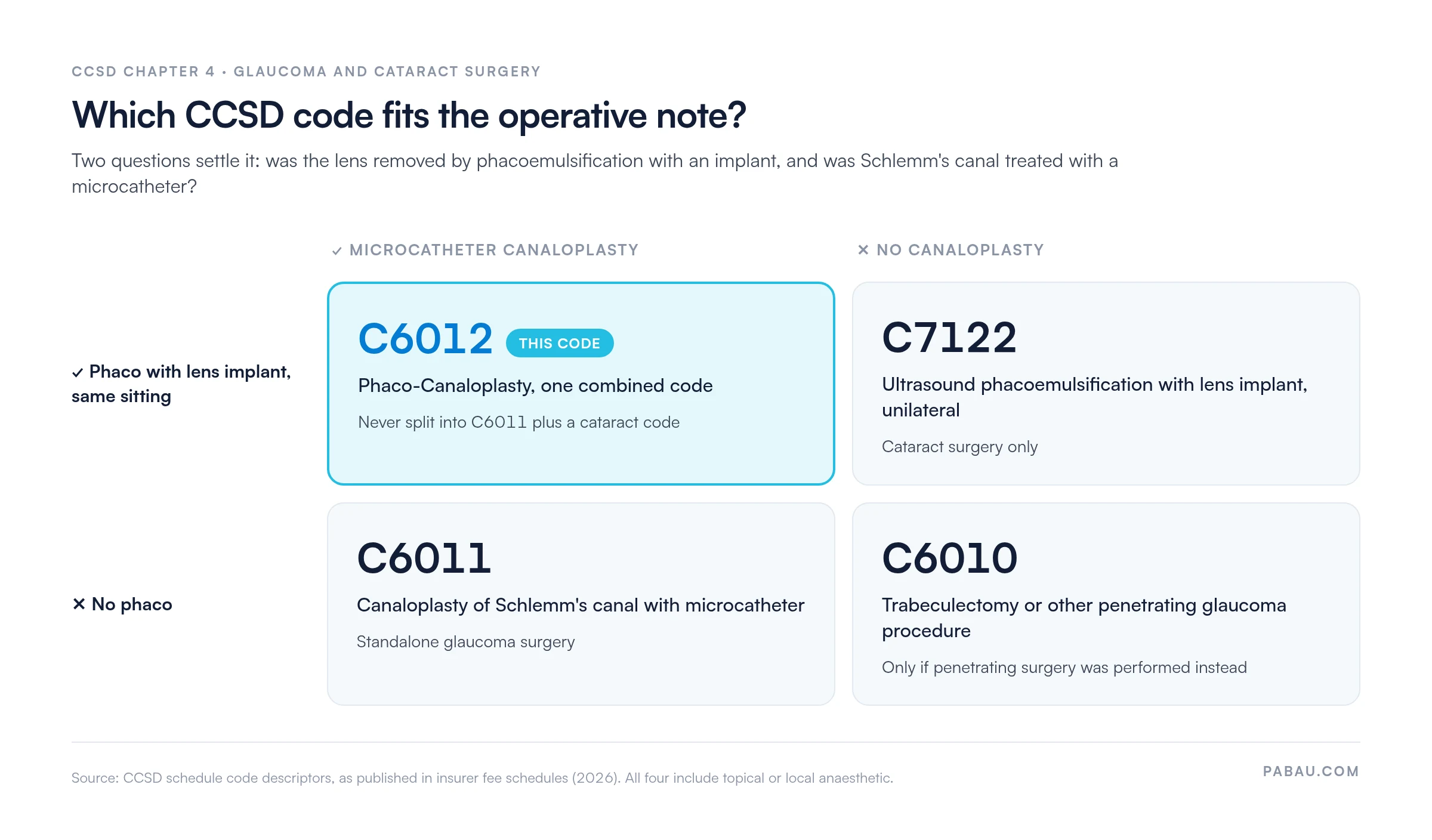
Phako-canaloplasty is one of several combined cataract-plus-glaucoma procedures performed in UK private ophthalmology. Choosing the correct CCSD code requires matching the mechanism and anatomical target, not just the combined nature of the surgery.
The key distinction between C6012 and stent-based MIGS codes is that canaloplasty leaves no permanent device in the trabecular meshwork or canal. A prolene suture tensions the canal but is not an implanted device in the sense of iStent or Hydrus. Using a canal stent code for phako-canaloplasty (or the reverse) is miscoding, and it will trigger denial or audit.
PMI payers audit C6012 claims against the operative note. An incomplete note is the most common clinical reason for records requests and subsequent denial. The operative note must confirm each element definitional to the code.
Using private practice claims management software that captures structured operative documentation reduces the risk of incomplete records at claim submission time. The checklist below maps to what PMI payers typically request when auditing a C6012 encounter.
Audit your last five C6012 operative notes against this checklist before submitting any new claims. If microcatheter use and canal circumnavigation distance are absent from even one note, review your theatre documentation workflow with your scrub team immediately.
The Royal College of Ophthalmologists publishes guidance on clinical record-keeping standards for glaucoma surgery. Following RCOphth standards gives the operative note an independently recognised framework that payers recognise.
UK private medical insurers such as Bupa, AXA Health, Vitality, and Aviva generally expect members to pre-authorise planned surgery, and C6012 is no exception. Surgery carried out without authorisation risks the whole claim going unpaid.
Most payers ask for the following supporting evidence when a consultant submits a pre-auth application. Check current payer portals for exact requirements, as criteria change annually. Our guide to Bupa CCSD codes explains how to check Bupa’s current codes and requirements in its code search tool.
Some PMI payers may classify phako-canaloplasty as an innovative or emerging technique and apply additional scrutiny. You can check fees in Vitality’s fee finder and Aviva’s fee schedule. Consultants should confirm the current policy with each insurer before advising patients on coverage expectations.
Emergency or urgent cases without pre-auth before surgery may follow a retrospective authorisation pathway. This is insurer-specific: contact the clinical governance team at the relevant PMI before proceeding.
You can catch each of the six denial reasons below before submitting the claim.
An appeal for a denied C6012 claim should include the original pre-auth correspondence and the operative note with the relevant passages highlighted. Add a consultant letter explaining the clinical rationale. Healix publishes its unbundling and appeal rules in its fee schedule guidelines, which offer a useful benchmark for understanding what documentation reviewers look for.
The most asked coder question about C6012: can you add a separate phako code or standalone canaloplasty code to the same invoice? The answer is no. C6012 is a bundled combined code. The single code fee already subsumes both the phacoemulsification and the canaloplasty components. Splitting them out is unbundling, regardless of whether each component might otherwise qualify for its own code.
Codes that MAY legitimately accompany C6012 on the same encounter:
Never bill C6012 as a bilateral procedure unless the operative note documents both eyes and the insurer’s fee schedule allows it. CCSD has no modifiers, and most PMI schedules treat ophthalmic procedures individually per eye.
Many private ophthalmology teams track C6012 claims across a theatre diary, a spreadsheet of pre-auth numbers, and each insurer’s portal. Every hand-off is a chance for the authorisation number or an operative detail to drop off the invoice.
Pabau, the practice management platform we build for private practices, keeps the operative note, the pre-authorisation reference and the invoice on one patient record. Billing staff generate a CCSD-structured invoice for C6012 from that record, then submit and track the claim through Healthcode. Book a demo to see the invoicing and claims workflow for private ophthalmic consultants.
Consultants moving from NHS work into private practice get one view of each claim. They can see what was billed, what is still with the insurer, and what needs chasing.

Pabau generates CCSD-structured invoices from the patient record, then submits and tracks them through Healthcode. Your C6012 claims reach the insurer with the code and pre-authorisation number intact.

C6012 pays for two operations as one, so the claim stands or falls on whether the record proves both happened at the same sitting. Treat the microcatheter line in the operative note as the part of the claim the insurer reads first.
Build the pre-auth request, the operative note and the invoice around the same code before the patient is booked. Then track each claim against the insurer’s time limit, so no encounter falls outside the submission window.
Book a demo to see how Pabau links the operative record, the invoice and the Healthcode claim for private ophthalmology practices.

Managing private ophthalmic billing workflows? Bupa CCSD codes guide covers the full Bupa procedure code framework and how to navigate their portal for authorisation and fee queries.
Concerned about denied claims across your private practice? Denial management in healthcare explains the systematic approach to tracking, appealing, and preventing rejected claims.
Billing the cataract component on its own? CCSD Code C7122 covers phacoemulsification with lens implant when no glaucoma procedure is performed.
Returning to theatre after earlier glaucoma surgery? CCSD Code C6150 explains how revision of previous glaucoma surgery is coded and documented.
CCSD Code C6012 covers microcatheter canaloplasty of Schlemm’s canal combined with phacoemulsification of the lens and IOL implantation. The surgeon performs both at the same operative sitting. The single code covers both the glaucoma and cataract components under one surgeon fee. The code includes topical or local anaesthetic, while a separate anaesthetist or sedation fee has its own code. It excludes biometry and post-operative injections.
Yes, a microcatheter is definitional to C6012. The official CCSD descriptor names microcatheter cannulation as part of the canaloplasty component. Schlemm’s canal surgery without a microcatheter is a different technique, so you code it under the code that matches the procedure performed rather than C6012.
The usual denial reasons are missing pre-authorisation, an operative note that does not confirm microcatheter use, and unbundling phako and canaloplasty into separate codes. Other causes include selecting a canal stent code instead of C6012 and a policy exclusion for innovative procedures. Late submission is the last one, so send the claim within the insurer’s published time limit (for example six months for Bupa and AXA Health).
No. C6012 is a bundled combined code that covers both the phacoemulsification and canaloplasty components. Adding a standalone phako code or the standalone canaloplasty code to the same invoice is unbundling, and PMI payers will reject it. Legitimate additional charges are limited to separate anaesthetist or sedation fees, biometry, and distinct procedures on the fellow eye. Fellow-eye billing depends on the insurer’s policy.