ICD-10 Code V91.84XS: Other burn due to burning watercraft
ICD-10 Code V91.84XS: overview and key facts ICD-10 Code V91.84XS identifies the...

Last Updated: Oct 30, 2026
Billable Code Specific Code
W55.39XA is the billable ICD-10-CM code for other contact with other hoof stock, initial encounter.
It records contact with animals such as goats and sheep that was neither a bite (W55.31XA) nor a strike (W55.32XA). Report it after the injury code, never as the principal diagnosis. Don't confuse it with W55.59XA, which means other contact with raccoon.
Let Pabau's smart automation suggest the right codes, reduce claim denials, and keep your practice compliant—effortlessly.
Automate repetitive tasks and focus on what matters most—your patients.
Reduce coding errors and ensure compliance with the latest regulations.
Clean claims, fewer denials, and faster reimbursements.
Powerful insights and reporting to help your practice thrive.
HIPAA compliant SOC 2 certified GDPR-compliant Trusted by 4,000+ clinics worldwide

W55.39XA covers contact with other hoof stock, such as goats and sheep, that was neither a bite nor a strike, at the initial encounter.
Bites by other hoof stock go to W55.31XA, and kicks, butts or other strikes go to W55.32XA.
W55.39XA is an external cause code, so it always follows an injury code and is never the principal diagnosis.
Never swap it for W55.59XA, which means other contact with raccoon, not hoof stock.
ICD-10 Code W55.39XA is the billable ICD-10-CM code for other contact with other hoof stock, such as goats and sheep, at the initial encounter. It has been valid for encounters on or after October 1, 2015. The table below captures the fields a coder checks first.
W55.39XA records contact with other hoof stock that was neither a bite (W55.31XA) nor a strike (W55.32XA). Think of a sheep pinning a handler against a gate, or a goat trampling a farm worker’s foot.
The ICD-10-CM tabular list names two animals under subcategory W55.3: goats and sheep. Horses sit in W55.1, cattle in W55.2 and pigs in W55.4, so those species never land here. For any other hoofed species, check the Alphabetic Index before you assign the code.
Category W55 also includes contact with the saliva, feces or urine of a mammal. A handler exposed to goat or sheep waste, with no bite or strike, can therefore fall under W55.39XA.
As an external cause code, W55.39XA explains how an injury happened rather than what the injury is. The injury code comes first, and W55.39XA follows to tell the payer what caused it.
The code’s parent structure decides which animal and contact type it can describe. The full path from chapter to the W55.39XA code is shown below.
Two sibling codes share subcategory W55.3 with W55.39XA. W55.31XA covers being bitten by other hoof stock, and W55.32XA covers being struck by it. W55.39XA takes the remaining contact types, such as pressure, crushing, entrapment or trampling. The decision path below shows how the species, the contact and the encounter settle the code.
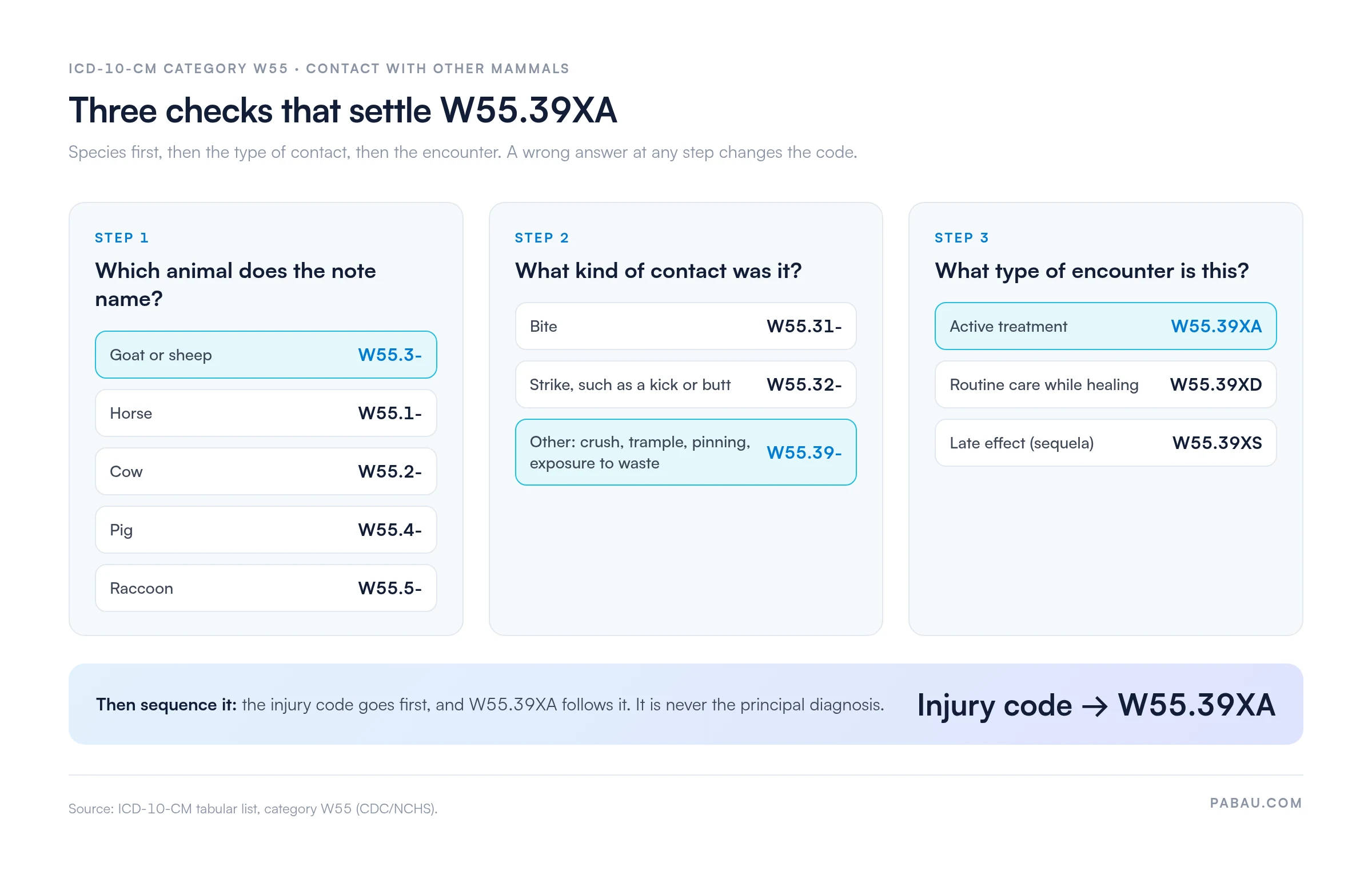
Watch the neighboring subcategory W55.5, which covers raccoons. W55.59XA reads almost the same as W55.39XA but means other contact with raccoon, so one wrong digit changes the animal on the claim.
W55.39XA follows the standard 7th character convention for injury and external cause codes. The X is a placeholder that fills the empty sixth position, and the final letter records the encounter type.
The A extension applies to every visit where the patient receives active treatment, including visits after the first. A patient who saw another provider first still takes A at your practice while active treatment continues.
The descriptor is narrow, so most routing errors come from the species or the contact type. The table below contrasts covered scenarios with the correct code for excluded ones.
Category W55 also carries four Excludes1 notes. An animal being ridden is coded as a transport accident (V80), and a bite or strike by a dog goes to W54. Rodents go to W53, and marine mammals go to W56.
Correct sequencing is the most reliable way to avoid a rejection on the first submission. Follow these four steps in order for every encounter involving this code.
S20.211A (contusion of right front wall of thorax, initial encounter) is a typical injury code after a sheep pins a handler. S30.11XA (contusion of abdominal wall, initial encounter) fits a crush against a pen rail. Document the body region and side so the most specific injury code is supported.
Audit your W55.39XA claims each quarter by filtering your clearinghouse rejection report by this code. Look for the code sent without an injury diagnosis, and for a D extension on a visit where active treatment was ongoing. Also search livestock claims for W55.59XA, since that code means raccoon.
Subcategory W55.3 holds three codes that coders often interchange, and two nearby subcategories add more risk. The clinical notes must document the animal and the nature of the contact to support the code.
“Patient injured by goat on farm” is not enough documentation. The chart must describe how contact occurred, which body part was affected and the species involved, per the CDC/NCHS ICD-10-CM coding guidelines.
Payers review external cause codes when the record does not clearly support them. For W55.39XA, the chart should contain the following elements to hold up in a retrospective review.
Strong documentation also supports medical billing compliance when a payer audits an injury claim.
Medicare, Medicaid and commercial payers accept W55.39XA as a secondary code. The rules for reporting external cause codes still vary by payer type.
The ICD-10-CM guidelines set no national requirement to report external cause codes. Reporting becomes mandatory where a state mandate or a payer policy requires it. Check each plan’s policy before you treat the code as optional.
Workers’ compensation carriers use external cause codes to establish how and where an occupational injury happened. W55.39XA appears most often in farm injury claims involving sheep and goats. Place and activity code requirements vary by state and by carrier.
Pabau, the practice management platform we build, connects to the Claim.MD clearinghouse for electronic claim submission. Clearinghouse rejections then show up before a claim reaches the payer’s adjudication stage, as our Claim.MD clearinghouse guide explains.
Most commercial insurers accept W55.39XA as a secondary code without prior authorization. The injury it accompanies may still need authorization, such as a fracture that requires surgical repair. Confirm insurance eligibility verification and authorization based on the principal diagnosis code, not the external cause code.
Denials on W55.39XA claims follow predictable patterns. The table below maps each one to a likely CARC (Claim Adjustment Reason Code) to support your denial management workflow.
Review denial codes against your ERA data after each remittance cycle. It is the fastest way to spot repeat W55.39XA errors before they spread across claims.
ICD-11, published by the World Health Organization, restructures external cause coding compared with ICD-10-CM. CMS has not announced a US transition date to ICD-11, and ICD-10-CM updates continue each October.
No action is needed for current billing. Keep using ICD-10 Code W55.39XA for all US claims until CMS issues transition requirements.
If your practice treats farm injuries often, keep a short list of the external cause codes you bill most, including W55.39XA. That list makes any future code-set transition easier to plan.
Coding W55.39XA correctly depends on what the clinician wrote: the species, the contact type and the encounter. When notes sit in one system and claims in another, those details get retyped or lost.
In Pabau, the patient record, the treatment note and the invoice live in the same place. Your coder builds the claim in Pabau’s claims software for practices, starting from the note the clinician signed.
The bite, strike or other-contact wording stays next to the code that depends on it. Fewer claims go out with a sibling code the notes don’t support.

Pabau keeps the treatment note, the diagnosis codes and the claim in one patient record, so coders work from what the clinician wrote. See how claims management fits your injury and occupational health workflow.

W55.39XA does one narrow job: it records non-bite, non-strike contact with goats, sheep and other hoof stock. It always sits after the injury it explains.
Make the subcategory digit your first check on every livestock claim, because W55.59XA describes a raccoon. Then confirm the contact type and the 7th character against the note before the claim goes out.
If your team bills farm or occupational injuries, book a demo to see how Pabau keeps the note and the claim together.

Need to understand how clearinghouse claim validation works? Claim.MD clearinghouse overview explains how electronic claim validation catches sequencing errors before payer submission.
Want a walkthrough of clean claim requirements? Submitting a clean claim covers the field-by-field requirements that keep external cause code claims out of the denial queue.
Looking to understand the full medical billing process? Medical billing fundamentals gives context on how external cause codes fit into the end-to-end revenue cycle workflow.
ICD-10 Code W55.39XA is the billable ICD-10-CM code for other contact with other hoof stock, initial encounter. It covers crush, trample, pressure or entrapment by animals such as goats and sheep, where the contact was not a bite or a strike.
Yes, W55.39XA is a valid, billable ICD-10-CM code. It cannot be the principal or first-listed diagnosis, so it always follows the injury code for the visit.
The 7th character sets the encounter type. A applies while the patient receives active treatment, D applies to routine follow-up during healing, and S applies to a late effect of the injury.
The ICD-10-CM tabular list names goats and sheep under subcategory W55.3. Horses go to W55.1, cattle to W55.2 and pigs to W55.4, so those species never route to W55.39XA.
No. W55.59XA means other contact with raccoon, initial encounter, and sits in subcategory W55.5. Hoof stock codes sit in W55.3, so check the fourth character before you submit.
Yes, W55.39XA is often reported on workers’ compensation claims for farm injuries involving sheep or goats. Carriers commonly ask for place, activity and status codes as well, and requirements vary by state.
The most frequent problems are W55.39XA sent without an injury code, the wrong 7th character, and notes that describe a bite or a kick. A missing place-of-occurrence code can also trigger a workers’ compensation rejection.