ICD-10 Code J02.9: Acute pharyngitis, unspecified
ICD-10 Code J02.9: Quick-reference overview ICD-10 Code J02.9 is the billable IC...

Last Updated: Nov 9, 2026
Billable Code Specific Code
J20.9 is the billable ICD-10-CM code for acute bronchitis, unspecified. It applies when the provider documents acute bronchitis and no causative organism is identified.
It sits in block J20-J22 (Other acute lower respiratory infections) in Chapter 10 of ICD-10-CM, Diseases of the respiratory system. Assigning it turns on three checks: J20.9 versus J40, the influenza exclusion, and documentation of an acute presentation.
Let Pabau's smart automation suggest the right codes, reduce claim denials, and keep your practice compliant—effortlessly.
Automate repetitive tasks and focus on what matters most—your patients.
Reduce coding errors and ensure compliance with the latest regulations.
Clean claims, fewer denials, and faster reimbursements.
Powerful insights and reporting to help your practice thrive.
HIPAA compliant SOC 2 certified GDPR-compliant Trusted by 4,000+ clinics worldwide

J20.9 is the billable ICD-10-CM code for acute bronchitis when no causative organism is documented. J40 covers bronchitis not specified as acute or chronic.
The J20 category runs from J20.0 (Mycoplasma pneumoniae) through J20.8 (other specified organisms) to J20.9 (unspecified), so assign the most specific code the documentation supports.
Influenza with respiratory manifestations (J09-J11) and chemical bronchitis (J68.0) take their own codes. COPD with an acute lower respiratory infection takes J44.0, with a J20.- code added to identify the infection.
Pabau, the practice management platform we build, connects to Claim.MD for electronic claims, eligibility checks and ERA receipt on respiratory diagnoses.
ICD-10 Code J20.9 is a billable diagnosis code with the official descriptor “Acute bronchitis, unspecified.”
it captures acute inflammation of the bronchi, typically lasting under three weeks, where no specific infectious agent has been documented. The code is valid for HIPAA-covered transactions.
J20.9 remains valid and billable, and the CDC/NCHS ICD-10-CM web tool carries its current tabular entry. Coders should verify the current release before submitting, because CMS publishes annual updates effective each October 1.
The J20 subcategory assigns a distinct 4-character code to each documented causative organism. J20.9 is the correct choice only when the pathogen is absent from the record. Before defaulting to J20.9, verify whether a culture result or clinical impression supports a more specific code.
The ICD-10-CM tabular list gives J20 its own inclusion terms, and several look-alike conditions take other codes. The order below runs those other routes first, so J20.9 is reached only once each one is ruled out.
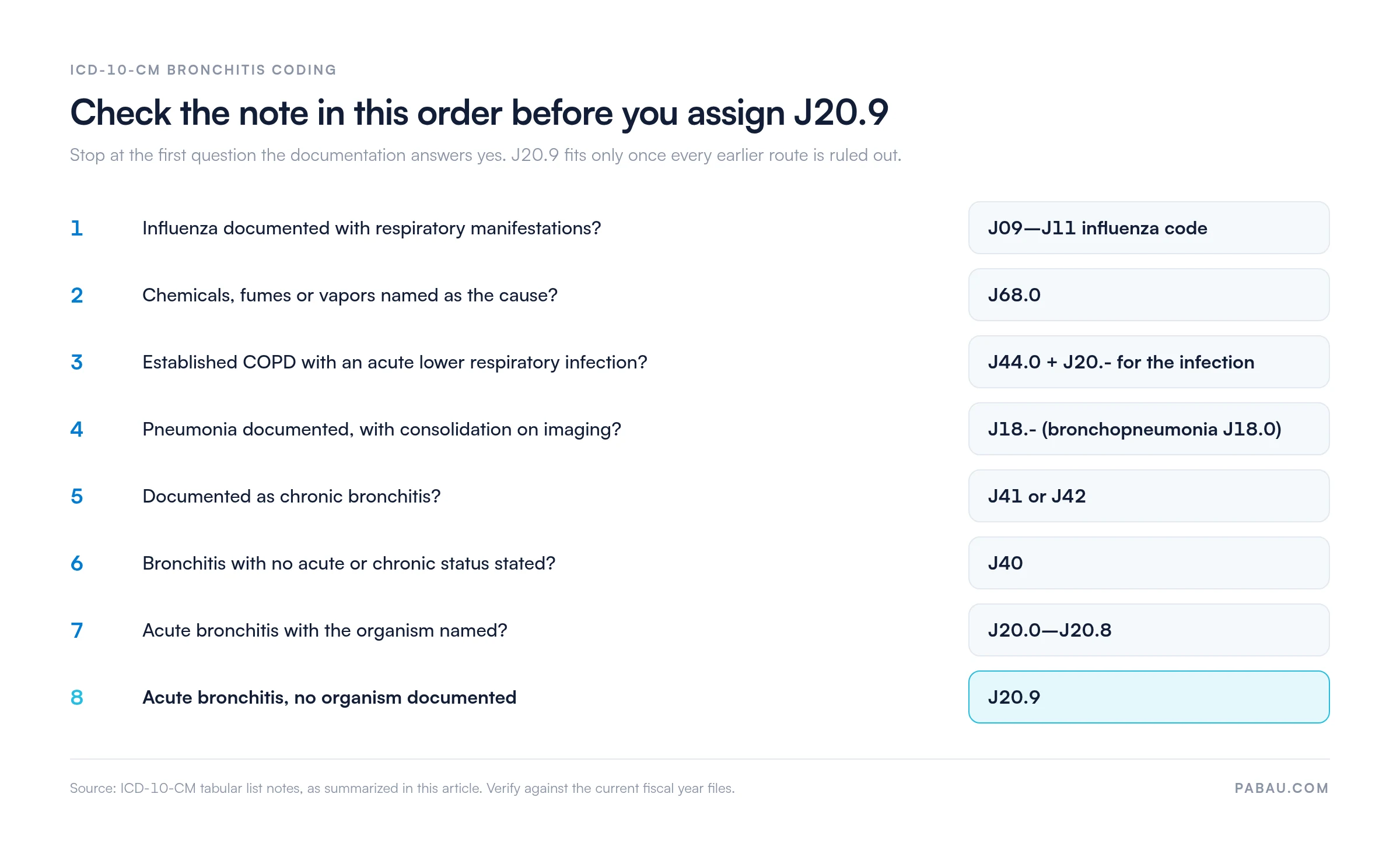
J40 (Bronchitis, not specified as acute or chronic) is the code most often confused with J20.9, and the two are not interchangeable. J40 applies when the documentation does not say whether the bronchitis is acute or chronic. J20.9 requires a documented acute presentation.
The CMS ICD-10 codes page publishes the annual tabular list. Check the J40 title and the notes under J20 there for the current fiscal year. Query your AHA Coding Clinic subscription for official guidance when documentation is ambiguous.
These code families describe distinct clinical entities. The documented duration and any COPD history decide which one applies.
When a patient with established COPD develops an acute lower respiratory infection, J44.0 is assigned. Its tabular entry carries a “Code also” note to identify the infection, so a J20.- code may be added as an additional code. Confirm against the current fiscal year’s tabular notes before coding.
Does the chart show signs of infection, such as fever, purulent sputum or a raised WBC? Query the provider before choosing between J44.0 and J44.1. J44.0 fits a documented infection, while J44.1 covers an exacerbation documented without one.
A claim for ICD-10 Code J20.9 holds up on audit when the clinical note contains each of the following elements. A note missing one of them invites a medical necessity denial.
Accurate documentation starts at the point of care. Practices that use structured clinical templates catch incomplete notes while the provider can still be queried.
Office visit E&M codes are the most common procedure codes paired with J20.9. The complexity level selected must match the documented medical decision-making or total time, not the diagnosis alone.
Acute bronchitis claims often arrive with thin documentation, and payers can dispute the choice between J20.9 and J40. The common denial triggers follow a predictable pattern.
Effective denial management workflows catch these triggers before submission rather than after. Pre-submission edits that flag symptom-only assessments and concurrent influenza codes cut J20.9 denials without manual review of every claim. A clean claim process that checks diagnosis-procedure pairings at the point of coding is the most reliable prevention tool.
Bronchitis, pneumonia and unspecified lower respiratory infection overlap in acute respiratory illness. The code follows the condition the provider documents, not symptom severity or a radiology report on its own.
J20.9 and J18.9 describe different sites, so they should not be assigned for the same condition. When the provider documents bronchopneumonia, code J18.0 rather than pairing a bronchitis code with a pneumonia code. J22 is the fall-back when the provider documents an acute lower respiratory infection without naming bronchitis or pneumonia.
J20.9 is accepted as a valid primary diagnosis for office and outpatient visits across most commercial payers and Medicare without prior authorization. Several nuances apply, however, depending on the MAC jurisdiction and service type.
Maintaining medical billing compliance for respiratory diagnoses means reviewing MAC-specific LCDs at least once a year. Coverage policies update on their own schedules, separate from the ICD-10-CM code set.
J20.9 remains valid and billable. ICD-10-CM changes take effect each October 1, and the CMS and CDC files for each fiscal year record what changed. The FY2027 code set has been in effect since October 1, 2026, so check the CMS/CDC FY2027 files for any change to the J20 block.
Where the tabular notes do not settle a bronchitis case, AHA Coding Clinic is the first source to query before escalating to your MAC. Our ICD-10-CM codes library covers the neighboring codes, and the CDC/NCHS web tool carries the authoritative code set for each fiscal year. Build an October 1 update review into the billing calendar to catch future changes to the J20 block.
The FY2027 ICD-10-CM files took effect on October 1, 2026, so check them now for any change to the J20 block. CMS and the CDC post each year’s files before that date. Review them as soon as they appear, so your billing team has time to update EHR code sets and charge entries.
J20.9 claims tend to go wrong in the handoff between the visit note and the claim. A coder reads the assessment, keys the diagnosis by hand, and only learns about a missing acute descriptor when the remittance comes back.
In Pabau’s claims management software, the practice builds the claim from the patient record. Eligibility checks run before the visit, and claims go to payers electronically through Claim.MD.
ERA remittances come back into Pabau too. A denied J20.9 line then sits next to the visit note that produced it. Your team can see at once whether the fix is the documentation or the code.

Pabau connects to Claim.MD for electronic claims, eligibility checks and ERA remittances. Your team codes acute bronchitis visits from the same record the provider documents in.

J20.9 is a code you reach by elimination. Assign it only after the note rules out influenza, a chemical cause, COPD, pneumonia and chronic bronchitis. The provider must also have called the bronchitis acute.
If the note says only “bronchitis,” query the provider or code J40 rather than reading acuity into the chart. That habit protects the claim on audit and keeps J20.9 for the visits that support it.
Pabau’s Claim.MD clearinghouse integration sends those claims electronically to thousands of US payers, with eligibility checks before the visit and ERA receipt after it. Book a demo to see how Pabau handles acute bronchitis claims from the visit note to payment.

Coding a COPD flare with no infection documented? ICD-10 Code J44.1 covers COPD with acute exacerbation and how it differs from J44.0.
Struggling with denial prevention on respiratory claims? Denial codes in medical billing explains the most common CARC reasons and corrective actions.
Want to understand how claims flow from submission to payment? Electronic remittance advice covers how ERAs and 835 files work in a standard billing cycle.
ICD-10 Code J20.9 is the billable diagnosis code for acute bronchitis, unspecified. It covers acute inflammation of the bronchi where no causative organism is documented. It falls within category J20 (Acute bronchitis) in block J20-J22 (Other acute lower respiratory infections), Chapter 10 of ICD-10-CM.
Use J20.9 when the provider’s note documents acute bronchitis. Use J40 when the documentation says only “bronchitis” without stating whether it is acute or chronic. In ICD-10-CM, documented acuity decides the choice, not the patient’s age.
J20.9 applies to acute bronchitis lasting under three weeks. J41 and J42 apply to chronic bronchitis, defined as productive cough for three or more months a year in two or more consecutive years. The duration documented in the note decides which applies.
Yes, as an additional code. When a patient with established COPD develops an acute lower respiratory infection, J44.0 is assigned. Its tabular entry tells coders to code also the infection, so a J20.- code may be added. Confirm the current tabular notes for your fiscal year before coding.
The most common reasons are thin documentation, the wrong code, and unsupported imaging. A note may list symptoms without a provider diagnosis of acute bronchitis, or J40 or J44.0 may apply instead. Chest X-ray claims also fail when they lack the clinical indicators the MAC’s LCD requires. Pre-submission edits that check the diagnosis-procedure pairing catch many of these denials.
J20.9 is assigned when the provider documents acute bronchitis, and J18.9 (pneumonia, unspecified organism) when the provider documents pneumonia. Pneumonia typically shows alveolar consolidation on imaging, but the code follows the provider’s diagnosis. The two describe different sites and should not be assigned for the same condition. Documented bronchopneumonia is coded J18.0.