ICD-10 Code Y76.0: Diagnostic obstetric and gynecological devices
ICD-10 Code Y76.0: Definition and billable status ICD-10 Code Y76.0 is a valid, ...

Last Updated: Oct 23, 2026
Billable Code Specific Code
Z46.1 is the billable ICD-10-CM code for encounter for fitting and adjustment of hearing aid.
Audiology and ENT practices report Z46.1 as the primary diagnosis whenever the visit exists to fit or reprogram a hearing aid. Most denials trace back to two errors. Coders reach for Z46.1 on a cochlear implant visit, or they leave the companion hearing-loss code off the claim.
Let Pabau's smart automation suggest the right codes, reduce claim denials, and keep your practice compliant—effortlessly.
Automate repetitive tasks and focus on what matters most—your patients.
Reduce coding errors and ensure compliance with the latest regulations.
Clean claims, fewer denials, and faster reimbursements.
Powerful insights and reporting to help your practice thrive.
HIPAA compliant SOC 2 certified GDPR-compliant Trusted by 4,000+ clinics worldwide

Z46.1 is a billable ICD-10-CM code for hearing aid fitting and adjustment encounters, separate from the implanted hearing device codes in Z45.32.
The code covers both fitting and adjustment visits, and it carries no laterality subdivision.
Medicare Part B generally does not reimburse hearing aid fitting. Z46.1 may appear on the claim, but payment is typically denied.
Pair Z46.1 with a hearing-loss code from H90 or H91, and keep Z46.1 as the principal diagnosis.
Pabau’s claims management software supports Z46.1 submission with built-in CPT and ICD-10 catalogs and a Claim.MD clearinghouse integration.
ICD-10 code Z46.1 is the official diagnosis code for “Encounter for fitting and adjustment of hearing aid” in ICD-10-CM. The classification is maintained jointly by the Centers for Medicare and Medicaid Services (CMS) and the National Center for Health Statistics. Z46.1 is billable, specific, and a terminal node, so no further character can add specificity to it.
The code falls under Chapter 21 of ICD-10-CM (Factors influencing health status and contact with health services, Z00-Z99). As a Z-code, it describes an encounter driven by circumstances other than active disease or injury. Coders use it when the visit purpose is the fitting or adjustment of a conventional hearing aid, not treatment of the hearing condition behind it.
Z46 is the parent block code covering encounters for the fitting and adjustment of assistive and medical devices. Z46.1 sits as a direct child of this category. Reading the Z46 family in full helps coders pick the right sibling code when the device is not a conventional hearing aid.
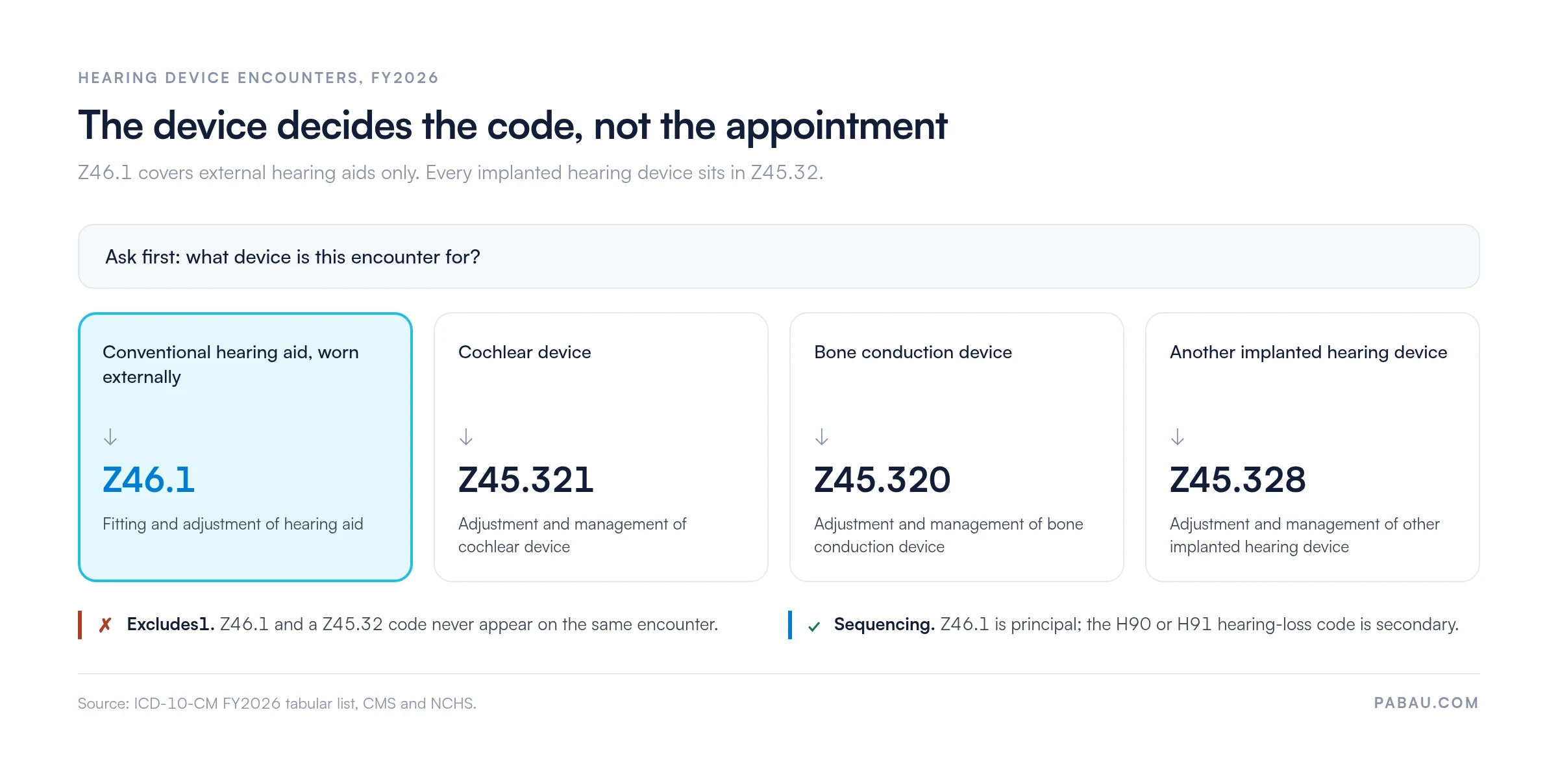
The line that matters inside this family runs between conventional hearing aids, which take Z46.1, and implanted hearing devices, which sit in Z45.32. Choosing the wrong parent category is the most consequential coding error in audiology billing. It changes DRG grouping and the payer’s adjudication logic.
Z46.1 applies when the primary or sole reason for the encounter is fitting or adjusting a conventional hearing aid. The CDC/NCHS ICD-10-CM tool confirms the code is appropriate across a range of hearing aid encounter types.
Z46.1 covers both fitting and adjustment encounters under one code, because ICD-10-CM classifies them as the same encounter type. A fitting encounter introduces the device to the patient. An adjustment encounter modifies a fit the patient already has. The code does not separate the two, so audiologists need no second code for follow-up visits.
The clinical note should still state whether the encounter was a new fitting or an adjustment. Payers sometimes audit Z46.1 claims to confirm the visit purpose matches the billed service. A note that says only “patient seen for hearing aid” names no clinical activity, and that vagueness is what creates denial risk.
Z46.1 carries an Excludes1 note, which means the excluded codes cannot be reported at the same encounter as Z46.1 under any circumstances. Excludes1 marks two situations that never occur together. When the clinical picture calls for an excluded code, Z46.1 is the wrong choice.
Implanted hearing devices are surgically placed and governed by the separate Z45.32 subcategory. Its members are Z45.320 for a bone conduction device, Z45.321 for a cochlear device, and Z45.328 for another implanted hearing device. None of them carries a laterality split, so one code covers the encounter whichever ear was treated.
Using Z46.1 for a cochlear implant programming visit is a consequential coding error. It misstates the device type, may trigger a medical necessity denial, and can raise compliance flags on audit. Conventional hearing aids are external devices that are never implanted. That one distinction drives the whole code choice, as the chart below sets out.
Documentation is what makes a Z46.1 claim defensible. The clinical note must support Z46.1 as the primary encounter reason. Without that support, payers can deny on medical necessity grounds even when the code itself is correct. These are the fields the note has to address.
Z46.1 is the diagnosis code, and it needs one or more CPT procedure codes to complete the claim. The table below lists the audiology CPT codes most often paired with it. Coverage for these codes varies significantly by payer.
Per the AMA’s CPT code set, these codes describe the audiological services performed, while Z46.1 describes the reason for the encounter. A complete audiology claim needs both elements. Pairing Z46.1 with a general evaluation and management code such as 99213 or 99214 is a common mismatch. Payers flag it during claim review when no hearing aid CPT code appears.
Verify CPT coverage before the appointment. Some commercial insurers cover 92590 and 92591 for hearing aid selection, but not 92592 or 92593 for follow-up checks. Checking benefits before the visit tells you which of the four the patient’s plan will actually pay.
Z46.1 identifies the encounter type. It does not describe the hearing condition underneath it, and payers frequently expect a secondary hearing-loss diagnosis on the same claim to establish medical necessity. The H90 and H91 series are the most relevant. Hearing-loss codes do carry laterality, so coders must pick the code for the specific ear or ears affected.
Coders who need the neighboring entries can browse the full ICD-10-CM code library for the rest of the H90 and H91 series.
Sequencing rule: Z46.1 is the principal diagnosis when the encounter’s primary purpose is the fitting or adjustment. The hearing-loss code from H90.x or H91.x is secondary. Listing the hearing-loss code first suggests the visit was for diagnosis or disease management rather than device fitting. That can change how the claim is adjudicated.
Billing Z46.1 involves several practical decisions that sit outside code selection. Knowing the payer’s coverage policy before submission saves a great deal of rework. Running insurance eligibility verification ahead of each fitting encounter confirms the benefit and reduces avoidable denials.
Most Z46.1 denials trace back to a small set of repeating errors. Catching them before submission is what keeps the rework cycle short, and each one below has a straightforward fix at the point of coding.
Before ICD-10-CM replaced ICD-9-CM in the United States on October 1, 2015, hearing aid fitting encounters were coded using V53.2. The table below maps that transition for practices handling legacy claims, payer audits on historical data, or ICD-9-based reporting.
For payer audits or appeals on claims dated before October 1, 2015, V53.2 is the code to cite. From that date onward, Z46.1 is required. Submitting Z46.1 against an earlier date of service, or V53.2 against a later one, is a coding error whatever the record says. The CMS ICD code lists archive confirms valid code sets by date-of-service year.
Z46.1 has remained stable since ICD-10-CM adoption, with no revisions, description changes, or validity changes across editions. The AAPC ICD-10-CM code lookup confirms consistent validity year over year. No annual tabular revision cycle since 2015 has touched the code, so a coder working across several fiscal years can treat it as fixed.
In most audiology practices, the fitting note lives in one system and the claim is keyed into another. The audiologist writes up the earmold impression and the programming session. A biller then retypes Z46.1, the H90.x code, and the CPT code from that note. Each retype is a chance to drop the laterality or reverse the sequencing.
Pabau, practice management software for healthcare practices, keeps the note and the claim in one record. Built-in ICD-10 and CPT catalogs mean Z46.1 and its companion codes are picked from a list rather than typed. The eligibility check sits on the same screen as the appointment. Claims then leave through the Claim.MD integration.
Practices running audiology billing alongside other specialties get more out of centralized claims management software than out of a standalone biller. One claim queue covers every specialty, so a denied Z46.1 claim surfaces in the same place as everything else the practice submitted that week.

Pabau connects the fitting note to claim submission in one platform, so Z46.1 and its companion codes reach the payer as documented. That means fewer manual coding errors and faster reimbursement on hearing aid encounters.

Hearing aid encounters code cleanly when the note names the device, the ears treated, and the clinical work performed. Z46.1 itself has not moved since 2015, so a denied claim almost never means the code was retired or revised. The cause is usually thin documentation, or a cochlear implant visit filed as a hearing aid visit.
Two habits remove most of that denial volume. Confirm the patient’s benefits before the appointment, and check that the paired H90.x code matches the ear the audiologist actually fitted. Neither takes more than a minute at the point of care, and both are far cheaper than an appeal. Book a demo to see how Pabau keeps Z46.1 claims clean from the fitting note to the remittance.

Need to verify eligibility before a hearing aid fitting visit? Insurance eligibility verification covers how to confirm payer coverage before the encounter to reduce avoidable denials.
Dealing with claim denials on audiology submissions? Denial management in healthcare outlines systematic workflows for tracking, appealing, and preventing repeat denials.
Want to understand the full claims lifecycle for your practice? Claim.MD clearinghouse overview explains how electronic claim submission and ERA processing works for US practices.
Looking for clean-claim best practices? Clean claim submission breaks down the elements every claim needs to pass initial payer edits without correction.
ICD-10 code Z46.1 is the billable ICD-10-CM diagnosis code for “Encounter for fitting and adjustment of hearing aid.” It is valid for all HIPAA-covered transactions from FY2016 through FY2026. The code covers encounters whose primary purpose is fitting or adjusting a conventional hearing aid, not diagnosing or treating the hearing condition itself.
Yes. Z46.1 is a valid billable code for FY2026, effective from October 1, 2025. The code has been billable and unchanged since its introduction with ICD-10-CM adoption on October 1, 2015.
Z46.1 covers conventional, non-implanted hearing aids. Implanted hearing device encounters fall under Z45.32, not Z45.0. That distinction matters because Z46.1 carries an Excludes1 note preventing its use alongside those codes. Z45.0 covers cardiac device encounters and has nothing to do with hearing.
Four CPT codes do most of the work. Use 92590 and 92591 for hearing aid examination and selection, monaural and binaural. Use 92592 and 92593 for a monaural or binaural hearing aid check. Coverage varies by payer, and Medicare Part B generally does not cover these codes.
Z46.1 applies to unilateral and bilateral hearing aid encounters alike, because the code has no laterality subdivision. A single Z46.1 covers a bilateral fitting. Document the bilateral work in the note, then use the binaural CPT codes 92591 or 92593 and a bilateral hearing-loss code such as H90.3.
The clinical note must state that the visit was for hearing aid fitting or adjustment. The note also identifies the device as a conventional hearing aid and specifies the ears addressed. It names the provider’s credential and describes the clinical activities performed. Without those elements, payers may deny on medical necessity grounds even when the code is correct.
Five errors account for most denials. Coders use Z46.1 for a cochlear implant encounter, which takes Z45.321. They omit the secondary hearing-loss code, get the laterality wrong on the paired H90.x code, or sequence Z46.1 as secondary instead of principal. The last one is billing Z46.1 for a purely diagnostic hearing evaluation.