ICD-10 code T87.52: Necrosis of amputation stump, left upper extremity
ICD-10 code T87.52 at a glance: Left arm, not left leg ICD-10 code T87.52 is the...

Last Updated: Oct 26, 2026
Billable Code Specific Code
W27.3XXD is the billable ICD-10-CM code for contact with needle (sewing), subsequent encounter. It applies when a patient returns for routine healing care, such as a wound check or dressing change, after active treatment has ended.
The code always follows the injury code, and both take D as their 7th character. Hypodermic needles are excluded from W27.3 and code to W46.0- or W46.1- instead. Mixing those up, or listing W27.3XXD first, gets the follow-up claim denied. The sections below cover the code's anatomy, sequencing rules, a pre-submission checklist and the denials to watch for.
Let Pabau's smart automation suggest the right codes, reduce claim denials, and keep your practice compliant—effortlessly.
Automate repetitive tasks and focus on what matters most—your patients.
Reduce coding errors and ensure compliance with the latest regulations.
Clean claims, fewer denials, and faster reimbursements.
Powerful insights and reporting to help your practice thrive.
HIPAA compliant SOC 2 certified GDPR-compliant Trusted by 4,000+ clinics worldwide

W27.3XXD reports contact with a sewing needle at a subsequent encounter, during routine healing or recovery care after active treatment ends.
Hypodermic needles are excluded from W27.3 and code to W46.0- for a plain needle or W46.1- for a contaminated one.
The 7th character on W27.3 should match the 7th character of the injury code it accompanies, such as S61.230D.
W27.3XXD is never the first-listed diagnosis, and place, activity and status codes are not repeated at a subsequent encounter.
Before you submit, confirm the note names a sewing needle and describes routine healing care rather than active treatment.
ICD-10 code W27.3XXD is the billable ICD-10-CM code for contact with needle (sewing), subsequent encounter. You use it at a wound check or dressing change once active treatment has ended, always after the injury code.
It sits in Chapter 20, External causes of morbidity (V00-Y99), under category W27, Contact with nonpowered hand tool.
The code tells a payer how the injury happened. A puncture wound or foreign body code carries the clinical detail, and W27.3XXD adds the cause.
W27.3 has only four characters, so two placeholder X characters push the D into position 7. Without them, the code is invalid on any claim.
W27.3 covers contact with a sewing needle, such as a finger puncture while hand-sewing, quilting or embroidering. The Alphabetic Index sends “needle (sewing)” to W27.3 and indexes hypodermic needles elsewhere.
The tabular lists no inclusion terms under W27.3, and the Index does not name suture needles. Confirm the instrument with the provider before you assign W27.3 to any needle other than a sewing needle.
The 7th character D marks an encounter after active treatment has finished, while the patient receives routine care during healing or recovery. Section I.C.19.a of the FY2027 ICD-10-CM Official Guidelines sets this rule.
Assignment turns on whether the patient is still in active treatment, not on whether this is their first visit or a new provider. A second visit can still be an A encounter.
The guidelines also rule out aftercare Z codes for injuries. A routine follow-up on the healing puncture takes the injury code with D, plus W27.3XXD.
The 7th character is the easiest place to slip on W27.3. The clinical note should state the encounter phase, and the coder maps it to A, D or S on each claim. The diagram below walks through both decisions in order.
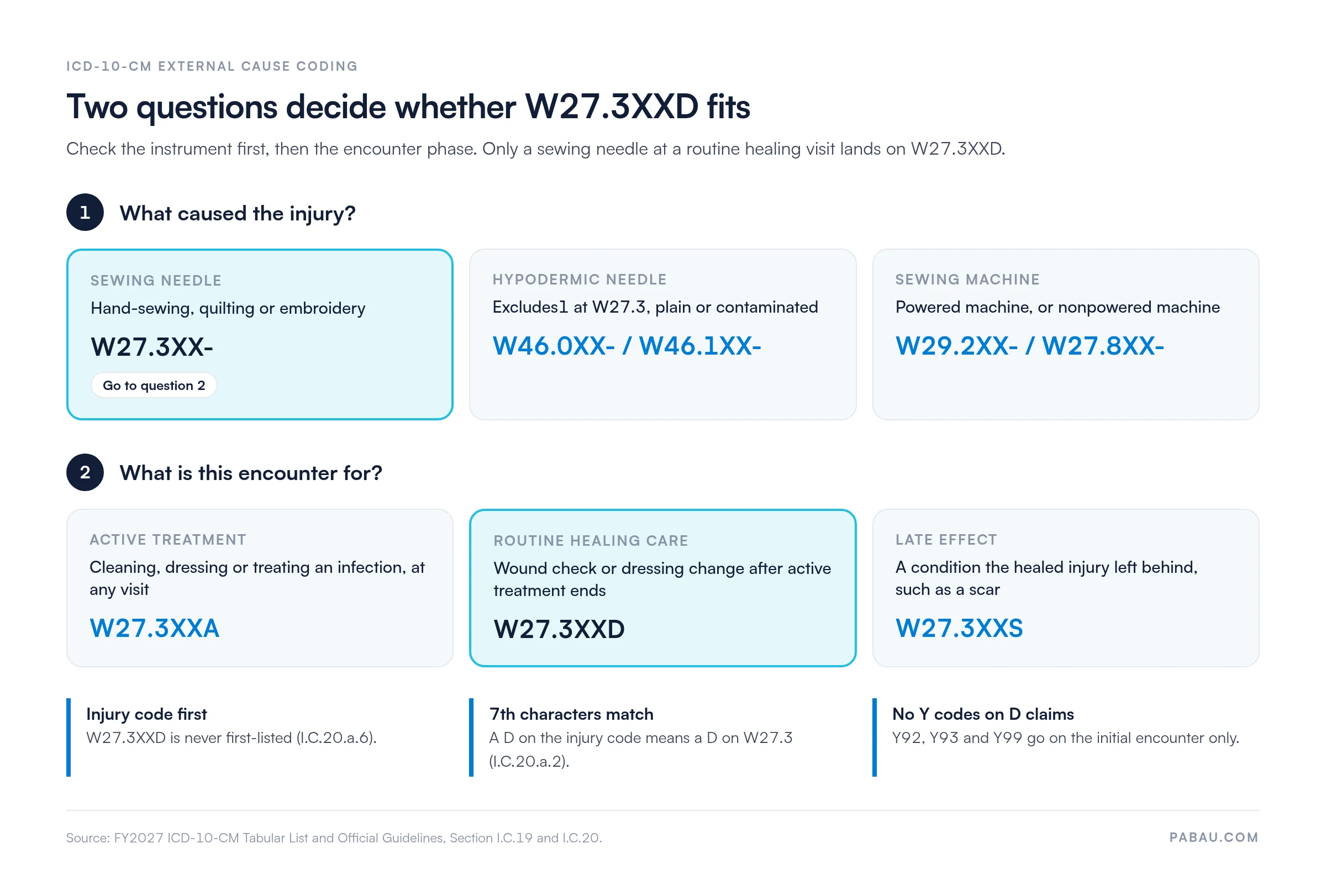
Here is how each phase maps to a character.
S is only for a condition the injury left behind. A wound that is still being dressed is not a sequela, so it never takes W27.3XXS.
An external cause code can never be the principal or first-listed diagnosis, under guideline I.C.20.a.6. The injury code goes first, and W27.3XXD follows it.
Guideline I.C.20.a.2 says the external cause 7th character should match the 7th character of the injury code. A D on the injury code means a D on W27.3.
Take a patient who returns for a dressing change on a punctured right index finger. The claim lists the codes like this.
Place (Y92), activity (Y93) and external cause status (Y99) codes are reported once, at the initial encounter. Do not repeat Y93.D2 (activity, sewing) or Y99.0 on a W27.3XXD claim.
Most confusion comes from neighboring needle and tool codes. Check the instrument first, then whether it was powered, before you pick a category.
W27.4XXD deserves a second look. It is one digit away and describes kitchen utensils, not needles. W29 also carries an Excludes1 note for nonpowered hand tools (W27.-), so W29 and W27 codes are not reported together.
A follow-up claim for a sewing needle injury takes the same path as any outpatient injury claim. Here is where W27.3XXD enters it.
Steps two and three need the most care. A scrubber passes any valid code, so a wrong but valid 7th character can still reach the payer.
Payer acceptance of ICD-10 code W27.3XXD depends on what the clinical note contains. Four elements should be clear to an auditor before submitting a clean claim.
Claims carrying ICD-10 code W27.3XXD fail for a predictable set of reasons. Each one below traces back to a tabular note or an official guideline, and each belongs in your denial management workflows.
Generating the claim from the invoice, as claims management software does, removes retyping errors such as dropped placeholders. The coding choices above still need a coder to review them.
W27.3XXD is a valid billable ICD-10-CM code for FY2027, which runs October 1, 2026 through September 30, 2027. It appears in the FY2027 ICD-10-CM code files, and the FY2027 addenda made no change to it.
There is no national requirement to report external cause codes. Reporting is mandatory only under a state-based mandate or a specific payer’s rules, so check your state requirements and payer contracts.
The code carries no payment of its own. Reimbursement attaches to the injury code and the visit or procedure codes on the same claim.
W27.3XXD comes up in tailoring, upholstery, textile and costume work, and in hobby sewing at home. The occupational detail is captured once, at the initial encounter, not on the D claim.
Y99.0, civilian activity done for income or pay, goes on the initial encounter only. Proper medical billing compliance also means checking what each workers’ compensation carrier expects on follow-up claims.
A needlestick from a syringe or other hypodermic needle codes to W46.0- or W46.1-, not W27.3. Where exposure to blood is documented, Z77.21 records contact with potentially hazardous body fluids. Review the complete medical billing process for occupational injury claims before you combine these codes.
These sources confirm current code status and guideline citations for W27.3XXD claims. To look up neighboring external cause codes, start from our ICD-10-CM code library.
Follow-up injury claims go wrong when the injury code and the cause code are keyed separately. The two fall out of step, and the claim goes out with mismatched 7th characters or a neighboring code.
Pabau, the billing and practice software we build, generates claims from the invoices you already raise. Nobody retypes patient details, and the ICD-10-CM code lookup library lets the coder check W27.3XXD against W46 first.
US claims go through Pabau’s Claim.MD integration. Eligibility checks and claim status sit alongside them, with remittance advice returned to the claims dashboard.
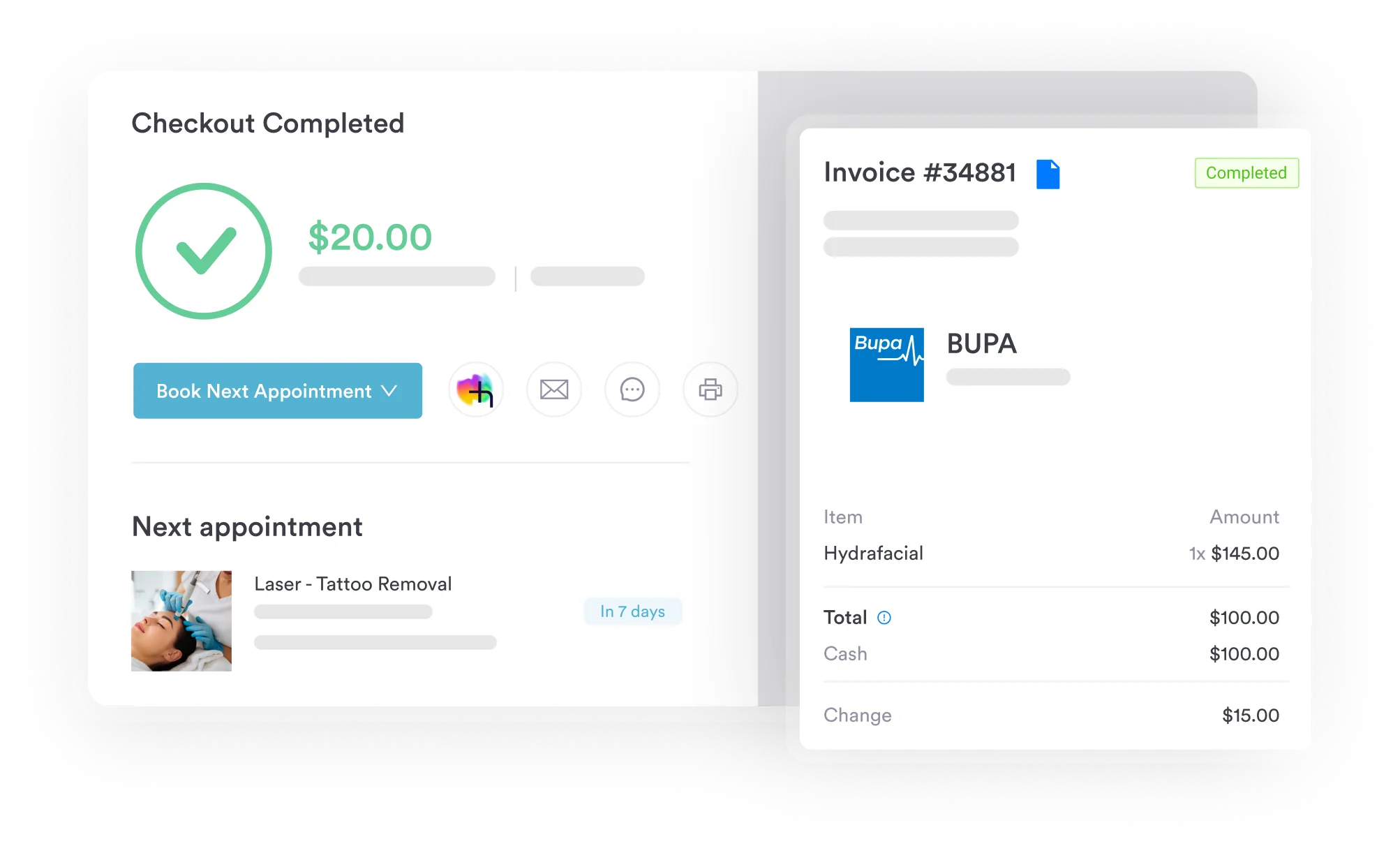
The result is a follow-up claim that matches the visit it bills, with fewer touchpoints between the dressing change and the payer.

Pabau generates claims from the invoices you already raise. US claims go through Claim.MD, with remittance advice returned to the claims dashboard.

W27.3XXD rewards a careful note more than a clever coder. When the record names a sewing needle and a healing-phase visit, the code follows almost on its own.
So build two habits. Ask providers to name the instrument every time, and check that both 7th characters match before the claim leaves. Those two checks prevent three of the five denials above.
To see where a clearinghouse fits this flow, read our Claim.MD clearinghouse guide. Book a demo to see how Pabau turns the invoice for a follow-up visit into a claim.

Need to understand how clean claims are built? Clean claim requirements and common errors covers the structural elements every ICD-10-coded claim must satisfy before submission.
Working through a denial on an ICD-10 claim? Denial management in healthcare explains how to build an appeals workflow that reduces write-offs on rejected external cause code claims.
Want to understand the full billing compliance picture? Medical billing compliance covers HIPAA coding mandates, payer audit triggers, and documentation standards that apply to every ICD-10-CM claim.
Yes. Category W27 sits in the accidents section of Chapter 20 (V00-X58), so it reports unintentional contact. A needle injury from assault or self-harm codes to X92-Y09 or X71-X83 instead.
Yes, at each encounter where the injury is still being cared for. Guideline I.C.20.a.2 assigns the external cause code for the length of treatment, with a 7th character that matches the injury code.
A syringe needlestick codes to W46.0- for a hypodermic needle or W46.1- for a contaminated one. W27.3 covers sewing needles only. Add Z77.21 where exposure to body fluids is documented.
No. Category W27 is on the list of codes exempt from present on admission (POA) reporting. On an inpatient claim, leave the POA field blank for W27.3XXD.
Yes. W27.3XXD is a valid billable code for FY2027, which runs October 1, 2026 through September 30, 2027. The FY2027 addenda made no change to it.