ICD-10 Code T87.81: Dehiscence of amputation stump
ICD-10 Code T87.81: clinical definition and scope of dehiscence ICD-10 Code T87....

Last Updated: Oct 7, 2026
Billable Code Specific Code
W16.722D is the billable ICD-10-CM code for jumping or diving from boat striking bottom causing other injury, subsequent encounter. It records how an injury such as a vertebral fracture or head injury happened, at follow-up visits after active treatment ends.
Coders most often confuse it with W16.721D, the same boat mechanism causing drowning and submersion, or with W16.722A, the initial encounter. A fall from a boat is coded as a watercraft accident instead.
Let Pabau's smart automation suggest the right codes, reduce claim denials, and keep your practice compliant—effortlessly.
Automate repetitive tasks and focus on what matters most—your patients.
Reduce coding errors and ensure compliance with the latest regulations.
Clean claims, fewer denials, and faster reimbursements.
Powerful insights and reporting to help your practice thrive.
HIPAA compliant SOC 2 certified GDPR-compliant Trusted by 4,000+ clinics worldwide

W16.722D records a jump or dive from a boat in which the person struck the bottom and sustained an injury other than drowning or submersion.
The 7th character D marks a subsequent encounter, used once active treatment is complete and the patient is in routine healing or recovery care.
W16.722D is an external cause code, so it follows the injury code it explains and is never the principal or first-listed diagnosis.
A fall from a boat is a watercraft accident coded from V90-V94, so the chart must say the patient jumped or dove before W16.722D applies.
ICD-10 Code W16.722D is a billable, specific ICD-10-CM external cause code. Its official descriptor is Jumping or diving from boat striking bottom causing other injury, subsequent encounter. It explains how an injury happened at a follow-up visit, while a separate code describes the injury itself.
The CDC/NCHS ICD-10-CM coding tool lists W16.722D as a valid, billable code. Four facts must all be documented before you assign it:
Following the hierarchy down from the chapter keeps you from landing on a neighboring subcategory when you search the tabular list.
Three branch points sit between W16 and this code. W16.7 covers a jump or dive from a boat. W16.6 covers a jump or dive into a natural body of water from somewhere else, such as the shore or a dock. Under W16.7, W16.71 is striking the water surface and W16.72 is striking the bottom.
The last split decides the outcome. W16.721 is the same boat mechanism causing drowning and submersion, and W16.722 covers any other injury. There is no W16.729 subcategory, so a code such as W16.729D is invalid and will be rejected.
The 7th character D means the patient is receiving routine care during healing or recovery after active treatment is complete. ICD-10-CM Official Guidelines Section I.C.19.a sets out how the A, D and S characters apply. Chapter 20 external cause codes follow the same encounter logic.
Subsequent encounter refers to the stage of care, not to how many times the patient has seen you. A patient referred to a spine clinic for follow-up after surgical fixation is at a subsequent encounter, even on their first visit to that clinic.
Fracture codes carry extra 7th characters, such as G for delayed healing and K for nonunion. W16.722 offers only A, D and S, so every follow-up fracture encounter takes W16.722D, whatever the healing status on the fracture code.
A patient dove off a pontoon boat into a shallow lake, struck the bottom and fractured a cervical vertebra. The ED visit and surgical fixation were coded with the S12 fracture code ending in A, plus W16.722A. Six weeks later, the patient sees an orthopedic surgeon to check fracture healing.
That follow-up visit is coded with the S12 fracture code ending in D, followed by W16.722D as the external cause. W16.722D does not apply in these situations:
W16.722D captures a narrow set of circumstances. Confirm each element below in the documentation before you assign it.
The W16 category carries four Excludes1 notes and one Excludes2 note. Each one sends a related event to a different code range:
W16.7 adds its own Excludes1 note, which sends a fall from a boat into water to the watercraft accident codes. That note is why the verb in the chart matters so much for this code.
Each sibling code differs from W16.722D by one element: the encounter, the outcome, the impact point or how the patient entered the water. The table lists the codes you are most likely to reach for by mistake. The AAPC ICD-10-CM code range is useful for browsing the wider block.
W16.722D versus V94.0XXD is the pair to watch. Both describe a person leaving a boat and hitting the bottom, and only the documented verb separates them. “Jumped” or “dove” points to W16.722D, while “fell” or “was thrown” points to the watercraft accident code.
Provider documentation must support every element of the descriptor. A note that says “history of boating injury” is not enough. For medical billing compliance, the clinical note should record each of the following.
A clean claim pairs W16.722D with at least one injury code that carries the same encounter stage. W16.722D on its own gives the payer no diagnosis to pay against.
Pull the original ED or operative note before you code the first follow-up visit. It usually records whether the patient jumped or fell and where they started from, details that outpatient follow-up notes often leave out.
Section I.C.20 of the ICD-10-CM Official Guidelines states that an external cause code is never the principal or first-listed diagnosis. Knowing the medical billing fundamentals means placing W16.722D after the codes for the conditions treated.
Sequence the claim in this order:
Place of occurrence (Y92), activity (Y93) and external cause status (Y99) codes are reported only at the initial encounter. Leave them off the W16.722D follow-up claim, even if they appeared on the claim for the ED visit.
There is no national requirement to report external cause codes. Some state mandates and individual payers do require them, and the CMS ICD-10 coding guidance treats them as data about how an injury happened. They do not establish medical necessity on their own.
Medicare and most commercial payers treat external cause codes like W16.722D as supplementary information. The claim needs a covered injury code in the principal position, or it will be denied. Practices that send electronic claims via Claim.MD can check coverage before the visit and see which claims come back denied.
Key payer considerations:
Most rejections on claims carrying ICD-10 Code W16.722D trace back to one of six errors. A denial management workflow that reviews these before submission prevents most of them.
Coding a W16.722D follow-up usually means going back to the ED note to confirm the patient jumped from a boat and what the injury was. Once the claim goes out, many practices have little view of whether it was accepted until payment arrives or fails to.
Pabau, the practice management platform we build, keeps patient records, insurer details and claims together. Its claims management software runs validation checks in the background, catching missing details such as membership numbers or authorization codes before submission. US practices send electronic CMS-1500 claims through the Claim.MD integration, which also runs real-time eligibility checks.
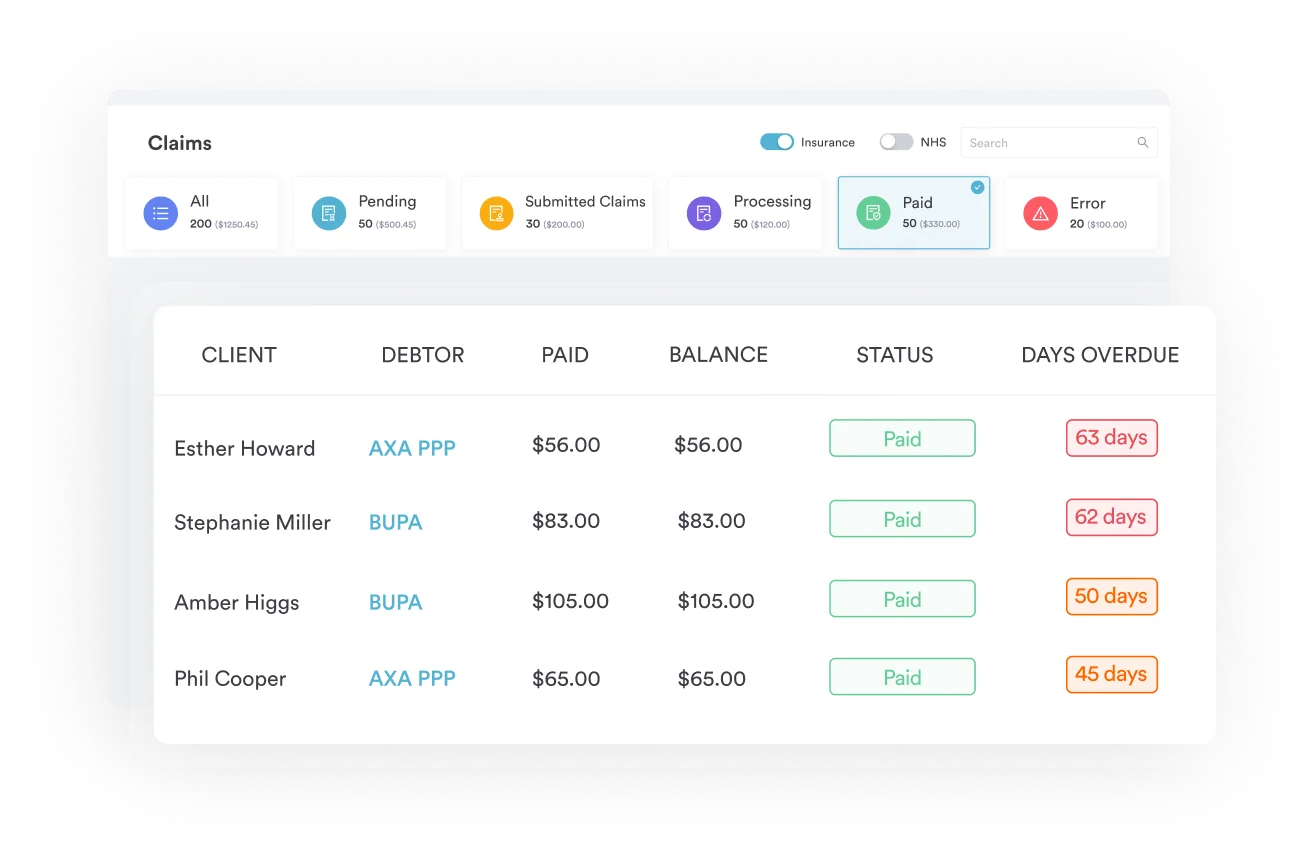
Every claim sits in one view as pending, submitted, processing, paid or error, and denied claims are flagged for rework. Remittance advice posts back against the claims it settles, so your team can see which follow-up injury claims were paid without chasing payers.

Pabau checks claims for missing details before submission, tracks each one from pending to paid and flags denied claims for rework. See how it fits your billing workflow.

W16.722D belongs on a follow-up claim only when the chart proves four facts. The patient jumped or dove from a boat, struck the bottom, sustained an injury other than drowning and is past active treatment. When one of those facts is missing, a sibling code or a watercraft accident code describes the event more accurately.
The habit worth building is to read the initial encounter note before coding the first follow-up. It settles jump versus fall and names the injury, so the external cause stays consistent across every visit in the episode of care. Book a demo to see how Pabau keeps follow-up injury claims moving from submission to payment.

Need to understand how clearinghouse validation reduces ICD-10 denials? Claim.MD clearinghouse guide explains how pre-submission edits catch claim errors before they reach the payer.
Looking to tighten your revenue cycle around external cause codes? Revenue cycle management fundamentals covers how external cause and injury codes fit into the broader billing workflow.
Want a reference on denial reason codes when W16.722D claims reject? Denial codes in medical billing provides a structured guide to CARC codes and how to respond to each rejection type.
ICD-10 Code W16.722D is the billable external cause code for a subsequent encounter after a jump or dive from a boat. The person struck the bottom and sustained an injury other than drowning or submersion. It is used at follow-up visits after active treatment for that injury has ended.
Both codes describe a jump or dive from a boat that strikes the bottom, at a subsequent encounter. W16.721D applies when the outcome is drowning and submersion. W16.722D applies when the outcome is another injury, such as a fracture, spinal cord injury or head injury.
W16.722A is used while the patient receives active treatment for the injury, such as the ED visit or surgery. W16.722D is used for routine follow-up care during healing or recovery. The mechanism and outcome are identical, and only the stage of care differs.
A fall from a boat is a watercraft accident, not W16.7. If the patient fell overboard and hit the bottom, the follow-up visit is coded V94.0XXD. Its descriptor is hitting object or bottom of body of water due to fall from watercraft, subsequent encounter.
W16.722D always follows the injury code it explains. The principal diagnosis is the injury being followed. Examples include a cervical vertebra fracture (S12.-), a cervical spinal cord injury (S14.1-) or an intracranial injury (S06.-). That injury code carries its own subsequent encounter character.
No. Place of occurrence (Y92), activity (Y93) and external cause status (Y99) codes are reported only once, at the initial encounter. A follow-up claim with W16.722D leaves them off, even when they appeared on the claim for the first visit.