ICD-10 Code S00.04XD: External constriction of part of scalp
ICD-10 code S00.04XD: Definition and billable status ICD-10 Code S00.04XD is a v...

Last Updated: Oct 7, 2026
Billable Code Specific Code
V93.86XD is the billable ICD-10-CM code for other injury due to other accident on board (nonpowered) inflatable craft, subsequent encounter. It records how an injury happened on a raft or similar unpowered inflatable when the patient returns for continued active treatment.
The code sits in Chapter 20 (External causes of morbidity, V00-Y99) under category V93. That category covers accidents on board a watercraft where the craft itself had no accident. V93.86XD is never the first-listed diagnosis, so the code for the injury being treated always comes first.
Let Pabau's smart automation suggest the right codes, reduce claim denials, and keep your practice compliant—effortlessly.
Automate repetitive tasks and focus on what matters most—your patients.
Reduce coding errors and ensure compliance with the latest regulations.
Clean claims, fewer denials, and faster reimbursements.
Powerful insights and reporting to help your practice thrive.
HIPAA compliant SOC 2 certified GDPR-compliant Trusted by 4,000+ clinics worldwide

V93.86XD records how an injury happened on board a nonpowered inflatable craft, such as a raft, when no other V93 code fits.
It applies only when the craft itself had no accident. Capsizing, sinking or collision moves the case to V90 or V91 codes.
The code is never the first-listed diagnosis. Sequence the injury code first, then add V93.86XD.
The 7th character D means active treatment is still under way, and it should match the 7th character on the injury code.
Place of occurrence and activity codes belong on the initial encounter only, so leave Y92 and Y93 off a V93.86XD claim.
ICD-10 Code V93.86XD is the billable ICD-10-CM code for “other injury due to other accident on board (nonpowered) inflatable craft, subsequent encounter.”
It describes how an injury happened on an unpowered inflatable boat, such as a raft, when the craft itself had no accident. The official short descriptor is “Oth injury due to oth accident on board inflatbl crft, subs.”
The code is valid for FY 2027 claims, according to the CDC/NCHS ICD-10-CM browser tool. It is an external cause code, so it explains the circumstances of an injury rather than the injury itself.
The 7th character D means the patient is still receiving active treatment for the injury, at a visit after the initial one. A suture removal, a fracture follow-up with routine healing or a wound check all count. The deciding factor is whether the provider is still managing the injury itself.
The FY 2027 ICD-10-CM Official Guidelines ask coders to assign the external cause code at every encounter where the injury is treated. They also state that its 7th character should match the 7th character on the injury code for that encounter.
V93.86XD covers an injury sustained on board a nonpowered inflatable craft that no more specific V93 code describes. The word “other” appears twice in the descriptor for a reason. The injury type is unspecified, and so is the accident behind it.
Three conditions must all hold before the code applies:
Typical events include a rafter struck by another passenger’s paddle or a hand caught in a rope on board. A wrist strained while paddling in rough water can fit as well. The Tabular List also includes accidental poisoning by gases or fumes on watercraft under V93.8.
In the Index to External Causes, the path is Accident, on board watercraft, unpowered craft, inflatable. The same index sends canoes and kayaks to V93.85, so the craft named in the note decides the code. The four checks below show where each answer sends the claim.
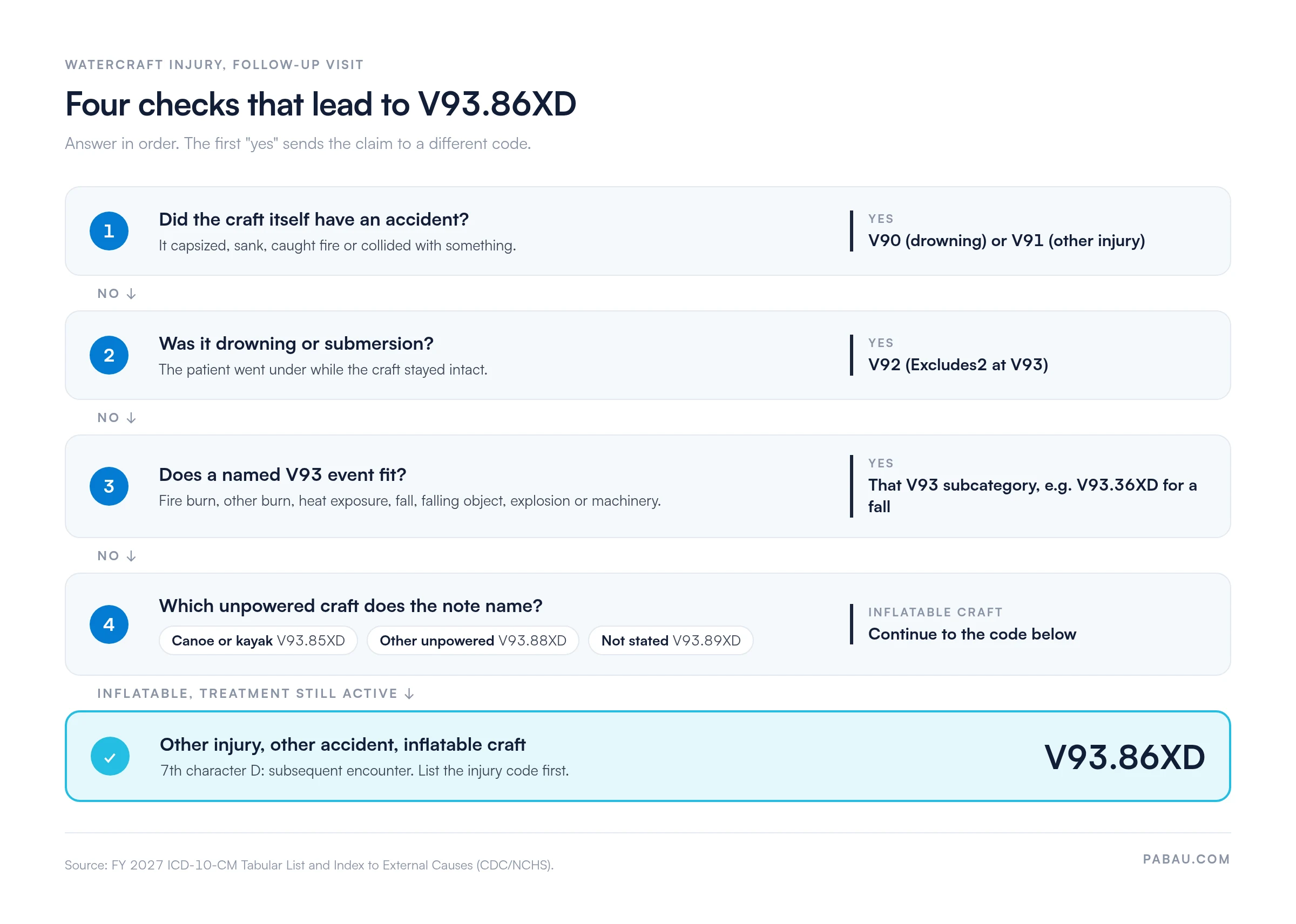
The notes below sit at category V93 in the FY 2027 ICD-10-CM Tabular List, so they apply to V93.86XD. Subcategories V93.8 and V93.86 add no excludes notes of their own.
An Excludes1 note means the two codes are never reported together. An Excludes2 note means the excluded condition is not part of V93, but both codes may appear on one claim when the patient has both.
Coding errors with V93.86XD usually come from choosing the wrong watercraft type or the wrong kind of accident. The table below lists the neighbors that get swapped most often, with descriptors taken from the FY 2027 ICD-10-CM code file.
External cause codes in Chapter 20 can never be the first-listed diagnosis, according to the official guidelines. V93.86XD explains how and where the injury happened, while the injury code explains what it is.
Follow this order on every claim that includes V93.86XD:
Check that the 7th character on V93.86XD matches the 7th character on the injury code for the same visit. A follow-up claim pairing an A injury code with a D external cause code contradicts itself, and it invites a payer query.
The pairing always depends on the injury the provider documented, not on the watercraft. The examples below show how that works on follow-up visits.
A subsequent encounter claim needs a record that shows active treatment is continuing. Sound medical billing workflows start with that documentation, before anyone builds the claim.
At minimum, the record for a V93.86XD visit should contain:
If the note shows a healed injury and no active care, the D character may not hold up. Review whether a sequela code fits the visit better.
V93.86XD does not drive payment on its own. It describes the circumstances of the injury, while the first-listed injury code supports medical necessity.
Reporting rules differ by payer and by state:
Where no mandate applies, the guidelines still encourage voluntary reporting. The data feeds injury research and prevention work, including water-sports safety.
Problems on V93.86XD claims follow predictable patterns. Good denial management workflows catch them before submission. The table below maps each scenario to its fix.
Knowing the denial codes payers return helps practices correct these errors on appeal and prevent them on future claims.
Audit a sample of claims carrying V93.86XD, or any Chapter 20 code, each month. Look for external cause codes in the first position and mismatched 7th characters, and fix the template or habit that caused them.
A follow-up visit for a rafting injury often starts with a note in one system and a claim in another. Codes get retyped, and the 7th character from the first visit tends to travel with them.
Pabau, the practice management platform we build, keeps the appointment, the clinical note and the invoice on one patient record. Its claims software for practices builds the claim from that visit. US billing teams can submit claims electronically and check eligibility through Pabau’s Claim.MD integration.
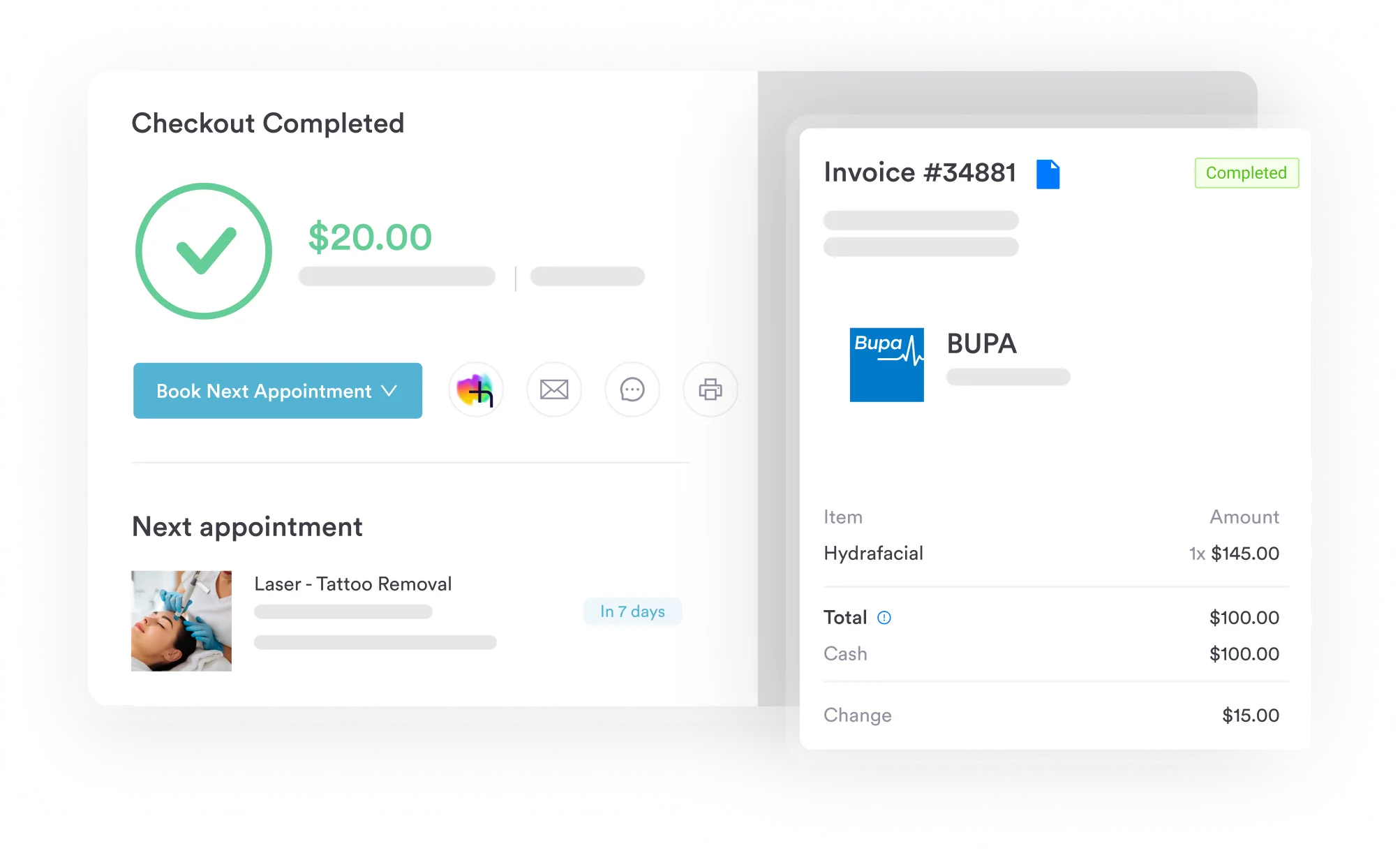
Your coders work from the same record the provider wrote, so the claim reflects the follow-up visit that took place. That matters for V93.86XD, because the 7th character D only holds when the note shows active treatment. When the injury code, the craft and the visit date all sit in one record, a coder can check them before the claim goes out.

Pabau keeps notes, appointments and claims together, so follow-up visits are billed from the record the provider wrote.

V93.86XD is a narrow code. Reach for it only when three facts hold. The patient was on an unpowered inflatable craft, the craft had no accident, and no other V93 code describes the event. Once those three checks pass, the claim rests on sequencing, a matching 7th character and a note that shows active treatment.
To see how Pabau keeps clinical notes and clean claims on the same record, book a demo.

Need to understand how claim denials are tracked and appealed? Denial management in healthcare covers the end-to-end process for reducing rejection rates across ICD-10 claims.
Want to see how the Claim.MD integration works in practice? Pabau’s Claim.MD clearinghouse guide explains eligibility checks, remittances and electronic claim submission for US payers.
Looking for the bigger picture on billing? Revenue cycle management explained walks through the full claim lifecycle from coding to payment posting.
V93.86XD is the billable ICD-10-CM code for other injury due to other accident on board a (nonpowered) inflatable craft, subsequent encounter. It explains how an injury happened on a raft or similar unpowered inflatable when the craft itself had no accident. It is reported at follow-up visits where the injury is still being treated.
Yes, V93.86XD is a billable ICD-10-CM code, valid for FY 2027. It is an external cause code, so it can never be the first-listed diagnosis. List the code for the injury being treated first, then add V93.86XD.
V93.86XA is for the initial encounter, when the injury first receives active treatment. V93.86XD is for later visits where active treatment of the same injury continues. Once the injury has healed and a late effect is treated, V93.86XS applies instead.
No, V93.86XD does not cover burns. Burns on board a watercraft are coded from V93.0- for a localized fire or V93.1- for other burns. A burn caused by the craft itself catching fire is coded from V91.0- instead.
No. The official guidelines report place of occurrence (Y92), activity (Y93) and external cause status (Y99) codes only once, at the initial encounter. A subsequent encounter claim carries the injury code and V93.86XD without them.
The first-listed code is always the injury the provider is treating, with a subsequent encounter 7th character. Examples include S02.2XXD for a healing nasal fracture or S61.411D for a right-hand laceration. V93.86XD then follows as the external cause code.