

ICD-10 code S61.201A: Open wound of left index finger without nail damage
ICD-10 code S61.201A covers a left index finger wound of unstated type ICD-10 co...

Last Updated: Oct 16, 2026
Billable Code Specific Code
V91.02XD is the billable ICD-10-CM code for burn due to fishing boat on fire, subsequent encounter. It is an external cause code, so it records how the burn happened while a burn T-code records the injury itself.
The code sits in category V91 within the V90-V94 water transport accidents block. It is always sequenced after the burn T-code and never listed first. The 7th character D applies to every follow-up visit once initial active treatment, coded V91.02XA, is complete.
Let Pabau's smart automation suggest the right codes, reduce claim denials, and keep your practice compliant—effortlessly.
Automate repetitive tasks and focus on what matters most—your patients.
Reduce coding errors and ensure compliance with the latest regulations.
Clean claims, fewer denials, and faster reimbursements.
Powerful insights and reporting to help your practice thrive.
HIPAA compliant SOC 2 certified GDPR-compliant Trusted by 4,000+ clinics worldwide

V91.02XD is a billable ICD-10-CM external cause code for burns from a fishing boat fire, reported at a subsequent (follow-up) encounter.
The 7th character D separates follow-up visits from the initial encounter (A) and sequela (S). Keeping XA after the first active-treatment visit is the most common denial trigger.
V91.02XD is never the first-listed diagnosis. A burn T-code for the degree and body site must precede it on every claim.
Practice management software like Pabau checks that payer details, such as membership numbers and authorization codes, are in place before each claim is sent.
ICD-10 code V91.02XD is the billable external cause code for a burn caused by a fishing boat on fire, reported at a subsequent encounter. It sits in Chapter 20 of ICD-10-CM and always follows a burn T-code on the claim. Per the CDC/NCHS ICD-10-CM web tool, the code is valid and billable for the current fiscal year. The table below sums up the facts to confirm before you submit a claim.
V91.02XD covers a patient burned when a fishing boat caught fire, seen at a follow-up visit after initial active treatment. The code captures both the vessel type and the encounter phase. A fishing boat is coded apart from a merchant ship, a passenger ship, or a sailboat.
Three elements must all be true for V91.02XD to apply:
V91.02XD is an external cause code. It describes how and where the injury happened, while the accompanying T-code records the burn itself by degree (first, second, third) and body site. That T-code is listed first on the claim.
The 7th character is mandatory for all V91.02 codes and changes what the code reports. The CMS ICD-10-CM official guidelines allow three options. Choosing the wrong one after the first visit is the top coding error in this code family. The character reflects the phase of care, not the severity of the injury.
The diagram below follows one fishing boat burn through all three phases and shows the claim order at a follow-up visit.
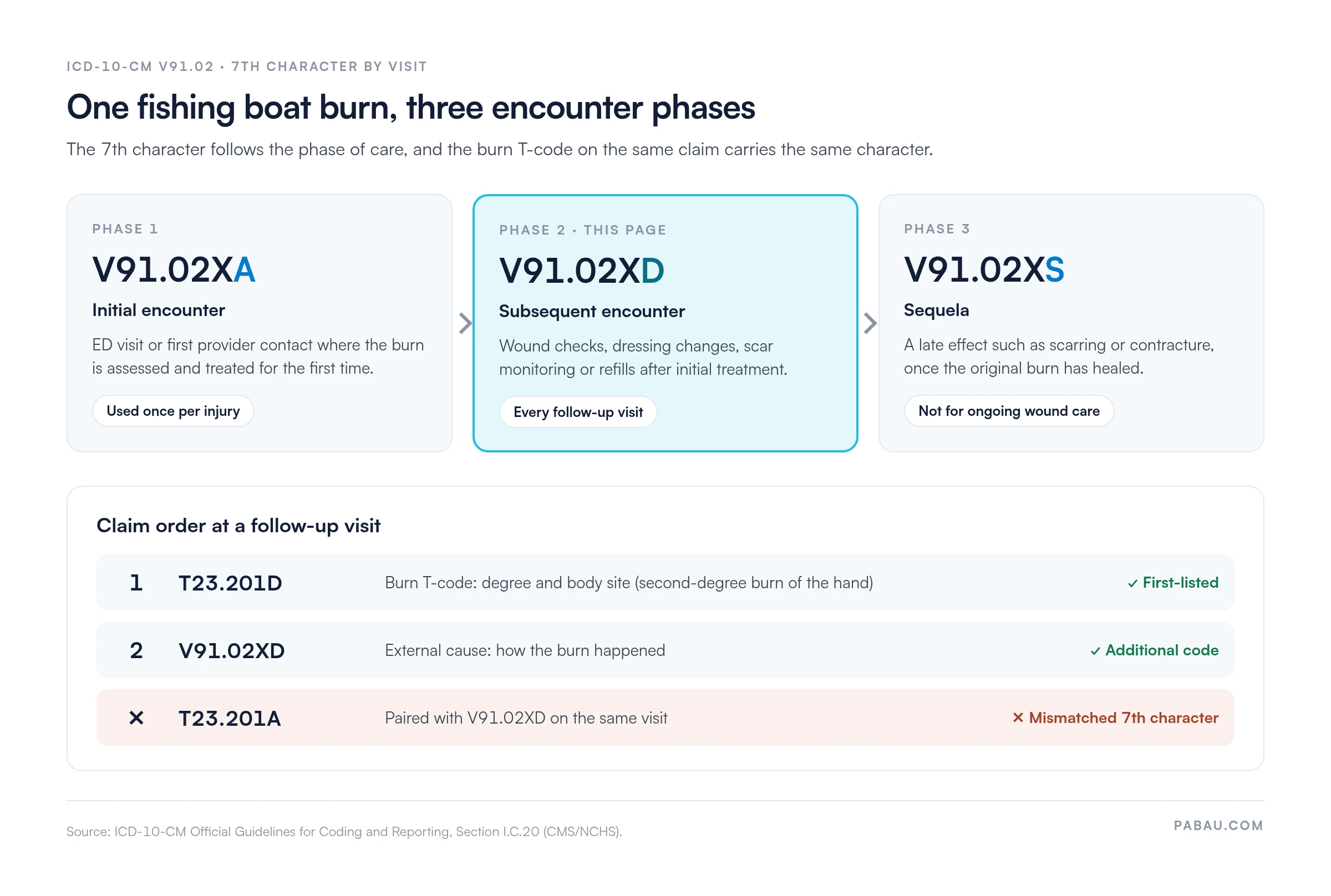
V91.02XA applies at the first encounter where a provider actively treats the burn. V91.02XD applies at every visit after that, for as long as the patient receives routine care for the same injury.
The practical test is documentation-based: If the clinical note reflects active initial evaluation and management of a new burn, XA is correct. If the note shows wound checks, dressing changes, scar monitoring, or medication refills for an established injury, XD is correct. A single injury can generate many XD claims across weeks or months of follow-up. It generates only one XA claim.
V91.02XD is classified under Chapter 20 of ICD-10-CM (External Causes of Morbidity), so it can never stand alone as a diagnosis. Section I.C.20 of the ICD-10-CM Official Guidelines governs every external cause code. It states that codes from this chapter are never the principal or first-listed diagnosis. The injury code describes what was injured, and the external cause code describes how and why.
The same rule holds for burns from other mechanisms. X05.XXXD reports a nightwear burn at a subsequent encounter, and it also follows the T-code on the claim.
Correct sequencing on a claim containing V91.02XD follows this order:
The T-code depends on the burn degree and the specific body site involved. The table below lists the burn T-code categories most often paired with V91.02XD on a subsequent-encounter claim. Each T-code must also carry the 7th character D to match the encounter phase. AAPC’s ICD-10-CM code lookup helps you confirm the correct T-code subdivision by body site and degree.
Category V91 and its V91.0 subcategory carry exclusion notes that decide whether V91.02XD is the right code. Reading them correctly prevents both over-coding and under-coding on complex trauma cases.
V91.02XD sits in V91.0, the subcategory for burns due to a watercraft on fire. The table below lists every V91.0 code at the subsequent encounter, so you can confirm the documented watercraft matches the code.
When documentation says “commercial fishing vessel” rather than “merchant ship,” V91.02XD remains appropriate. When the vessel type is ambiguous, V91.09XD (unspecified watercraft) is the fallback. Never assume the vessel type from context alone.
Medicare, Medicaid, and most commercial payers do not require prior authorization for external cause codes. They do expect documentation that supports the code’s clinical logic, and five points carry most of the weight.
Watercraft burn claims are a niche category, but their denials are predictable. Most trace back to one of the five causes below. Tracking the denial codes behind rejections on V91 claims over a quarter shows which cause drives them at your practice.
Run a quarterly audit of all V91.02 claims across all 7th characters. Flag any claim where XA appears more than once for the same patient and injury date. That pattern usually points to a copy-paste error in the EHR, which repeats across follow-up visits and builds a denial backlog. Correct the template at source rather than fixing individual claims.
V91.02XD has no direct one-to-one ICD-9-CM equivalent. The ICD-9-CM E-code system covered external causes of injury, but it lacked vessel-type detail and encounter-phase 7th characters. Per ResDAC’s ICD coding resources for Medicare files, General Equivalence Mappings (GEMs) for external cause codes are approximate. They should not be used for prospective coding, so the crosswalk below is for historical reference and payer audit response only.
If a payer audit references legacy ICD-9 data, point out that the CMS GEMs documentation flags this conversion as approximate.
A follow-up burn claim can pass every coding check and still bounce because a membership number or authorization code is missing. That rejection lands weeks later, after several more XD visits have gone out the same way.
Practice management software like Pabau includes claims management with validation checks. They run in the background each time you send a claim and confirm the payer details insurers need are in place. Sequencing the burn T-code first and choosing the 7th character stay with your coder.
In the US, Pabau connects to the Claim.MD clearinghouse. From there you submit claims electronically, run real-time eligibility checks, track claim status, and post electronic remittance advice (ERA). Each claim shows as pending, submitted, processing, paid, or error, so a rejected V91.02XD claim is easy to spot and resubmit.
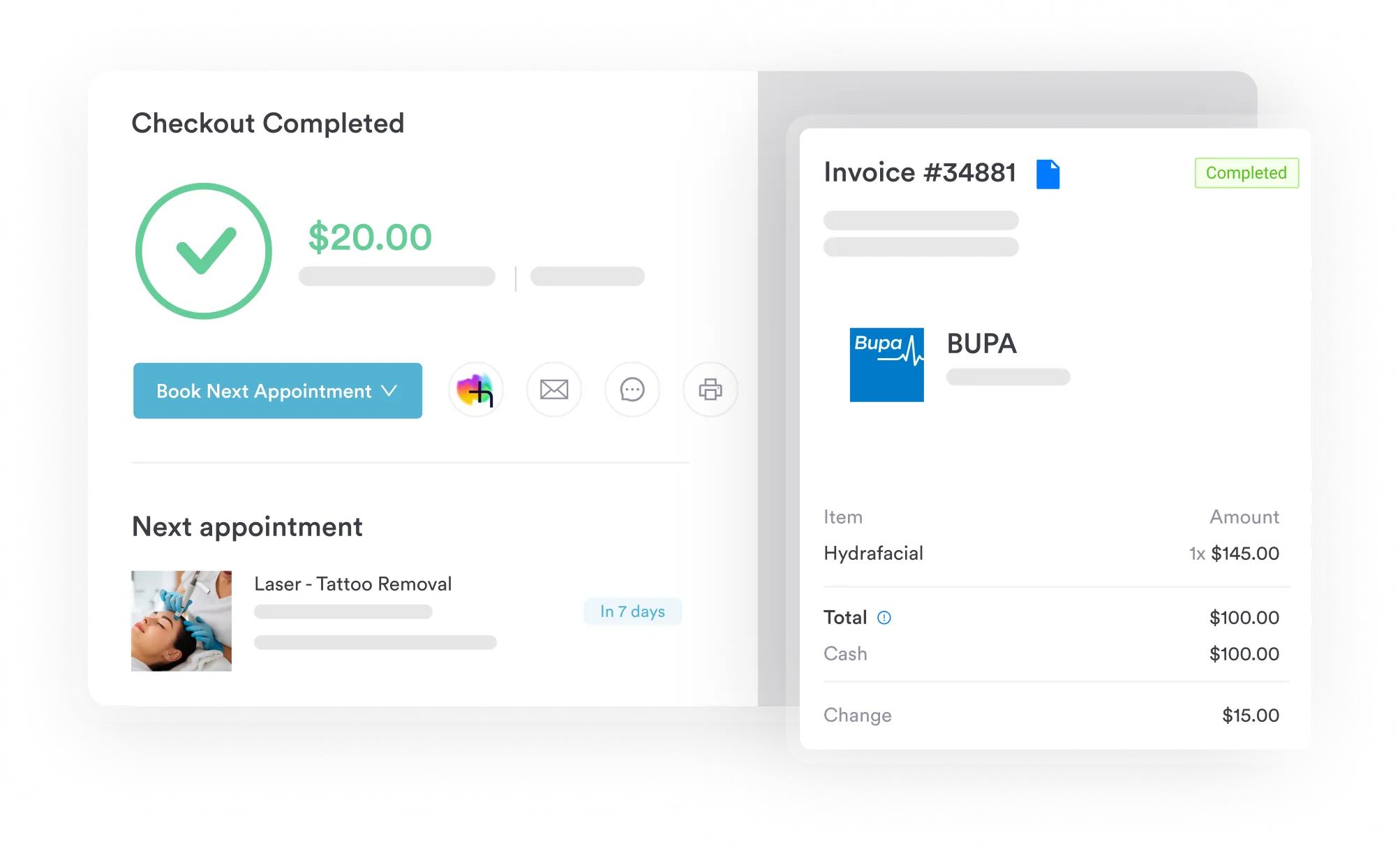

Pabau checks membership numbers and authorization codes before each claim is sent. It then tracks every V91.02XD claim through Claim.MD from submission to payment.

V91.02XD claims fail for a short, predictable list of reasons. Build three checks into every follow-up visit: The burn T-code goes first, both codes carry D, and the note names the fishing boat fire.
The trade-off is a few seconds of review per claim against a denial that can repeat across weeks of wound care visits. Fix the EHR template once, and the same error stops copying forward.
Book a demo to see how Pabau checks payer details before each V91.02XD claim leaves your practice and tracks it until it’s paid.

Need to understand how denials on injury codes are tracked? Denial management in healthcare walks through how to categorize, track, and reduce coding-related rejections across claim types.
Want a reference for common medical billing denial codes? Denial codes in medical billing covers the CO, OA, and PR code series and how each maps to a corrective action.
Looking for guidance on keeping claims compliant across code sets? Medical billing compliance covers documentation standards, audit triggers, and the payer rules that apply across ICD-10-CM coding.
Want fewer claims bounced back for missing details? Clean claims in medical billing explains what payers check before they accept a submission.
Did the patient also go into the water? ICD-10 code V90.22XS covers the submersion side of a burning fishing boat at the sequela stage.
ICD-10 code V91.02XD is the billable external cause code for a burn sustained when a fishing boat caught fire, reported at a subsequent encounter. That means follow-up care after initial active treatment. It belongs to ICD-10-CM Chapter 20 and is always listed after a burn T-code on the claim.
Yes, V91.02XD is a valid and billable ICD-10-CM code for fiscal years 2025 and 2026. It cannot be the first-listed diagnosis, though. A burn T-code must precede it on the claim.
V91.02XA is for the initial encounter, the first visit where the burn is actively treated. V91.02XD is for subsequent encounters after initial treatment, such as wound care follow-ups and dressing changes. Using XA on repeat follow-up visits is the most common denial trigger in this code family.
Switch to 7th character D once the first active treatment visit is documented. If the note shows a wound check, dressing change, scar monitoring, or medication refill for an established injury, D is correct. A single burn generates only one XA claim but may generate many XD claims across weeks of follow-up.
The primary diagnosis must be a burn T-code that reflects the burn’s degree (first, second, or third) and body site. For example, T23.201D reports a second-degree burn of the right hand at a subsequent encounter. The T-code must also carry the 7th character D to match V91.02XD.
The top causes are listing V91.02XD first, keeping XA after initial treatment, and submitting without a paired T-code. Mismatched 7th characters between the T-code and the V91.02 code, and thin documentation of the fire, account for most of the rest.



