ICD-10 code V66.3XXD: Heavy transport vehicle occupant
ICD-10 code V66.3XXD: Full description and official classification ICD-10 code V...

Last Updated: Oct 30, 2026
Billable Code Specific Code
V91.84XS is the billable ICD-10-CM code for other injury due to other accident to sailboat, sequela. It records the cause of a late effect, such as a scar or post-traumatic arthritis, from a sailboat accident injury other than drowning.
The code sits in subcategory V91.84, alongside V91.84XA for the initial encounter and V91.84XD for subsequent encounters. As an external cause code, it is always secondary and never the principal diagnosis.
Let Pabau's smart automation suggest the right codes, reduce claim denials, and keep your practice compliant—effortlessly.
Automate repetitive tasks and focus on what matters most—your patients.
Reduce coding errors and ensure compliance with the latest regulations.
Clean claims, fewer denials, and faster reimbursements.
Powerful insights and reporting to help your practice thrive.
HIPAA compliant SOC 2 certified GDPR-compliant Trusted by 4,000+ clinics worldwide

V91.84XS is the billable ICD-10-CM external cause code for other injury due to other accident to sailboat, sequela.
Use it when a patient is treated for a late effect of a non-drowning injury from an accident to a sailboat.
V91.84XS is always secondary: list the sequela condition first, then the injury code with the S 7th character, then V91.84XS.
V91 requires an accident to the sailboat itself, so a fall on deck during normal sailing belongs in V93.34- instead.
There is no national mandate to report external cause codes, so follow any state or payer requirement that applies to your practice.
ICD-10 Code V91.84XS identifies the external cause of a sequela: a residual condition left by an injury from an accident to a sailboat. Its official descriptor is “Other injury due to other accident to sailboat, sequela.”
“Other injury due to other accident” is a catch-all within category V91. It covers non-drowning injuries where the mechanism was not fire, crushing, a fall due to collision, or a falling object. Each of those mechanisms has its own V91 subcategory. The CDC/NCHS ICD-10-CM browser tool lists V91.84XS as a valid, billable code.
ICD-10 Code V91.84XS is a seven-character code. Each segment carries a precise meaning, and changing any one of them produces a different code.
The X placeholder is not optional. Without it, the code cannot take the 7th character and becomes invalid. The same rule applies across many external cause codes, not only V91.84.
The 7th character tells the payer what stage of care the encounter covers. Choosing between A, D and S is the most consequential decision on these claims.
Confusing D and S is the error to watch in this code family. The ICD-10-CM Official Guidelines (Section I.B.10) define a sequela as the residual effect after the acute phase of an injury has ended. There is no time limit on when a sequela code can be used.
Section I.C.20.i adds a limit that matters here. A sequela external cause code is not used for follow-up care, such as rehabilitation therapy, when no late effect has been documented. That visit takes V91.84XD instead, as the decision path below shows.
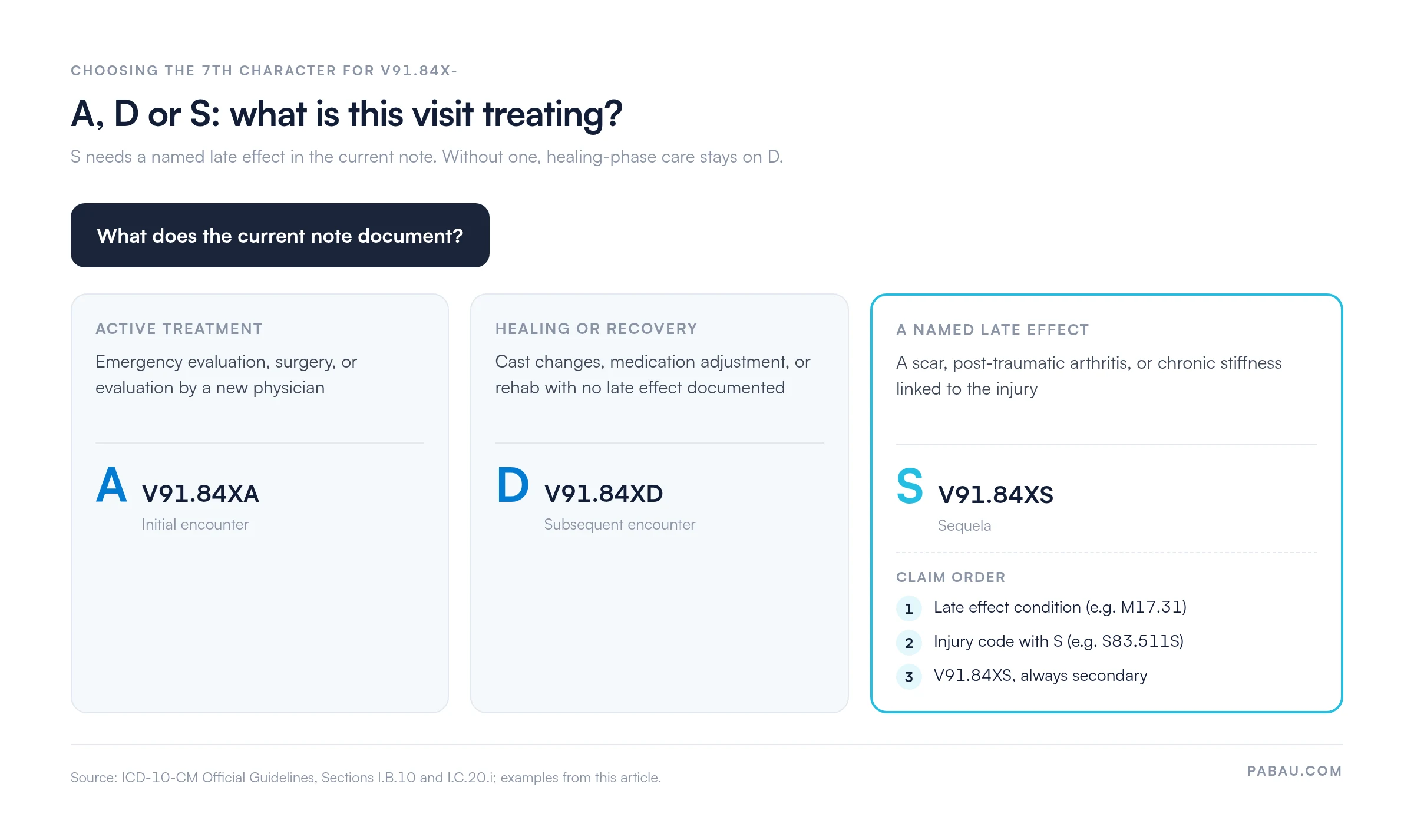
Before assigning the S suffix, find the late effect in the current note. A named residual condition, such as a scar or post-traumatic arthritis, supports S. Routine recovery care with no residual condition named supports D.
V91.84XS covers the external cause of a late effect from a non-drowning injury in an accident to a sailboat. The visit must treat the residual condition, not the original injury.
V91.84XS describes how the original injury happened, not the condition being treated. The codes for the condition and the injury carry that clinical detail. The code also does not apply to:
Sequela coding usually needs two codes before the external cause. Section I.B.10 places the code for the residual condition first, followed by the injury code with the S 7th character. V91.84XS then follows as the external cause code.
Per Section I.C.20, external cause codes are always secondary and never the principal or first-listed diagnosis. Section I.C.20.i also bars pairing a sequela external cause code with a related current injury code. For superbill documentation, keep the condition code in the first diagnosis position.
Place of occurrence (Y92), activity (Y93) and external cause status (Y99) codes are reported only once, at the initial encounter. They are not added again at a sequela visit.
Laterality must agree across the codes. A right-knee condition code paired with a left-knee injury code is a mismatch that invites a payer query.
Sequencing matters because payer systems read diagnosis codes in field order, so the first-listed code drives how the claim is processed. Our guide to medical billing workflows follows that path from visit note to payment.
The three V91.84X codes describe the same external cause at different stages of care.
Within subcategory V91.8, the 5th character names the type of watercraft. Picking the right vessel matters as much as picking the right mechanism.
The same vessel scheme runs through the other V91 subcategories. A falling-object injury on an unpowered craft, for example, is coded to V91.38XS at a sequela visit. The rest of chapter 20 sits in our ICD-10-CM codes library.
The record has to show three things: how the original injury happened, that it has healed, and which late effect is being treated now. Coders cannot infer any of them from context.
Billing compliance starts with the visit note. A precise statement, such as “post-traumatic arthritis of the right knee following an ACL sprain when a sailboat capsized,” supports every code on the claim.
There is no national requirement to report ICD-10-CM external cause codes. The Official Guidelines say reporting is required only under a state-based mandate or a particular payer’s rule. Otherwise, providers are encouraged to report them voluntarily for injury research.
Check each payer’s policy rather than assuming one rule fits every claim. Where V91.84XS is reported, it has to be correct, because a wrong external cause code is still a coding error in audit.
Good denial management workflows trace each rejected claim to its root cause. A sequencing error and a mechanism error need different fixes and different prevention steps.
Clean claim submission also requires every diagnosis code to be supported by the same encounter note. Adding to the record after the fact to justify a code does not meet CMS documentation standards.
Sequela claims fail when the visit note and the claim tell different stories. When notes sit in one system and claims are built in another, the mechanism and the late effect drop out between them.
Pabau, the practice software we build for medical practices, keeps clinical notes, billing and claims in the same patient record. Custom clinical forms can prompt providers to record the mechanism, the side of the body and the late effect at every sequela visit. Coders then work from the same record the provider signed.
When the claim is ready, Pabau’s claims management software submits it through our Claim.MD clearinghouse integration and tracks its status. Your team sees a rejection quickly and can rework it from the original note.

Pabau keeps clinical notes, billing and claims in one system, and submits and tracks claims through our Claim.MD clearinghouse integration.

V91.84XS is a narrow code, and most errors on it come from picking the wrong neighbor. Start from the documented mechanism: an accident to the sailboat itself points to V91, an on-board fall to V93. Then confirm a named late effect before choosing S over D.
Get those two decisions right and the sequencing follows: condition first, injury code with S second, V91.84XS last. Book a demo to see how Pabau keeps sequela notes and claims in one system for your billing team.

Need to understand how a clearinghouse works? Claim.MD clearinghouse overview explains how claims move from your practice to payers through a clearinghouse.
Managing multiple denial types across your billing team? Denial codes in medical billing covers common CARC denial reasons and how to build a systematic appeal workflow.
Want to see how ERA remittances map to specific denials? Electronic remittance advice guide explains how 835 ERA files link denial codes back to specific claim lines.
Coding another sailboat or watercraft injury? ICD-10 Code V91.38XS covers the sequela code for a falling-object injury on an unpowered watercraft.
ICD-10 Code V91.84XS is the billable ICD-10-CM code for other injury due to other accident to sailboat, sequela. It records the external cause when a patient is treated for a late effect of that injury, such as a scar or post-traumatic arthritis.
Yes. V91.84XS is a valid, billable ICD-10-CM code. It is an external cause code, so it is always reported as a secondary code and never as the principal diagnosis.
The 7th character sets the stage of care. A is the initial encounter for active treatment, and D covers routine care during healing or recovery. S is for treating a residual condition caused by the injury.
Use V91.84 when the injury came from an accident to the sailboat itself, with no more specific V91 mechanism. A fall on board during normal sailing belongs in V93.34. A burn from a sailboat on fire belongs in V91.04.
No national requirement makes external cause codes mandatory. Report V91.84XS when a state mandate or a payer requires it. Otherwise the Official Guidelines encourage voluntary reporting.
The record should state that the original injury happened in an accident to a sailboat, and on which side of the body. It should also name the late effect treated at this visit and link it to that injury.