ICD-10 code S61.201A: Open wound of left index finger without nail damage
ICD-10 code S61.201A covers a left index finger wound of unstated type ICD-10 co...

Last Updated: Oct 16, 2026
Billable Code Specific Code
W00.1XXS is the billable ICD-10-CM code for fall from stairs and steps due to ice and snow, sequela. It applies once the original fall injury has healed and the patient is treated for a lasting residual condition.
It is an external cause code, so it is always reported second. The residual condition code goes first and carries medical necessity. The seventh character is not interchangeable across the three W00.1 forms. A covers initial treatment, D covers follow-up during healing, and S covers the sequela.
Let Pabau's smart automation suggest the right codes, reduce claim denials, and keep your practice compliant—effortlessly.
Automate repetitive tasks and focus on what matters most—your patients.
Reduce coding errors and ensure compliance with the latest regulations.
Clean claims, fewer denials, and faster reimbursements.
Powerful insights and reporting to help your practice thrive.
HIPAA compliant SOC 2 certified GDPR-compliant Trusted by 4,000+ clinics worldwide

W00.1XXS is a valid, billable ICD-10-CM code for fall from stairs and steps due to ice and snow, sequela, active for FY2026.
The 7th character S marks a sequela, meaning the patient is treated for a residual condition caused by the original fall. ICD-10-CM sets no time limit on when a sequela may be coded.
W00.1XXS is always a secondary code, because ICD-10-CM guidelines bar external cause codes from the principal diagnosis position. The residual condition code, such as M25.561 for pain in the right knee, is listed first.
The XX placeholders between W00.1 and S are mandatory. Omitting them produces a truncated, invalid code that payers reject.
ICD-10 Code W00.1XXS is the ICD-10-CM code for “Fall from stairs and steps due to ice and snow, sequela.” It sits in Chapter 20 (External causes of morbidity, V00-Y99), inside the W00-W19 fall block.
The code is valid and billable for FY2026 and carries no exclusion notes of its own. It must always appear as a secondary code, paired with the residual condition code.
Each segment of W00.1XXS carries a specific meaning under CMS ICD-10-CM coding rules. Misreading any one of them produces an invalid or incorrectly sequenced claim.
That placeholder rule holds across Chapter 20. The sequela code V90.22XS carries an X in position 6 for the same reason, so its S can sit in position 7.
The three 7th-character options for W00.1 reflect the encounter type, not the injury severity. They are mutually exclusive. A single patient’s fall generates W00.1XXA on the first visit and W00.1XXD on follow-up visits during active treatment. W00.1XXS applies only once the acute phase has resolved and a lasting residual effect remains.
A sequela is a condition that results directly from an earlier injury. ICD-10-CM Official Guidelines Section I.B.10 places no time limit on when one may be coded. Healing is what separates a sequela from a subsequent encounter. Once the original fall injury has finished healing, any remaining deficit becomes a sequela.
Chronic knee pain from cartilage damage in an icy-stair fall two years ago is a sequela. So is post-traumatic arthritis in the ankle from that same incident. Those conditions carry their own ICD-10-CM diagnosis codes, and W00.1XXS is the external-cause companion that identifies the origin.
Three conditions must be documented before sequela coding is appropriate. The acute injury must be fully resolved, with no fracture, wound, or soft-tissue injury still under treatment.
The current condition must be causally linked to the original fall, and the record must say so explicitly rather than chronologically. The nature-of-injury code describing the residual condition must also be selectable and valid.
Many coders reach for W00.1XXS while the patient is still healing, treating a subsequent visit as a sequela encounter. If the original injury still needs active treatment or monitoring, W00.1XXD is the correct code.
Switch to W00.1XXS only when the provider documents that the injury has resolved and the patient presents for a residual complaint alone.
W00.1XXS applies narrowly. The fall must have happened on stairs or steps, and ice or snow must have caused it. A fall on icy flat ground at the same level goes to W00.0XXS.
A fall on indoor stairs with no icy surface goes to W10.9XXS. An unspecified fall goes to W19.XXXS, and that code is acceptable only when the specifics are genuinely unavailable. The table below sets out the boundaries coders cross most often.
Per ICD-10-CM Official Guidelines Section I.C.20, external cause codes are never listed as the principal diagnosis, and W00.1XXS is no exception. The residual condition code always comes first. The correct claim sequence for a sequela encounter runs in three steps.
The chart below traces the whole path. It shows the three checks that rule W00.1XXS in, and the code that applies when one of them fails. The claim order sits at the bottom.
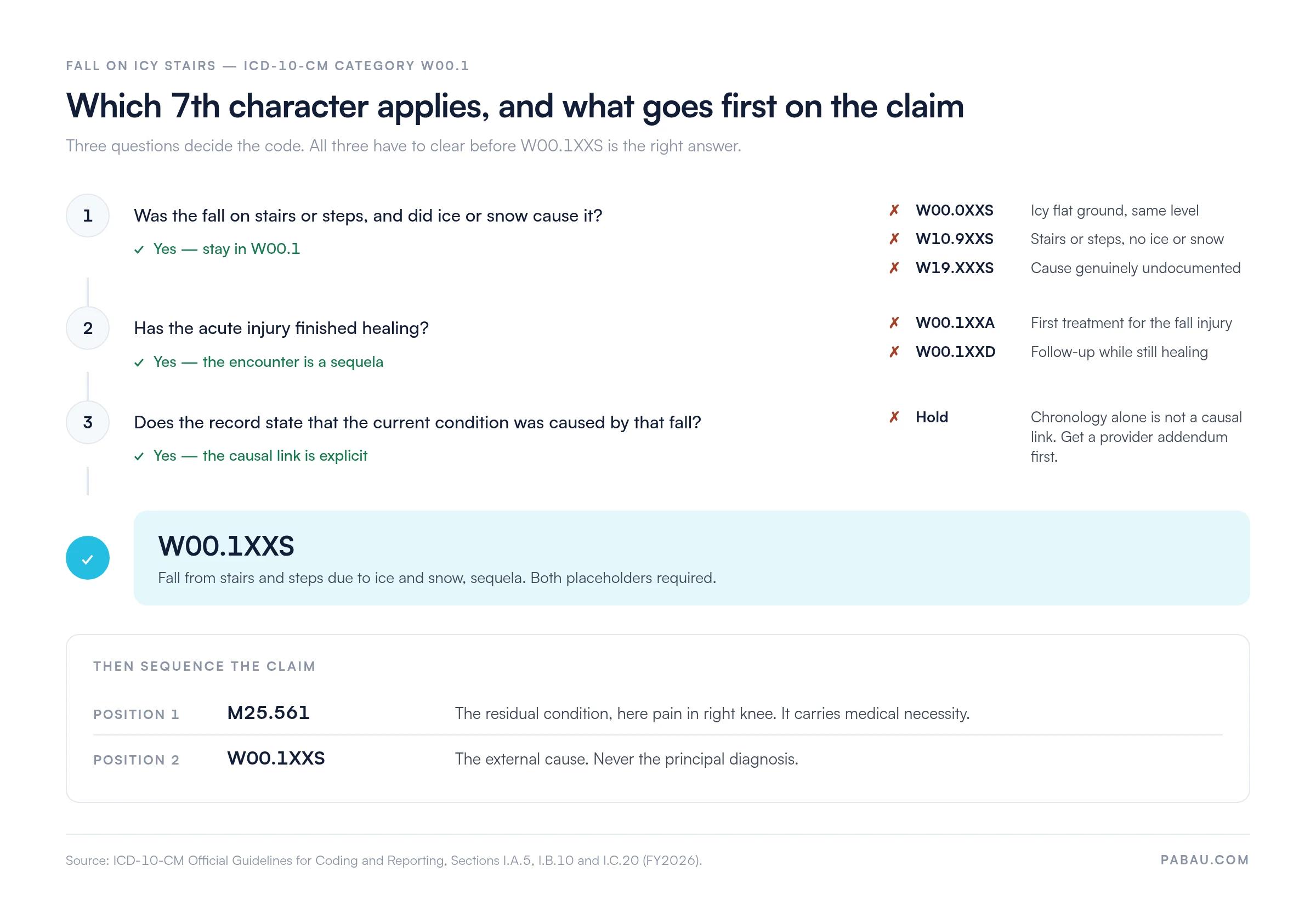
Worked example. A patient presents with chronic right knee pain and stiffness. It began after she slipped on ice-covered front steps eighteen months ago. The acute injury has fully resolved, and the provider’s note links the current pain causally to that fall.
Primary code: M25.561 (Pain in right knee). Secondary code: W00.1XXS (Fall from stairs and steps due to ice and snow, sequela). Both codes travel on the same claim, and the payer adjudicates M25.561 for coverage while W00.1XXS supplies the etiology.
Under-documentation is the leading audit trigger on sequela external cause code claims. Payers and auditors look for five elements in the medical record before they accept W00.1XXS as a valid secondary code. Missing even one is grounds for denial or post-payment recoupment.
Those five elements are also what clean claim submission standards ask for. The record that satisfies an auditor usually keeps the claim out of the appeal cycle.
The consequences also run past a single claim. A pattern of sequela coding without adequate causal documentation can trigger a broader probe across a provider’s claims. Strong documentation at the point of care is the most reliable protection.
Review documentation for the prior fall at the start of every sequela encounter, before the visit note is finalized. The assessment or plan must state the causal link between the original fall and today’s complaint. If it does not, ask the provider to add one clarifying sentence. That one sentence is the difference between a clean sequela claim and a denial that takes two billing cycles to resolve.
External cause sequela codes fail for reasons of their own, separate from the usual diagnosis code denials. Five rejection patterns account for most W00.1XXS claims that come back.
Practices running claims management software with pre-submission validation catch most of these before the claim leaves the practice. Principal-diagnosis sequencing edits and code-length checks flag the first and third patterns automatically.

Medicare requires external cause codes to appear as secondary codes, paired with a billable condition code that establishes medical necessity. W00.1XXS on its own cannot generate a covered service. No National Coverage Determination restricts W00.1XXS specifically, but Local Coverage Determinations often apply to the principal diagnosis paired with it.
A patient whose chronic pain is coded as M54.59 (Other low back pain) may face LCD-based documentation requirements. Those requirements attach to M54.59, not to W00.1XXS. Always check the LCD for the principal diagnosis code rather than the external cause code.
Commercial payers generally follow the CMS ICD-10-CM guidelines for external cause codes. Most accept W00.1XXS as a secondary code with no prior authorization, because authorization attaches to the procedure and the principal diagnosis. The AAPC ICD-10-CM code reference lists the current ranges if you need to confirm a companion code.
Most practices catch a sequencing or documentation error after the payer does. The claim goes out with W00.1XXS in position 1, or with no causal statement behind it, and the rejection arrives two weeks later. By then the note is signed and the provider has moved on.
Practice management software like Pabau keeps the clinical note, the coded diagnosis and the claim in the same patient record. Coders see the provider’s wording on the original fall while they are choosing the 7th character, rather than requesting it afterwards.
Claims run through pre-submission checks before they leave, so a principal-diagnosis error or a truncated code is caught inside the practice. Denials that do come back are tracked by reason code, which shows whether one provider’s sequela notes keep failing the same test.

Pabau’s claims management tools help practices submit clean claims, track denials, and manage coding workflows. Your billing team spends less time on rejections and more time on care.

Two decisions carry almost all the denial risk on a W00.1XXS claim. The first is whether the encounter is genuinely a sequela rather than a follow-up visit. The second is whether the record says, in the provider’s own words, that the current condition came from that fall.
Both are settled in the note, before the claim is built. A practice that reviews the prior-fall documentation at the start of the encounter rarely has to appeal one of these claims. Reviewing it at the point of billing is already too late.
Sequela claims reject for predictable reasons, and most of them are fixed in the note. Book a demo to see how Pabau keeps the fall documentation, the diagnosis codes and the claim in one record.

Need to understand how clearinghouse validation works for ICD-10 claims? Claim.MD clearinghouse overview explains how electronic claim validation catches coding errors before payer submission.
Want to see the same sequela rules applied to a different injury code? ICD-10 code S65.503S works through the billing and sequela coding rules for a hand blood vessel injury.
Looking to build a cleaner ICD-10 billing process? Superbill documentation guide walks through how to structure clinical records so that sequela codes are supported at every stage of the billing cycle.
Need a process for the denials that still come back? Denial management in healthcare covers the causes, the appeal workflow, and the checks that stop repeat rejections.
ICD-10 Code W00.1XXS is a billable ICD-10-CM external cause code for a fall from stairs and steps due to ice and snow, sequela. It is used when a patient presents for treatment of a residual condition caused by a prior icy-stairway fall. Chronic joint pain and post-traumatic arthritis are typical examples. It is always listed as a secondary code, never as the principal diagnosis.
Yes, W00.1XXS is a valid, billable ICD-10-CM code confirmed as active for FY2026 by the CDC/NCHS ICD-10-CM tabular list. It can be submitted on a claim as a secondary external cause code. It cannot serve as the principal diagnosis, because the associated residual condition code must occupy that position.
The difference is the encounter type. W00.1XXA (initial encounter) is used the first time a patient receives treatment for the fall injury. W00.1XXD (subsequent encounter) is used for follow-up visits while the injury is still actively healing. W00.1XXS (sequela) is used only after the acute injury has resolved and the patient presents for a persistent residual condition caused by the original fall. Each 7th character is mutually exclusive for any given visit.
Yes. W00.1XXS must always be paired with a separate ICD-10-CM code identifying the residual condition being treated. Examples include M25.561 for pain in the right knee, or M19.171 for post-traumatic osteoarthritis of the right ankle and foot. Per ICD-10-CM Official Guidelines Section I.B.10, the residual condition code is sequenced first, and W00.1XXS follows as the secondary external cause code explaining the etiology.
W00.0XXS covers a fall on the same level due to ice and snow, sequela, meaning the patient slipped and fell on a flat icy surface. W00.1XXS covers a fall from stairs or steps due to ice and snow, sequela. The distinction is the surface type: flat ground versus stairs. Both follow the same sequela coding logic, but the subcategory (.0 vs .1) reflects where the fall occurred.
The record must show five things. It needs a documented history of the original fall on icy stairs or steps. It needs an explicit provider statement linking the current condition to that fall. It needs documentation that the acute injury has fully resolved. It needs a full description of the residual condition, coded separately, plus a timeframe for the original injury. Missing any one of these is the primary trigger for audit findings and denials on sequela claims.