ICD-10 code T87.52: Necrosis of amputation stump, left upper extremity
ICD-10 code T87.52 at a glance: Left arm, not left leg ICD-10 code T87.52 is the...

Last Updated: Oct 26, 2026
Billable Code Specific Code
V86.51XD is the billable ICD-10-CM code for driver of ambulance or fire engine injured in nontraffic accident, subsequent encounter.
It sits within the V86.5 external cause block, which covers drivers of special all-terrain or other off-road motor vehicles injured in nontraffic accidents. Coders apply this code as a supplementary external cause code alongside a primary injury diagnosis to document how and where the injury occurred. The 7th character and the pairing of V86.51XD with a correctly sequenced injury code are two common sources of denials on these claims.
Let Pabau's smart automation suggest the right codes, reduce claim denials, and keep your practice compliant—effortlessly.
Automate repetitive tasks and focus on what matters most—your patients.
Reduce coding errors and ensure compliance with the latest regulations.
Clean claims, fewer denials, and faster reimbursements.
Powerful insights and reporting to help your practice thrive.
HIPAA compliant SOC 2 certified GDPR-compliant Trusted by 4,000+ clinics worldwide

V86.51XD covers the driver of an ambulance or fire engine hurt in an accident entirely off a public highway.
The 7th character D marks a subsequent encounter, once active treatment is over and routine follow-up care has begun.
V86.51XD is a supplementary external cause code, so it always follows a primary injury code and is never listed first.
Some workers’ compensation carriers and state systems require external cause codes, so confirm each payer’s policy.
ICD-10 code V86.51XD reports one specific scenario. The driver of an ambulance or fire engine was hurt in an accident entirely off a public highway. The patient is now back for follow-up care rather than first treatment.
Three facts must all be true before you assign it. The patient was driving. The vehicle was an ambulance or fire engine, not an ATV or snowmobile. And the accident counts as nontraffic under ICD-10-CM definitions.
Under those definitions, a nontraffic accident happens entirely somewhere other than a public highway. A fire engine hitting a barrier on a station forecourt qualifies. So does an ambulance backing into a hospital dock. An ambulance crash on a public road during a call does not.
The 7th character D tells the payer that active treatment is complete. The patient is now in routine care, such as cast checks, medication adjustment or physical therapy follow-up. It says nothing about severity or outcome.
Section I.C.20 of the ICD-10-CM Official Guidelines governs external cause codes. The 7th character rules for injuries, in Section I.C.19, set the three encounter types available for V86.51X codes.
A common slip is keeping XA across several visits because the patient is still in treatment. Once care shifts to routine management, D replaces A as the 7th character. That switch is a clinical call, not a calendar one, so the note should state the purpose of each visit.
Here’s how it plays out. A firefighter breaks a wrist while reversing a fire engine in the station yard. The emergency department visit carries the fracture code with 7th character A, plus V86.51XA. Six weeks later, the cast check carries the fracture code with D, plus V86.51XD.
V86.5 is the non-billable parent for drivers of special all-terrain or other off-road motor vehicles injured in nontraffic accidents. It can’t go on a claim. Every claim requires a fully specified 7-character code (6th character X, 7th A, D or S).
V86.51XD applies only to ambulances and fire engines. For any other vehicle, work through the other V86.5 subcodes.
The ATV code, V86.55XD, is an easy sibling to confuse, because notes sometimes describe emergency vehicles as “off-road vehicles”. For a first visit after a crash in some other off-road vehicle, the right code is V86.59XA.
Check the clinical note for the exact vehicle description before assigning any V86.5 code. ‘Emergency vehicle’ is not sufficient. If the record specifies ambulance or fire engine, V86.51XD is correct. If it says rescue truck, ATV, or utility vehicle, work through V86.55XD or V86.59XD before billing.
Four neighboring codes catch coders out on these claims. Each one turns on a single detail the chart has to settle. When the accident happened on a public highway, the traffic-accident recode is V86.01XD, shown in the last row.
The four checks below run in order, and each failed check points to its own code.
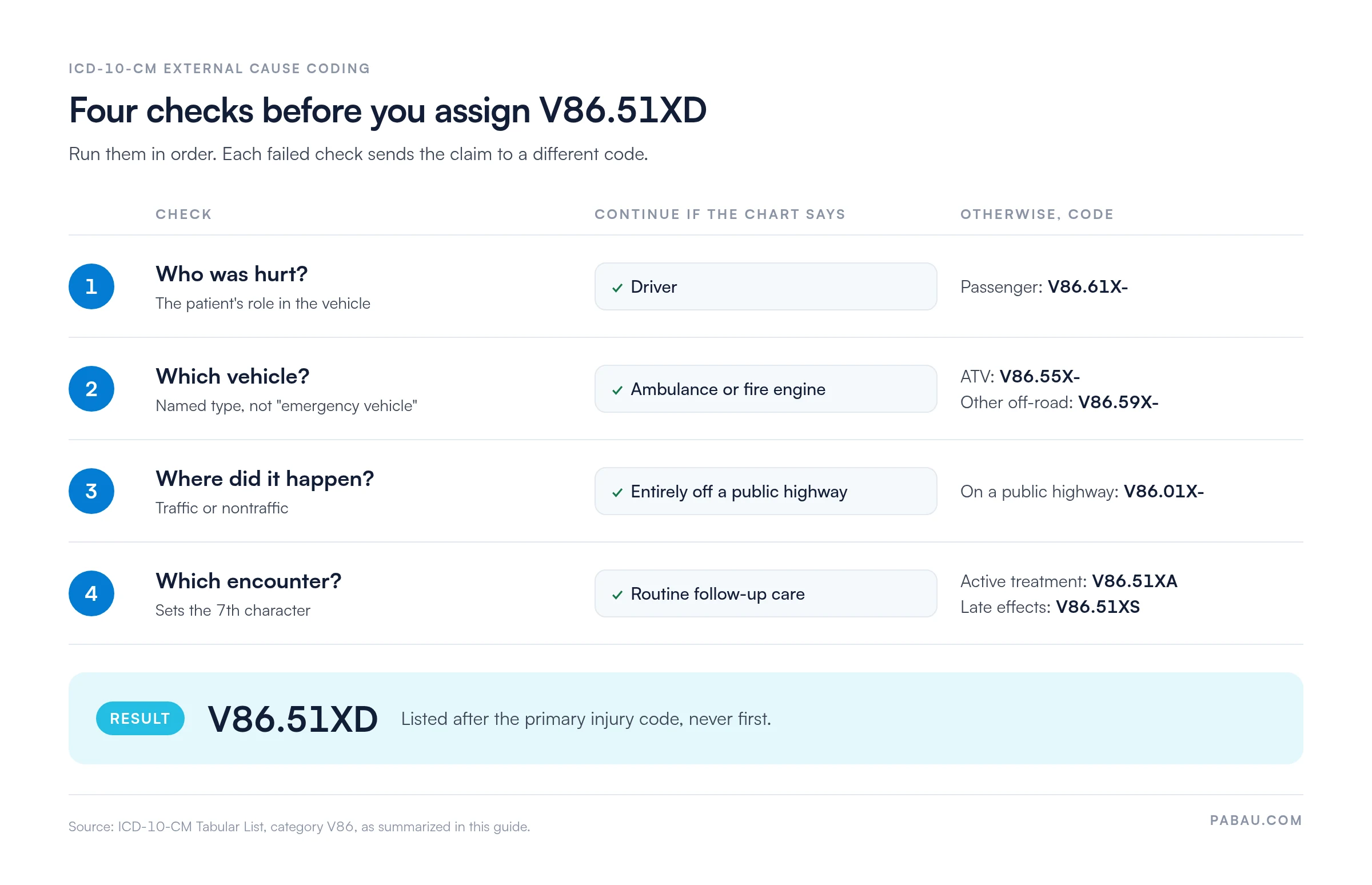
External cause codes are only as defensible as the notes behind them. For V86.51XD, the record must establish five details before a coder can assign it with confidence. Good medical billing compliance means capturing them at the point of care, not rebuilding them from vague notes at billing time.
For a clean claim submission, flag any chart that’s missing the vehicle type or patient role. Then query the provider before billing rather than guessing.
V86.51XD is a supplementary external cause code. It can’t be the principal or first-listed diagnosis on any claim. The primary injury code always comes first, and V86.51XD follows to explain how the injury happened.
A typical follow-up claim moves through four steps.
Payer positions on external cause codes vary. The Official Guidelines state there is no national requirement to report external cause codes. Reporting is voluntary unless a state mandate or a particular payer requires it. So confirm each payer’s policy before treating V86.51XD as optional.
Denials on external cause claims follow predictable patterns. Knowing them in advance turns reactive appeals into documentation fixes. Strong denial management workflows start before the claim goes out, not after the remittance arrives.
The denial codes in medical billing on a rejected claim tell you which of these patterns triggered it. That way, you can fix the right detail first.
You can stop these denials before the claim leaves your practice. Confirm four details on every V86.51XD claim:
The check takes about 30 seconds per claim, which is far less time than an appeal.
Ambulance and fire engine drivers are occupational vehicle operators. An injury at the wheel during their duties is an occupational injury. So the claim usually routes to a workers’ compensation carrier when the driver was on duty, rather than a standard health plan.
Some workers’ compensation carriers and state systems require external cause codes. Confirm each payer’s policy. V86.51XD records how the injury happened in a format those carriers recognize, and missing it can delay payment. Workers’ comp coding rules also vary by jurisdiction, so check requirements with each state authority.
Two more points apply to occupational claims for emergency services staff.
Insurance eligibility verification at intake identifies the workers’ compensation carrier for emergency services staff. It also surfaces state-specific documentation requirements before the first claim goes out.
Without a connected system, these claims bounce between the chart, a spreadsheet and the clearinghouse portal. Every handoff is a chance to drop the injury code or the 7th character.
Pabau, the practice management platform we build, keeps billing in the same place as the patient record. Its claims management software generates claims straight from the visit invoice, so nobody re-keys the codes.
US practices send those claims through the Claim.MD clearinghouse. Real-time eligibility checks (270/271 transactions) confirm coverage before the claim goes out. Denied claims come back flagged for rework, so your team can fix them quickly.
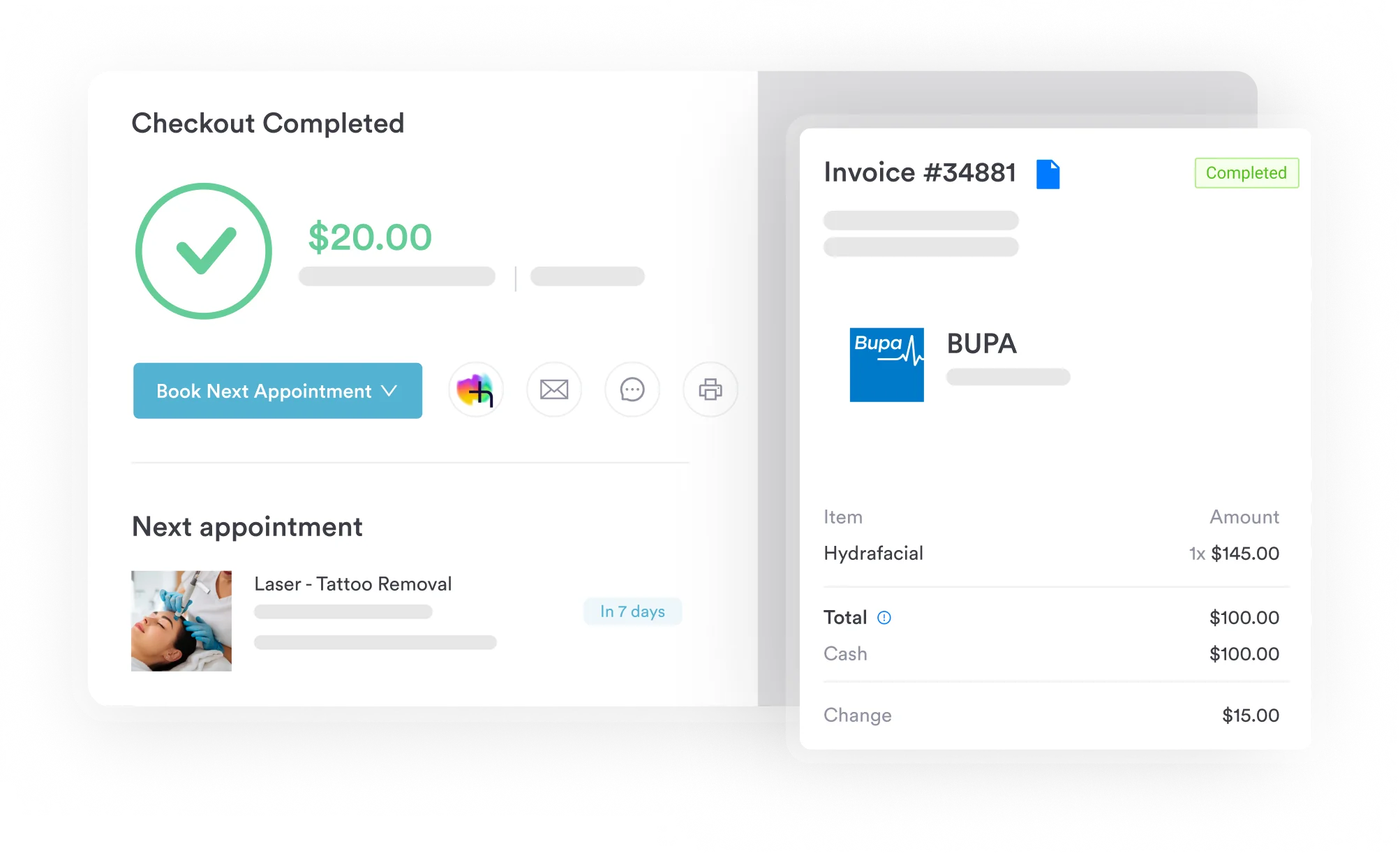

Pabau’s claims management software helps your team keep patient records, invoices and claims in one place before the claim leaves your practice.

Assigning V86.51XD comes down to the chart. When the notes name the driver, the vehicle and an off-highway location, the code follows naturally. When one detail is missing, query the provider before billing. A short question costs far less than an appeal.
Then keep each claim in one system from invoice to payer, so the injury code and V86.51XD stay paired. Book a demo to see how Pabau handles claims and denials for occupational injury visits.

Need to understand how denials get resolved? Denial management in healthcare covers the end-to-end workflow for identifying, appealing and preventing claim rejections.
Looking for guidance on clean claim requirements? 837 electronic claim file explains what a valid claim file must contain before it reaches the clearinghouse.
Want to see how claims reach the clearinghouse? Claim.MD clearinghouse covers how Pabau sends claims to payers electronically.
Coding a different off-road vehicle? ICD-10 code V86.59XA covers drivers of other special off-road vehicles at the initial encounter.
Yes. The Official Guidelines say to assign the external cause code, with the right 7th character, for each encounter where the injury is treated. So every follow-up visit for that injury can carry V86.51XD.
No, not on a follow-up claim. Place of occurrence (Y92), activity (Y93) and external cause status (Y99) codes are reported once, at the initial encounter. At that first visit, Y99.0 fits a paid driver and Y99.2 fits a volunteer.
Yes, if the accident involves the public highway. ICD-10-CM counts an accident as traffic when it starts on, ends on, or involves a vehicle partly on the highway. That case takes V86.01X-, not V86.51X-.
Not as a national rule. The Official Guidelines state there is no national requirement to report external cause codes. Reporting is voluntary unless a state mandate or a particular payer requires it. Some workers’ compensation carriers and state systems do require them, so confirm each payer’s policy.