ICD-10 code Y83.0: Surgical operation with whole organ transplant
ICD-10 code Y83.0 names the transplant as the cause, not the problem ICD-10 code...

Last Updated: Nov 19, 2026
Billable Code Specific Code
V86.42XS is the billable ICD-10-CM code for person injured while boarding or alighting from snowmobile, sequela. It records where a late effect began. The patient was hurt getting on or off a snowmobile, and that injury has since healed. The visit now treats what it left behind, such as stiffness, pain or a scar.
It is an external cause code, so it never goes first on the claim. The residual condition leads, and the original injury code follows with S in the seventh position. V86.42XS then explains how the injury happened. Whether the snowmobile was on a road or a trail does not change the code.
Let Pabau's smart automation suggest the right codes, reduce claim denials, and keep your practice compliant—effortlessly.
Automate repetitive tasks and focus on what matters most—your patients.
Reduce coding errors and ensure compliance with the latest regulations.
Clean claims, fewer denials, and faster reimbursements.
Powerful insights and reporting to help your practice thrive.
HIPAA compliant SOC 2 certified GDPR-compliant Trusted by 4,000+ clinics worldwide

ICD-10 code V86.42XS reports a late effect of an injury the patient got while boarding or alighting from a snowmobile.
The fourth character 4 means boarding or alighting, and the fifth character 2 means snowmobile. Riding injuries take a driver, passenger, outside or unspecified occupant code instead.
V86.4 codes have no traffic or nontraffic split, so a snowmobile boarding fall takes V86.42XS on a road or a trail.
List the residual condition first, then the original injury code with seventh character S, then V86.42XS as the external cause.
Claims run into trouble when V86.42XS is listed first, the X is dropped, or the note never ties the late effect to the snowmobile injury.
ICD-10 code V86.42XS is the billable code for a person injured while boarding or alighting from a snowmobile, sequela. You report it when that injury has healed and the visit treats a condition it left behind. The 2027 ICD-10-CM code files from CMS list V86.42XS as a valid billable code under that exact descriptor.
V86.42XS is an external cause code from Chapter 20, External causes of morbidity (V00-Y99). It records how an injury happened, not the injury itself. It sits in category V86, which covers occupants of special all-terrain or other off-road motor vehicles injured in transport accidents. Our ICD-10-CM code guide explains how the wider code set is organized.
The fourth character is where most wrong-code choices start. In V86, values 0 to 3 cover drivers, passengers, people on the outside and unspecified occupants in traffic accidents. Value 4 covers boarding or alighting. Values 5, 6, 7 and 9 repeat the occupant roles for nontraffic accidents.
V86.42 has only five characters, so the X fills the sixth slot before the S. Submitting V86.42S or V86.422S produces an invalid code string. A clearinghouse format edit will usually reject it before the claim reaches the payer.
The seventh character S marks a sequela, which is a residual condition that remains after the acute phase of an injury has ended. It is not interchangeable with A (initial encounter) or D (subsequent encounter). Each one tells the payer a different phase of care.
A sequela claim that reports V86.42XS carries at least three codes. ICD-10-CM Official Guidelines Section I.B.10 puts the condition or nature of the sequela first. Section I.C.19.a then requires the injury code that caused it, carrying S as its seventh character. V86.42XS follows as the external cause, and Section I.C.20.a.6 bars it from the first position.
The guidelines set no time limit on when a sequela code can be used. The clinical test is whether the original injury has healed. If the patient is still being treated for the fracture, wound or sprain itself, D applies. If the injury has healed but a residual condition such as chronic pain, stiffness or nerve damage remains, S applies.
Documentation has to make that distinction explicit. A note that reads “continued treatment of snowmobile injury” does not support sequela coding. The provider must state that the acute injury has resolved and that the current problem results from it. Section I.C.20.i.3 also rules out the sequela external cause code for follow-up visits where no late effect is documented.
Category V86 covers occupants of special all-terrain or other off-road motor vehicles injured in transport accidents. Snowmobiles, dune buggies, ATVs, dirt bikes, military vehicles, ambulances and fire engines each get their own fifth character. The right code depends on what the patient was doing, which vehicle it was and the phase of care. The path below traces those three choices for a snowmobile.
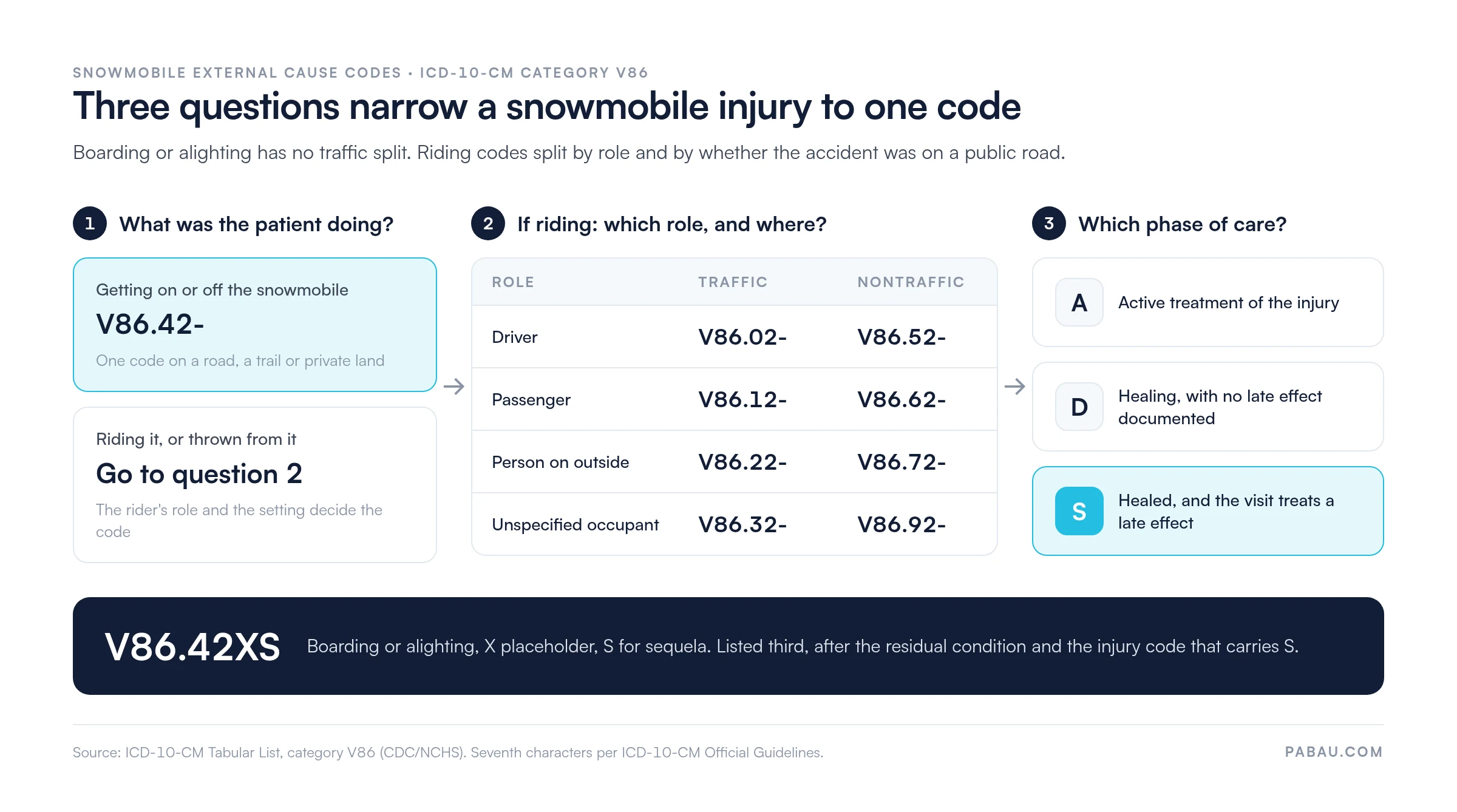
V86.4 has no code for an unspecified vehicle. When the note says only “off-road vehicle,” query the provider before you choose between V86.42XS and its siblings. For the same snowmobile boarding injury at a healing-phase visit, see our guide to ICD-10 code V86.42XD.
V86.42XS covers one mechanism on one vehicle. The patient was getting on or off a snowmobile when the injury happened, and the visit now treats its late effect. Unlike most V86 codes, the V86.4 codes do not split traffic from nontraffic accidents, so the setting does not change the code.
When in doubt, check the inclusion notes in the CDC/NCHS ICD-10-CM browser tool for the current fiscal year. The code set is updated every October 1.
Support for V86.42XS has to come from the provider’s note, not from a coder’s inference. Each of the five points below should be stated in the record.
Practices facing payer audits should check their medical billing compliance policies against these five points. A missing element can be enough for a retrospective adjustment.
V86.42XS is an external cause of morbidity code. Section I.C.20.a.6 states that it can never be the principal or first-listed diagnosis. Build the claim in this order.
Example claim: M19.171, then S82.61XS, then V86.42XS. The arthritis drives the visit, the fracture code shows where it came from, and V86.42XS records how the fracture happened. Never pair V86.42XS with a related current injury code carrying A or D. Section I.C.20.i.2 rules out that combination.
Run a quick check before submitting any claim with V86.42XS. Confirm the residual condition is listed first and the injury code carries S as its seventh character. Check that the note names a snowmobile and a boarding or alighting mechanism. Then confirm the provider documented that the acute injury has healed.
There is no national requirement to report external cause codes. The ICD-10-CM guidelines make Chapter 20 reporting optional unless a state mandate or a particular payer requires it. Providers are still encouraged to report them voluntarily, because the data supports injury research and prevention.
Pabau, the practice management platform we build, sends electronic claims to thousands of US payers through its Claim.MD integration. Its claims management software scrubs each claim for missing or invalid details before it leaves the practice. Each fix then takes seconds, before a rejection ever comes back.
Errors on claims carrying V86.42XS tend to repeat. Each one below has a specific fix, and each can be caught before submission. Effective denial management workflows treat them as rule-based edits rather than case-by-case investigations.
When appealing a denial, attach the original encounter records alongside the current note. Showing the timeline of injury, healing and residual condition is the clearest case you can make.
The three scenarios below show the code applied correctly, applied too early and applied to the wrong mechanism.
Fourteen months ago, a patient slipped stepping off a snowmobile at the end of a ride and fractured the right lateral malleolus. The fracture healed after surgical repair. The patient now has post-traumatic arthritis in the right ankle. The note reads: “Post-traumatic osteoarthritis, right ankle, secondary to a lateral malleolus fracture sustained stepping off a snowmobile. Fracture healed.”
Correct coding: M19.171 first, then S82.61XS, then V86.42XS. The fracture has healed, and the arthritis drives the visit.
A second patient returns six weeks after the same kind of fall. The fracture has not healed, and the patient is in physical therapy. A coder applies V86.42XS because the patient is past the emergency phase.
Correct coding: This is a subsequent encounter, so the injury code takes D and the external cause is V86.42XD. Use S only once the provider documents that the injury has healed and a late effect is being treated.
A third patient was riding as a passenger when the snowmobile hit a drift on a backcountry trail. The wrist fracture healed, but the patient now has chronic wrist pain. The coder picks V86.42XS because a snowmobile was involved.
Correct coding: The patient was riding, not boarding or alighting, and the accident happened off public roads. The external cause is V86.62XS, passenger of snowmobile injured in nontraffic accident, sequela.
Check the original encounter record before assigning the sequela character. If the patient was still in active treatment at the last visit, the injury may not have healed. Confirm the move to sequela is documented in the current note, never inferred from the months that have passed.
A sequela claim needs three codes in a fixed order, and each one depends on a detail in the provider’s note. In many practices, someone at the billing desk reads that note days later and rebuilds the sequence by hand. That is when the residual condition slips out of first position or the S drops off the injury code.
In Pabau, the claim opens pre-filled from the invoice, in the same system as the clinical note. The biller codes straight from the provider’s documentation. Claim validation then scrubs each claim for missing or invalid details before it goes to the clearinghouse.
If a claim still comes back rejected, Pabau flags it as Needs action and shows the reason. The fix and the resubmission happen in one place. The insurer still makes the final decision, but fewer claims leave the practice with avoidable errors.

Pabau keeps the clinical note, the invoice and the insurance claim in one system. Claim validation checks each claim for missing or invalid details before it reaches the clearinghouse.

V86.42XS is narrow by design. It fits only when the patient was getting on or off a snowmobile, the injury has healed, and a late effect is now being treated. Change any one of those facts and a sibling code takes over, whether that is V86.42XD, V86.62XS or V86.45XS.
The safest habit is to code from the note outward. Name the residual condition, identify the injury behind it, then confirm the vehicle and the mechanism before V86.42XS goes on the claim. When the note cannot answer one of those questions, a provider query costs far less than a denial and an appeal.
Pabau keeps the note and the claim in one system, so billers code from the provider’s documentation rather than a retyped summary. Book a demo to see how Pabau handles external cause coding on injury claims.

Need the full picture on claim denials? Denial management in healthcare covers the end-to-end workflow for identifying, appealing, and preventing recurring claim denials.
Looking up denial reason codes from your remittance? Denial codes in medical billing decodes CARC and RARC codes attached to rejected claims.
Want to understand how claims flow from submission to payment? What is revenue cycle management explains the full cycle from patient registration to final payment posting.
ICD-10 code V86.42XS reports a person injured while boarding or alighting from a snowmobile, sequela. It is used when that injury has healed and the visit treats a late effect it caused. It is an external cause code, so it is always listed after the condition and injury codes.
All three describe the same snowmobile boarding or alighting injury at different phases of care. V86.42XA is for active treatment, and V86.42XD is for the healing phase. V86.42XS is for a late effect once the injury has healed, such as post-traumatic arthritis or a scar.
No. ICD-10-CM Official Guidelines Section I.C.20.a.6 states that an external cause code can never be a principal or first-listed diagnosis. List the residual condition first, then the injury code with seventh character S, then V86.42XS.
Not for this code. The V86.4 boarding and alighting codes have no traffic or nontraffic split, so V86.42XS applies on a road, a trail or private land. The setting matters once the patient is riding, when the driver and passenger codes take over.
Use a passenger code instead of V86.42XS. A passenger with a late effect from an accident off public roads takes V86.62XS. A passenger injured on a public road takes V86.12XS.
The note must name a snowmobile and a boarding or alighting mechanism. It must state that the original injury has healed, name the residual condition and link that condition to the injury. Coders cannot infer any of these points from elapsed time alone.
Common causes include listing V86.42XS first, dropping the X placeholder, and leaving out the residual condition or the sequela injury code. Others are coding a riding injury as boarding, or using S while the injury is still healing. A pre-submission review catches each of them.
Yes. Section I.C.19.a requires both the code for the sequela and the injury code that caused it, with S on the injury code only. V86.42XS then adds how the injury happened. Sent alone, it gives the payer no reason for the visit.