ICD-10 Code S42.444P: Medial epicondyle fracture, right humerus
ICD-10 Code S42.444P: full descriptor and code validity ICD-10 Code S42.444P car...

Last Updated: Oct 13, 2026
Billable Code Specific Code
V61.3XXS is the billable ICD-10-CM code for unspecified occupant of heavy transport vehicle injured in collision with pedal cycle in nontraffic accident, sequela.
The code applies when the record does not say whether the patient was driving, riding, or on the outside of the vehicle. The collision happened away from a public highway rather than in traffic. The seventh character S marks a late effect, so V61.3XXS is reported secondary to the principal diagnosis for the residual condition.
Let Pabau's smart automation suggest the right codes, reduce claim denials, and keep your practice compliant—effortlessly.
Automate repetitive tasks and focus on what matters most—your patients.
Reduce coding errors and ensure compliance with the latest regulations.
Clean claims, fewer denials, and faster reimbursements.
Powerful insights and reporting to help your practice thrive.
HIPAA compliant SOC 2 certified GDPR-compliant Trusted by 4,000+ clinics worldwide

V61.3XXS is billable and specific. It covers an unspecified occupant of a heavy transport vehicle injured in a nontraffic collision with a pedal cycle.
The 7th character S marks a late effect of the original injury. The sequela itself, such as chronic pain or scarring, is the principal diagnosis and V61.3XXS is secondary.
External cause codes like V61.3XXS never stand alone on a claim. Each one accompanies a principal diagnosis that describes the residual condition.
Nontraffic is part of the definition. A collision in a yard, depot or private road is V61.3XXS, while the same event in traffic is V61.9XXS.
Pabau’s claims management software puts ICD-10 lookup inside the clinical workflow, so coders pair external cause codes with the right principal diagnosis before submission.
ICD-10 code V61.3XXS is the billable, specific code for “Unspecified occupant of heavy transport vehicle injured in collision with pedal cycle in nontraffic accident, sequela.” It is valid for reimbursement under the current ICD-10-CM edition and can be used on claims for external cause reporting. The word “nontraffic” carries weight here. The collision has to have happened away from a public highway, in a yard, a depot, or on a private road.
The code sits within the ICD-10-CM External causes chapter (V00-Y99), which groups codes by the circumstances of injury rather than by the resulting diagnosis. V61.3XXS covers the occupant whose role in the vehicle was never documented. It is not the driver code (V61.0XXS) and not the documented passenger code (V61.1XXS). That distinction matters at the claim level because payer edits can reject codes that do not match the documented role. Verify both the occupant role and the traffic status against the clinician’s documentation before assigning any V61 subcategory code. You can cross-check descriptions using the CDC/NCHS ICD-10-CM web tool.
V61.3XXS sits four levels deep in the ICD-10-CM hierarchy. Understanding that path helps coders navigate related codes and spot sequencing errors before they reach the payer.
The two placeholder X characters (positions 5 and 6) are structural fillers required because category V61 does not use those positions for additional specificity. They must appear in the submitted code. Omitting them produces an invalid code that payers reject outright, and it is one of the most common formatting errors on V61-range claims.
On an electronic claim the code must appear exactly as V61.3XXS, all seven characters, with no truncation. Billing systems that auto-populate ICD-10 fields sometimes strip trailing characters on short codes. Confirm your system preserves all seven before the claim goes out.
The 7th character S means the encounter treats a direct late effect of a previous injury. It is not for care of the original acute injury. All three 7th characters for V61.3 are specific and billable; the choice among them determines claim validity.
A critical sequencing rule applies to V61.3XXS. The sequela condition is coded first as the principal diagnosis, and V61.3XXS follows as a secondary external cause code. Reversing that order puts the external cause code in the lead, which payers and auditors flag during chart reviews. The AAPC ICD-10-CM code lookup includes sequencing guidance notes that reinforce this rule at the code level.
V61.3XXS is confirmed as a billable, specific ICD-10-CM code under the current edition. In ICD-10-CM terminology, “billable” means the code sits at the highest level of specificity and can appear on a claim for reimbursement. It is not a header code or a non-billable parent category.
That said, V61.3XXS functions exclusively as a supplementary external cause code. Payer edits in most commercial and Medicare systems reject claims where an external cause code appears in the principal diagnosis field. The code belongs in a secondary diagnosis slot. It sits alongside an S-qualified condition code that describes the residual injury, such as post-traumatic spinal pain or the sequela of a rib fracture.
For practices managing high volumes of injury-related claims, a clearinghouse edit that validates ICD-10 sequencing catches external-cause-as-principal errors before they turn into denials. Proactive denial management workflows built around those edits cut the manual rework on V61-range sequela claims.
Payer policies on external cause code reporting vary. Most Medicaid programs and many commercial payers encourage or require them; Medicare does not mandate external cause codes but accepts them. Confirm the specific payer’s policy before deciding whether V61.3XXS adds value to the claim or creates noise. The CMS ICD-10 codes page publishes the annual official guidelines, including external cause code reporting requirements by program.
When submitting claims with V61.3XXS, always lead with the sequela condition code (e.g., chronic post-traumatic pain, post-injury arthropathy). Audit your billing system’s diagnosis field order before claim generation. External cause codes in the principal slot trigger automated edits at most clearinghouses.
The V61 category covers every occupant role in a heavy transport vehicle that collides with a pedal cycle. It branches twice: First by the injured person’s role, then by whether the accident happened in traffic or off the public highway. Picking the wrong branch is an accuracy error that carries audit risk. Driver instead of unspecified occupant, or traffic instead of nontraffic, each lands the claim on a different code. The grid below maps both branches onto the V61 sequela (S) codes, and the table after it lists them in full.
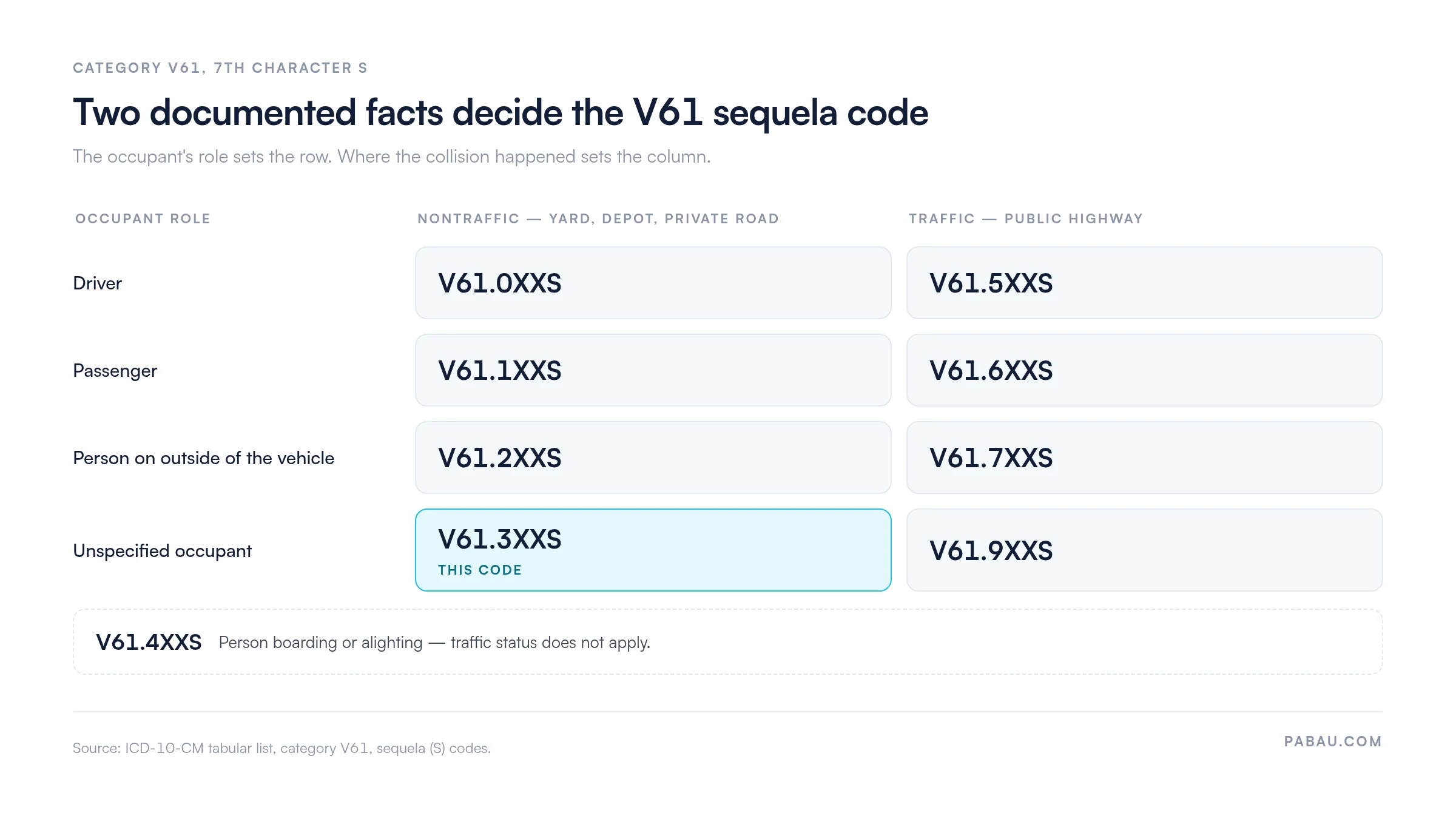
V61.3XXS and V61.9XXS are the two unspecified-occupant codes in the category. Both apply when the record does not say whether the patient was driving, riding, or on the outside of the vehicle. The traffic status is what separates them, so a depot or private-road collision belongs in V61.3XXS and a highway collision belongs in V61.9XXS. Where the record does name the role, ICD-10-CM guidelines direct coders to the more specific sibling instead. A documented passenger in a nontraffic accident is V61.1XXS, and the same passenger in traffic is V61.6XXS. The same specificity rule runs through the rest of the ICD-10-CM code index. An unspecified code is correct only where the record gives no narrower option.
The vehicle class is a separate fork from the occupant role. A passenger in a pick-up truck or van, injured in the same nontraffic pedal cycle collision, takes V51.1XXS for the sequela encounter.
A noncollision event is outside V61 altogether, and buses sit in their own block at V70-V79. A bus driver left with a late effect from a noncollision transport accident off the public highway takes V78.0XXS.
ICD-10-CM Official Guidelines Section I.C.20 governs external cause code reporting. These rules apply universally to V61.3XXS and every other V00-Y99 code. The key requirements are:
Practices seeing high volumes of post-accident sequela cases benefit from enforcing these sequencing rules at data entry rather than at claim review. Catching a sequencing error upstream costs far less than appealing the denial it would otherwise produce. That control belongs in the documentation step, where the coder still has the chart in front of them.
The WHO ICD-10 browser provides the international classification basis for the V60-V69 block. It helps when comparing US ICD-10-CM codes against international equivalents in research or multi-jurisdiction documentation.
Reporting external cause codes like V61.3XXS accurately depends on two decisions and one control. The coder picks the right code, sequences it behind the principal diagnosis, and the billing system enforces both before the claim leaves the practice. Pabau, practice management software for healthcare practices, integrates ICD-10 code lookup into the documentation and billing workflow through its claims management software. Coders search, select, and sequence codes inside the same platform they use for clinical notes.
For injury-related sequela cases, the transition from an acute-injury encounter to a sequela encounter is where coding errors cluster. The move runs from 7th character A or D across to the S variant. A coder working in a disconnected system must track that progression by hand, one patient at a time. In Pabau the patient’s record links the clinical encounter history to billing, so the current encounter type is confirmed before the code is picked.
Pabau also integrates with Claim.MD, its US clearinghouse partner, which processes CMS-1500 and 837P claims against more than 4,000 US payers. Real-time eligibility verification and electronic remittance advice (835 files) close the loop between ICD-10 code submission and payment confirmation. For a practice working through sequela denials, that loop is where recovery starts. The remittance names the edit that rejected the claim.

Pabau’s claims management software integrates ICD-10 lookup and sequencing into your clinical workflow, with Claim.MD clearinghouse integration to catch errors before submission.

ICD-10 code V61.3XXS is a straightforward billable code in structure but a common source of sequencing errors in practice. The sequela 7th character requires a principal diagnosis naming the late-effect condition. The external cause code never takes that slot.
Three steps keep these claims clean. Pair V61.3XXS with the right principal diagnosis. Confirm the occupant role and traffic status in the documentation, then verify the payer’s policy on external cause reporting.
Pabau’s clearinghouse connection and built-in ICD-10 code lookup reduce the manual steps between documentation and clean claim submission. That matters most for practices handling injury sequela claims at volume. Book a demo to see how Pabau handles the full coding-to-payment workflow.

Need the principal diagnosis that sits in front of a sequela external cause code? ICD-10 code S01.00XS works through a scalp wound sequela from documentation to claim.
Need a framework for managing coding-related denials? Denial codes in medical billing explains CARC codes and how to build a systematic appeals workflow.
Looking to verify ICD-10 code submissions against payer edits? What makes a clean claim outlines the clearinghouse validation steps that catch sequencing errors before submission.
Coding a cycle collision where the bike had a motor? ICD-10 code V24.21XD covers e-bike accidents, which sit outside the pedal cycle categories.
ICD-10 code V61.3XXS is a billable external cause code for an unspecified occupant of a heavy transport vehicle. The occupant was injured when that vehicle collided with a pedal cycle in a nontraffic accident, and the encounter being coded is the sequela. It sits in the External causes of morbidity chapter (V00-Y99) and is valid under the current ICD-10-CM edition.
Yes, V61.3XXS is a billable, specific ICD-10-CM code valid for reimbursement purposes. However, it must always appear as a secondary diagnosis code on a claim. The principal diagnosis field is reserved for the sequela condition being treated.
The 7th character distinguishes the encounter type. A is for initial encounters while the patient receives active treatment for the acute injury, and D is for subsequent encounters during healing or follow-up. S is for sequela encounters, used once the original injury has resolved. The patient is then treated for a late effect such as chronic pain or post-traumatic arthritis. Only the S variant applies when there is no acute injury left to treat.
Use the S character when the original injury is fully resolved and the patient presents for treatment of a direct late effect. That covers chronic post-traumatic pain, scarring, deformity, or neuropathy caused by the original accident. The sequela condition code is the principal diagnosis and the S-coded external cause code is secondary.
In ICD-10-CM, a heavy transport vehicle refers to large goods vehicles, semi-trucks, heavy goods vehicles (HGVs), and similar commercial transport designed for cargo. The V60-V69 block covers occupants of these vehicles, distinguishing them from passenger car occupants (V40-V49) and motorcycle riders (V20-V29).
Sibling codes in the V61 category split by occupant role and by traffic status. The nontraffic codes are V61.0XXS (driver), V61.1XXS (passenger), V61.2XXS (person on outside) and V61.3XXS (unspecified occupant). The traffic codes are V61.5XXS, V61.6XXS, V61.7XXS and V61.9XXS in that same role order. V61.4XXS covers a person injured while boarding or alighting the vehicle.
A pedal cycle in ICD-10-CM is a land transport vehicle driven solely by pedals, such as a bicycle or a tricycle. A motor-assisted cycle is classified with motorcycles instead, so it falls outside the V61 category. Collisions with other nonmotor vehicles, animal-drawn vehicles among them, belong to category V66 rather than V61.
Both codes describe an unspecified occupant of a heavy transport vehicle injured in a collision with a pedal cycle. V61.3XXS applies when the accident happened away from a public highway, such as in a yard, a depot, or on a private road. V61.9XXS applies when the accident happened in traffic. Code the traffic status the record supports rather than defaulting to either one.