ICD-10 Code S42.444P: Medial epicondyle fracture, right humerus
ICD-10 Code S42.444P: full descriptor and code validity ICD-10 Code S42.444P car...

Last Updated: Oct 13, 2026
Billable Code Specific Code
V78.0XXS is the billable ICD-10-CM code for driver of bus injured in noncollision transport accident in nontraffic accident, sequela.
Coders most often confuse it with V78.0XXD, the subsequent encounter code. The distinction turns on whether treatment for the original injury continues or a late effect has emerged. The 2026 ICD-10-CM edition, effective October 1, 2025, confirms V78.0XXS as valid for HIPAA-covered transactions. Report it alongside a principal diagnosis naming the sequela condition, never on its own.
Let Pabau's smart automation suggest the right codes, reduce claim denials, and keep your practice compliant—effortlessly.
Automate repetitive tasks and focus on what matters most—your patients.
Reduce coding errors and ensure compliance with the latest regulations.
Clean claims, fewer denials, and faster reimbursements.
Powerful insights and reporting to help your practice thrive.
HIPAA compliant SOC 2 certified GDPR-compliant Trusted by 4,000+ clinics worldwide

V78.0XXS covers a bus driver, a noncollision mechanism, and a nontraffic setting. Documentation has to support all three.
The 7th character S means sequela, so the acute injury has already resolved. Report the residual condition as the principal diagnosis, with V78.0XXS as the external cause.
The CDC tabular list gives V78 no Excludes1 or Excludes2 note. Its only Includes notes describe an overturning bus.
V78.0XXS is billable and valid for HIPAA-covered electronic transactions under the 2026 ICD-10-CM edition (effective October 1, 2025).
Pabau’s claims management software supports external cause code pairing and clean claim submission for transport accident encounters.
The table below summarizes the core reference data coders need before submitting a claim using ICD-10 code V78.0XXS.
V78.0XXS sits inside ICD-10-CM’s external cause code framework, so it supplements a principal diagnosis rather than standing alone. The sequela condition is coded as the primary diagnosis, whether that is chronic pain, scarring, or another residual effect of the original bus accident. V78.0XXS then follows as an additional code that captures the external cause mechanism.
The official ICD-10-CM descriptor for V78.0XXS names four distinct clinical qualifiers. Each must be documented in the medical record before this code can be submitted.
All four qualifiers must be simultaneously true, and failing any one of them moves the encounter to a different code. The chart below shows where each failed check sends the coder instead.
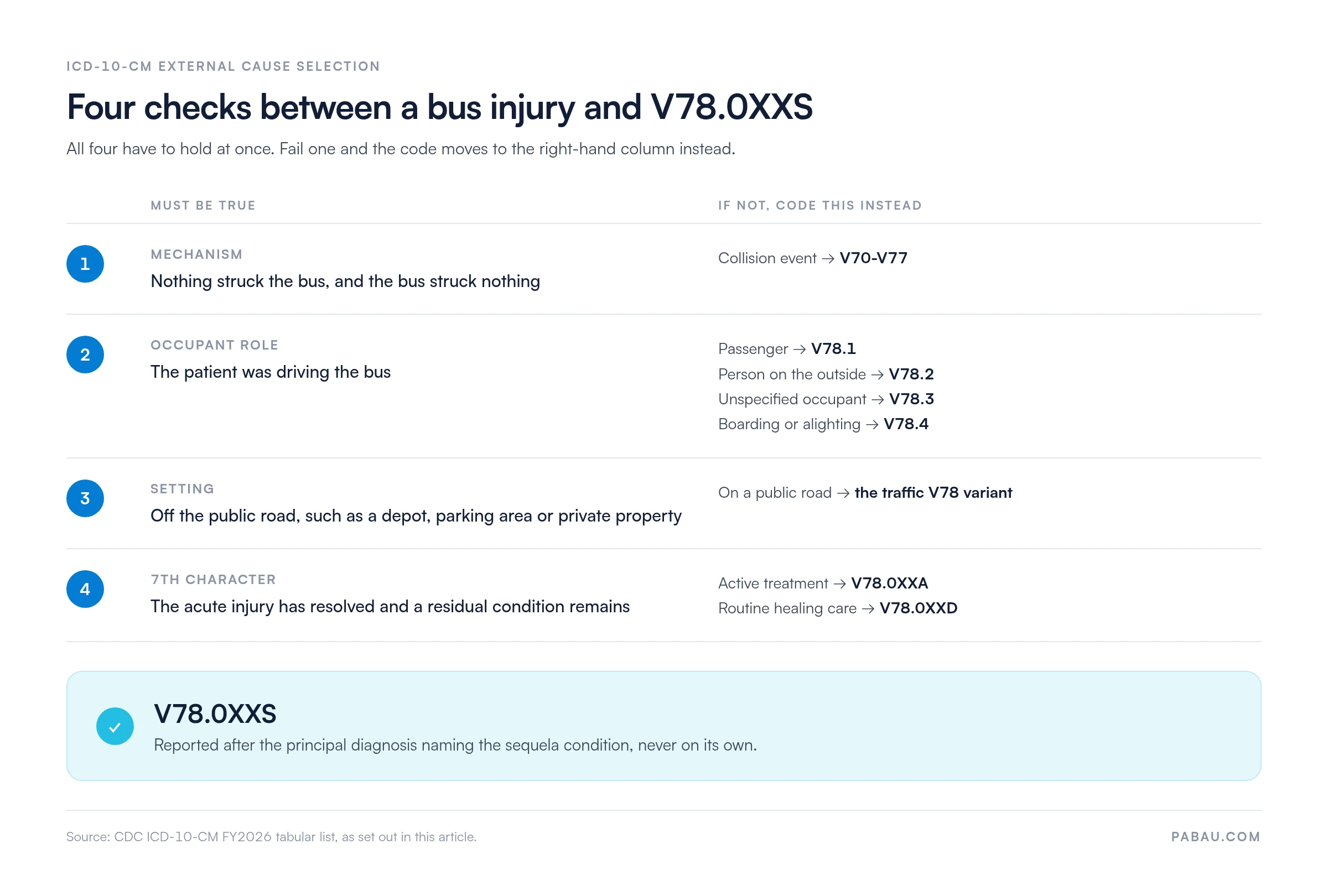
If the accident happened on a public road, the correct parent category shifts from the nontraffic to the traffic variant. The applicable code changes with it.
The 7th character S designates a sequela encounter. The provider is treating a condition that is the direct late effect of a prior injury, not the acute injury itself. Per the CMS ICD-10-CM Official Guidelines for Coding and Reporting, sequela coding requires two codes on the claim. The sequela condition code is listed first, and the external cause code carrying the S extension follows as an additional code.
A common error: Coders apply D (subsequent) when the patient returns months later with a condition traceable to the bus accident. If the acute injury has resolved and the current complaint is a residual effect, S is correct.
Document the prior injury explicitly in the medical record even during a sequela encounter. The record should state the original accident date, mechanism, and how the current condition traces directly to that event. Without this chain of causation, payers may deny the sequela claim as lacking medical necessity.
A noncollision transport accident is an injury event involving a moving vehicle, where no impact with another vehicle or object caused the injury. The CDC tabular list gives the V78 category only two Includes notes, both describing an overturning bus. The scenarios below are the mechanisms coders meet most often in this category, rather than official notes.
ICD-10-CM separates transport accidents by where they occur in relation to the public road network. The distinction directly determines which V78 subcode applies.
If the provider’s documentation does not specify the traffic/nontraffic distinction, coders cannot default to nontraffic. Query the provider, or use the unspecified variant where a query is not possible.
Understanding the ICD-10-CM hierarchy helps coders select the right code from within the V78 family and cross-reference parent-level notes. The breadcrumb from broadest to most specific is:
The CDC/NCHS ICD-10-CM web tool provides the full tabular list and index navigation for the V78 category, updated for the current code year. Checking each breadcrumb by hand does not scale across a claim batch. Claims software for coders flags any code submitted outside its valid hierarchy range before the claim leaves the practice.
V78.0XXS is one of several billable codes within the V78 category. Selecting the wrong occupant-type code is the most common mistake in this family. The table below shows the V78.x sequela codes (S extension) alongside the initial encounter (A) and subsequent encounter (D) variants for the driver role.
For a broader cross-reference of ICD-10-CM codes by keyword, the AAPC Codify ICD-10-CM lookup lists all V78 child codes and their descriptions. The WHO ICD-10 browser numbers the international transport accident block V01-V99, which is why some references differ from the CDC’s V00-V99 range.
The CDC tabular list attaches no Excludes1 or Excludes2 note to V78, which surprises coders who expect one on every external cause category. What the category does carry is two Includes notes, and both describe an overturning bus.
Separation from collision events therefore comes from the structure of the code block rather than from an exclusion note. A bus injury caused by an impact belongs in V70-V77, not in V78. Where the striking vehicle is never specified, the traffic collision sequela for an unspecified bus occupant is V79.60XS.
For sequela encounters, the ICD-10-CM Official Guidelines (Section I.C.20) place the external cause code with the S extension after the sequela condition code. That ordering decides how the claim lines are sequenced. Reversed code order is a common denial trigger, so a clean claim check should confirm the sequence before the file is transmitted.
Providers and patients rarely use the precise ICD-10-CM descriptor when documenting or describing an injury. These lay terms and alternate phrasings map to V78.0XXS and may appear in intake forms, insurance correspondence, or prior medical records.
A referring provider may use one of these phrasings without stating “nontraffic” or “noncollision” anywhere in the record. The treating facility then has to query the originating provider before assigning V78.0XXS.
External cause codes, including V78.0XXS and fall codes such as W00.1XXS, are exempt from Present on Admission (POA) reporting. POA indicators apply to diagnosis codes, so facilities assign none to V78.0XXS on an inpatient claim. Standard diagnosis codes work differently, since POA status there affects hospital reimbursement and quality metrics.
For claim submission, V78.0XXS is valid for HIPAA-covered electronic transactions when it is reported as an additional code. Validation at the clearinghouse stage catches an external cause code that arrives without a paired principal diagnosis, before the 837P file is transmitted. Review denial codes for the rejection reasons payers attach most often to external cause codes.
Code lookup pages describe what V78.0XXS means, but rarely say what the medical record itself has to contain. These are the minimum documentation elements needed before a coder can defensibly assign V78.0XXS on a sequela claim.
Flag V78.0XXS claims for secondary review if the original injury occurred more than two years prior. Long gaps between the injury date and the sequela encounter increase payer scrutiny. Ensure the provider note explicitly documents the causal link. Attach any supporting imaging, therapy records, or specialist notes that trace the current condition to the accident.
Most practices catch a V78.0XXS ordering error the slow way. A coder assigns the pair from memory and the claim goes out. Weeks later the payer returns it with a rejection that someone has to research before it can be corrected.
Practice management software like Pabau moves that check to the point of coding. Diagnosis codes are held against the encounter in the patient record. The sequela condition and its external cause code stay attached to the same visit. Claims are validated and submitted electronically, which surfaces an unpaired external cause code while the coder still has the chart open.
For a billing team handling transport accident claims, that means fewer rejections to rework and a shorter wait for payment. The documentation trail behind each sequela claim also stays in one place. That matters when a payer asks how the residual condition connects to an accident from two years ago.

Pabau’s claims management tools help practices validate ICD-10-CM external cause codes, pair sequela codes correctly, and submit clean claims the first time. See how it works for your billing team.

V78.0XXS covers a narrow scenario. A bus driver was injured in a noncollision, off-road accident, and now presents with a late-effect condition. The documentation carries the whole claim, because those four qualifiers exist only in the provider’s own words.
Treat the code as the second half of a pair. Assign the residual condition first, attach V78.0XXS behind it, and the POA exemption takes care of itself. Where the record does not name the setting or the driver role, query before you submit rather than after a denial.
Pabau’s claims management tools validate external cause pairings before a claim is transmitted. Book a demo to see how your billing team can clear sequela claims without a manual code-order check.

List Item #1
List Item #2
ICD-10 code V78.0XXS is the billable ICD-10-CM diagnosis code for a bus driver injured in a noncollision transport accident in a nontraffic setting. The current encounter treats a sequela, meaning a late effect of that injury. It is valid for HIPAA-covered transactions under the 2026 ICD-10-CM edition, effective October 1, 2025. Report it as an additional code alongside the principal sequela condition diagnosis.
Yes, V78.0XXS is a billable, specific ICD-10-CM code valid for HIPAA-covered electronic transactions. It cannot be used as a standalone code – it requires a principal diagnosis code identifying the residual condition being treated in the sequela encounter.
The 7th character S designates a sequela encounter. The provider is treating a condition that is the direct late effect of a prior injury, not the acute injury itself. It differs from D (subsequent encounter), which applies when routine care for the healing injury is still ongoing. Once the original injury has clinically resolved and a residual condition remains, S is the correct extension.
A nontraffic accident occurs off a public roadway, such as in a bus depot, parking lot, or on private property. The vehicle is not part of general traffic flow there. A traffic accident occurs on or adjacent to a public road open to general traffic. The distinction changes the applicable V78 subcode, so provider documentation must specify the setting.
A noncollision transport accident is an injury event involving a moving vehicle. The injury was not caused by that vehicle striking another vehicle or a fixed object. For bus occupants, common noncollision mechanisms include falls inside the bus, injuries from sudden braking, or bus overturning without a prior collision impact.
The V78 category covers bus occupants injured in noncollision transport accidents. Key related codes include V78.0XXA and V78.0XXD, the driver’s initial and subsequent encounters. The sequela codes for other occupants are V78.1XXS for a passenger, V78.3XXS for an unspecified occupant, and V78.4XXS for a person boarding or alighting. The correct code depends on the occupant’s role, the encounter type, and whether the accident was traffic or nontraffic.