ICD-10 Code Y74.2: General hospital and personal-use implant failure
ICD-10 code Y74.2: Definition, descriptor, and billable status ICD-10 code Y74.2...

Last Updated: Oct 29, 2026
Billable Code Specific Code
T87.31 is the billable ICD-10-CM code for neuroma of amputation stump, right upper extremity. It covers a painful nerve overgrowth at the cut end of a nerve after an arm or hand amputation. The code sits in Chapter 19 under category T87 (Complications peculiar to reattachment and amputation), and it needs precise sequencing and documentation.
Two errors cause most trouble with this code. Coders use the unspecified sibling T87.30 (or the non-billable parent T87.3) when laterality is documented. Or they confuse stump neuroma pain with phantom limb pain, which codes separately to G54.6.
Let Pabau's smart automation suggest the right codes, reduce claim denials, and keep your practice compliant—effortlessly.
Automate repetitive tasks and focus on what matters most—your patients.
Reduce coding errors and ensure compliance with the latest regulations.
Clean claims, fewer denials, and faster reimbursements.
Powerful insights and reporting to help your practice thrive.
HIPAA compliant SOC 2 certified GDPR-compliant Trusted by 4,000+ clinics worldwide

T87.31 is the billable code for neuroma of a right upper extremity amputation stump. Neither the parent T87.3 nor the unspecified T87.30 replaces it when laterality is documented.
T87.31 is a complication-of-amputation code with no 7th character, not a sequela code. List it first when the neuroma is the focus of the encounter.
Phantom limb pain is coded to G54.6, not T87.31. The two conditions present differently, and payers reject a claim that conflates them.
Pabau’s claims management software scrubs claims for missing or invalid details before submission through Claim.MD.
ICD-10 code T87.31 is the billable ICD-10-CM code for neuroma of amputation stump, right upper extremity.
It describes a painful nerve overgrowth at the cut end of a nerve after an arm or hand amputation. The code is valid for HIPAA-covered transactions in the current fiscal year, and the table below lists the fields coders check before submitting a claim.
A neuroma of the amputation stump is a non-neoplastic nerve overgrowth that forms when a severed peripheral nerve tries to regenerate after amputation. In the right upper extremity, it typically involves the median, ulnar, or radial nerve at the residual limb. The result is a firm, tender nodule that hurts sharply or burns on palpation, and often during prosthetic use.
Clinically, T87.31 applies when stump pain comes from a demonstrable neuroma rather than from infection, wound dehiscence, or phantom sensation. That distinction drives both code selection and payer review. A tender nodule at the stump end, reproducible with direct palpation, is the core documentation anchor for this code.
The parent code T87.3 is not billable. ICD-10-CM requires one of five child codes, each naming the condition (neuroma) and the affected limb with its laterality. Select the child code that matches the patient’s documented amputation site.
Note that T87.33 covers the right lower extremity. Coders who scan the list and stop at “right” often pick it by mistake. Always confirm the limb type (upper vs. lower) against the clinical documentation before finalizing the code.
Phantom limb pain is coded to G54.6, not T87.31, and the two codes are not interchangeable for the same symptom. The clinical distinction hinges on where the pain is perceived. Neuroma pain is localized to the physical stump and reproducible by palpating a specific point. Phantom pain is felt in the missing limb itself, with no palpable stump trigger.
A patient can have both conditions at once. In that case, report both T87.31 and G54.6, and sequence each according to the focus of the encounter.
T87.31 is one of several distinct complication codes within category T87. Picking the wrong sibling is a documentation accuracy issue that payers flag during clinical review. The exam finding in the note decides which code applies, as the decision path below shows.
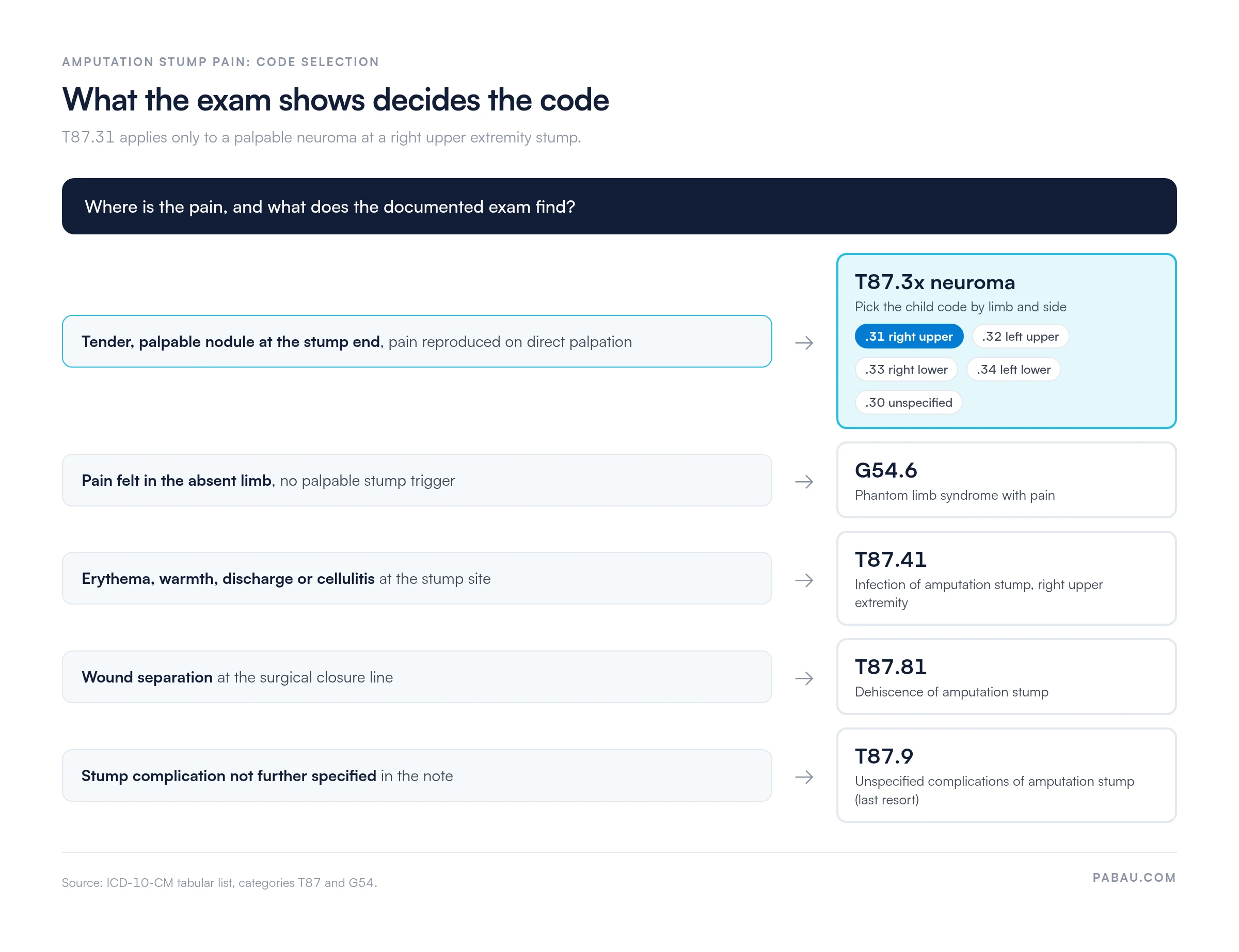
The table below sets out the codes most often confused with T87.31 and the clinical trigger for each.
T87.31 is a complication-of-amputation code. It has no 7th character, and ICD-10-CM does not treat it as a sequela (late-effect) code. Report it as the principal or first-listed diagnosis when the neuroma is the focus of care. Sequencing on complication codes like this one is a routine check in medical billing compliance audits.
Follow this sequence for T87.31 encounters:
When a neuroma is excised, T87.31 is paired with a CPT code for the neurectomy. The choice depends on which nerve is involved. 64782 covers a hand nerve other than a digital nerve, and 64783 adds each further hand nerve. 64784 covers a major peripheral nerve. Always check the current-year CPT book for editorial revisions before billing.
Append the RT (right side) modifier to the CPT code so it matches the laterality of T87.31. Payers audit CPT-to-ICD-10 linkage for laterality, and an LT modifier on a T87.31 claim is an immediate mismatch.
Z89 status codes give payers the amputation history behind the claim. They are commonly added to show amputation level, per payer policy. When you add one, match it to the level documented in the clinical record.
Medicare and most commercial payers require clinical documentation that supports medical necessity before approving T87.31 claims. That matters most when the claim includes a neuroma excision. Thin documentation is a common trigger for clinical review requests on this code, and sound medical billing documentation practices keep those requests to a minimum.
Payers commonly require the following elements, though specific requirements vary by payer and plan:
Flag the amputation level and laterality in a dedicated problem list entry in your practice management system. Coders working from encounter notes alone often miss laterality, because it appears only in the patient’s past medical history and not in the chief complaint. A consistent problem-list entry puts laterality in front of the coder at every future T87.31 encounter.
Most T87.31 denials trace back to laterality errors or thin documentation. Both are avoidable with a structured pre-submission review. Solid denial management workflows catch most of them before the claim leaves the practice.
The ICD-9-CM to ICD-10-CM mapping for T87.31 is a one-to-many crosswalk, because ICD-9 did not carry the same laterality specificity. Practices using legacy systems for prior authorization lookups should treat any ICD-9 crosswalk as approximate. Verify coverage under the current ICD-10-CM code with the payer directly.
According to the CMS General Equivalence Mappings (GEMs), T87.30–T87.34 map from ICD-9-CM 997.61 (Neuroma of amputation stump), a one-to-many split by limb and laterality. Use this crosswalk for historical research only, not for current claim submission.
A laterality-specific code like T87.31 leaves little room for error on the claim. The standard for submitting a clean claim on stump neuroma encounters starts with correct ICD-10 specificity and a matching CPT laterality modifier. Where the payer expects one, it also includes a Z89 status code.
Pabau, the practice management platform we build, handles that work in its claims management software. Pabau scrubs each claim for missing or invalid details before submission, and sends it through Claim.MD. Through that integration, CMS-1500 claims reach thousands of US payers, and eligibility checks run before the visit.
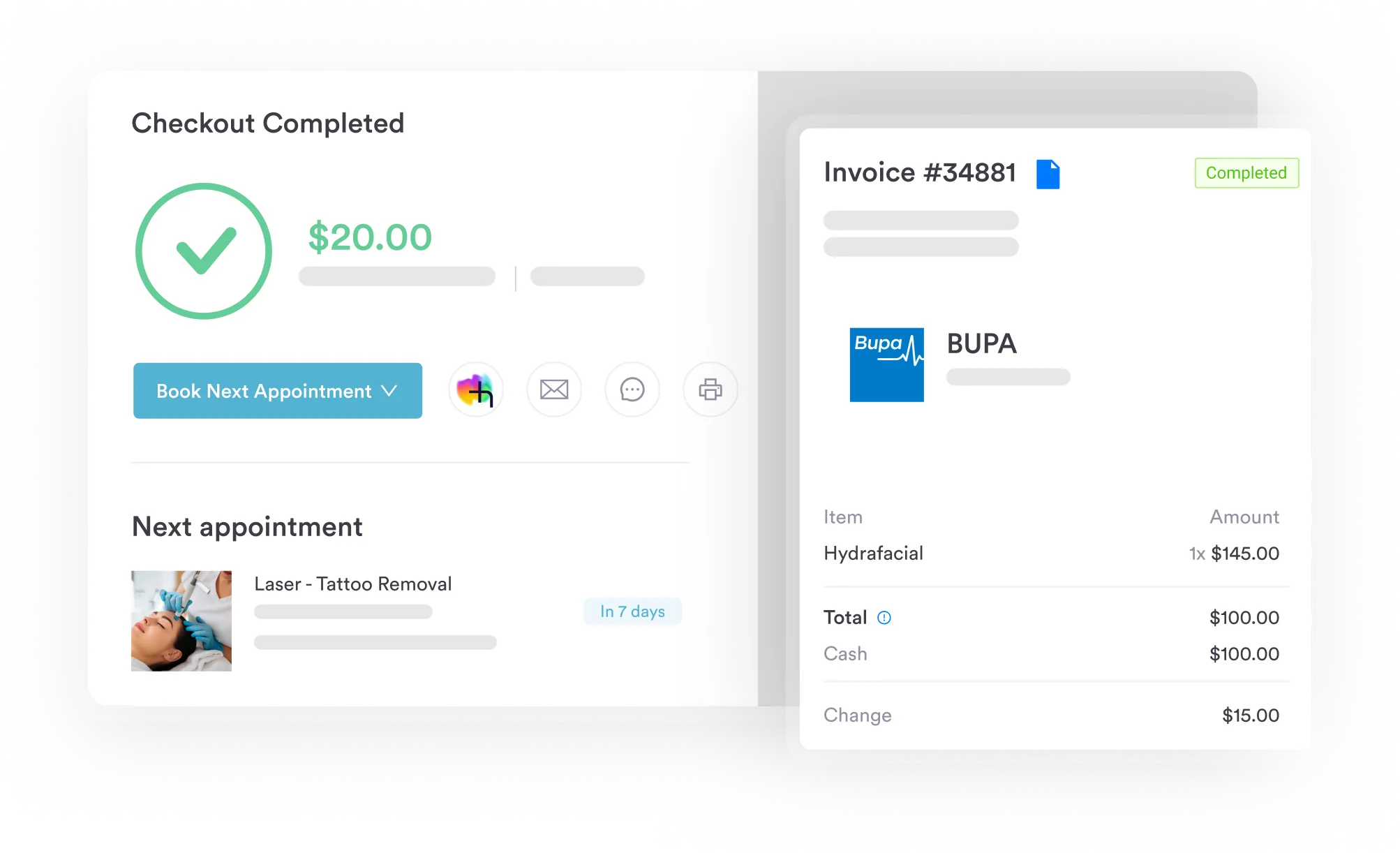
Claim.MD also returns electronic remittance advice on each claim. When a T87.31 claim is denied, the CARC denial codes show whether laterality, medical necessity, or sequencing caused it. Coders can then apply the right fix.

Pabau scrubs each claim for missing or invalid details before submission, and sends it through Claim.MD to thousands of US payers. See how it works for your practice.

Code T87.31 only when the note documents a tender, palpable neuroma at a right upper extremity stump. If the pain sits in the absent limb, G54.6 is the code, and both can apply in the same visit. A problem-list entry that records amputation level and laterality prevents most rework. No coder then has to dig those details out of the history.
Pabau scrubs each claim for missing or invalid details and sends it through Claim.MD. Incomplete T87.31 claims are caught before a payer sees them. Book a demo to see how Pabau handles claims for amputation stump coding in your practice.

Want to see how clearinghouse submission works end to end? Pabau’s Claim.MD clearinghouse integration explains how claims, eligibility checks, and remittance flow through Claim.MD.
Need guidance on managing denied amputation-related claims? Denial codes in medical billing covers the most common CARC codes and corrective workflows for ICD-10-CM rejections.
Looking for a broader overview of the claims submission process? Revenue cycle management fundamentals outlines how ICD-10 coding fits into the end-to-end claim-to-payment workflow.
ICD-10 code T87.31 is the billable ICD-10-CM diagnosis code for neuroma of amputation stump, right upper extremity. A stump neuroma is a painful nerve overgrowth at the cut end of a peripheral nerve after arm or hand amputation. The code sits in Chapter 19 under category T87 (Complications peculiar to reattachment and amputation), and it is a complication-of-amputation code, not a sequela code.
T87.31 is neuroma of the amputation stump in the right upper extremity (arm or hand). T87.33 is neuroma of the right lower extremity (leg or foot). Both are right-sided, but they cover different limbs. Selecting T87.33 for an arm stump neuroma is a coding error that payer audits will catch. Always confirm upper vs. lower extremity from the clinical documentation.
T87.31 codes pain arising from a palpable neuroma at the physical stump. G54.6 codes pain perceived in the absent (phantom) limb with no identifiable stump trigger. The key clinical differentiator is whether directly palpating a tender nodule at the residual limb end reproduces the pain. Both codes can be reported together if a patient has both conditions.
Report T87.31 as the principal or first-listed diagnosis when the neuroma is the focus of the encounter. It is a complication-of-amputation code with no 7th character, not a sequela code. A Z89.x status code is commonly added to show amputation level, per payer policy, matched to the documented level.
The most common cause is submitting T87.30 (unspecified) when laterality is documented. A CPT laterality modifier that conflicts with T87.31, such as LT on a right-side procedure, is another. Thin medical necessity documentation and wrong sequencing, where the original amputation code is listed ahead of T87.31, round out the list.
The ICD-9-CM source code is 997.61 (Neuroma of amputation stump). Under the CMS General Equivalence Mappings (GEMs), T87.30–T87.34 map from 997.61, a one-to-many split by limb and laterality. Use the crosswalk for historical research or legacy lookups only, not for current claim submission.