ICD-10 Code Y74.2: General hospital and personal-use implant failure
ICD-10 code Y74.2: Definition, descriptor, and billable status ICD-10 code Y74.2...

Last Updated: Oct 29, 2026
Billable Code Specific Code
T86.92 is the billable ICD-10-CM code for unspecified transplanted organ and tissue failure. It records failure of a transplanted organ or tissue when the documentation does not name the organ.
The code sits under the non-billable subcategory T86.9 in category T86. Once the record identifies the organ, the organ-specific failure code applies instead, such as T86.12 for a kidney transplant.
Let Pabau's smart automation suggest the right codes, reduce claim denials, and keep your practice compliant—effortlessly.
Automate repetitive tasks and focus on what matters most—your patients.
Reduce coding errors and ensure compliance with the latest regulations.
Clean claims, fewer denials, and faster reimbursements.
Powerful insights and reporting to help your practice thrive.
HIPAA compliant SOC 2 certified GDPR-compliant Trusted by 4,000+ clinics worldwide

ICD-10 Code T86.92 is billable in current ICD-10-CM and reports failure of a transplanted organ or tissue when the record does not identify the organ.
It sits in Chapter 19, block T80-T88, under category T86 and the non-billable subcategory header T86.9.
Once the organ is documented, its own failure code replaces T86.92, such as T86.12 for a kidney or T86.42 for a liver.
The fifth character records the complication type. Rejection is T86.91, failure T86.92, infection T86.93, and other complications T86.99.
Pabau, the practice management platform we build, submits claims through Claim.MD, tracks their status, and reconciles the ERAs that come back.
ICD-10 Code T86.92 is a billable, five-character code in current ICD-10-CM for failure of a transplanted organ or tissue that the record does not identify. ICD-10-CM is the diagnosis code set the Centers for Medicare and Medicaid Services (CMS) requires on HIPAA claims. It places T86.92 in Chapter 19, block T80-T88, under category T86 (Complications of transplanted organs and tissue).
The official descriptor is “Unspecified transplanted organ and tissue failure.” In that descriptor, “unspecified” describes the organ, not the complication. The failure itself must be documented. The table below summarizes the key classification facts.
Verify billable status against the current year’s CDC/NCHS ICD-10-CM tool before submission, because annual updates can change code validity across the T86 category.
T86.92 covers documented failure of a transplanted organ or tissue when the record does not say which organ or tissue was transplanted. The provider must describe the transplant as failing, not only note that the patient has had one.
Under the ICD-10-CM Official Guidelines, a T86 code is assigned only when the complication affects the function of the transplanted organ. Transplant failure meets that test by definition.
Scenarios where T86.92 may apply include:
T86.92 depends on the organ being missing from the record itself. If the organ appears anywhere in the current record, use it and assign the organ-specific failure code. The specificity principle in the Official Guidelines makes T86.92 a fallback, never the first choice.
T86.92 does not apply once the transplanted organ is documented. Each organ-specific subcategory in T86 has its own failure code, and that code replaces T86.92.
The organ-specific codes that take precedence when documentation names the organ:
Two other situations sit outside T86.92. Graft-versus-host disease is reported with a code from D89.81-, not with T86.92. A transplant patient with no documented complication gets a Z94.- transplant status code instead of any T86 code.
Subcategory T86.9 is a non-billable header with five billable children. In each one, the record does not identify the organ, and the fifth character names what went wrong.
The key distinction: T86.92 means the provider documented failure. If the note says rejection, report T86.91, and if it says infection, report T86.93. A complication with no stated type takes T86.90. Submitting the T86.9 header returns an invalid-code edit.
Sequencing for T86.92 follows the ICD-10-CM Official Guidelines for Coding and Reporting, Section I.C.19.g.3. Before assigning it, confirm that the failure is the reason for the encounter or that it affects care during the encounter.
Four sequencing scenarios come up most often. In each, the code order tells the payer which condition drove the visit, a basic rule of medical billing.
Query the attending provider before settling on T86.92. The record should state which organ or tissue was transplanted, that the transplant has failed, and how the failure affects the current encounter. Once the organ is documented, the code moves from T86.92 to the organ-specific failure code.
Medicare, Medicaid, and commercial payers each apply medical necessity criteria before paying claims that carry ICD-10 Code T86.92. CMS publishes no national coverage determination (NCD) specific to T86.92. Payer policies and the Local Coverage Determinations (LCDs) for the billed service govern acceptance instead.
Medical necessity documentation for T86.92 claims generally includes:
Also check prior authorization requirements for transplant follow-up visits, because some commercial payers tie authorization to the specific organ transplanted. A clean claim submission for a T86.92 encounter includes complete patient demographics, a valid rendering provider NPI, and codes for the documented complication.
Payers can question an unspecified-organ code, because transplant claims often carry other clues to the organ. Most T86.92 denials fall into five categories, and each has a fix your denial management process can apply.
The claim denial codes on a T86.92 remittance show which of these problems the payer flagged. Match each one to the list above before you correct and resubmit the claim.
Clinical documentation improvement (CDI) specialists can often replace T86.92 with an organ-specific code through a targeted provider query. A second question confirms that failure, rather than another complication, is what the provider means.
Use this two-step query sequence when T86.92 is the provisional code:
Read the two answers together, as the decision path below shows. If the provider confirms the organ, report that organ’s code for the documented complication, such as T86.12 for kidney transplant failure.
If the organ stays unknown, the complication type picks the T86.9 code. Failure keeps T86.92, rejection moves to T86.91, infection moves to T86.93, and another named complication moves to T86.99.
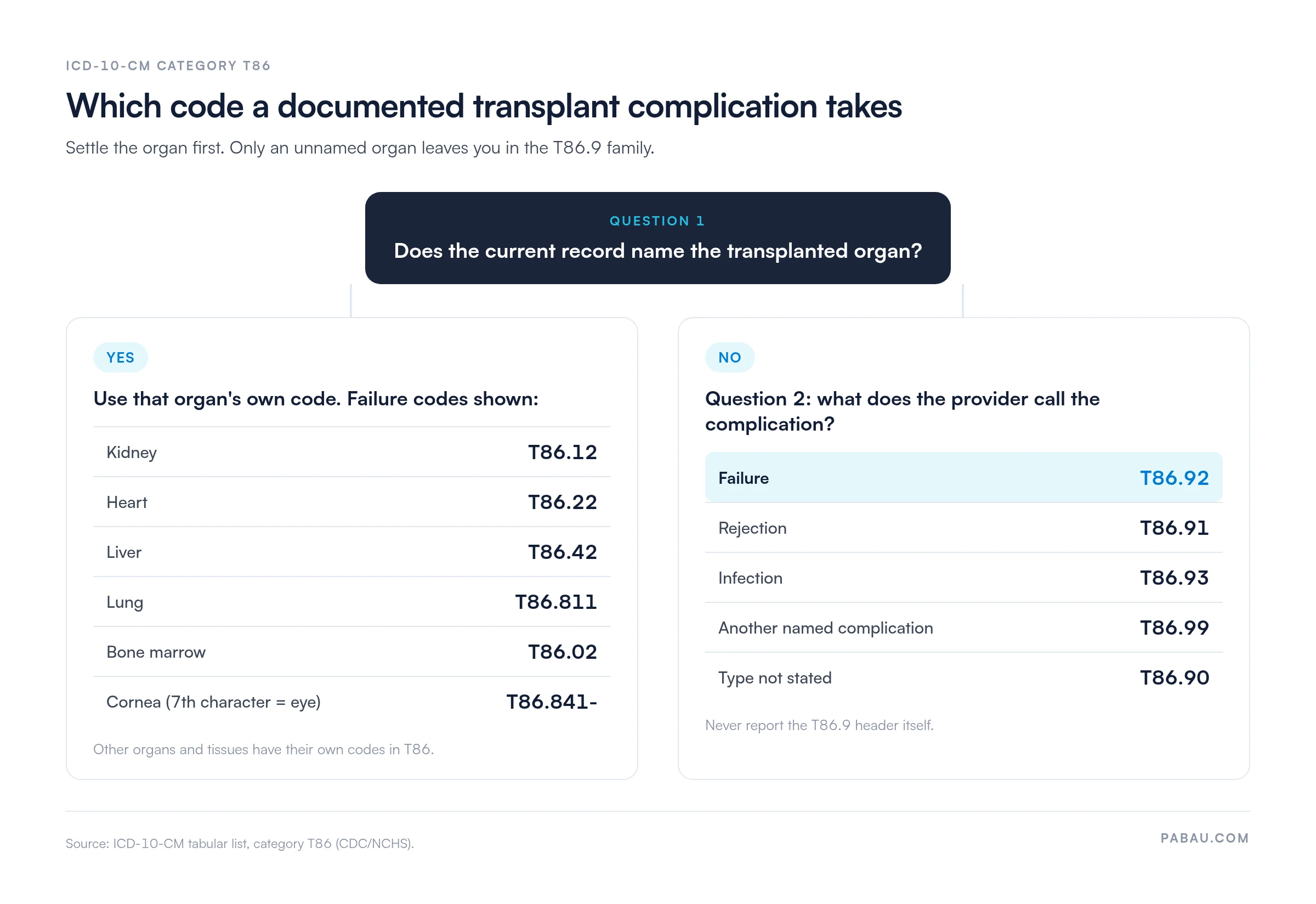
Good medical billing compliance practice requires documenting the query and the provider’s response in the record. That record supports the final code assignment and answers payer audit requests.
Before submitting a T86.92 claim, check the procedure codes on the same claim. A procedure that implies a specific organ, such as renal dialysis, points to an organ-specific code instead. Catching that before submission avoids a denial and resubmission cycle.
A T86.92 claim often needs a second look. The payer may question the unspecified organ, and the remittance can return a denial code your team has to trace back to the record. That trail usually runs across a clearinghouse portal, a spreadsheet, and the chart.
Pabau’s claims management software submits the claim through Claim.MD and tracks its status alongside your schedule and patient records. When the ERA arrives, Pabau reconciles it against the claim, so the denial code sits next to the encounter it belongs to.
Your coder sees a rejected T86.92 claim the day the response lands. The provider query can then go out while the encounter is still fresh, and fewer claims age out while someone hunts for the remittance.

Pabau’s US claims management submits your T86.92 claims through Claim.MD, tracks each claim’s status, and reconciles the ERAs that come back. Your team sees payer responses in one place and can act on a rejection sooner.

Treat T86.92 as a holding code. It fits only when the provider documents failure and no source in the current record names the organ.
That puts the work before submission. Send the two-step query, check the procedure codes on the claim for an organ clue, and confirm the fifth character. A few minutes there cost less than a denial, a corrected claim, and a second wait for payment.
The trade-off is speed. Holding the claim for a provider answer slows submission, but it heads off the payer question an unspecified-organ code tends to attract. Book a demo to see how Pabau tracks each transplant claim from submission to remittance.

Want to understand how a clearinghouse handles your claims? Pabau’s Claim.MD clearinghouse guide explains how a claim travels from your practice to the payer through a clearinghouse.
Want to reduce overall denial rates across your billing workflow? Understanding electronic remittance advice (ERA) covers how to read 835 files and CARC denial codes to identify patterns across T86 and other transplant claims.
Looking for guidance on insurance eligibility verification before transplant follow-up visits? Insurance eligibility verification outlines how to confirm active coverage and LCD restrictions before the appointment.
ICD-10 Code T86.92 is the billable ICD-10-CM code for unspecified transplanted organ and tissue failure. It sits in Chapter 19 under category T86 (Complications of transplanted organs and tissue). Use it when the provider documents failure of a transplant but the record does not identify the organ.
Use T86.92 when the provider documents failure and the organ remains unidentified. T86.90 covers a complication of unstated type, T86.91 rejection, and T86.93 infection. T86.99 covers any other named complication. All five are billable, but their parent, T86.9, is a non-billable header.
Yes. T86.92 can be the principal diagnosis when transplant failure is the condition chiefly responsible for the encounter. Add a secondary code that identifies the complication. Payers may question an unspecified-organ code, so the record should show why the organ could not be identified.
Common causes are an organ identifiable elsewhere on the claim, a complication type that does not match the note, and a missing secondary code. Sequencing errors and submitting the non-billable T86.9 header also cause denials. Audit each claim field against the record before submission to catch most of these.
Any transplant failure where the organ is documented takes the organ-specific code instead. Kidney failure uses T86.12, heart T86.22, liver T86.42, and lung T86.811. Rejection, infection, and other complications of an unidentified organ use T86.91, T86.93, and T86.99. Graft-versus-host disease is coded with D89.81-.