ICD-10 Code V28.01XD: E-bike driver noncollision accident, nontraffic, subsequent encounter
ICD-10 Code V28.01XD: Definition and billable status ICD-10 Code V28.01XD is the...

Last Updated: Oct 20, 2026
Billable Code Specific Code
T86.822 is the billable ICD-10-CM code for skin graft (allograft) (autograft) infection. It covers infection of a patient's own grafted skin and of donor skin, and it is complete at six characters, with no 7th character.
The code sits in category T86, complications of transplanted organs and tissue. Assigning it requires a documented prior skin graft and a provider's diagnosis of infection at the graft itself. Add a code that specifies the infection, plus a B95-B97 organism code when a culture identifies one.
Let Pabau's smart automation suggest the right codes, reduce claim denials, and keep your practice compliant—effortlessly.
Automate repetitive tasks and focus on what matters most—your patients.
Reduce coding errors and ensure compliance with the latest regulations.
Clean claims, fewer denials, and faster reimbursements.
Powerful insights and reporting to help your practice thrive.
HIPAA compliant SOC 2 certified GDPR-compliant Trusted by 4,000+ clinics worldwide

T86.822 covers infection of both allograft (donor) and autograft (patient’s own) skin grafts under ICD-10-CM category T86.
The code is billable at six characters and takes no 7th character, so T86.822A, D or S is an invalid code.
Add a code that specifies the infection, plus a B95-B97 organism code when a culture identifies the organism.
T86.822 is distinct from the T81.4- codes for surgical site infection, so the note must show the graft tissue itself is infected.
ICD-10 code T86.822 is the specific, billable code for an infectious complication of a transplanted skin graft. The CDC/NCHS ICD-10-CM code lookup tool confirms it as valid for the current fiscal year.
The full official descriptor is “Skin graft (allograft) (autograft) infection.” The parentheticals confirm that donor-derived and patient-derived graft tissue fall under the same code.
The code lives in chapter 19 of the ICD-10-CM tabular list, which covers injury, poisoning and certain other consequences of external causes. Within it, T86 is the category for complications of transplanted organs and tissue. It is complete at six characters and takes no 7th character.
That sets it apart from most chapter 19 codes, including the T81.4- surgical site infection codes it is often confused with.
The table below summarizes the key administrative attributes of T86.822 as published by CMS in the annual ICD-10-CM release.
T86.822 applies when a skin graft develops an infectious complication after the graft procedure is complete. It turns up most often in burn reconstruction, post-Mohs repair, chronic wound management in dermatology practices, and reconstructive surgery after trauma or cancer excision.
Common clinical presentations that map to this code include:
The code applies across graft types:
No. Allograft and autograft infections both take T86.822, which is why the official descriptor names both terms in parentheses.
Rejection is the one place the graft type does matter. T86.820 reads “Skin graft (allograft) rejection”, because a patient’s own skin does not trigger rejection. Failure and infection codes cover both graft types.
The allograft and autograft distinction still matters for the operative report and for CPT code selection. Document the graft type in the chart for audit defense, and the diagnosis code stays the same either way.
Understanding the parent hierarchy helps coders navigate the tabular list and confirm the correct level of specificity. The path to T86.822 runs through six levels of the CDC/NCHS ICD-10-CM tabular list. That depth is a US clinical modification, since the WHO’s international ICD-10 stops well short of T86.822.
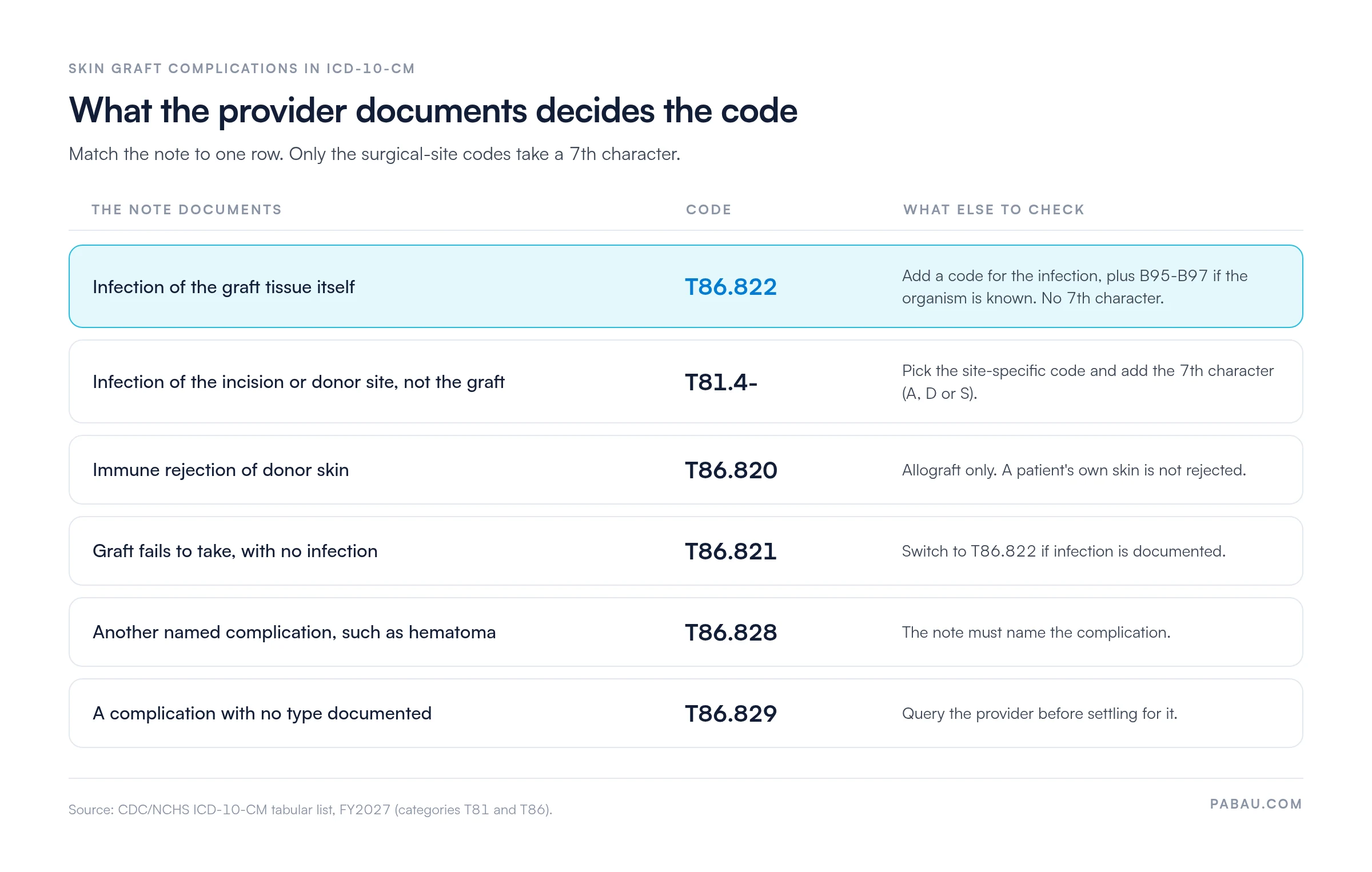
All five T86.82x codes cover different types of skin graft complications. Selecting the wrong one is the most common coding error in this group. The table below clarifies when to use each, drawing on the AAPC ICD-10-CM code reference.
Rejection (T86.820) is an immune-mediated process. The host’s T-cells recognize the donor graft as foreign and mount an inflammatory response, with no bacterial or fungal pathogen involved. Failure or non-take (T86.821) is a structural problem: the graft does not vascularize or adhere properly.
Neither condition has an infectious cause. Neither should be coded T86.822 unless infection is separately documented alongside the failure or rejection.
Infection (T86.822) requires clinical evidence of a microbial cause: a positive wound culture, documented organisms, or a clinical diagnosis of infection by the treating provider. The chart note must support this distinction, because payers audit the clinical basis for each code in this subcategory.
The T81.4- codes (infection following a procedure) are right when the surgical wound itself is infected. T86.822 is correct when the graft tissue is the infected structure. The documentation must name the site of infection, because a code that does not match the note invites a denial.
T81.4 is no longer a billable code on its own. It splits into site-specific codes such as T81.41- (superficial incisional surgical site) and T81.49- (other surgical site), and each one needs a 7th character.
Per ICD-10-CM Official Guidelines, when both a wound infection and a graft infection are documented, report both codes. Sequence them according to the principal reason for the encounter, and do not substitute one for the other. The grid below puts every skin graft scenario in one place.
No. T86.822 is a complete, billable code at six characters, and category T86 has no 7th-character extensions. Appending A, D or S turns it into a code that does not exist, and the claim comes back as an invalid-code rejection.
Most chapter 19 injury codes do take a 7th character, which is why the mistake is so common on T86 claims. Encounter stage is shown by the visit note and by sequencing, not by a suffix. The same T86.822 is reported at the first visit, at dressing changes, and at antibiotic follow-ups while the infection is active.
Late effects work differently. Once the infection has resolved, code the residual condition itself, such as a scar contracture, rather than T86.822.
The ICD-10-CM tabular list places a “use additional code to specify infection” note at T86.822. Report a code that names the infection, and add a B95-B97 organism code after it when the culture identifies the cause.
If the causative organism is not documented or the culture result is pending, do not add a B95-B97 code. Reporting an organism code without documentation is a compliance risk, not a coding shortcut.
The chart must contain each of the following elements to support T86.822 at audit. A missing element leaves the claim open to recoupment, a risk covered in our guide to medical billing compliance.
T86.822 is an ICD-10-CM diagnosis code. The CPT procedure codes are reported separately and must be medically necessary for the documented graft infection encounter. These encounters typically pair the diagnosis with debridement under CPT 97597, a wound culture, and re-grafting under CPT 15100.
Verify CPT code descriptors against the current AMA CPT code set before billing, as code descriptions and bundling edits change annually.
Claims with ICD-10 code T86.822 are denied more often than the code’s straightforward descriptor suggests. Knowing the pattern lets billing teams catch errors at the claim-building stage rather than the appeals stage. Tracking these patterns is the core of denial management workflows.
Before submitting any T86.822 claim, run a quick three-point check. First, confirm the code ends at T86.822 with no 7th character. Second, verify a B95-B97 organism code is present if culture results are in the chart. Third, confirm the chart names the original graft procedure and its date. Catching these before transmission costs seconds, and catching them after denial costs hours.
Accurate use of ICD-10 code T86.822 requires coders to verify three source documents before assigning it. They are the operative report confirming the graft procedure and type, the visit note confirming active infection, and any culture or microbiology results.
If you are new to the payer side, our overview of medical billing fundamentals shows how the diagnosis code travels with the claim.
Set your claim scrubber to flag T86.822 with any character appended. A front-end invalid-code rejection generates no remittance with a denial reason code. It often sits unworked in billing queues longer than a clinical denial does.
Most T86.822 rejections start as small slips at the billing desk. A suffix gets typed onto the code, an organism code is left off, or the chart has no graft date. Teams usually catch them only when the claim bounces, then re-key the fix by hand.
Pabau, the practice management platform we build, pre-fills each claim from the visit invoice. Its error-checking claims software scrubs every claim for missing or invalid details before it leaves Pabau. If a claim still comes back rejected, Pabau flags it as Needs action and links straight to the field to fix.
For dermatology and plastic surgery practices, graft infection claims go out clean the first time. Your billing team spends its hours on payment follow-up instead of resubmissions.

Pabau scrubs every claim for missing or invalid details before it leaves Pabau. Each claim is then tracked through to payment.

T86.822 is one of the simpler codes to get right once you trust the tabular list over habit. Code it at six characters, and pair it with an infection code and the organism when the culture names one.
The judgment call is the infected structure. When the note says graft tissue, T86.822 holds. When it says incision or donor site, a T81.4- code with its 7th character takes over, and a quick provider query beats a guess.
Get those two decisions right and skin graft infection claims stop cycling back as rejections. Book a demo to see how Pabau catches coding errors on graft infection claims before they reach the payer.

Need to understand how clearinghouse validation catches ICD-10 errors before they reach payers? Claim.MD clearinghouse overview explains how real-time scrubbing works for diagnosis and procedure code errors.
Working through a backlog of claim rejections? Electronic remittance advice (ERA) guide covers how to read 835 ERA files and match CARC denial codes to corrective actions.
Want to understand how eligibility verification reduces downstream denials? Insurance eligibility verification guide covers real-time payer checks before the claim is built.
ICD-10 code T86.822 is the billable ICD-10-CM diagnosis code for skin graft (allograft) (autograft) infection. It covers infectious complications at the site of a transplanted skin graft. It falls under category T86 (complications of transplanted organs and tissue) in chapter 19 of ICD-10-CM, and it takes no 7th character.
Yes, T86.822 is a billable ICD-10-CM code, confirmed as valid by the CDC/NCHS and CMS for current fiscal years. It is billable as a six-character code, with no 7th character. Appending A, D or S creates an invalid code that returns as a front-end rejection.
T86.820 is skin graft rejection (immune-mediated), T86.821 is skin graft failure or non-take (structural), and T86.822 is skin graft infection (microbial cause). Rejection involves the host immune system attacking donor tissue, and failure involves the graft not vascularizing. Infection involves a documented pathogen at the graft site, and only T86.822 carries the note to add a code specifying the infection.
Yes. The parenthetical in the official descriptor “(allograft) (autograft)” confirms that T86.822 applies to infection of both donor-derived and patient-derived skin grafts. The graft type does not change the ICD-10 code. It affects only the CPT procedure code and the operative report documentation.
T86.822 applies when the graft tissue itself is infected. The T81.4- codes (infection following a procedure) apply when the surgical wound or incision site is infected instead, and they need a 7th character. When documentation is ambiguous, query the treating provider. Both codes can be reported if the wound and the graft are each documented as infected.
The most common reasons are a 7th character wrongly appended, a missing infection or B95-B97 organism code, and T86.829 submitted when infection is clearly documented. Inadequate chart documentation of the original graft procedure is another. Front-end claim scrubbing catches most of these before they reach the payer.