



HCPCS code E0198: Water pressure pad billing guide
HCPCS code E0198 is a water pad for a standard mattress HCPCS code E0198 is the ...

Last Updated: Oct 13, 2026

CPT Code 20955 describes a fibula bone graft with microvascular anastomosis, used in mandibular and long-bone reconstruction.
Medicare pays 20955 at different facility and non-facility rates. Check the current figure in the CMS Physician Fee Schedule lookup tool.
The operative note has to name the fibula, the peroneal vessels, and the anastomosis technique to survive an audit.
Modifier -22 is the modifier most often contested on this code, so attach a written justification to every claim that carries it.
Practice management software like Pabau attaches CPT codes to the treatment note, so coders are not retyping them at billing.
CPT Code 20955 is the procedure code for bone graft with microvascular anastomosis; fibula. The American Medical Association (AMA) assigns it to a fibula harvest whose blood supply is reconnected at the recipient site.
The code sits in the Musculoskeletal System, Grafts and Implants subsection of the CPT manual. Unlike the simpler bone graft codes beside it, 20955 requires both a fibula harvest and a microsurgical vascular connection. If the operative note is missing either element, payers downcode or deny the claim.
Reconstructive surgery practices using claims management software can attach 20955 to the patient record at the point of care. That removes the manual transcription step behind most errors on high-value surgical claims.
The surgeon harvests a segment of the patient’s fibula together with its vascular pedicle, usually the peroneal artery and vein. That segment moves to the recipient site, where microsurgical anastomosis reconnects the blood supply.
Surgeons also call this a fibular free flap. It is used most often for mandibular reconstruction after tumor resection, long-bone defect repair, and avascular necrosis of the femoral head.
Orthopedic surgeons and plastic and reconstructive surgeons handle most of these cases. A practice treating this population needs a plastic surgery practice management system built for long operative notes.
All four elements belong in the operative note. Missing documentation of the anastomosis technique is the single most common reason 20955 claims get audited.
Medicare payment for 20955 varies by site of service and geographic locality. The CMS Physician Fee Schedule lookup tool is the authoritative source for current rates. Amounts published on third-party sites often lag the current fiscal year.
The table below covers the variables that decide the payment. No dollar figures are listed here, because rates move with every annual CMS update and shift again with the locality modifier.
Practices tracking reimbursement across high-value surgical codes get more from practice management software with procedure-level revenue reporting. It surfaces patterns a static fee schedule lookup never shows.
Relative Value Units (RVUs) determine how Medicare calculates payment. Every CPT code carries three RVU components. Each one is multiplied by a matching Geographic Practice Cost Index (GPCI), then by the national conversion factor.
The formula is Payment = [(wRVU x Work GPCI) + (PE RVU x PE GPCI) + (MP RVU x MP GPCI)] x Conversion Factor. Because 20955 carries a substantial work RVU, even a modest locality adjustment moves the final payment noticeably. Pull the values from the current CMS MPFS file rather than last year’s figures.
Audit your 20955 claims quarterly. Pull your facility vs non-facility split and compare your submitted amounts against the current CMS conversion factor. A single missed GPCI update on a high-wRVU code like this can create hundreds of dollars in variance per case.
Modifiers tell payers about the circumstances around a procedure. For 20955, the ones that matter cover procedural complexity, laterality, and multiple-procedure billing. A wrong modifier, or a missing one that was justified, changes both the payment and the audit risk.
Modifier -22 is the one payers contest most on this code. They want a separate written justification attached to the claim, explaining why the work went well beyond the typical service. “Complex case” on its own will not carry it. Name the specific factors, such as operative time, vascular anomalies, or scarring from earlier treatment. Coding sits in the middle of the revenue cycle, between registration and payment posting.
Every CPT claim needs a diagnosis code that establishes medical necessity. The ICD-10-CM codes below cover the most common clinical indications for 20955. A mismatch between the diagnosis and the procedure is a top denial trigger on high-complexity surgical claims.
Code to the highest level of specificity. For fracture codes, that means laterality, fracture type, and encounter type. Use A for the initial encounter, D for a subsequent one, and S for sequela. An unspecified fracture code billed when the chart documents the side is a correctable error that delays payment.
The National Correct Coding Initiative (NCCI) defines which procedure codes bundle together and cannot be billed separately. For 20955, bundling questions come up around closure codes, vascular access codes, and other grafting codes reported in the same session.
Edit pairs change quarterly, so check the current CMS NCCI tables before you submit. The guidance below covers the general principles rather than the pairs in force for any one quarter.
When an NCCI edit flags a pair, the modifier indicator tells you what you can do about it. A “1” means a valid modifier such as -59 or XS can bypass the edit. A “0” means the edit is absolute. Check the indicator before you append any bypass modifier.
Coders working with 20955 mostly need to separate it from the bone graft codes sitting beside it. The microvascular anastomosis requirement is the dividing line.
Which code you pick inside this family depends entirely on the donor site named in the operative note. An iliac crest harvest billed as 20955 is a coding error even when the microsurgical technique was identical. Donor site specificity is the first audit checkpoint for the whole series.
Craniofacial reconstruction sits in a different family again. 21179 covers reconstruction of the forehead and supraorbital rims with grafts, which is recipient-site work rather than a vascularized harvest. The AMA’s coding resources carry the official manual definitions for each code.
Prior authorization for 20955 varies by payer. Most commercial insurers require it for elective reconstructive procedures involving microvascular surgery, given the cost and the operative complexity. Medicare does not require it for most inpatient surgical procedures, though individual Medicare Advantage plans set their own rules.
Document medical necessity clearly in the request. Payers are looking for four things:
A denied authorization can often be overturned at peer-to-peer review when the clinical documentation is complete. HIPAA-compliant billing workflows keep that documentation moving securely between the practice and the payer.
Clean claims for 20955 depend on operative notes that spell out each element of the procedure. Payer auditors and Recovery Audit Contractors look for specific language. A vague “bone graft with repair” does not support 20955, and it will trigger a records request or a denial.
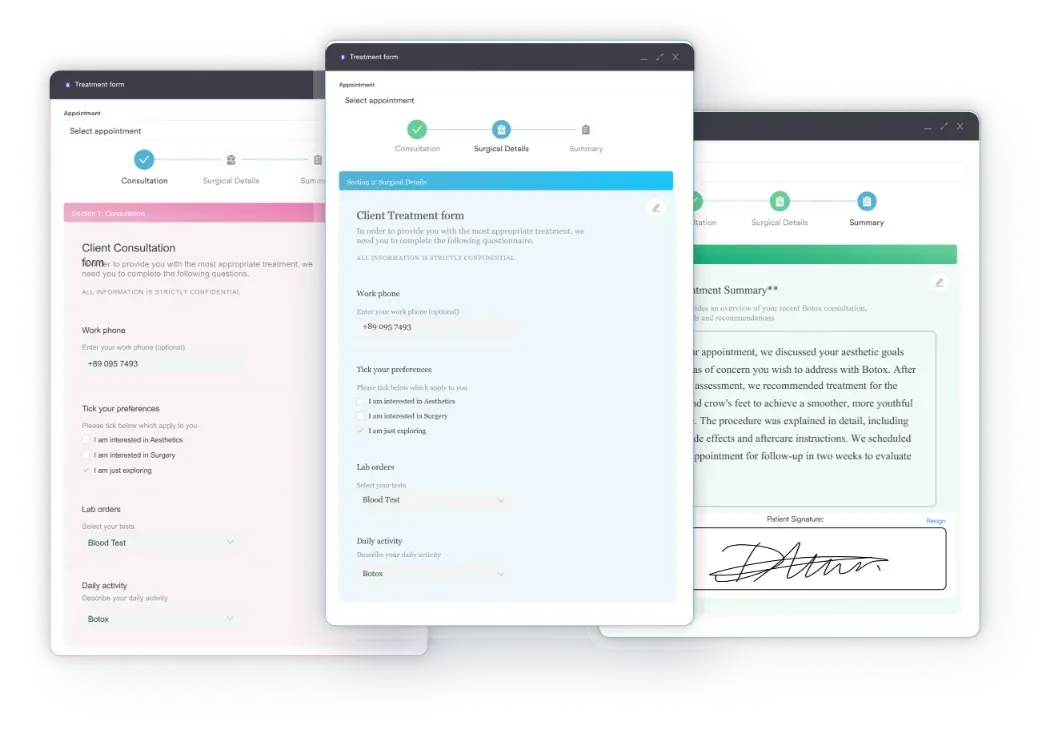
Practices using digital intake forms tied to the surgical workflow capture structured pre-operative data. The clinical record and the billing claim then tell the same story.
Run a pre-claim documentation checklist on every 20955 submission. Confirm the operative note names the fibula as the donor site, identifies the peroneal vessels, and describes the anastomosis technique. A 10-minute review prevents a 45-day denial cycle.
Most reconstructive practices code 20955 twice. The surgeon dictates the operative note, and a coder reads it back days later. That coder then retypes the code, the modifier, and the diagnosis into a separate billing system.
Practice management software like Pabau keeps all of it on one record. The CPT code, the modifier, and the paired ICD-10 code attach to the treatment note as it is written. Consent forms, imaging notes, and clinical photos sit on the same patient file.
So when a prior authorization request or a records request lands, nothing has to be hunted down. For orthopedic, reconstructive, and sports medicine practices, that means fewer denials traced back to a transcription slip.

Pabau attaches CPT codes, modifiers, and ICD-10 pairings directly to the treatment note. Coders build accurate claims without leaving the platform.

CPT Code 20955 pays well because the work is hard, and payers scrutinize it for the same reason. What separates an approved claim from a downcode is almost always the anastomosis description in the operative note.
Fix the note template once and the rest follows. Name the donor site, name the peroneal vessels, describe the anastomosis, and record the patency check. Your coder then has everything needed on the first pass, and a modifier -22 justification takes minutes rather than an afternoon.
Book a demo to see how Pabau ties CPT coding to the clinical record for reconstructive surgery teams.

Coding craniofacial trauma alongside the flap? 21422 covers open treatment of a palatal or maxillary fracture, a frequent neighbor to mandibular reconstruction.
Need the fracture side of the claim right? S62.163P shows how the seventh character changes a fracture code once malunion is documented.
Coding a urethral disorder from another disease? ICD-10 code for urethral disorders covers this manifestation code and the sequencing instruction that sits above it in the tabular list.
Coding a UTI without a specific site? ICD-10 code for urinary tract infection classifies urinary tract infections when the anatomical site is not clinically specified.
Billing spinal reconstruction too? 22212 walks through osteotomy of the thoracic spine, another high-RVU musculoskeletal code.
CPT Code 20955 is bone graft with microvascular anastomosis using the fibula as the donor site. It covers harvesting a fibula segment with its vascular pedicle and reconnecting that blood supply at the recipient site. It is used mainly for mandibular reconstruction, long-bone defect repair, and avascular necrosis cases.
Medicare reimbursement for CPT 20955 varies by locality and site of service. The CMS Physician Fee Schedule lookup tool is the authoritative source. Rates change each January with the annual MPFS update. Facility rates sit below non-facility rates, because the facility absorbs the overhead separately.
The modifiers used most often are -22 for increased procedural services, -51 for multiple procedures, -62 for two surgeons, and -80 for an assistant surgeon. Modifier -50 may also apply, but confirm the bilateral indicator in the current MPFS file before you use it.
Yes, NCCI bundling edits apply to CPT 20955. Component services inherent to the procedure bundle into the primary code and cannot be billed separately. That includes vessel dissection, wound closure, and surgical preparation. Edit pairs change quarterly, so verify against the current CMS NCCI tables before submitting additional codes.
Prior authorization requirements depend on the payer. Most commercial insurers require pre-authorization for 20955, given the cost and complexity of microvascular reconstruction. Medicare fee-for-service generally does not require it for inpatient cases. Medicare Advantage plans and Medicaid programs set their own rules, so verify with the payer before scheduling.
Common pairings include M87.059 for idiopathic aseptic necrosis of the femur and C41.1 for malignant neoplasm of the mandible. Trauma cases often use S82.409A, infection cases M86.00, and congenital cases Q74.2. Code to the highest level of specificity, including laterality and encounter type where they apply.



