ICD-10 code S61.201A: Open wound of left index finger without nail damage
ICD-10 code S61.201A covers a left index finger wound of unstated type ICD-10 co...

Last Updated: Oct 16, 2026
Billable Code Specific Code
T86.39 is the billable ICD-10-CM code for other complications of heart-lung transplant. It applies only to patients who received a combined heart-lung transplant, and only when the documented complication falls outside rejection, failure, and infection.
The code sits at the residual end of the T86.3x subcategory, below T86.31, T86.32 and T86.33. Physician documentation has to name the complication and place it outside those three categories before a coder can assign it.
Let Pabau's smart automation suggest the right codes, reduce claim denials, and keep your practice compliant—effortlessly.
Automate repetitive tasks and focus on what matters most—your patients.
Reduce coding errors and ensure compliance with the latest regulations.
Clean claims, fewer denials, and faster reimbursements.
Powerful insights and reporting to help your practice thrive.
HIPAA compliant SOC 2 certified GDPR-compliant Trusted by 4,000+ clinics worldwide

T86.39 is a valid, billable ICD-10-CM code for FY2026 covering post-transplant complications in combined heart-lung recipients only — not heart-only or lung-only transplant patients.
The code is a residual bucket for complications that are not rejection (T86.31), failure (T86.32), or infection (T86.33). Physician documentation must explicitly support the “other” designation.
Z94.3 (heart and lungs transplant status) is routinely sequenced alongside T86.39, and omitting it is a frequent denial trigger.
Pabau’s claims management software validates required claim fields, such as membership and authorization numbers, before a transplant claim is submitted.
ICD-10 Code T86.39 is a specific, billable ICD-10-CM code valid for FY2026 encounters.
Its official descriptor is “Other complications of heart-lung transplant.” The code lives within the T86 parent category, “Complications of transplanted organs and tissue.” Its T86.3x subcategory is reserved for combined heart-lung transplant complications. According to the CDC/NCHS ICD-10-CM web tool, T86.39 carries no 7th character requirement and is reported at the 5-character level.
The T86.3x subcategory contains four sibling codes. T86.39 sits at the residual end, so it is only appropriate when none of the three more specific codes applies:
T86.39 has no 7th character extension. Some coders confuse this with other injury-category codes that do require A/D/S suffixes. The CMS ICD-10 codes page confirms T86.39 is reported as a 5-character code at every encounter type.
“Other” in T86.39 names a defined set of post-transplant complications whose clinical mechanisms differ from rejection, failure, and infection. Coders sometimes read the word as “unspecified,” which sends the claim out on the wrong code. Physicians and CDI specialists need a working list of what legitimately belongs here so documentation queries land correctly.
Complications that fall under T86.39 include:
One qualifier runs through all six. The physician must document the complication and the clinical reasoning that places it outside rejection, failure, and infection. A vague “transplant complication” note does not support the code.
The four T86.3x codes are mutually exclusive at any given encounter. Picking the wrong sibling code is one of the most common claim denial patterns on transplant complication claims, according to the AAPC’s ICD-10-CM coding resources. The table below maps each code to its clinical presentation and the key documentation language coders should look for.
When a transplant patient presents with declining function plus a concurrent infection, query the physician. Ask whether the infection is the primary complication (T86.33) or a secondary event alongside another complication type. Dual documentation prevents both under-coding and over-coding at the same encounter.
T86.39 applies exclusively to patients who received a combined heart-lung transplant. Using it for a heart-only or lung-only recipient is a coding error that generates a medical necessity mismatch on audit. The FY2026 tabular list keeps the T86.3x subcategory structurally separate from the heart-only (T86.2x) and lung-only (T86.81x) subcategories. This distinction matters most in large transplant centers where all three patient populations coexist.
The same split applies to the transplant status codes. A lung-only recipient carries Z94.2, while a combined heart-lung recipient carries Z94.3.
Confirm the transplant type from the patient’s surgical history before selecting any T86.3x code. The heart-only and lung-only rows above are where most misassignments start, because the sibling codes look alike at a glance. T86.29 and T86.81 are category headers rather than billable codes, so a claim carrying either one is rejected on specificity.
An infection in a heart-only recipient takes T86.23, while T86.33 stays reserved for a combined heart-lung graft.
T86.39 carries both Excludes1 and category-level note guidance that coders must review before reporting. Misapplying these exclusions is a source of claim edits and CDI queries.
Key exclusions and limitations:
In complex multi-system cases, route a CDI query before assigning T86.39 to an ambiguous encounter. Reproducing the excludes notes verbatim from the tabular list at the point of coding is the safest practice.
Transplant complication encounters almost always involve a cluster of Z codes that capture transplant status and ongoing medication regimens. Omitting one can trigger a denial for insufficient clinical context. Practice management software like Pabau handles the administrative side of that. Its tools for cleaner claims management check each claim for membership numbers and authorization codes before it is submitted.
Four Z codes appear on transplant complication claims often enough to build into your coding checklist.
Sequencing rule: When the patient presents specifically because of the complication covered by T86.39, that code is the principal diagnosis. Z94.3 follows as an additional code. If the encounter is a scheduled follow-up and the complication is an incidental finding, Z09 or Z76.89 may take the principal position. T86.39 then moves to secondary.
ICD-10-CM Official Guidelines Section II governs inpatient principal diagnosis selection. Section IV governs outpatient encounters. Verify the current FY2026 guidelines for any recent sequencing updates.
Supporting T86.39 requires more than a chart note mentioning a transplant complication. The physician documentation must carry four distinct elements before a coder can assign this code. Transplant codes sit among the highest-scrutiny codes at audit. A note that would pass for a routine encounter often will not pass here.
The four documentation elements required:
CDI query triggers for T86.39:
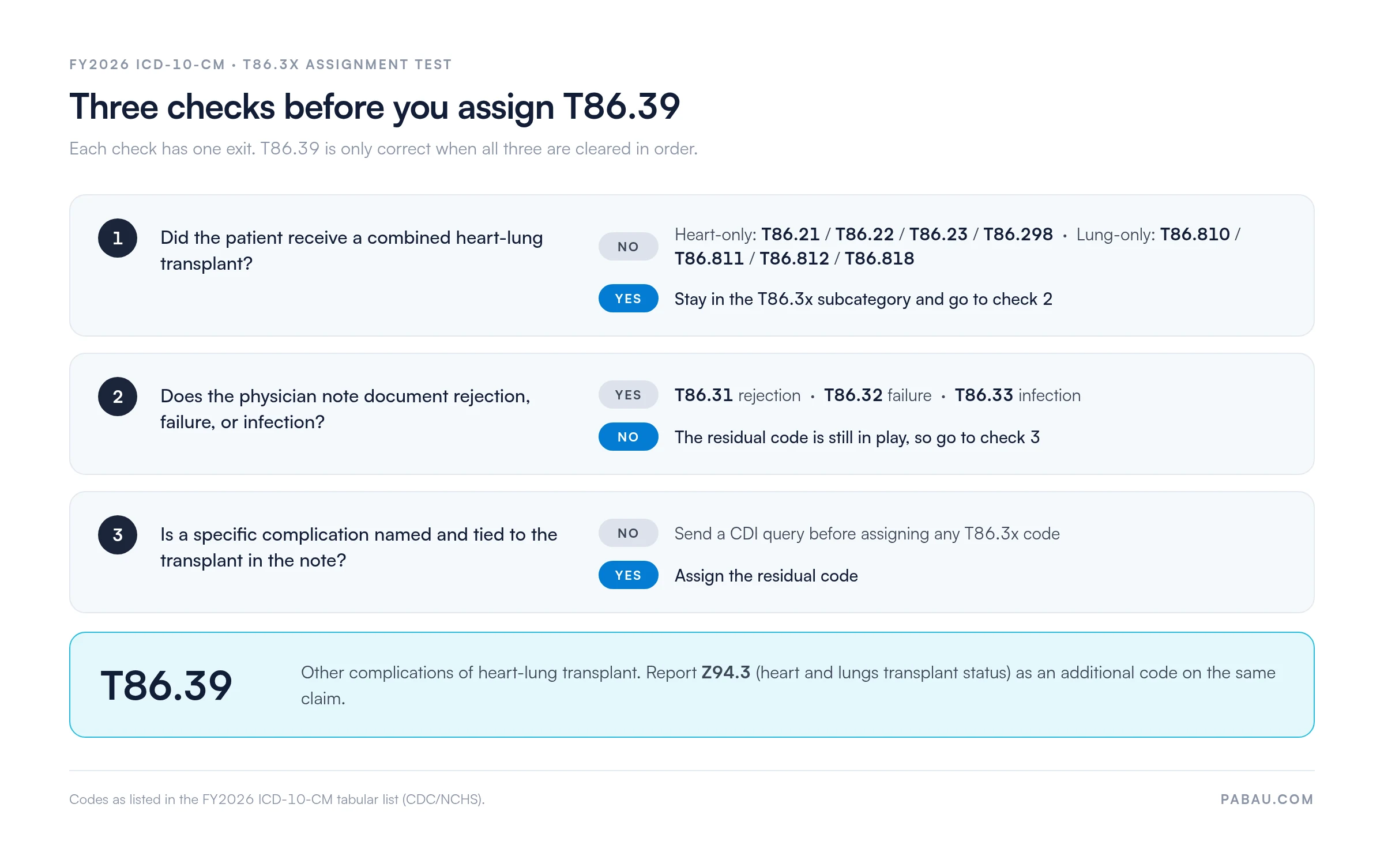
Those four elements resolve into three checks that run in order. An encounter failing any of them does not get T86.39.
Transplant complication claims carry above-average denial rates because payers apply heightened scrutiny to high-cost patient populations. A systematic pre-submission review catches most of what a payer would reject. Reading the denial codes a payer returns on transplant encounters also helps coders build a targeted appeal rather than a generic one.
Appeal timelines matter as much as the coding itself on transplant accounts. Most commercial payers require appeals within 60-180 days of the initial denial. Transplant cases often involve multiple payers, such as Medicare plus a commercial secondary, and each carries its own window.
Heart-lung transplant patients typically fall under transplant-specific managed care plans or Medicare coverage that includes heightened utilization management. Practices should verify payer policies before submitting T86.39 claims for high-cost management encounters. Compliance on a transplant account also means documenting that pre-authorization was obtained where the plan required it. A clean claim submission carries every required code, authorization number, and modifier before it leaves the practice.
Key payer considerations for T86.39 claims:
Build a payer-specific pre-submission checklist for transplant complication claims. For each active payer in your transplant population, record the prior authorization triggers, the accepted secondary diagnosis codes, and the appeal windows. Review this checklist quarterly as payer policies update.
Most practices find a missing authorization number only after the payer rejects the claim. A biller rebuilds the submission, resubmits, and waits out another adjudication cycle. On a transplant account with two payers in sequence, that adds weeks to payment on a high-value claim.
Pabau validates each claim against the fields the payer requires before it leaves the practice. Membership numbers, authorization codes, and payer identifiers are checked at submission, and anything incomplete is flagged for the biller to correct. Claims then go out electronically through the Claim.MD clearinghouse or direct to Medicare.
Choosing between T86.39 and T86.31 stays with the coder and the CDI team, where it belongs. Pabau clears the administrative half of the denial pile, so the claims your billers chase are the ones that turn on clinical documentation.

Pabau checks membership numbers, authorization codes, and payer identifiers on each claim before submission. Electronic claims go out through Claim.MD or direct to Medicare, so fewer transplant claims come back on administrative errors.

T86.39 is a physician-driven code with a narrow job. Before assigning it, confirm the patient received a combined heart-lung transplant. Check that the note names the complication and places it outside rejection, failure, and infection. Then pair Z94.3 and sequence by the reason for the encounter.
Where the documentation is thin, a CDI query costs far less than an appeal. Move the query into the coding step rather than the denial step, and T86.39 accounts stop consuming rework time.
Pabau’s claims management software checks each transplant claim for the membership numbers, authorization codes, and payer identifiers it needs before submission. Book a demo to see how that works against your own transplant billing workflow.

Need a framework for managing claim denials systematically? Denial management in healthcare walks through a structured approach to tracking, appealing, and preventing recurring denials across all code types.
Want to understand how clearinghouse validation works? What makes a clean claim explains the pre-submission checks that stop transplant complication claims from failing on technical grounds.
Looking for broader transplant billing compliance context? Medical billing compliance requirements covers documentation, sequencing, and audit readiness across high-complexity patient populations.
ICD-10 Code T86.39 is the billable ICD-10-CM diagnosis code for other complications of heart-lung transplant. It covers complications in combined heart-lung recipients that are not rejection (T86.31), failure (T86.32), or infection (T86.33). Examples include chronic allograft vasculopathy, bronchiolitis obliterans syndrome, and drug-induced complications of the transplant management regimen.
Yes, T86.39 is a valid, billable ICD-10-CM code for FY2026, reportable as a 5-character code with no 7th character extension required. It is confirmed in the current CMS/NCHS tabular list as a specific code acceptable for submission.
T86.31 covers heart-lung transplant rejection, meaning immune-mediated graft rejection confirmed by biopsy or clinical criteria. T86.32 covers heart-lung transplant failure, meaning primary graft non-function or loss. T86.39 covers the other complications that do not meet the documented criteria for rejection, failure, or infection. It is a residual category, and assigning it by default is a coding error.
Z94.3 (heart and lungs transplant status) is reported as an additional code on every encounter for a combined heart-lung transplant recipient. Z79.899 is added when the patient is on long-term immunosuppressive therapy. Sequencing position for T86.39 depends on whether the complication drove the encounter (principal) or was an incidental finding during a follow-up visit (secondary).
The physician note must confirm combined heart-lung transplant history and name the specific complication. It must document a causal link between that complication and the transplant. It must also carry clinical information distinguishing the complication from rejection, failure, and infection. Missing any of these elements is a CDI query trigger.
Graft-versus-host disease is reported with D89.81x and should never be coded within the T86.3x subcategory. Malignancy arising in a transplanted organ uses a neoplasm code from Chapter 2 when the condition has progressed to a diagnosed malignancy. Pre-existing conditions unrelated to the transplant do not qualify for T86.39, even when present in a transplant patient.