ICD-10 Code S42.444P: Medial epicondyle fracture, right humerus
ICD-10 Code S42.444P: full descriptor and code validity ICD-10 Code S42.444P car...

Last Updated: Oct 13, 2026
Billable Code Specific Code
T85.518A is the billable ICD-10-CM code for breakdown (mechanical) of other gastrointestinal prosthetic devices, implants and grafts, initial encounter. It covers a GI device that fractures, collapses or malfunctions when no more specific T85.51 code fits.
The word "other" limits its scope. Bile duct prostheses take T85.510A and esophageal anti-reflux devices take T85.511A, so check both siblings first. Skipping that check is a common cause of specificity denials. The 7th character A marks active treatment of the complication, while D marks routine follow-up and S a sequela.
Let Pabau's smart automation suggest the right codes, reduce claim denials, and keep your practice compliant—effortlessly.
Automate repetitive tasks and focus on what matters most—your patients.
Reduce coding errors and ensure compliance with the latest regulations.
Clean claims, fewer denials, and faster reimbursements.
Powerful insights and reporting to help your practice thrive.
HIPAA compliant SOC 2 certified GDPR-compliant Trusted by 4,000+ clinics worldwide

T85.518A is a billable FY2027 ICD-10-CM code for mechanical breakdown of GI prosthetic devices that no more specific T85.51 code covers.
The 7th character A designates initial encounter (active treatment); use D for subsequent care and S for sequela.
Feeding tubes are coded in K94.-, gastric bands in K95.0-, and a displaced GI device in T85.528A, so none of them belongs under T85.518A.
Documentation must explicitly state mechanical breakdown, identify the specific GI device, and confirm the encounter is for active treatment.
Pabau’s Claim.MD integration sends electronic CMS-1500 claims, checks eligibility in real time and tracks claim status for complication codes like T85.518A.
ICD-10 code T85.518A is the billable diagnosis code for breakdown (mechanical) of other gastrointestinal prosthetic devices, implants and grafts, initial encounter.
It is valid in the FY2027 code set, which took effect on October 1, 2026. You can confirm it in the CDC/NCHS ICD-10-CM official tool.
The table below gives the reference data coders check before submitting a claim. Our ICD-10-CM code library covers neighboring Chapter 19 codes in the same format.
T85.518A covers mechanical breakdown of gastrointestinal prosthetic devices, implants and grafts that no device-specific T85.51 code captures. Mechanical breakdown means a physical failure of the device itself, such as fracture, collapse, kinking, rupture or malfunction. Displacement, obstruction, perforation and infection each have their own codes.
The devices that typically fall under the “other” umbrella in T85.518A include:
Two device groups often get filed here by mistake. A bile duct prosthesis has its own code, T85.510A. Gastrostomy and jejunostomy feeding tubes (PEG tubes, G-tubes and J-tubes) are ostomy devices, so their malfunction is coded in K94.-. That means K94.2- for a gastrostomy and K94.1- for an enterostomy.
Gastric band complications are classified in K95.- (complications of bariatric procedures), not T85.518A. A mechanical problem with an adjustable gastric band goes to K95.09, other complications of gastric band procedure.
The exclusion notes sit at two levels. Category T85 carries one Excludes2 note, and the T80-T88 block above it carries a longer list that applies to every code in the block.
Breakdown, displacement and other mechanical complications each have their own subcategory. T85.518A is for structural failure or malfunction of the device itself. If the note describes the device moving out of position, code T85.528A. If it describes obstruction, perforation or protrusion without structural failure, code T85.598A.
The 7th character on T85.518A is not optional. Without it, the code is incomplete and non-billable. The three variants serve distinct clinical purposes as defined in ICD-10-CM Chapter 19 guidelines.
A common error is defaulting to T85.518D for any follow-up visit. Use D only when the active treatment phase is finished and the patient is in routine recovery. If the physician is still managing the acute complication (for example, deciding on device removal or replacement), the encounter is still A.
Confirm T85.518A by ruling out its two device-specific siblings first. The table below shows the whole T85.51 family, so coders can pick the right level of specificity.
The practical rule: if the documentation names a bile duct prosthesis or an esophageal anti-reflux device, use T85.510A or T85.511A. For any other GI prosthetic device, implant or graft that breaks down, T85.518A applies. T85.51 has no unspecified code, so the choice is always one of these three.
Before assigning T85.518A, run a two-step check. First, confirm the complication is structural failure, not displacement or infection. Second, verify the device is not a bile duct prosthesis or esophageal anti-reflux device. If both confirm, T85.518A is the right code. Document both steps in your coding note to support audit queries.
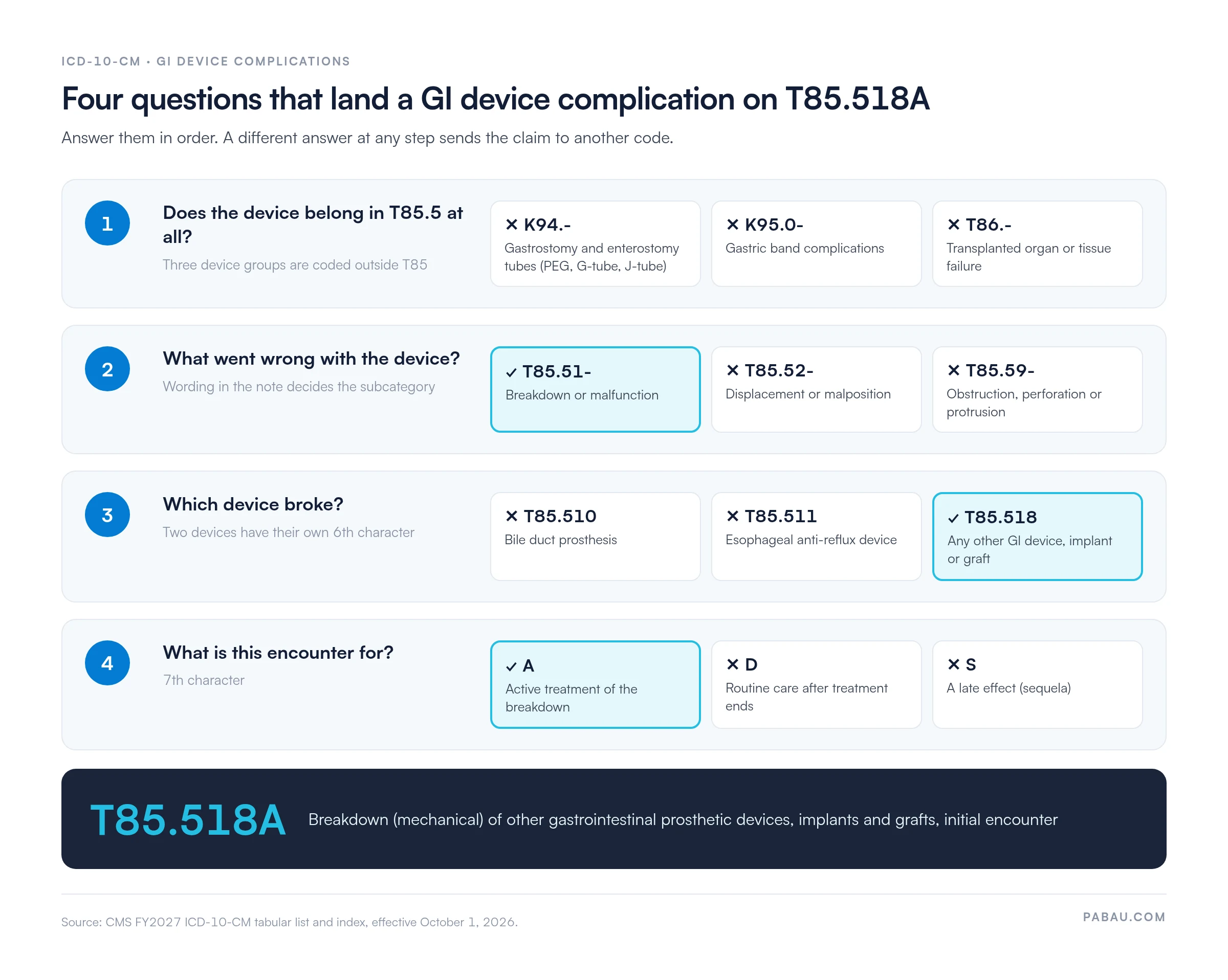
The device check is the third of four questions. The flow below adds the two that come first, which decide whether the device belongs in T85.5 at all and what kind of complication occurred.
No exact ICD-9-CM equivalent exists for T85.518A. The CMS General Equivalence Mappings (GEMs) map it to 996.59 as an approximate match. Coders working in hybrid environments or preparing for retrospective audits should note the mapping limitations.
When pulling legacy data or comparing across coding years, treat 996.59 as a rough match only. The encounter qualifier (initial vs subsequent) had no ICD-9 equivalent, so the crosswalk loses that specificity. Per ResDAC’s guidance on ICD codes in Medicare files, ICD-9 to ICD-10 crosswalks are approximate. They should not be used for clinical or coverage determinations.
Insufficient documentation is a common cause of denials on T85.518A. Payers audit this code closely because it requires evidence of physical device failure, not just a GI complaint. Solid medical billing compliance starts with what the physician writes before the claim is submitted.
The medical record must contain all four of these elements to support the code:
T85.518A documents the reason for a procedure. It typically pairs with a procedure code for the intervention, such as device revision, device removal or exploratory laparotomy. Per CMS ICD-10 coding guidance, the procedure code drives reimbursement while T85.518A provides the medical necessity documentation.
Check the Local Coverage Determination (LCD) for the procedure before submission, because some LCDs set their own documentation requirements.
Denials on T85.518A follow a predictable set of errors, and each one can be caught at the documentation or coding stage.
Good denial management workflows catch these patterns before they become write-offs. Tracking T85.518A denial reasons across a quarter shows whether the root cause is documentation, coding specificity or missing procedure pairings. Teams can then fix the right problem.
Each denial reason above starts before submission, in the note, the code choice or the missing procedure pairing. Without a shared system, a coder finds them by rereading every chart against the claim.
Pabau, the practice management platform we build, keeps the clinical note, the invoice and the claim in the same patient record. Its claims software for practices turns invoices into electronic CMS-1500 claims through the Claim.MD clearinghouse integration.
Eligibility is checked in real time before the visit. After submission, claim statuses and electronic remittance advice (ERA) flow back into the claims dashboard. A denied T85.518A claim shows up as soon as the payer returns it.
With the invoice, the procedure and the payer on one record, your coder can confirm that T85.518A matches the documented device before the claim goes out. A gap then surfaces in review instead of as a denial. Book a demo to see that workflow with your own payers and codes.

Pabau’s Claim.MD clearinghouse integration helps practices submit T85.518A and other complication codes as electronic claims. Real-time eligibility checks and claim status tracking come built in.

T85.518A is a narrow code. Feeding tubes, gastric bands, displaced devices and the two named siblings all route somewhere else. Assign it only after the four-question flow above has ruled them out.
The payoff is a claim that survives review the first time. A note that names the device and says it broke supports the code, the A character and the procedure it pairs with. That is what a clean claim looks like on a complication code.
Pabau keeps the note, the codes and the claim in one record, so those checks happen before submission. Book a demo to see how it handles complication-code claims for your practice.

Need to understand how denials are categorised and resolved? Denial codes in medical billing covers CARC denial reasons and how to appeal them systematically.
Want to learn how clearinghouses process ICD-10 claims? Medical claims clearinghouses explained walks through the end-to-end submission and adjudication workflow.
Looking for guidance on revenue cycle documentation? What is revenue cycle management covers the full billing lifecycle from encounter to payment posting.
Coding a different T85 device complication? T85.41XA covers breast prosthesis leakage, another code in the same category.
ICD-10 Code T85.518A is the billable diagnosis code for breakdown (mechanical) of other gastrointestinal prosthetic devices, implants and grafts, initial encounter. It covers structural failure of a GI implant, such as a fractured gastric reservoir, that no device-specific T85.51 code captures. The patient must be receiving active treatment for the complication.
Yes, T85.518A is a billable ICD-10-CM diagnosis code in the FY2027 code set, which took effect on October 1, 2026. It can be submitted on claims when the documentation supports mechanical breakdown of an other GI prosthetic device during an initial encounter.
T85.518A covers mechanical breakdown (structural failure) of other GI prosthetic devices. T85.598A covers other mechanical complications of those devices, such as obstruction, perforation or protrusion. Displacement has its own code, T85.528A, so a device that has moved out of position is coded there instead.
Use T85.518A when the patient is receiving active treatment for the mechanical breakdown. Examples are an ED evaluation, a surgical revision, or the first specialist visit for the complication. Use T85.518D for routine care after the active treatment phase is complete (wound checks, routine post-op visits). Use T85.518S only for a late effect or sequela that is a direct consequence of the original device failure.
No. Gastric band complications are classified in K95.- (complications of bariatric procedures), not T85.518A. A mechanical problem with an adjustable gastric band is coded K95.09, other complications of gastric band procedure.
The medical record must contain four elements. It needs explicit mechanical failure language (such as “mechanical breakdown” or “structural failure”) and identification of the specific GI device involved. It also needs documentation confirming the encounter is for active treatment, plus physician attestation. Missing any of these elements creates grounds for a payer denial.