

HCPCS code E0198: Water pressure pad billing guide
HCPCS code E0198 is a water pad for a standard mattress HCPCS code E0198 is the ...

Last Updated: Oct 13, 2026
Billable Code Specific Code
T85.41XA is the billable ICD-10-CM code for breakdown (mechanical) of breast prosthesis and implant, initial encounter.
This page covers the 7th character choice and the sibling codes inside T85.4. It also covers the documentation payers look for and the CPT codes that pair with T85.41XA.
Let Pabau's smart automation suggest the right codes, reduce claim denials, and keep your practice compliant—effortlessly.
Automate repetitive tasks and focus on what matters most—your patients.
Reduce coding errors and ensure compliance with the latest regulations.
Clean claims, fewer denials, and faster reimbursements.
Powerful insights and reporting to help your practice thrive.
HIPAA compliant SOC 2 certified GDPR-compliant Trusted by 4,000+ clinics worldwide

ICD-10 code T85.41XA covers breakdown (mechanical) of breast prosthesis and implant at the initial encounter. It is a billable, specific code for fiscal year 2026.
Use T85.41XA while the patient is receiving active treatment for the breakdown. Switch to T85.41XD once routine healing begins.
T85.41XA covers rupture, deflation and structural failure of the implant shell. Leakage codes to T85.43XA and capsular contracture to T85.44XA.
Practice management software like Pabau embeds ICD-10-CM codes in the clinical encounter, so T85.41XA reaches the claim without manual re-entry.
Knowing where T85.41XA sits in the hierarchy prevents miscategorization. T85 sits in the injury and poisoning chapter, not with the breast disorders in N60-N65, which is where the confusion usually starts. Confirming the path keeps you under the correct parent category.
The classification path runs from broadest to most specific:
You can verify this path using the CDC/NCHS ICD-10-CM web tool.
The “X” in position 6 is a placeholder character. ICD-10-CM uses it to hold the 7th character position open when a code has fewer than six characters before the extension. It carries no clinical meaning on its own.
The 7th character is where most T85.41XA errors happen. Whether the encounter is initial or subsequent decides which character you append. Get it wrong and the denial is difficult to reverse once the claim cycle closes. Per the AAPC ICD-10-CM code guidelines, encounter type reflects the nature of the visit rather than its timing.
Common mistake: Coders sometimes keep reporting T85.41XA through post-operative follow-up visits because the operative note is still in the chart. Once active treatment concludes, switch to T85.41XD. Reporting the initial-encounter code at a routine wound check will raise a payer audit flag.
Mechanical breakdown of a breast prosthesis means structural or physical failure of the implant device itself. Document the specific failure mode, because that description is what supports the code you select.
T85.41XA applies across several failure presentations:
Capsular contracture is a separate complication with its own code (T85.44XA) and must not be coded as mechanical breakdown. Implant leakage codes to T85.43XA rather than T85.41XA. The ICD-10-CM tabular list maintains these distinctions explicitly.
The chart below walks both decisions in order. The failure mode picks the base code, then the encounter type picks the character appended to it.
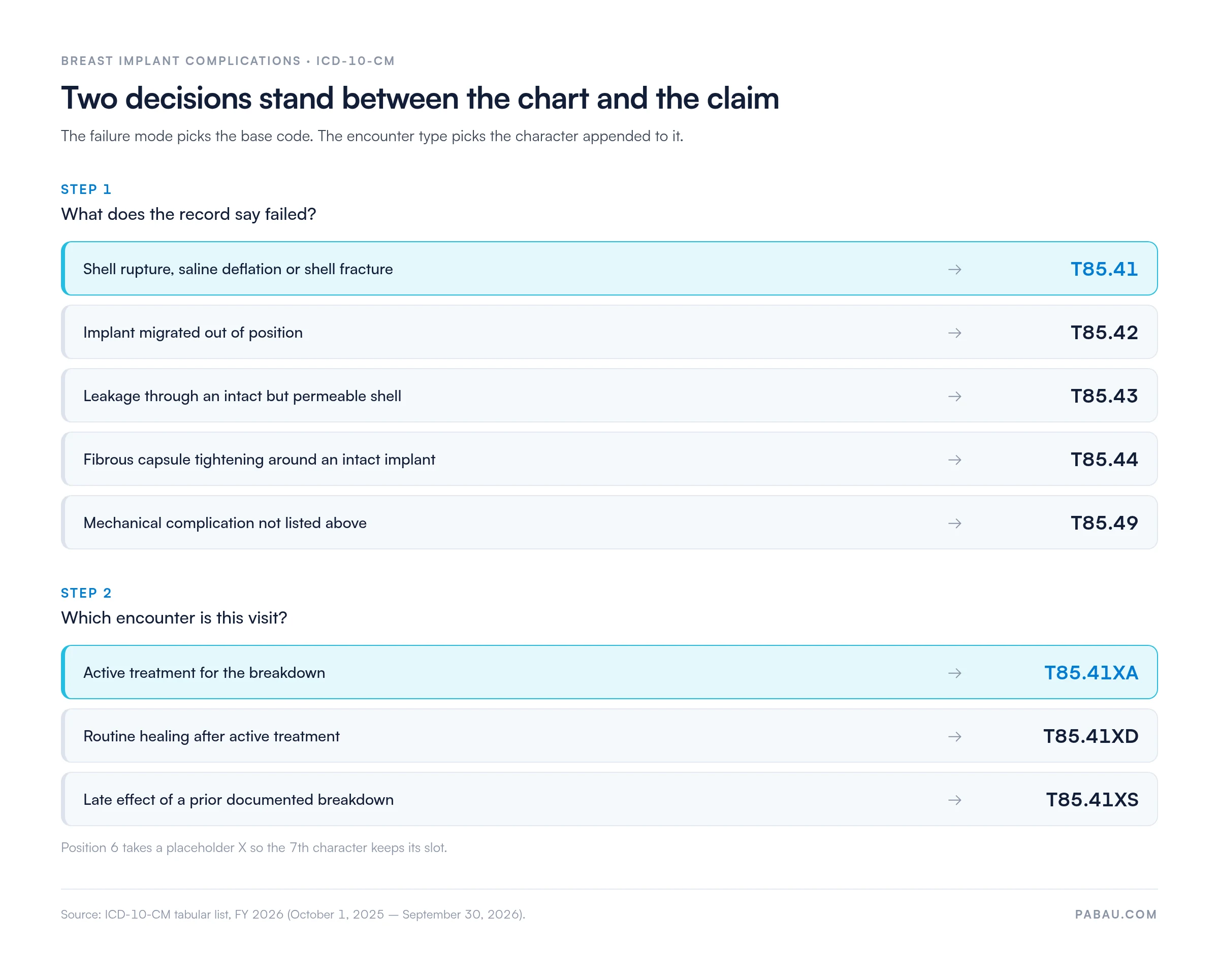
T85.41XA still applies at the initial encounter when imaging confirms intracapsular rupture and the patient has not yet chosen surgery. The visit is where the treatment decision is being made. Document the imaging findings, the clinical presentation, and the plan you discussed.
Breast implant complication coding sits across several sibling codes inside T85.4. Selecting the wrong sibling produces a code that contradicts the operative findings, which delays reimbursement. Confusing T85.41XA with T85.43XA is the most common version of that error.
T85.41XD is the code for the same mechanical breakdown at a subsequent encounter. The practical dividing line is what the provider is doing at that visit. If they are actively managing the breakdown, use T85.41XA. Active management covers evaluating treatment options, performing the revision surgery, and ordering imaging to guide a decision. Once treatment ends and the patient enters routine healing, every follow-up visit takes T85.41XD.
Rupture is the presentation coders ask about most often in plastic and reconstructive practices. Both intracapsular and extracapsular silicone rupture map to T85.41XA at the initial encounter. The distinction between the two belongs in the clinical documentation rather than in the code.
Key guidance for rupture scenarios:
Insufficient documentation is the leading cause of T85.41XA denials. Medical necessity for breast implant revision surgery has to be supported by the clinical record. Payers reviewing a claim for implant removal or replacement look for specific evidence before they release payment. A thin record produces the same medical billing denial codes every time, so it pays to fix the chart before submission rather than at appeal.
Required documentation elements include:
A clean revision claim needs the diagnosis code and its procedural companion. Submit T85.41XA as the diagnosis and pair it with the CPT code for the procedure actually performed. Where the implant comes out intact, 19328 is the pairing, and the table below covers the rest.
Submitting T85.41XA and the relevant CPT code together through a clearinghouse validates the diagnosis-procedure linkage before it reaches the payer. Practice management software like Pabau integrates with Claim.MD, which reaches thousands of US payers. It carries built-in ICD-10 and CPT catalogs, so the pairing is confirmed in real time.
For reconstructive patients, always document the original reason for implant placement in the clinical note. Say whether it was post-mastectomy reconstruction or cosmetic augmentation. Some payers apply different coverage rules to each, so the distinction decides how the revision claim is assessed.
T85.41XA applies equally in post-mastectomy reconstruction, where implant-based reconstruction after cancer treatment is common. That scenario is documentation-intensive and needs careful sequencing. Capturing the reconstruction history matters as much as the breakdown diagnosis itself.
Sequencing considerations for reconstruction patients:
Coders working inside claims management software can attach secondary diagnosis codes alongside T85.41XA in the same encounter record. The claim is then complete before anyone submits it.
In most plastic surgery practices the coder works downstream of the chart. The surgeon documents the revision, then somebody opens a lookup tool, finds T85.41XA, and retypes it into a billing system. Each hand-off is a place for the 7th character to drift or the CPT pairing to go missing.
Pabau, our practice management software, holds the ICD-10-CM list inside the clinical encounter. The coder selects T85.41XA against the note that describes the breakdown. The code then travels into the claim with the imaging report and the operative findings. The code is never retyped between the chart and the clearinghouse.
For a reconstructive practice, that matters most on the secondary codes. Z85.3 and the CPT procedure sit on the same record as the diagnosis. The claim leaves the practice complete instead of coming back for documentation.

Pabau embeds ICD-10-CM codes inside the patient encounter. Select T85.41XA at the point of care and it flows straight through to the claim. That removes both the re-entry step and the separate lookup tool.

Mechanical breakdown of a breast implant is a precise clinical finding, and it needs an equally precise code. T85.41XA is the right call at the initial encounter. The claim still fails if the 7th character, the CPT pairing, or the imaging evidence does not line up behind it.
The trade-off worth remembering is that the code carries little information on its own. It says the implant failed mechanically, and stops there. The details a payer weighs live in the documentation you attach: laterality, rupture type, and the reason revision is necessary. Build that habit and the encounter-character question stops generating denials.
Pabau puts ICD-10-CM selection inside the clinical encounter, so the code and its evidence travel together to the payer. Book a demo to see how a reconstructive practice codes T85.41XA in a single pass.

Managing claims for aesthetic and reconstructive procedures? Medical billing compliance covers the documentation and coding rules that protect claims across the full procedure spectrum.
Billing across multiple implant complication codes? What is revenue cycle management explains how the full billing workflow connects from diagnosis coding through ERA reconciliation.
Worried about denials on a revision claim? Denial management in healthcare walks through the workflow for catching, reworking and resubmitting a denied claim.
ICD-10 code T85.41XA is a billable ICD-10-CM diagnosis code describing breakdown (mechanical) of breast prosthesis and implant, initial encounter. It falls under category T85, which covers complications of other internal prosthetic devices, implants, and grafts. The code is valid for fiscal year 2026. Use it at the first encounter where a patient receives active treatment for a mechanically failed breast implant.
Yes. T85.41XA is a fully specific, billable ICD-10-CM code. It can be reported as a principal or secondary diagnosis on a claim. CMS and commercial payers accept it for fiscal year 2026, which runs from October 1, 2025 through September 30, 2026.
T85.41XA applies at the initial encounter, when the patient is receiving active treatment for the mechanical breakdown. That includes the surgical revision visit. T85.41XD applies at subsequent encounters, meaning post-operative follow-up during routine healing after active treatment has concluded. The underlying condition is the same. The 7th character reflects the stage of care rather than the passage of time.
Capsular contracture codes to T85.44XA at the initial encounter, T85.44XD at a subsequent encounter, or T85.44XS as a sequela. It is a separate complication from mechanical breakdown and must not be coded as T85.41XA. Capsular contracture involves the fibrous capsule tightening around an intact implant, not a failure of the implant’s structural integrity.
T85.41XA codes structural failure of the implant shell, such as rupture, deflation or fracture. T85.43XA codes leakage of breast prosthesis and implant, typically gel bleed through an intact but permeable shell. If the operative or imaging findings confirm a shell fracture or rupture, T85.41XA is correct. If they show gel permeation without confirmed shell failure, T85.43XA applies.
T85.41XA supports the medical necessity argument for revision surgery when it is paired with adequate clinical documentation. That means imaging confirming rupture or structural failure, a clinical presentation note, and a physician’s medical necessity statement. The code alone does not guarantee payer coverage. Payer-specific policies on cosmetic versus reconstructive implants apply separately and vary by plan.



