

ICD-10 Code R63.4: Abnormal weight loss
ICD-10 code R63.4: Definition, billability and code structure ICD-10 code R63.4 ...

Last Updated: Nov 13, 2026
Billable Code Specific Code
T84.023S is the billable ICD-10-CM code for instability of internal left knee prosthesis, sequela. It marks a current problem, such as stiffness or an unsteady gait, as the aftermath of an unstable left knee replacement. That instability has already been treated.
The S character applies only to that aftermath. While the instability itself is being treated, the claim takes T84.023A, and routine healing visits after treatment take T84.023D.
Let Pabau's smart automation suggest the right codes, reduce claim denials, and keep your practice compliant—effortlessly.
Automate repetitive tasks and focus on what matters most—your patients.
Reduce coding errors and ensure compliance with the latest regulations.
Clean claims, fewer denials, and faster reimbursements.
Powerful insights and reporting to help your practice thrive.
HIPAA compliant SOC 2 certified GDPR-compliant Trusted by 4,000+ clinics worldwide

T84.023S reports a condition left behind by an unstable left knee replacement, not the instability while someone is still treating it.
Revision surgery for the instability is active treatment, so it takes T84.023A, and routine healing visits after it take T84.023D.
On a sequela claim, the residual condition is listed first, such as M25.662 for left knee stiffness, and T84.023S follows it.
Displaced hardware after a femur fracture repair belongs in T84.12-, because T84.02- covers joint prostheses only.
Leave Z96.652 off the claim, because T84.023S already tells the payer a left knee prosthesis is present.
ICD-10 code T84.023S is the billable code for instability of internal left knee prosthesis, sequela. You use it when a left knee replacement became unstable, that problem was treated, and a condition it left behind now brings the patient in. Think of stiffness or an unsteady gait that keeps someone in physical therapy long after the revision healed.
The code sits in Chapter 19 of ICD-10-CM, under category T84 and subcategory T84.02. It is valid in the FY2027 code set, which took effect on October 1, 2026.
Before you look at anything else on a T84.023S claim, ask one question. Is anyone still treating the instability itself? If the answer is yes, S is the wrong character, and the next sections show what to use instead.
Read the code from left to right and each level gets more specific. The table shows what every step adds.
The 6th character sets the joint and the side. Within T84.02, 0 and 1 are the right and left hip, and 2 and 3 are the right and left knee. An 8 means another joint and a 9 an unspecified one. The hip codes say “dislocation” in their official titles, while the two knee codes say “instability”.
T84.02 covers joint replacements only. Fixation hardware from a fracture repair, such as a femoral nail, plate or screws, is coded in T84.12- instead.
The classic error on this code is reading S as “late” or “long after surgery”. The calendar has no say here. Official Guidelines Section I.C.19.a reserves S for conditions that arise as a direct result of an injury or complication. Its own example is scarring after a burn.
For complication codes, the same section ties the 7th character to treatment of the condition the code names. If the provider is treating the instability, the visit is active treatment and takes A, even when the knee was replaced years ago. Three questions, asked in order, settle the character on any visit.
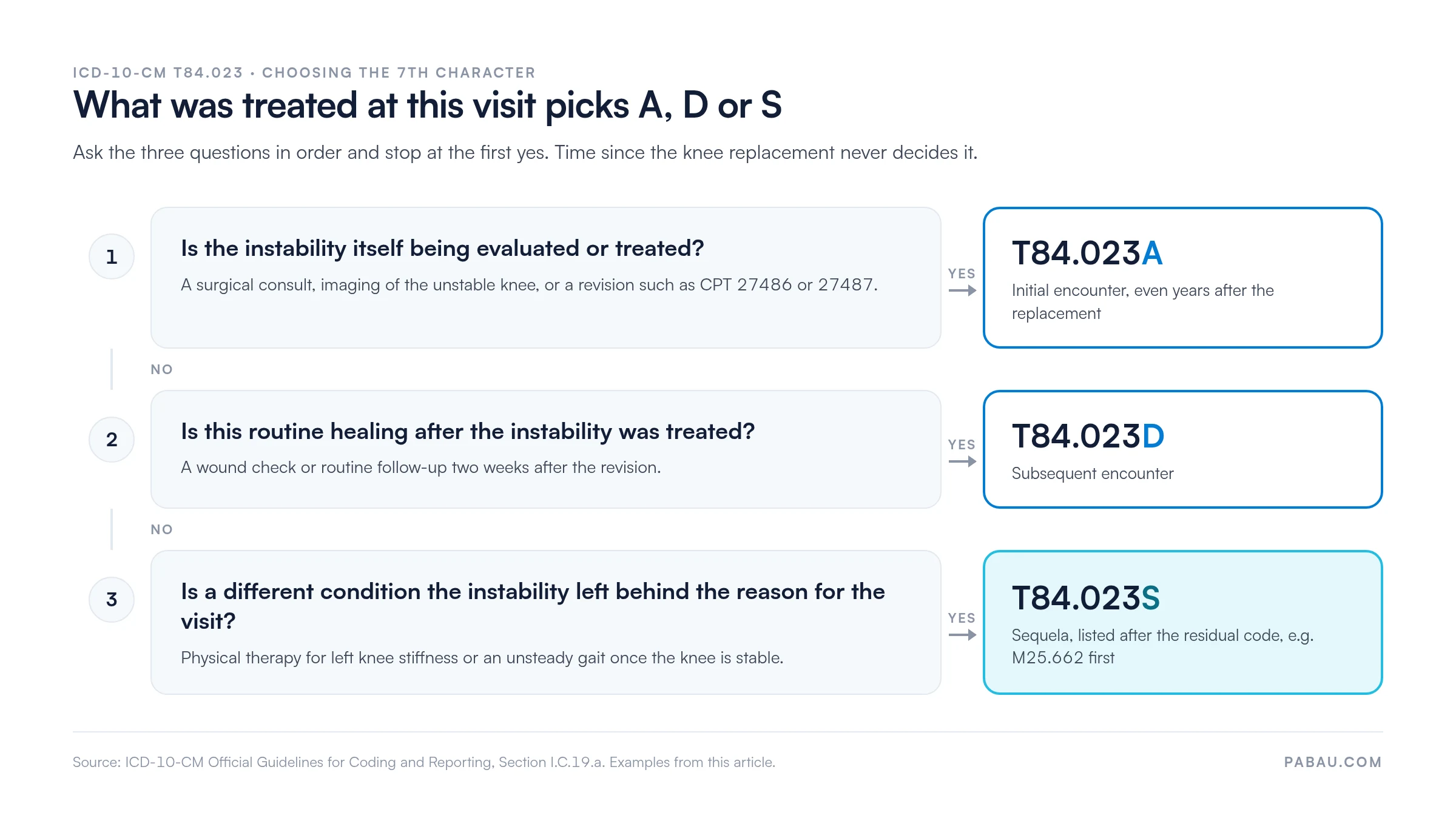
Section I.C.19.a also sets the order on a sequela claim. The residual condition is listed first, and T84.023S follows to show where it came from. The S goes on the T84 code only, never on the residual condition’s code.
Permanent sutures fall under T85 rather than T84, and breakdown, displacement and leakage each have their own subcategory. Once a different mechanical complication of permanent sutures resolves and leaves a granuloma, the claim adds T85.692S after that residual condition.
The rule is easier to see on one patient. In this illustrative case, watch the 7th character change as the care changes.
Across all three claims, the character followed the care given that day.
Ask providers to name the residual condition and its cause in one line of the assessment. A line such as “left knee stiffness, residual from treated instability of left TKA” gives the coder both codes and their order.
When a T84.023S claim comes back, the fix is usually one of these neighbors. Check the side, the joint, the type of failure and the 7th character, in that order. The CDC ICD-10-CM browser tool confirms each descriptor.
Category T84 carries one Excludes2 note with two entries. Excludes2 means the condition isn’t part of T84, but both codes may appear together when the patient has both. Knowing these is part of medical billing compliance for orthopedic practices.
The tabular list has no Excludes1 note at T84, T84.0, T84.02 or T84.023. Subcategory T84.02 lists instability and subluxation as inclusion terms, which is why an unstable knee sits under a dislocation heading.
Two instructions at the T80-T88 block level matter here. One says to use additional codes for the specified condition resulting from the complication, which backs up the sequencing above. The other says to add codes from Y62-Y82 for the devices involved and the circumstances, where they apply.
T84.023S is a diagnosis code, so it rides on the line for whatever service the provider performed. Match the procedure to the 7th character before you pair them.
A revision billed with T84.023S is the pairing that draws the most payer questions. Surgery on the instability is active treatment, so a 27486 line carrying S tells the payer the problem was already resolved. The sequela code belongs on therapy lines instead, such as 97116 gait training for an unsteady walk.
On a professional claim, the work runs in six steps. Most sequela denials trace back to one of the first three.
Steps one and two are where a quick provider query pays off. A one-line note tying the stiffness to the treated instability costs less than a resubmission.
When a denial does arrive, the reason code points to the fix. Our guide to denial codes in medical billing maps the common ones to a next step. For the wider process, see our denial management guide.
Sequela claims tend to stall in the handoffs. The therapist documents the gait problem, the coder hunts for the revision date, and the biller chases an authorization that lapsed last week.
Pabau, the practice management and billing platform we build, keeps those pieces on one patient record. US practices send electronic claims through Claim.MD, the Claim.MD clearinghouse Pabau connects to. It handles eligibility checks, CMS-1500/837P claims and ERA remittances.
Prior authorization codes, dates and sessions sit on the patient’s case, and Pabau warns your team when one is missing. Your billers see the authorization status before a therapy visit is billed. Remittances come back to the same place, through Pabau’s claims management software.

Pabau sends US claims through Claim.MD with eligibility checks and ERA remittances, and tracks prior authorizations on each case. Your team spends less time chasing paperwork after a knee revision.

With T84.023S, read the encounter before you read the dates. If the provider treated the instability, the claim takes A, then D for routine healing. S is only for a different condition that the instability left behind.
Get that call right and the rest follows. The residual condition leads, the side matches the op note, and each procedure line points at the right diagnosis. Get it wrong and you’ll be defending a revision claim that says the problem was already resolved.
Billing knee revisions and the therapy after them? Book a demo to see how Pabau tracks authorizations and sends US claims through Claim.MD.

Need a framework for the whole billing cycle? Revenue cycle management guide covers the process from eligibility checks through payment posting.
Sending US claims electronically? Claim.MD clearinghouse overview explains how practices send claims, check eligibility and receive ERA remittances through the integration.
Want fewer claims coming back for corrections? Clean claim requirements lists the data a claim needs before it reaches the payer.
Common causes include soft-tissue imbalance, ligament laxity, component malposition and wear of the plastic insert. Instability can appear soon after surgery or years later. The cause matters for coding, because loosening, wear and breakage each have their own T84 codes.
T84.84X- reports pain due to internal orthopedic prosthetic devices, implants and grafts. It doesn’t name the joint or the side, so the note has to. Its 7th character follows the same A, D and S logic as T84.023-.
Not by national rule. Official Guidelines Section I.C.20 says external cause reporting is required only under a state mandate or payer requirement. Where your practice reports one, Y83.1 describes a surgical implant as the cause of a later complication.
Wear of the bearing surface has its own subcategory, T84.06-. Use T84.063- for the left knee and T84.062- for the right, with the 7th character set by the encounter.



