ICD-10 Code V09.01XS: Pedestrian injured in nontraffic accident involving military vehicle, sequela
ICD-10 Code V09.01XS: Code description and clinical meaning ICD-10 code V09.01XS...

Last Updated: Oct 26, 2026
Billable Code Specific Code
T32.87 is the billable ICD-10-CM code for corrosions involving 80-89% of body surface with 70-79% third degree corrosion. It records how much of the whole body a chemical burn covers, while the T20-T25 codes record each site. It takes no 7th character.
Assigning it takes two documented numbers: the total body surface corroded, and the share of the whole body that is third degree. Injuries at this extent almost always need burn center admission.
Let Pabau's smart automation suggest the right codes, reduce claim denials, and keep your practice compliant—effortlessly.
Automate repetitive tasks and focus on what matters most—your patients.
Reduce coding errors and ensure compliance with the latest regulations.
Clean claims, fewer denials, and faster reimbursements.
Powerful insights and reporting to help your practice thrive.
HIPAA compliant SOC 2 certified GDPR-compliant Trusted by 4,000+ clinics worldwide

ICD-10 code T32.87 is a complete, billable code for corrosions covering 80-89% of the body surface with 70-79% third-degree corrosion.
T32 codes take no 7th character, so T32.87 is reported exactly as written, with no A, D or S extension.
The fifth character records the third-degree share of total body surface, so T32.80 through T32.88 split the 80-89% band by depth.
Code first the T51-T65 toxic-effect code for the chemical and intent, then the site-specific corrosion codes, then T32.87 for extent.
Pabau’s claims management software keeps the burn note, the codes and the claim in one patient record, so extent codes match the documentation.
ICD-10 code T32.87 is the billable ICD-10-CM code for corrosions involving 80-89% of body surface with 70-79% third degree corrosion. It describes how much of the body a chemical burn covers, and how much of the whole body is full thickness.
T32.87 sits in category T32, which classifies corrosions by extent rather than by site. The code is valid in the FY2026 code set and unchanged in the FY2027 release effective October 1, 2026, per the CMS ICD-10 code files.
The quick-reference table below summarizes the facts coders need before selecting this code.
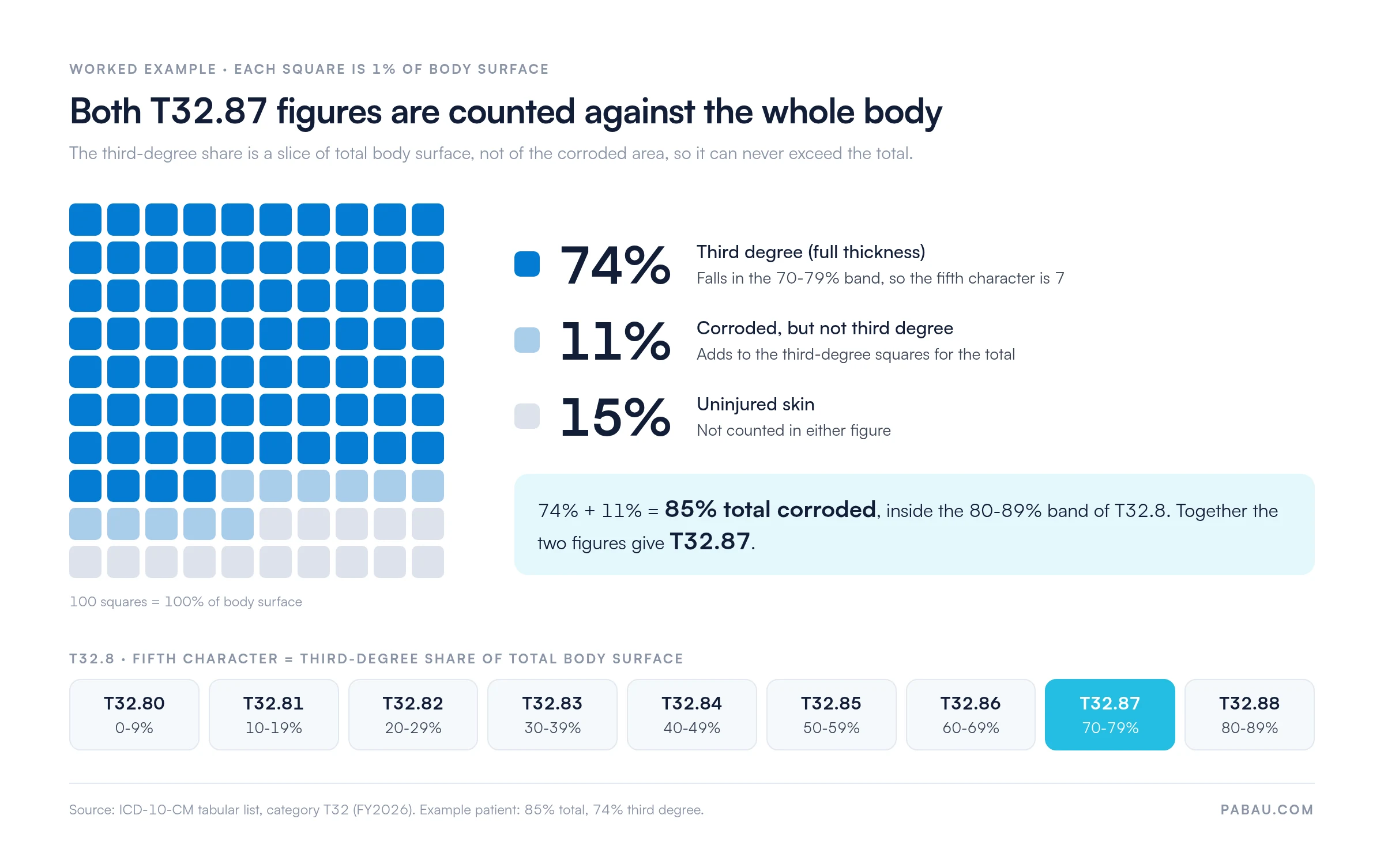
T32.8 is a header that groups nine billable codes, T32.80 through T32.88. Every one of them keeps total involvement at 80-89% of body surface. The fifth character then records how much of the whole body is third degree.
There is no T32.89, because the third-degree share cannot be larger than the 80-89% total. The percentage is measured against the whole body, not against the corroded area.
So a patient with 85% total involvement and 74% full-thickness involvement codes to T32.87. The provider must document both figures, or the coder cannot pick between T32.80 and T32.88. The grid below shows how the two figures nest.
T32 codes classify chemical corrosions by total body surface area, and T31 codes classify thermal burns the same way. The causative agent decides the category, so a chemical injury never takes a T31 extent code. A thermal burn of the same extent and depth codes to T31.87 instead.
Clinicians usually estimate body surface area with the rule of nines for adults. ICD-10-CM itself builds categories T31 and T32 on that classic rule, per guideline I.C.19.d.6 of the official guidelines.
The same guideline lets providers adjust the percentages for infants and children, whose heads are proportionally larger than an adult’s. The Lund-Browder chart is the common alternative for children.
To support T32.87, the corroded regions must add up to 80-89% and the full-thickness regions to 70-79%. Both totals should appear as numbers in the provider’s note, which coders can check against the CDC/NCHS ICD-10-CM coding tool.
Missing or vague provider documentation is the root cause of most T32.87 queries and audit findings. The record needs five elements before a coder can assign the code. Consistent medical billing compliance depends on capturing them at the time of the encounter.
If any element is missing, query the provider before assigning T32.87. A code assigned by inference rather than explicit documentation creates compliance exposure.
T32.87 is usually a supplementary code. The T32 category note allows it as the primary code only when the site of the corrosion is unspecified.
For inpatient encounters, the Uniform Hospital Discharge Data Set (UHDDS) rules and the circumstances of admission govern the principal diagnosis. Check with your compliance officer before applying general sequencing guidance to a specific inpatient claim.
Check every corrosion note for two numbers before you assign T32.87: total body surface corroded and the share that is third degree. If the note says ‘extensive chemical injury’ without figures, query the provider. A code the record cannot support will not survive an audit.
Guideline I.C.19.d.9 says an external cause code should be used with burns and corrosions to identify the source, intent and place. For a corrosion, the chemical and intent come from the T51-T65 toxic-effect code, which needs no extra intent code.
Section I.C.20 of the ICD-10-CM Official Guidelines for Coding and Reporting adds that no national requirement exists for external cause reporting. Chapter 20 codes are required only under a state mandate or a payer’s rules, though voluntary reporting is encouraged.
Corrosions at this extent almost always mean a burn center admission. Emergency care does not wait for authorization, but many commercial and managed-care plans want notice of the admission soon after it happens. Billing teams that submit through claims software for practices catch an incomplete code set before the payer does.

Authorization and notification rules vary by payer. Verify current policies directly with the insurer before claim submission.
T32.87 depends on two documented thresholds, total body surface and third-degree share, so it has two distinct failure points. The table below addresses each. Once a denial lands, the denial management workflow guide covers the response. Our denial codes guide explains each code a payer can return.
Before submitting any T32.87 claim, check it against the clean claim criteria. It needs a toxic-effect code, site codes with the right 7th characters, and T32.87 with no extension.
Skin grafting is common at this level of corrosion. T32.87 is a diagnosis code and does not describe the procedure.
Autografts and allografts are reported separately with ICD-10-PCS codes for inpatient facility claims or CPT codes for professional claims. On a professional claim, a split-thickness autograft to the trunk, arms or legs starts with CPT code 15100 for the first 100 sq cm.
Several neighboring codes are easily confused with T32.87. The comparison table below names each and the distinction that matters, with descriptors checked against the ICD List code reference.
Coders working corrosion claims often chase BSA figures through scanned charts and free-text notes. A missing third-degree figure means a query, and the claim sits until someone answers it.
Pabau, the practice management and billing platform we build, keeps the treatment note, the diagnosis codes and the claim in one patient record. Clinical form templates can prompt for total BSA and third-degree percentage, so the numbers are there before coding starts.
Claims then go out through Pabau’s claims management software and the Claim.MD integration, which checks each claim before the payer sees it. You get fewer queries, fewer resubmissions and a cleaner audit trail for high-severity admissions.

Pabau keeps the burn note, the BSA figures and the claim in one patient record, so your T32.87 claims match the documentation before submission.

T32.87 is a complete code, and the hard part is proving it. The note has to show total involvement of 80-89% and full-thickness involvement of 70-79% of total body surface. If either figure is missing or out of band, the claim needs a sibling code or a query.
Build the claim around the documentation: toxic-effect code first, site codes next, then T32.87 with no 7th character. Teams that capture both percentages at the bedside spend far less time on queries and appeals.
Pabau’s claims management software keeps notes, codes and claims in one record. Book a demo to see how it keeps your corrosion claims consistent with the chart.

Need a clean claim checklist for high-severity diagnosis codes? Clean claim requirements in medical billing covers every element a claim needs before submission.
Looking for the full picture on how clearinghouse submission works? Medical claims clearinghouse overview explains the end-to-end claims workflow from EHR to payer.
Want to understand how electronic remittance works after a claim is paid? Electronic remittance advice (ERA) guide explains 835 remittance files and how to reconcile payments.
Billing the graft prep that often follows a major corrosion? CPT code 15002 for skin graft site preparation covers wound bed preparation before grafting.
ICD-10 code T32.87 means corrosions involving 80-89% of body surface with 70-79% third degree corrosion. It records the extent of a chemical burn, not its site, and sits in category T32.
Yes, T32.87 is a billable ICD-10-CM code and is reported exactly as written. It is valid in FY2026 and unchanged in the FY2027 code set. Its parent, T32.8, is a non-billable header.
No. Category T32 has no 7th character, so T32.87 never takes an A, D or S extension. The encounter character goes on the site-specific corrosion and toxic-effect codes instead.
T32.8 is the non-billable header for corrosions of 80-89% of body surface. T32.87 is one of its nine billable child codes, the one where 70-79% of the body is third degree.
In ICD-10-CM, burns (T31) come from heat, flame, hot substances, electricity or radiation, while corrosions (T32) come from chemicals such as acids and alkalis. Both use the same extent structure, and the agent decides which category applies.
The provider must document the chemical agent, total BSA between 80% and 89%, and a third-degree share of 70-79% of total body surface. Body regions, depth by site, intent and encounter type complete the record.
Yes, T32.87 is valid in both settings. Corrosions covering 80-89% of the body almost always need burn center admission, so outpatient use is rare. UHDDS rules govern principal diagnosis assignment on inpatient claims.