ICD-10 code S61.201A: Open wound of left index finger without nail damage
ICD-10 code S61.201A covers a left index finger wound of unstated type ICD-10 co...

Last Updated: Oct 16, 2026
Billable Code Specific Code
T31.87 is the billable ICD-10-CM code for burns involving 80-89% of body surface with 70-79% third degree burns.
Both figures are measured against the whole body, not against the burned area alone. T31 classifies burns by extent rather than by site, so T31.87 is reported behind a T20-T29 site code, never ahead of it. The neighboring code T31.88 covers the same 80-89% extent with 80-89% third degree burns, so the documented third degree percentage is what separates them.
Let Pabau's smart automation suggest the right codes, reduce claim denials, and keep your practice compliant—effortlessly.
Automate repetitive tasks and focus on what matters most—your patients.
Reduce coding errors and ensure compliance with the latest regulations.
Clean claims, fewer denials, and faster reimbursements.
Powerful insights and reporting to help your practice thrive.
HIPAA compliant SOC 2 certified GDPR-compliant Trusted by 4,000+ clinics worldwide

T31.87 is the billable ICD-10-CM code for burns covering 80-89% of body surface, with 70-79% third degree.
Both figures are shares of the whole body, never shares of the burned area alone.
T31 codes report extent rather than location, so a T20-T29 site code is always sequenced first.
The chart has to carry total TBSA and third degree TBSA as two separate numbers.
Practice management software like Pabau builds the claim from the invoice, checks eligibility, and tracks it to payment.
ICD-10 code T31.87 reports burns across 80-89% of body surface, where 70-79% of that body surface is third degree. It is billable and specific, so it stands on its own line of a claim. What it does not tell the payer is where on the body the burn sits. That job belongs to a T20-T29 site code, and T31.87 is sequenced behind it.
T31.87 has been in the ICD-10-CM code set since the United States adopted it on October 1, 2015. It has come through every annual update since, and it remains valid for the FY2026 year. Even so, re-check it each October 1, because that is when new revisions take effect.
Every code in the T31.8x group covers the same total extent, which is 80-89% of body surface burned. Only the last digit moves. It records how much of the body surface carries full thickness injury, in bands of ten percentage points.
Laid out side by side, the group reads as a ladder. Each rung lifts the third degree band by ten points, and T31.87 sits second from the top.
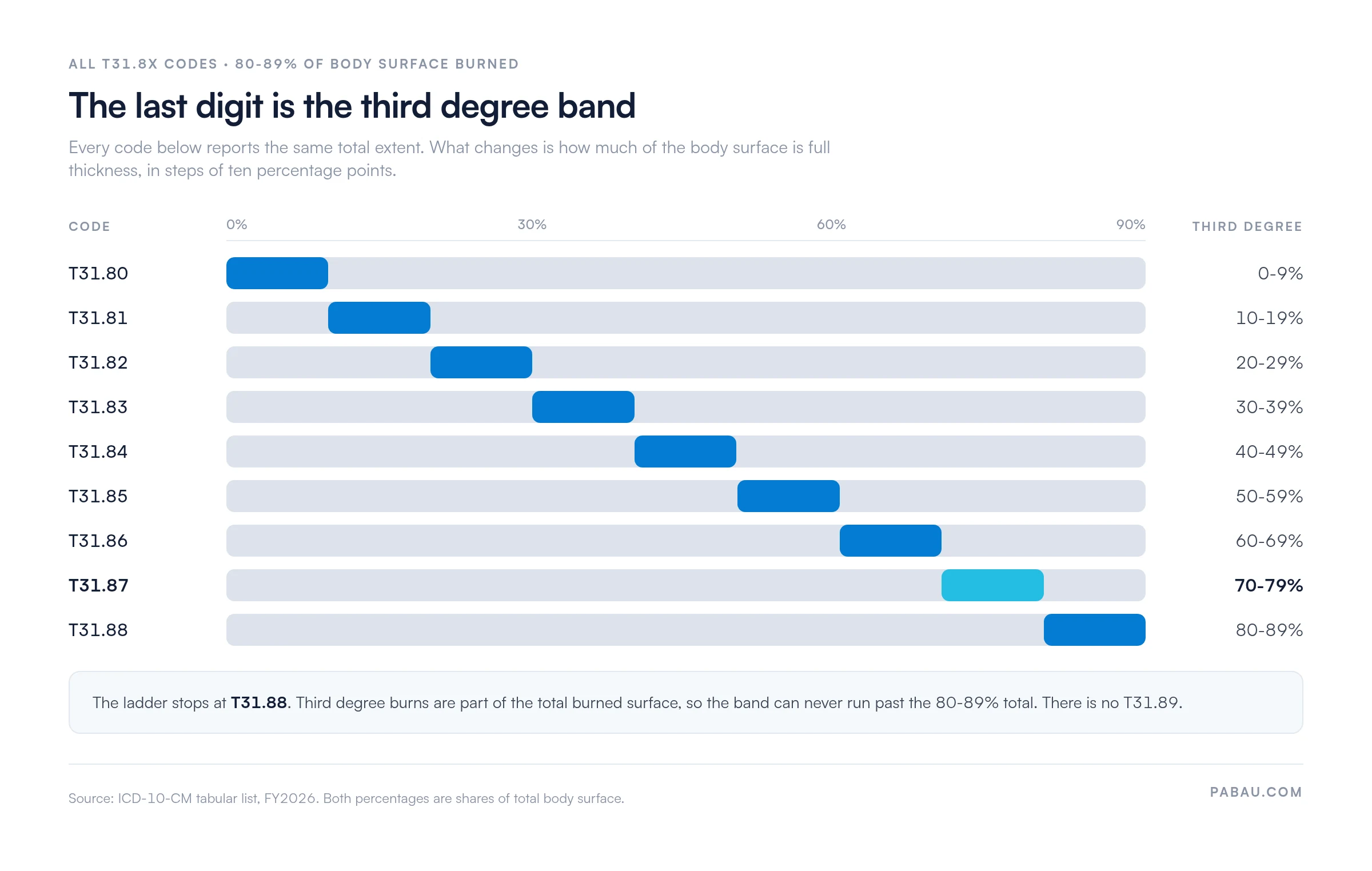
Notice where the ladder ends. Third degree burns are part of the total burned surface, so the third degree figure can never climb above the total. A group capped at 89% cannot carry a rung for 90% or more. That makes T31.88 the last child code, and T31.89 does not exist.
The other T31 subcategories work the same way across the rest of the ICD-10 diagnostic codes library, from T31.0 upward. Learn the pattern once and every burn extent code in the chapter becomes readable.
Third degree burns destroy the epidermis and the dermis, then reach into the subcutaneous tissue. They do not blanch under pressure. They are often painless at the burn site itself, because the nerve endings there have been destroyed.
The second figure in the code is the one people misread. The 70-79% in T31.87 is a share of the whole body, not a share of the burned area. Picture a patient with 85% of body surface burned, and 72% of body surface full thickness. That patient codes to T31.87.
Now change one number. If only 60% of body surface is full thickness within the same 85% burn, the claim codes to T31.86 instead. Read that 60% as a share of the burned area and you land on the wrong rung entirely.
Record total TBSA and third degree TBSA as two separate figures in every burn admission note. Express both as a percentage of the whole body. Neither number can be derived from the other. A note that says only ‘85% burns’ will not support T31.87.
Every T31 code rests on a TBSA estimate, and that estimate has to come from the chart rather than the coder. Two tools are accepted, and the patient’s age decides which one applies.
The Rule of Nines splits the adult body into regions worth 9% each, or simple multiples of 9%. Burn diagrams drawn from it are quick to read. Confirm which tool produced the diagram before you trust the percentages on it.
The Lund-Browder chart adjusts those regions for age. A two-year-old’s head is roughly 17% of body surface, against 9% in an adult. Run the Rule of Nines on that child and the estimate comes out low, which walks the claim down to the wrong sibling code. The record should name the tool that was used.
An auditor reading the chart should be able to rebuild the code from it, without calling anyone. Six items do that work.
Burn diagrams help, as long as each zone is labeled with its own percentage. A shaded outline with no numbers on it gives a coder no figure to work from.
These two codes share a total extent of 80-89%. The third degree band is the only thing separating them, and it moves by ten points. T31.87 needs 70-79%, while T31.88 needs 80-89%.
Both errors come from the same root, which is a chart that describes the burn in words instead of numbers. When a physician writes “third degree burns over most of the burned surface”, neither code can be assigned. Send a query before the claim goes out, not after the denial comes back.
A severe burn admission produces one of the longest claims a practice will ever send. Once you can see the order it comes together in, the failure points are easy to spot.
Run this over the claim while it is still editable. Each line takes a few seconds and each one maps to a denial reason.
When a burn claim does come back rejected, a documented denial management process decides whether it gets reworked quickly or quietly written off. High-acuity claims are worth too much to leave sitting in a queue.
Pull last quarter’s T31.8x claims and filter for T31.87 and T31.88. Compare each submitted code against the third degree percentage in the chart. Any mismatch is a preventable denial, or an overbilling risk, and it is cheaper to correct before the payer finds it.
T31.87 never travels alone. A severe burn claim carries a site code, this extent code, and a short run of external cause codes explaining how the injury happened.
Chemical injuries sit outside this pattern. A corrosion is reported with T54 for the corrosive substance and X46 for accidental contact, rather than an X00-X19 fire code. Extent for a corrosion comes from category T32, not T31.
Assembling a claim this long by hand invites transcription slips. Good claims management software pulls the line items straight off the patient’s invoice, so what leaves the practice matches what was charged.

Most burn billing teams work across two screens. The chart lives in one system, the claim is keyed into another, and the percentages get retyped somewhere in between. Every retype is a chance to drop a digit.
Practice management software like Pabau closes that loop. Pabau builds the claim directly from the invoice on the patient record, so the codes your team assigned are the codes that go out. Coverage is checked in real time before the encounter, which surfaces eligibility problems while you can still act on them.
After submission, Pabau tracks the status of each claim and posts the electronic remittance advice back against the invoice. Your biller can see what paid and what did not, without logging into a separate payer portal. That is less chasing, and a shorter path from discharge to payment.

Pabau generates claims from your invoices, checks eligibility in real time, and tracks every submission through to remittance. See how that fits a high-acuity burn billing workflow.

T31.87 comes down to two numbers, both measured against the whole body. Get them written into the chart at admission and the code picks itself.
So the work that protects this claim happens before coding starts. A physician who records total TBSA and third degree TBSA separately saves the biller a query, a delay, and often a denial. One number on its own leaves the coder with a question to send back.
If your burn claims still get keyed in twice, the problem is the workflow rather than the coding. Book a demo to see how Pabau builds the claim from the patient record and follows it through to payment.

Need to understand burn claim denials in depth? Denial management in healthcare covers how to build a systematic response workflow for high-acuity claim rejections.
Submitting clean claims for complex diagnoses? Clean claim requirements explains what payers look for before processing a multi-code submission like T31.87 plus T20-T29.
Looking for a US medical billing clearinghouse? Medical claims clearinghouse options breaks down how electronic claim validation works and what to look for in a clearinghouse partner.
Section I.C.19 treats T31 as an additional code. It is required when the burn site is not documented at all. It is also advised whenever third degree burns cover 20% or more of body surface, and burn units rely on it to report mortality data.
The site code for the highest degree burn leads. A patient with third degree burns on the trunk and second degree burns on an arm is sequenced with the trunk code first. T31.87 follows the site codes, never ahead of them.
T31 covers thermal burns only. A chemical injury is classified as a corrosion, so extent is reported from category T32 instead. Add T54 for the corrosive substance and X46 for accidental contact with it.
No. Third degree burns are part of the total burned surface, so that figure can never run higher than the total. It is why the T31.8x group stops at T31.88, and why no code exists there for 90% or more third degree burns.