ICD-10 code S61.201A: Open wound of left index finger without nail damage
ICD-10 code S61.201A covers a left index finger wound of unstated type ICD-10 co...

Last Updated: Oct 16, 2026
Billable Code Specific Code
T32.75 is the billable ICD-10-CM code for corrosions involving 70-79% of body surface with 50-59% third degree corrosion. The code sits in the T32 category, which classifies corrosion injuries by extent of body surface involved rather than by anatomical site, and it applies to chemical injuries only, never to thermal burns.
T32.75 is reported alongside the site-specific T20-T25 corrosion codes, and it drives DRG assignment on inpatient burn admissions. It is valid for current-year billing under the CMS FY2026 ICD-10-CM code set, effective October 1, 2025. The fifth character carries the third-degree percentage, which is the part of the code auditors check first.
Let Pabau's smart automation suggest the right codes, reduce claim denials, and keep your practice compliant—effortlessly.
Automate repetitive tasks and focus on what matters most—your patients.
Reduce coding errors and ensure compliance with the latest regulations.
Clean claims, fewer denials, and faster reimbursements.
Powerful insights and reporting to help your practice thrive.
HIPAA compliant SOC 2 certified GDPR-compliant Trusted by 4,000+ clinics worldwide

ICD-10 Code T32.75 covers chemical corrosions affecting 70-79% TBSA, with 50-59% of that area classified as third degree.
T32 codes classify corrosion injuries by extent of body surface rather than by site. They are sequenced alongside site-specific T20-T25 codes, per Official Guidelines Section I.C.19.d.
TBSA must be documented by the treating physician using the Rule of Nines or a Lund-Browder chart. Coders cannot estimate or calculate it themselves.
Pabau’s claims management tools build each claim from the patient record and submit it electronically through the Claim.MD integration.
The table below provides the essential reference data coders need before assigning T32.75 to a claim.
ICD-10 Code T32.75 encodes two clinical dimensions in one alphanumeric string. The first is the total percentage of body surface involved. The second is the percentage with third-degree, full-thickness corrosion. Reading the structure this way prevents the most common miscoding errors on large-surface cases.
The fifth character (5) encodes the third-degree sub-range within the 70-79% TBSA band. Neighboring codes in the T32.7x subcategory change only at the fifth character:
Selecting T32.70 when documented third-degree percentages sit in the record is a common auditor finding. Code to the highest level of specificity the physician documentation supports.
The T32 category classifies corrosion injuries by total body surface area involved, not by anatomical site. That separates it from the T20-T25 codes, which describe where on the body the injury sits. T32 works as an extent modifier for the site-specific code, never as a standalone replacement for it.
T32 covers corrosions only. Thermal burns classified by extent use the T31 category. The two categories are parallel in structure but mutually exclusive in application, determined by the causative agent.
Misassigning T31.75 when the mechanism is chemical is a payer audit trigger. The documentation must state “corrosion” or identify the chemical agent for T32 codes to be defensible.
ICD-10-CM Official Guidelines Section I.C.19.d governs when and how T32.75 is assigned, and item d.6 carries the extent and sequencing rule. The wording is short, but it decides both which code leads the claim and which one supplies the extent.
T32.75 is used as an additional code, not a principal diagnosis, in most admissions. The site-specific T20-T25 corrosion code carries the principal diagnosis when the reason for admission is the corrosion injury itself.
T32.75 leads the claim only when the corrosion injury is the condition established after study as chiefly responsible for the admission. It also requires that no more specific site code can be sequenced first, which is rare in burn center practice.
Total body surface area calculation is the clinical foundation of ICD-10 Code T32.75 assignment. The TBSA percentage documented by the physician determines which T32 subcategory applies. A 40-49% total, for example, codes to the T32.4x band, which starts at T32.40. Coders cannot calculate or estimate TBSA independently.
The Rule of Nines divides the adult body into regions, each representing roughly 9% of TBSA. The American Burn Association and standard burn medicine literature both use this breakdown, which runs as follows:
The Lund-Browder chart offers more precise TBSA estimation, particularly for pediatric patients, by adjusting head and lower extremity percentages for age. Burn centers use it routinely for any patient under 15, because the Rule of Nines overestimates head TBSA in children. Either method is acceptable for coding, provided the physician documents the result explicitly.
Key documentation requirement: the attending physician or burn surgeon records the TBSA percentage and the percentage of third-degree involvement separately. A note stating only “extensive burns” or “most of the body burned” will not support T32.75 and triggers a query.
ICD-10-CM Official Guidelines Section I.C.19.d.6 requires T32 extent codes to be reported alongside site-specific T20-T25 codes where those apply. ICD-10 Code T32.75 does not replace the site-specific code. It adds the extent and degree information that moves DRG assignment and payer reimbursement.
All site-specific codes must use the corrosion subtype, not the burn subtype, when the mechanism is chemical. Mixing thermal burn site codes with T32.75 is a coding error.
Large-surface corrosion cases usually involve several concurrent diagnoses and procedures. The claim depends on capturing all of them, not only the extent code. The table below lists the codes most often reported alongside ICD-10 Code T32.75 in inpatient burn center admissions.
Sepsis coding needs particular care. Per ICD-10-CM Section I.C.1.d, sepsis sequences first when it meets the principal diagnosis criteria, whatever the severity of the injury. Multi-code submissions of this size draw a predictable set of rejections. The reference on denial codes explains what each rejection means before you rework the claim.
Flag every T32.75 admission for a coding query if the physician’s note states only the total TBSA without separately documenting the third-degree percentage. Querying before submission avoids retrospective corrections and protects the specificity of the fifth character.
Documentation failures are the main cause of downcoding on large-surface corrosion cases. The fifth character cannot be supported without specific numbers from the physician, which is why burn centers audit their T32 assignments so closely.
Each of those five elements supports a different part of the claim, and each one fails differently when it is absent:
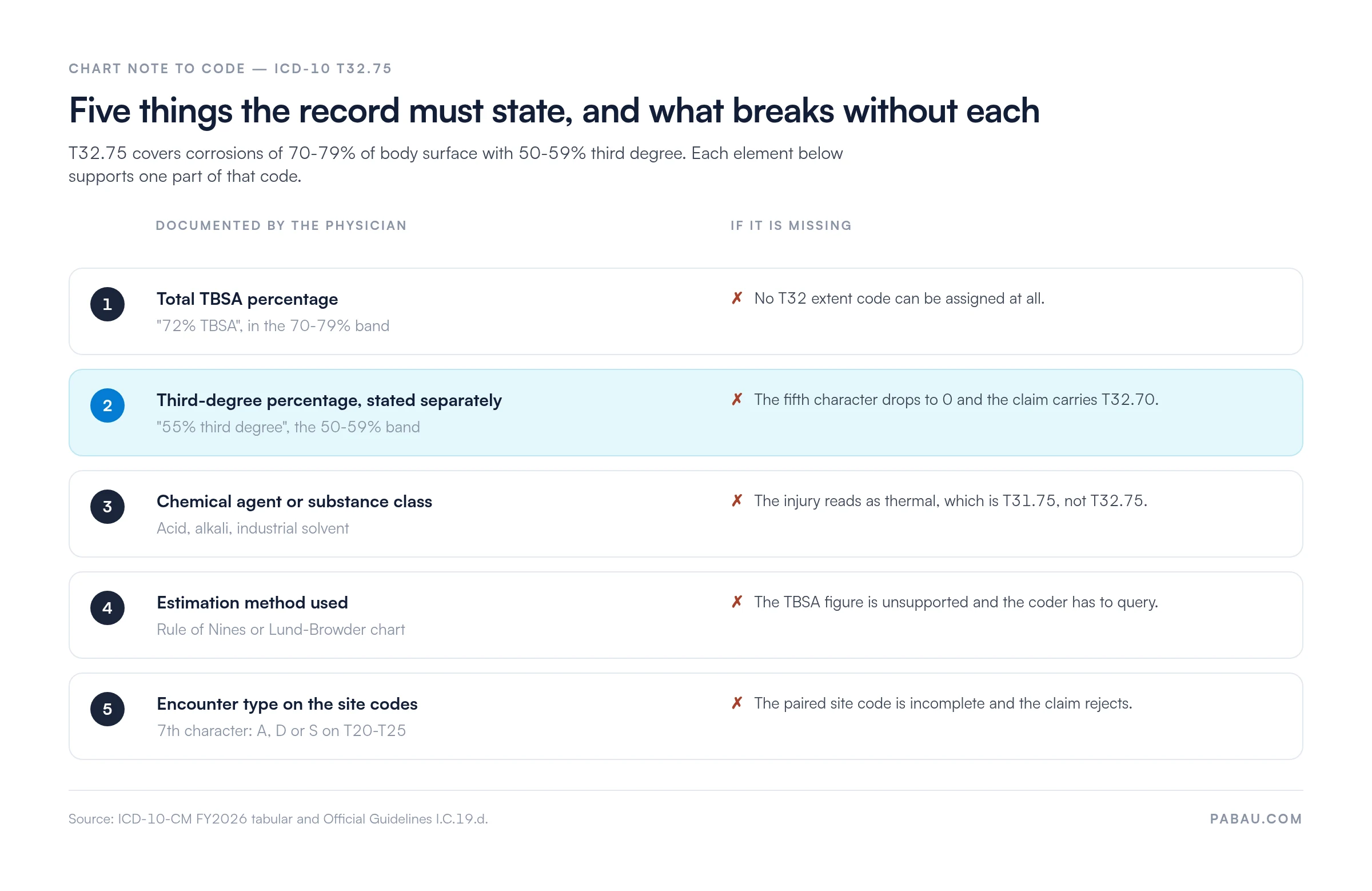
Auditors compare the documented TBSA against the coded T32 subcategory. A chart showing 73% TBSA paired with a T32.6x code (60-69%) will not survive review. A built-in ICD-10 catalogue inside claims management software keeps the full descriptor in front of the coder at the point of entry. That is where the mismatch gets caught.
The guidance on submitting a clean claim sets out what a payer expects at this level of complexity. Run those checks before the file leaves the billing office.
Coders can verify active code status and tabular context for T32.75 through the CDC/NCHS ICD-10-CM web tool. It provides the official U.S. code lookup by year. The CMS ICD-10 codes page carries the annual update files and code descriptions used for coverage verification. For crosswalk lookups, the AAPC Codify ICD-10-CM tool and ICD List both mirror official CMS/NCHS data and include the DRG grouper detail burn centers use.
Practices submitting corrosion claims electronically should confirm that their billing platform handles 837P sequences of the length these admissions need. A single case can carry T32.75, several T20-T25 site codes, and an external cause code before any complications are added.
Coding a T32.75 admission means carrying two numbers out of the chart note and onto the claim without losing either one. In most billing setups those numbers are re-keyed at least once, which is where the TBSA figure and the coded subcategory drift apart.
Practice management software like Pabau holds the clinical record and the billing record in one system. The documented TBSA percentages stay attached to the encounter the coder works from. Pabau’s claims management tools build the claim from that record and submit it electronically through the Claim.MD integration. Eligibility checks run in real time, and claim status comes back into the same screen rather than a separate payer portal.
The coder still decides which fifth character the documentation supports. What changes is how much of the admission gets typed twice, and how fast a rejected corrosion claim reaches the person who can answer it.


Pabau’s claims management builds each claim from the patient record and submits it through the Claim.MD integration. Eligibility checks and claim status sit in the same screen your coders already work in.

ICD-10 Code T32.75 stands or falls on two figures in the physician’s note: the total TBSA, and the third-degree percentage stated separately. With both recorded and the chemical agent named, the code holds up under review. Without them, the claim drops to T32.70 or reads as a thermal burn.
Raise the query while the patient is still in the burn unit, not after the claim has been submitted. A question answered at the bedside costs a fraction of a retrospective correction, and it keeps the fifth character the record earned. Book a demo to see how Pabau carries documented TBSA figures from the chart note through to the submitted claim.

Need to know what a payer expects on a multi-code claim? Submitting a clean claim explains the pre-submission checks that keep burn center claims out of the denial queue.
Working out why corrosion claims keep coming back? Denial management in healthcare covers how to track rejections and rework them inside the filing window.
Auditing your own T32 assignments? Medical billing compliance guidance sets out the regulatory framework behind inpatient claim submission.
ICD-10 Code T32.75 is the billable ICD-10-CM diagnosis code for corrosions involving 70-79% of the total body surface area. Of that surface, 50-59% carries third-degree, full-thickness corrosion from a chemical agent. It belongs to the T32 category, which classifies corrosion injuries by body surface extent, not by anatomical site.
The Rule of Nines divides the adult body into regions, each representing roughly 9% of total body surface area. It gives clinicians a rapid bedside estimate of the percentage burned or corroded. The physician documents the resulting TBSA percentage. The coder then uses that figure to select the correct T31 or T32 subcategory, such as T32.75 for the 70-79% range.
T32.75 requires documented third-degree (full-thickness) corrosion of 50-59% of the affected body surface within the 70-79% total TBSA range. If third-degree involvement is documented as 60-69%, the correct code is T32.76; at 40-49%, T32.74 applies. The fifth character changes with each 10-percentage-point increment in third-degree coverage.
Yes. ICD-10-CM Official Guidelines Section I.C.19.d.6 require T32.75 to be reported as an additional code alongside the appropriate T20-T25 site-specific corrosion codes. T32.75 provides the extent dimension that the site codes do not carry; both are needed for a complete picture of the injury.