

ICD-10 code S61.201A: Open wound of left index finger without nail damage
ICD-10 code S61.201A covers a left index finger wound of unstated type ICD-10 co...

Last Updated: Oct 16, 2026
Billable Code Specific Code
T32.76 is the billable ICD-10-CM code for corrosions involving 70-79% of body surface with 60-69% third degree corrosion. It reports a chemical injury by extent rather than by site, and it is complete at five characters with no 7th character.
Two percentages decide it. One is the total corrosion extent across all depths. The other is the share of body surface that is full thickness. Record only one of them, or blend them into a single estimate, and the claim goes out at the wrong severity.
Let Pabau's smart automation suggest the right codes, reduce claim denials, and keep your practice compliant—effortlessly.
Automate repetitive tasks and focus on what matters most—your patients.
Reduce coding errors and ensure compliance with the latest regulations.
Clean claims, fewer denials, and faster reimbursements.
Powerful insights and reporting to help your practice thrive.
HIPAA compliant SOC 2 certified GDPR-compliant Trusted by 4,000+ clinics worldwide

T32.76 is a billable ICD-10-CM code for corrosions covering 70-79% total body surface area with 60-69% classified as third degree
Two TBSA figures drive the code, the total corrosion extent at 70-79% and the third-degree component at 60-69%
T32.76 is complete as written and takes no 7th character, because category T32 carries no 7th-character instruction in the ICD-10-CM tabular list
Site codes from T20-T28 record where the corrosion sits, and T32.76 adds the extent data payers use to judge severity
Practice management software like Pabau captures both TBSA figures and the causative agent in the note, so the claim carries its support
ICD-10 code T32.76 is a billable, specific ICD-10-CM diagnosis code, valid for reimbursement and claims submission. Its full official descriptor reads: Corrosions involving 70-79% of body surface with 60-69% third degree corrosion.
The code sits in category T32, which classifies corrosions by extent of body surface involved. Its subcategory, T32.7, covers every corrosion with 70-79% total body surface area (TBSA) involvement. The final digit then narrows that to a third-degree share.
T32.76 is confirmed current and valid for FY 2025 and 2026 coding per the CMS ICD-10 codes release. The code is complete at five characters and takes no 7th character, because category T32 carries no 7th-character instruction in the tabular list.
The site-specific injury categories T20 through T28 do carry one, which is where the habit comes from. Submit T32.76 exactly as the tabular list prints it.
The 70-79% range comes from a TBSA calculation made at the bedside, not from the coder’s desk. TBSA is the percentage of skin affected by the corrosive injury, worked out with the Rule of Nines or a Lund-Browder chart. For T32.76, the total corrosion extent has to land between 70% and 79%.
Corrosions differ from thermal burns in causation. They come from chemical agents such as strong acids, alkalis or other caustic substances, rather than from heat. The ICD-10-CM Official Guidelines treat both the same way for TBSA classification, but the causative agent still has to be documented separately.
According to the WHO ICD-10 classification framework, category T32 applies to chemical corrosions classified by extent, whatever the agent involved. The four points below are what a coder actually checks in the note.
T32.76 belongs to subcategory T32.7, which covers corrosions involving 70-79% of body surface. Within that subcategory, the final digit reports how much of the body surface is third degree, in ten-point bands. Picking the right sibling means having both figures in front of you.
Parent code T32.7 is not billable on its own, so one of T32.70 through T32.77 has to be selected. Documentation that never quantifies the third-degree component pushes the coder down to T32.70, which reports only 0% to 9% full-thickness involvement and understates severity.
That two-figure pattern repeats across the burn and corrosion categories, so it is worth learning once. The rest of the ICD-10-CM code library follows the same tabular conventions for ranges and additional-code instructions.
Category T32 runs on two independent TBSA measurements, and mixing them up produces the wrong code every time. This is where T32.76 assignment breaks down most often in practice.
Axis 1, the subcategory digit. Total body surface affected by the corrosion, at any depth. For T32.76 that is 70-79%. It counts every area carrying first-, second- or third-degree involvement.
Axis 2, the final digit. How much of the body surface carries full-thickness, third-degree corrosion. For T32.76 that is 60-69%. Axis 2 is always a subset of Axis 1, never larger than it.
A patient with 75% total corrosion and 65% third-degree corrosion maps to T32.76. Both percentages are read against the whole body surface, which is why the smaller of the two belongs to the deeper injury.
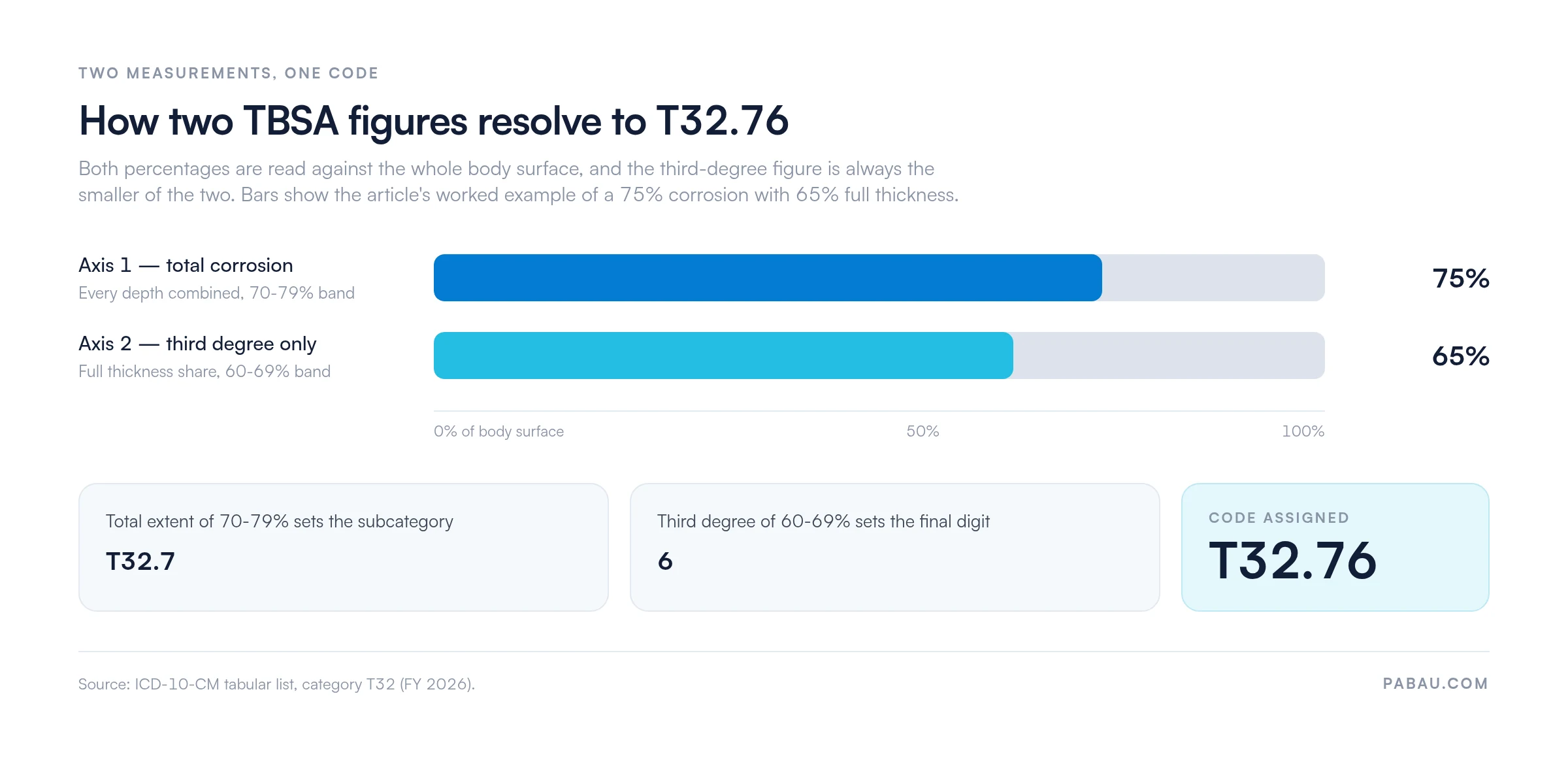
One check catches most of these errors. If the third-degree percentage is larger than the total figure, the note is wrong, so query the record before you select a code.
When reviewing documentation for T32.76 coding, look for two distinct TBSA numbers, not one. The clinical note should state total corrosion extent (e.g. 75%) and the third-degree component separately (e.g. 65%). If the physician’s note gives a single figure, the documentation is incomplete for this code level and needs a query before submission.
The ICD-10-CM Official Guidelines for Coding and Reporting (Section I.C.19) govern how T32 codes are applied. Per CDC/NCHS guidance, these rules apply to corrosion coding under category T32.
Sequencing also changes what the stay is worth. On an inpatient admission, T32.76 moves the MS-DRG weight and the expected reimbursement much further than a lower-specificity T32.70 does.
Four data points have to appear in the clinical record before a coder can assign T32.76 with confidence. Miss any one of them and the selection stalls, which usually ends in a query delay or a downcoded submission.
Treatment note templates that prompt for each element at the point of care cut the query cycle sharply. A TBSA field, a third-degree field, an agent field and a site field turn four follow-up questions into four required entries.
T32.76 is a diagnosis code, so it is paired with CPT procedure codes describing the treatment delivered. At 70-79% TBSA those procedures fall into three groups: debridement, skin grafting and wound management.
The codes below are the ones that come up most often on corrosion claims. Check coverage policy for the treating facility’s payer mix first, using the AAPC ICD-10-CM crosswalk as a starting point.
Payers running medical necessity edits cross-check the diagnosis against the procedure. A T32.76 diagnosis paired with a minor wound care CPT can trigger a Level II edit or an audit flag. The severity has to be documented behind it.
Outpatient follow-up is where that mismatch shows up most, because 97597 describes a much smaller wound than the diagnosis implies. Tying each procedure note back to the TBSA figures recorded for that encounter keeps the pairing defensible.
Four mistakes account for most T32.76 rejections. Each one is visible on the claim before it goes out, so a short pre-submission check catches all four.
Turn that into four questions the biller answers before the claim leaves the practice.
The 7th-character error is the one worth writing into a coding policy. That rule applies so widely elsewhere in Chapter 19 that coders reach for it here out of habit. Clean billing on high-acuity corrosion claims starts with submitting T32.76 exactly as the tabular list prints it.
A code reference page explains what T32.76 means, but the claim still rests on what the clinician wrote at the bedside. Practices lose money on severe cases when the treatment note and the billing system never meet.
Practice management software like Pabau keeps both in one place. Treatment note templates can prompt clinicians for total TBSA, third-degree TBSA, the causative agent and the affected sites. All four elements then exist before anyone opens the claim.
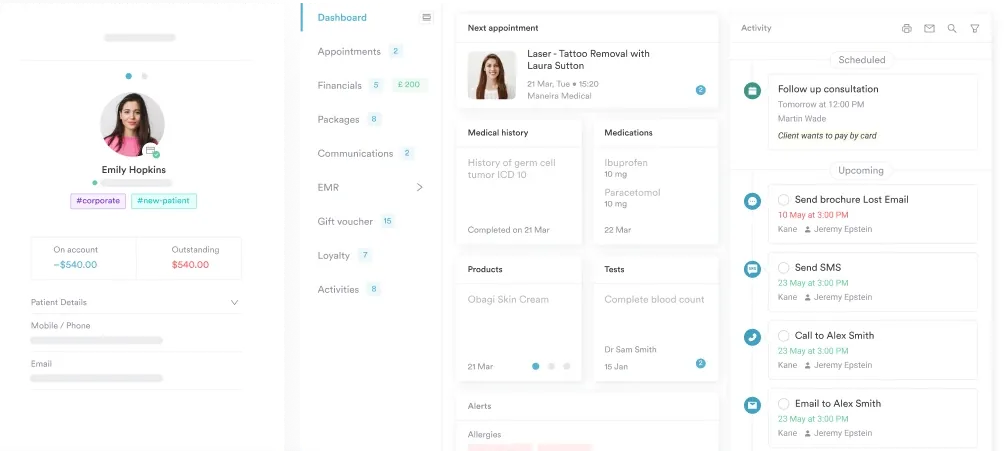
Once the encounter note is complete, the ICD-10-CM code attaches straight to the claim record. There is no second lookup tool and no copy-paste step between the chart and the claim.
Billing then runs from that same record. Pabau’s claims software for practices submits through Claim.MD, reaching over 4,000 US payers by electronic 837P submission.

Electronic remittance advice comes back through the same channel. A team reviewing a T32.76 denial can match the reason code against the original encounter note without leaving the platform.

Pabau connects clinical documentation to billing workflows. Your team captures both TBSA figures, records the corrosive agent and submits through a validated clearinghouse without switching tools.

T32.76 is complete as written, so the work sits in the documentation behind it. Two independent TBSA measurements, the corrosive agent and the affected sites all belong in the record. Without them, the code will not survive payer review.
Practices that build those capture requirements into their note templates fare better than those reconstructing figures at billing time. They see fewer queries, fewer downcodes and faster reimbursement on severe corrosion cases.
To see how structured TBSA capture and validated claim submission fit your team’s burn and wound care documentation, book a demo.

Coding a thermal burn at the same extent? ICD-10 code T31.76 covers burns involving 70-79% of body surface, the thermal mirror of T32.76, with the same two-figure structure.
Wondering how denial codes affect your burn and wound care claims? Denial codes in medical billing explains the most common payer denial reasons and how to resolve them before resubmission.
Looking to understand how clearinghouse submission affects code accuracy? Claim.MD clearinghouse guide covers how electronic claim validation works and what the 4,000+ payer network means for practices submitting high-acuity diagnosis codes.
T32.76 reports corrosions covering 70-79% of total body surface area, with 60-69% of that surface classified as third degree. Both figures come from the clinical record, and the deeper figure is always the smaller of the two.
No. Category T32 carries no 7th-character instruction, so T32.76XA, T32.76XD and T32.76XS are not valid codes. The 7th characters A, D and S belong to the site-specific injury categories such as T20 through T28.
T31.76 covers thermal burns at the same two extents, while T32.76 covers chemical corrosions. The categories mirror each other digit for digit, so the agent named in the note decides which one applies.
No. Category T32 measures body surface only. Corrosions confined to the eye, the respiratory tract or the digestive tract are reported from T26-T28 instead.
Use a Lund-Browder chart. A child’s head takes a larger share of body surface than an adult’s, and the legs a smaller one. The Rule of Nines misstates both.
The treating provider does. Coders assign T32.76 from what the provider recorded, rather than calculating the percentages themselves, so a note carrying one figure needs a query first.



