ICD-10 Code T63.591D: Toxic effect of other venomous fish
ICD-10 Code T63.591D: Quick reference ICD-10 Code T63.591D reports the toxic eff...

Last Updated: Oct 23, 2026
Billable Code Specific Code
T32.71 is the billable ICD-10-CM code for corrosions involving 70-79% of body surface with 10-19% third degree corrosion. It is a complete five-character code with no placeholder X and no seventh character.
Corrosions come from chemical agents, while thermal burns of the same extent are coded under T31. T32.71 is the primary code only when the corrosion site is unspecified. Otherwise it is an additional code that gives the percentage alongside the T20-T25 site codes, which carry the A, D or S character.
Let Pabau's smart automation suggest the right codes, reduce claim denials, and keep your practice compliant—effortlessly.
Automate repetitive tasks and focus on what matters most—your patients.
Reduce coding errors and ensure compliance with the latest regulations.
Clean claims, fewer denials, and faster reimbursements.
Powerful insights and reporting to help your practice thrive.
HIPAA compliant SOC 2 certified GDPR-compliant Trusted by 4,000+ clinics worldwide

ICD-10 code T32.71 covers chemical corrosions of 70-79% of body surface, with 10-19% of the body surface corroded to third degree.
T32.71 is a complete, billable five-character code. It takes no placeholder X and no 7th character, so T32.71XA, T32.71XD and T32.71XS do not exist.
Use T32.71 as the primary code only when the corrosion site is unspecified. Otherwise it is an additional code that gives the percentage alongside the T20-T25 site codes.
Pabau’s claims management software keeps the chart and the claim in one record, so companion codes are on file before submission.
ICD-10 code T32.71 reports chemical corrosions covering 70-79% of the body surface, with 10-19% at third degree. The table below gives the facts to check before you review documentation or submit a claim.
ICD-10 code T32.71 applies when a corrosion has affected between 70% and 79% of a patient’s total body surface area.
Of the total body surface, 10-19% is third-degree (full-thickness) corrosion. Both percentages should come from the treating provider’s documentation. The code does not apply to thermal, electrical, or radiation injuries, which fall under T31 (burns classified by extent) or the site-specific T20-T25 burn codes.
Corrosions at this extent represent life-threatening injuries. Facilities coding T32.71 are typically acute care hospitals, burn centers, or trauma units. T32.71 itself carries no encounter type. The 7th character on the companion T20-T25 site codes and the T51-T65 toxic effect code records whether care is initial, subsequent or for a sequela.
In the ICD-10-CM code set, category T32 classifies corrosions by the percentage of body surface involved. The fourth character (.7) identifies the 70-79% TBSA range. The fifth character (1) gives the percentage of body surface with third-degree corrosion, here 10-19%. The code ends there. T32.71 is a complete, billable code with no placeholder X and no 7th character.
The full T32.7 family covers every third-degree band within the 70-79% TBSA range. The fifth character depends on documented third-degree depth, so a wrong child code changes the code and may trigger a query.
T32 covers corrosions, which are chemical injuries. T31 covers thermal burns classified by extent. The ICD-10-CM Official Coding Guidelines, Section I.C.19.d, draw a firm line between these categories based on the causative agent, not the depth of injury.
When a single incident involves both a thermal component and a chemical component, code each separately. The physician must explicitly identify which injuries are thermal and which are chemical. Coders should not infer the agent from the clinical description alone. If the documentation is ambiguous, query the physician before assigning T32.71.
The Rule of Nines is the standard clinical tool for estimating TBSA in adults. It divides the body into regions, each representing approximately 9% of total surface area, allowing rapid bedside estimation.
For young children, clinicians often switch to the Lund and Browder chart, which allows for a larger head and smaller legs. Use the TBSA percentage the provider documents. The official coding guidelines let providers adjust the Rule of Nines percentages for infants, children and patients with larger buttocks, thighs or abdomen.
When TBSA documentation is missing or ambiguous, submit a physician query before assigning any T32.7x code. A claim submitted with T32.71 and no supporting TBSA notation in the record is a common reason for a query or denial. Document the query and the physician’s response in the record.
T32.71 rarely appears on a claim alone. When the record names the sites, it is an additional code to the T20-T25 site codes. Which other codes join it depends on the documentation. Check the complete code combination before submission. On high-acuity injury cases, that check is where claims management software earns its keep.

For T32.71, the medical record needs five documentation elements. When one is missing, query the provider before coding. Under sound medical billing compliance, that query is a routine step in the coding workflow.
The T32 category note sets the rule. T32 is the primary code only when the site of the corrosion is unspecified. When the site is specified, it is used as an additional code with categories T20-T25.
In that role, T32.71 adds the percentage that the site codes cannot show. The coder assigns a separate T20-T25 code for each documented site, per Section I.C.19.d.5. T32.71 then gives the total extent and the third-degree share. The chart below maps where it lands for each type of visit.
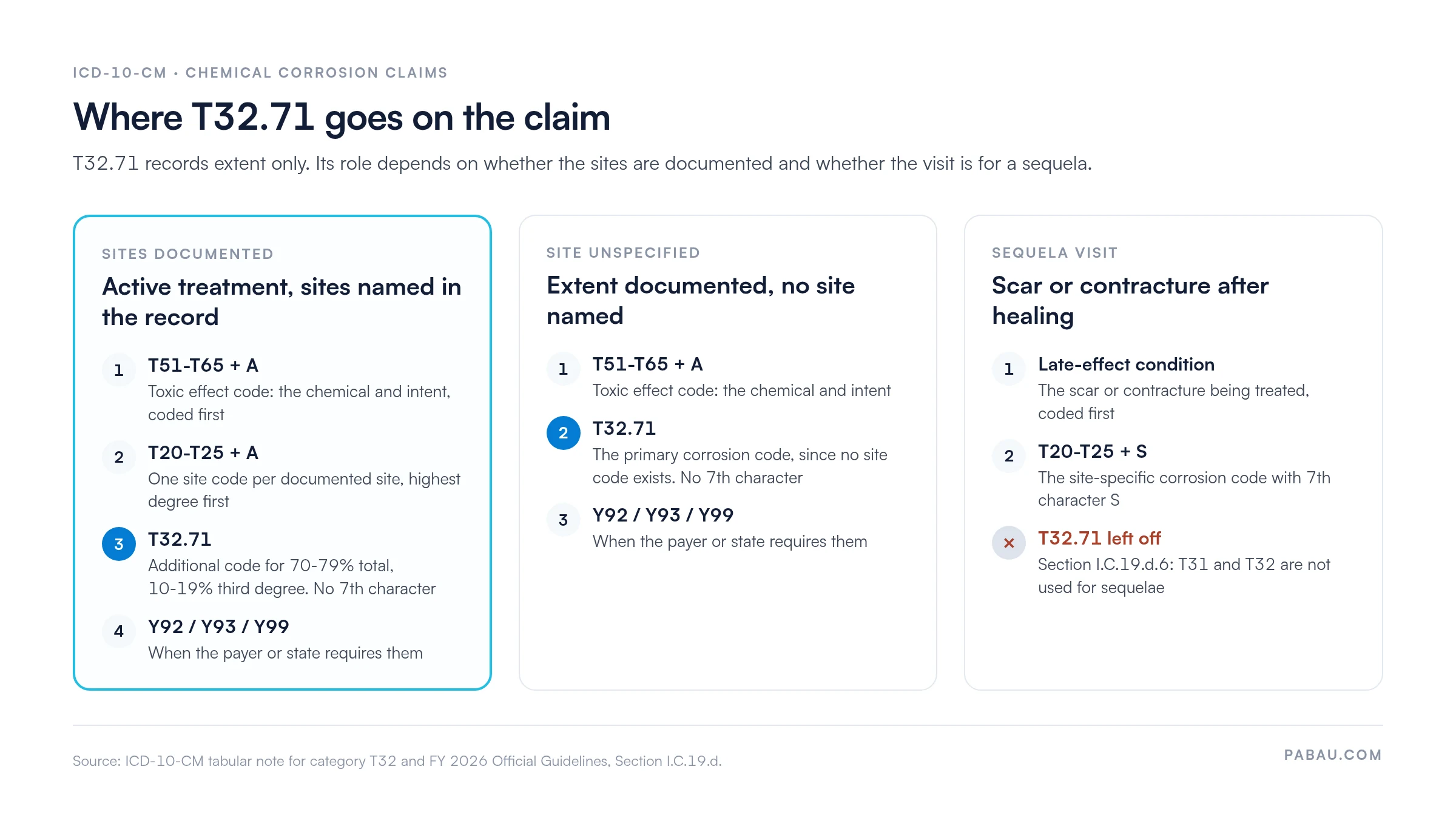
Seventh characters sit on the companion codes, not on T32.71. Every code in the site-specific categories takes A, D or S, and so do the toxic effect codes in T51-T65.
Common documentation pitfall: Coders sometimes copy the encounter character from the site codes onto T32.71. T32.71XA does not exist in the tabular list, so claim edits flag it as an invalid code.
On the site codes, use A while the patient receives active treatment, including a readmission for the same corrosion. Use D for routine healing follow-up after active treatment ends.
Take an accidental alkali splash at a factory. The patient has third-degree corrosion of the trunk and second-degree corrosion of the limbs. The provider documents a total extent of 74%, with 14% third degree.
The site codes appear as subcategories because the full code depends on the exact site and laterality in the record. Among the corrosion codes, the site with the highest degree is sequenced first, per Section I.C.19.d.1.
Section I.C.19.d.6 states that codes from T31 and T32 should not be used for sequelae of burns or corrosions. A visit for a scar or contracture after healing is coded with the late-effect condition first.
The site-specific corrosion code with 7th character S follows it, and T32.71 stays off that claim. A hypertrophic scar on the trunk six months after discharge is coded this way.
Under the Medicare Severity Diagnosis Related Group (MS-DRG) system, T32.71 sits in the CMS extensive-burns list. That list groups to MS-DRG 927 with a skin graft, or 933 without one, when mechanical ventilation exceeds 96 hours. Other T32.71 cases group by the remaining diagnoses and procedures on the claim.
DRG weights and reimbursement rates are updated annually in the Medicare IPPS Final Rule. Verify against the current fiscal year grouper tables before quoting figures to finance teams.
Complication codes captured late can change the final DRG. Code sepsis, acute kidney injury and other documented complications before the claim is final. Reading the electronic remittance advice on multi-code cases like T32.71 shows how the payer adjudicated the claim. Sound revenue cycle management separates correct reimbursement from systematic underpayment on high-acuity burn cases.
Denials on T32.71 claims cluster around six preventable errors. Catching them at pre-submission review costs less rework than fixing them later through denial management.
Coding T32.71 correctly depends on details spread across the chart. The coder needs the chemical, each site and its depth, the TBSA total, and the encounter status before the claim can go out.
Pabau, the practice management platform we build, keeps treatment notes, digital forms and invoices in one patient record. A treatment-specific form can ask for the chemical, the TBSA total and the third-degree share at every visit.
When the claim is ready, Pabau’s clean claim workflow submits it through the Claim.MD clearinghouse. Rejections come back into the same system to be corrected and resubmitted.

Pabau keeps treatment notes, TBSA documentation and claim tracking in one patient record. Your billing team codes high-acuity encounters like T32.71 from a complete chart.

T32.71 is one of the simpler codes on a corrosion claim, because it is complete at five characters and records only the extent. The work that decides whether the claim gets paid sits around it.
That means a toxic effect code first and a site code for each documented area. The place code follows where a payer or state requires it. It also means keeping T32.71 off sequela visits.
Practices that treat chemical injuries get cleaner claims when the chart captures the agent, sites, depth and TBSA at the point of care. To see how Pabau keeps that documentation and the claim in one record, book a demo with our team.

Need to understand denial patterns on complex injury codes? Denial management in healthcare covers root-cause analysis and appeal workflows for high-complexity claims.
Want to verify code pairs before submission? Clean claim submission best practices outlines the pre-submission checks that prevent the most common payer rejections.
Building a query process that holds up in an audit? Medical billing compliance guidance covers documentation and coding standards for multi-code injury encounters.
ICD-10 code T32.71 is the billable ICD-10-CM code for corrosions involving 70-79% of body surface with 10-19% third-degree corrosion. It belongs to category T32 and is complete at five characters, with no placeholder X and no 7th character.
Yes. T32.71 is a valid, billable and specific ICD-10-CM code exactly as written. Codes such as T32.71XA, T32.71XD and T32.71XS do not exist, and adding a 7th character makes the claim invalid.
T31 classifies burns by extent of body surface area and applies to thermal, electrical, and radiation injuries. T32 applies only to corrosions caused by chemical agents. The causative agent, not the depth of injury, determines which category applies. A third-degree injury from flame uses T31. The same depth from a caustic chemical uses T32.
The fifth character 1 indicates that 10-19% of the body surface is third-degree (full-thickness) corrosion. T32.70 covers 0-9% third degree, and T32.72 covers 20-29%. The percentage should come from the provider’s documentation, and the coder queries the provider when it is missing.
A toxic effect code from T51-T65 is coded first to identify the chemical and intent. Site-specific corrosion codes (T20-T25) are added for each documented site, and T32.71 follows them to give the extent. Report Y92, Y93 and Y99 codes when required by payer or state, per the guidelines.
Frequent denial triggers are adding a 7th character to T32.71, a missing toxic effect code, and absent TBSA documentation. Others are using T31 (thermal burn) codes for a chemical injury, missing site codes, and reporting T32.71 on a sequela visit.
Physicians use the Rule of Nines for adults and the Lund-Browder chart for pediatric patients. The Rule of Nines assigns 9% to the head and 9% to each arm. The anterior trunk, posterior trunk and each leg get 18% each, and the genitalia (perineum) get 1%. Coders use the TBSA percentage the treating provider documents and query the provider when it is missing.