ICD-10 Code Y76.0: Diagnostic obstetric and gynecological devices
ICD-10 Code Y76.0: Definition and billable status ICD-10 Code Y76.0 is a valid, ...

Last Updated: Oct 23, 2026
Billable Code Specific Code
T32.66 is the billable ICD-10-CM code for corrosions involving 60-69% of body surface with 60-69% third degree corrosion.
Assigning it takes two documented figures. The clinician has to record the total body surface area affected, and the share of that area with full-thickness damage.
Let Pabau's smart automation suggest the right codes, reduce claim denials, and keep your practice compliant—effortlessly.
Automate repetitive tasks and focus on what matters most—your patients.
Reduce coding errors and ensure compliance with the latest regulations.
Clean claims, fewer denials, and faster reimbursements.
Powerful insights and reporting to help your practice thrive.
HIPAA compliant SOC 2 certified GDPR-compliant Trusted by 4,000+ clinics worldwide

ICD-10 Code T32.66 describes corrosions involving 60-69% of body surface with 60-69% third degree corrosion, billable in the 2026 ICD-10-CM edition.
Corrosions are chemical injuries, not thermal burns. Using T32.66 requires clear documentation of the causative chemical agent and the total body surface area affected.
The rule of nines or Lund-Browder chart must support the 60-69% TBSA estimate recorded in the clinical note before this code can be assigned.
T32.66 reports extent only, so a site-specific corrosion code from T20-T25 is sequenced ahead of it for general body sites.
Practice management software like Pabau carries a built-in ICD-10 catalog, so coders can validate T32.66 against the note before the claim goes out.
ICD-10 Code T32.66 is a billable, valid diagnosis code in the 2026 edition of ICD-10-CM. It became effective on October 1, 2025, for FY2026 reporting.
The code belongs to the S00-T88 injury block, under the T30-T32 subblock for burns and corrosions. Within that subblock, T32 covers corrosions classified by extent of body surface involved.
Third degree corrosion across 60-69% of total body surface area (TBSA) is a critical, life-threatening injury. It carries a near-certain need for intensive care, fluid resuscitation, and surgical intervention. The code description carries two separate figures, and each one has its own documentation requirement.
In ICD-10-CM classification, a corrosion is an injury caused by a chemical or caustic substance, such as acids, alkalis, or caustic household cleaners. That is distinct from a thermal burn caused by heat or flame.
The causative agent for a corrosion is chemical, and the documentation must reflect this. Per CMS ICD-10-CM guidelines, coders cannot assign a corrosion code when the injury resulted from heat, radiation, or friction.
The first axis of T32.66 is the total body surface area affected. A corrosion involving 60-69% TBSA means the chemical injury covers more than three-fifths of the patient’s body.
At that extent, fluid loss, infection risk, and organ failure are all immediate concerns. The figure must be measured or estimated with the rule of nines or a Lund-Browder chart. The treating clinician then records it explicitly in the note.
The second axis specifies how much of the affected area is third degree, or full-thickness. For T32.66, 60-69% of the already-extensive injury runs through the epidermis and dermis into deeper tissue.
Third degree corrosions do not blanch, may appear leathery or charred, and lack sensation because the nerves are destroyed. This component also has to be supported by clinical documentation.
Selecting between burn and corrosion codes is one of the most common sources of miscoding in this category. The distinction is the causative mechanism, not the appearance of the wound.
The two injury types share most of their code ranges. T20 through T28 carry parallel subcodes for each body site, one set for burns and one set for corrosions of that same site. Only the extent categories are exclusive to one mechanism. T31 records burns by TBSA, and T32 records corrosions by TBSA.
When the chart describes a workplace acid spill or a caustic cleaning product exposure, assign corrosion codes. When it describes a kitchen fire or steam scalding, assign burn codes.
Mixing the two categories is a claim integrity issue. Miscoded burn and corrosion claims come back with denial codes that point straight at the documentation.
Placing ICD-10 Code T32.66 correctly within the code hierarchy helps coders verify they have selected the right subcategory. The full hierarchy from block to specific code is shown below.
According to the CDC/NCHS ICD-10-CM coding tool, the T32 category classifies corrosion extent on two axes. The first digit after the decimal is the total TBSA percentage.
The second is the percentage of third degree corrosion within that total. This dual-axis structure is unique to T31 and T32, so the chart has to support both figures independently.
T32.66 is one of ten billable subcodes under parent T32.6. Each sibling represents a different proportion of third degree corrosion within the same 60-69% TBSA range. The second figure in the note is what separates them. T32.60 sits at the low end, where the chart documents the least third degree involvement.
Accurate TBSA measurement is the foundation of any T32.x code assignment. Two methods are widely accepted in burn and corrosion care, and the note should say which one was used.
The rule of nines divides the adult body into anatomical regions, each representing 9% or a multiple of 9% of total body surface area. It is the most common bedside estimation tool used by emergency and burn clinicians.
Reaching the 60-69% band takes a combination of the large regions. The back (18%), both legs (36%), and the head and neck (9%) come to 63%, which sits inside it. The chart below shows how the region values stack up to that total.
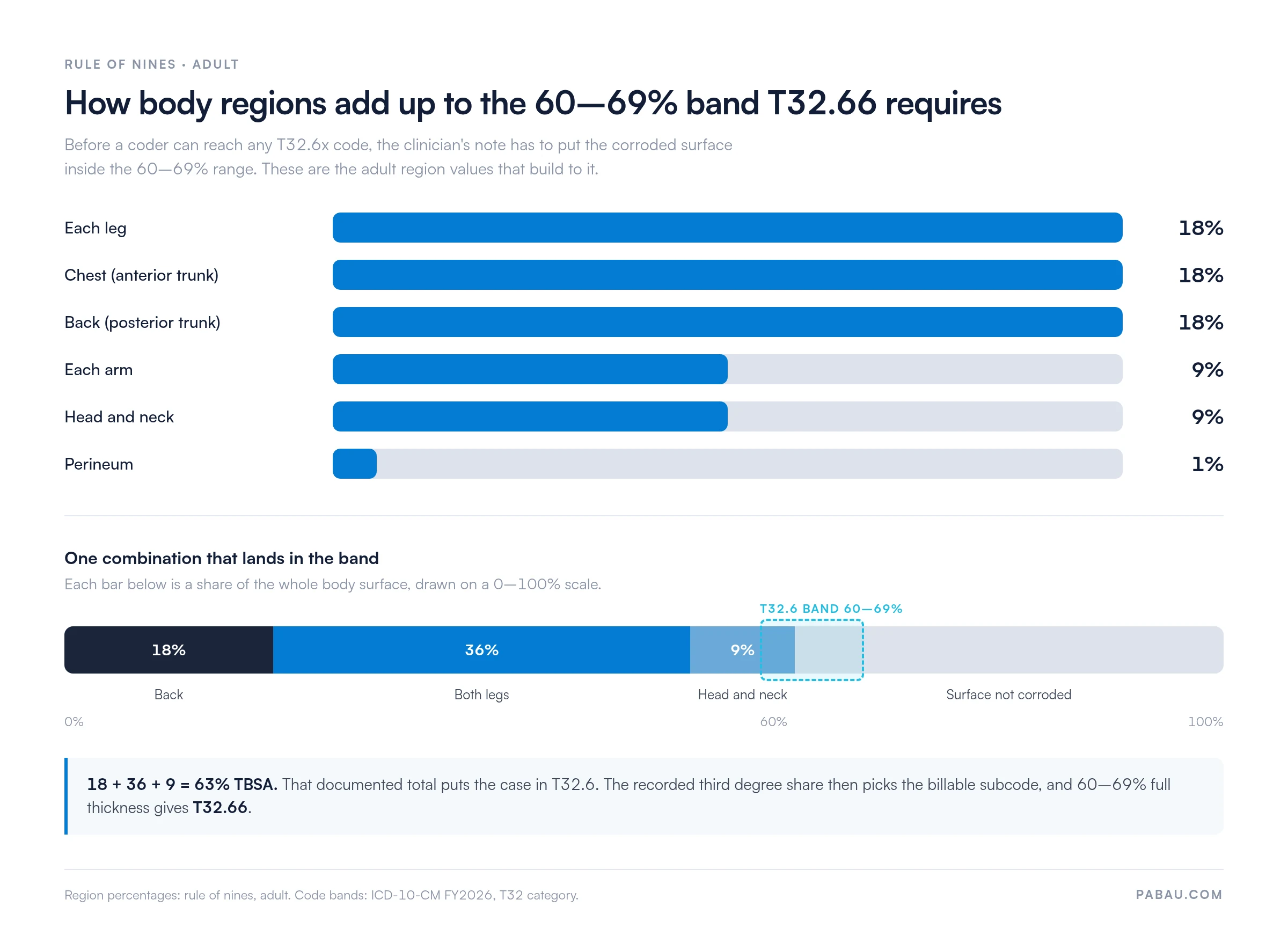
The calculation belongs in the chart, written by the clinician. A coder cannot derive the percentage from a wound description.
For pediatric patients, the Lund-Browder chart is more accurate than the rule of nines because it accounts for age-related differences in body proportions.
Children have proportionally larger heads and smaller legs than adults. Clinical notes for pediatric cases involving T32.66 should specify which estimation method was used.
The ICD-10-CM Official Guidelines for Coding and Reporting (Section I.C.19) govern how burn and corrosion codes are assigned and sequenced. T32.66 carries its own documentation and sequencing rules on top of those.
T32.66 is typically a secondary code. The primary code identifies the body site and the degree of the corrosion, and the site decides which range it comes from.
T32.66 is then reported as an additional code for the total extent of involvement. When the corrosion is the reason for the encounter and no site-specific code is more appropriate, T32.66 may serve as the principal diagnosis.
For medical billing compliance, the clinical record must support each element of the code before it can be assigned. Missing any of these elements is grounds for code revision or claim denial.
Run a documentation completeness check before coding any T32.x case. The chart needs four elements: the chemical agent, a clinician-estimated TBSA percentage, the third degree breakdown, and the site-specific corrosion code. Flag any case that gives a TBSA total but no third degree percentage, because that combination cannot support a T32.6x subcode at all.
Corrosion cases at the 60-69% TBSA level generate complex inpatient stays. Expect multiple attending physicians, surgical procedures, and extended ICU time on the same account.
A T32.66 claim never travels alone. The site-specific corrosion code leads, T32.66 reports the extent, and an external cause code describes the chemical exposure. Submit the three together, and confirm the record supports each one before the claim goes out.
ICD-10 Code T32.66 was not revised or reclassified in the FY2026 ICD-10-CM update cycle. The code description, billable status, and hierarchy are unchanged from prior editions.
The effective date of October 1, 2025 marks the standard annual activation of the FY2026 code set by CMS and NCHS. It does not signal a new or revised code entry.
Coders should still verify code validity each year with the CDC/NCHS ICD-10-CM web tool. T31 and T32 category codes have been subject to description edits in past update cycles. For FY2026, no changes affect T32.66 or its T32.6x siblings.
Check the CDC/NCHS code update files each October 1 to confirm T32.66 is unchanged. Then flag every T32.x code in your facility’s charge description master for the same annual review. An outdated code left in the CDM keeps producing claim edits on inpatient burn and corrosion cases.
Coding a corrosion case this large usually means moving between a code lookup, the clinical note, and the billing system. Each hop is a chance to transcribe T32.66 as T31.66, or to drop the external cause code on the way.
Practice management software like Pabau keeps those steps inside one record. The built-in ICD-10 catalog lets coders select and validate T32.66 against the note it belongs to. Claims then go out electronically through Claim.MD, Pabau’s US clearinghouse partner. Claim.MD supports real-time eligibility checks and electronic remittance advice on thousands of US payers.
Pabau’s claims management software also flags sequencing problems before submission, so T32.66 goes out behind the site-specific code rather than in front of it. The result is fewer rework cycles on the cases that cost the most to redo.


Pabau’s built-in ICD-10 catalog and Claim.MD clearinghouse integration help billing teams submit corrosion diagnoses accurately the first time. See how it works for your practice.

T32.66 is a simple code sitting on top of a demanding chart. The five digits are easy to look up. The two percentages behind them are what decide whether the claim survives review.
So the work sits upstream of the coder. Where the clinician records the chemical agent, the TBSA method and total, and the third degree share, the code follows from the note. Where one of those three is absent, no amount of coding skill recovers it, and the query goes back to the floor.
Book a demo to see how Pabau validates corrosion diagnosis codes and their sequencing before a claim leaves your billing team.

Need guidance on clean claim submission for complex diagnoses? Clean claim best practices covers the documentation and coding elements required to pass payer edits on first submission.
Want to understand how clearinghouse processing works? Medical claims clearinghouse overview explains how 837P files are validated before they reach the payer.
Looking to reduce denial rates on high-complexity cases? Denial codes in medical billing maps the most common CARC codes to the coding or documentation issues that trigger them.
Reconciling payments on a long inpatient stay? Electronic remittance advice explained shows how to match remittance data back to the diagnosis codes you submitted.
Want the wider picture around coding accuracy? Revenue cycle management explained sets out where diagnosis coding sits between the encounter and the payment.
ICD-10 Code T32.66 is a billable ICD-10-CM diagnosis code for corrosions involving 60-69% of body surface with 60-69% third degree corrosion. It sits in the T32 category, which classifies corrosions by the extent of body surface involved. The code is valid for diagnosis submission in the FY2026 edition, effective October 1, 2025. It reports a severe chemical injury covering more than three-fifths of the body, most of it full-thickness.
Yes. T32.66 is a billable, specific ICD-10-CM code valid for reimbursement submission in the 2026 edition. Its parent code T32.6 is not billable, because it stops at the TBSA range. T32.66 adds the third degree percentage, which gives it enough specificity to go on a claim. Verify billable status annually, since code status can change with each October update.
The difference is the causative agent. Burns come from heat, flame, radiation, electricity, or friction, and are coded in T20-T28 by site and T31 by extent. Corrosions come from chemical or caustic substances such as acids, alkalis, or industrial solvents. They are coded in T20-T28 by site, using the parallel corrosion subcodes, and in T32 by extent. The wound may look similar, so the mechanism recorded in the note decides which series applies.
For adults, the rule of nines is the standard estimation method. It assigns 9% to the head and neck and 9% to each arm. The chest, the back, and each leg are 18% apiece, and the perineum is 1%. For pediatric patients, the Lund-Browder chart is more accurate, because it accounts for age-related body proportions. The treating clinician calculates the estimate and states it in the chart. A coder cannot derive the percentage independently.
The parent code is T32.6, which covers all corrosions involving 60-69% of body surface regardless of third degree extent. T32.6 is not billable on its own. You have to select a subcode from T32.60 through T32.69 that matches the documented percentage of third degree corrosion. T32.66 applies when that third degree component is also 60-69% of the total affected area.
The siblings of T32.66 are T32.60 through T32.69. Each one represents a different share of third degree corrosion within the same 60-69% TBSA category. They run T32.60 (0%), T32.61 (10-19%), T32.62 (20-29%), T32.63 (30-39%), T32.64 (40-49%), T32.65 (50-59%), T32.67 (70-79%), T32.68 (80-89%), and T32.69 (90% or more). All are billable. Select the one that matches the third degree percentage in the clinician’s documentation.
The rule of nines divides the adult body into regions worth 9%, or a multiple of 9%, of total body surface area. It lets a clinician estimate the TBSA affected by a burn or corrosion at the bedside. For T32 coding, that percentage determines which T32 subcategory applies, from T32.0 through T32.9. The documented third degree breakdown then determines the specific billable code within it.