ICD-10 code S61.201A: Open wound of left index finger without nail damage
ICD-10 code S61.201A covers a left index finger wound of unstated type ICD-10 co...

Last Updated: Oct 16, 2026
Billable Code Specific Code
T32.65 is the billable ICD-10-CM code for corrosions involving 60-69% of body surface with 50-59% third degree corrosion.
Notably, the code is billable exactly as written, and the encounter character belongs on a different code entirely. With that distinction in mind, this reference covers the companion codes, the TBSA documentation the record needs, DRG impact, and the errors that trigger denials.
Let Pabau's smart automation suggest the right codes, reduce claim denials, and keep your practice compliant—effortlessly.
Automate repetitive tasks and focus on what matters most—your patients.
Reduce coding errors and ensure compliance with the latest regulations.
Clean claims, fewer denials, and faster reimbursements.
Powerful insights and reporting to help your practice thrive.
HIPAA compliant SOC 2 certified GDPR-compliant Trusted by 4,000+ clinics worldwide

In summary, ICD-10 code T32.65 is a complete, billable 5-character code for corrosions involving 60-69% of body surface with 50-59% third degree corrosion
T32.65 takes no 7th character and has no subcodes, so codes such as T32.650 or T32.655 do not exist in ICD-10-CM
Instead, the initial, subsequent, or sequela character sits on the site-specific T20-T25 corrosion code that is reported alongside T32.65
Together, a complete corrosion claim pairs the site codes, the T32.65 extent code, and a T54 code naming the chemical agent and the intent
Practice management software like Pabau puts ICD-10 search and structured note fields in the same workflow, so TBSA and agent detail reach the claim
To start, T32.65 is a complete, valid, billable ICD-10-CM code. Specifically, its official description is Corrosions involving 60-69% of body surface with 50-59% third degree corrosion. In fact, the code is five characters long, and five characters is all it ever takes.
Also, T32.65 has no 7th-character extension and no child codes. Indeed, the FY2026 edition took effect on October 1, 2025, and left the T32.6 series unchanged. As a result, its siblings run from T32.60 to T32.66, and each one is terminal.
At times, coders go looking for a “T32.650” or a “T32.655” to carry the encounter type. However, those codes do not exist. Instead, the encounter character lives somewhere else, and the next section shows exactly where.
To help with that, the table below gathers the reference data a coder or biller needs before assigning T32.65.
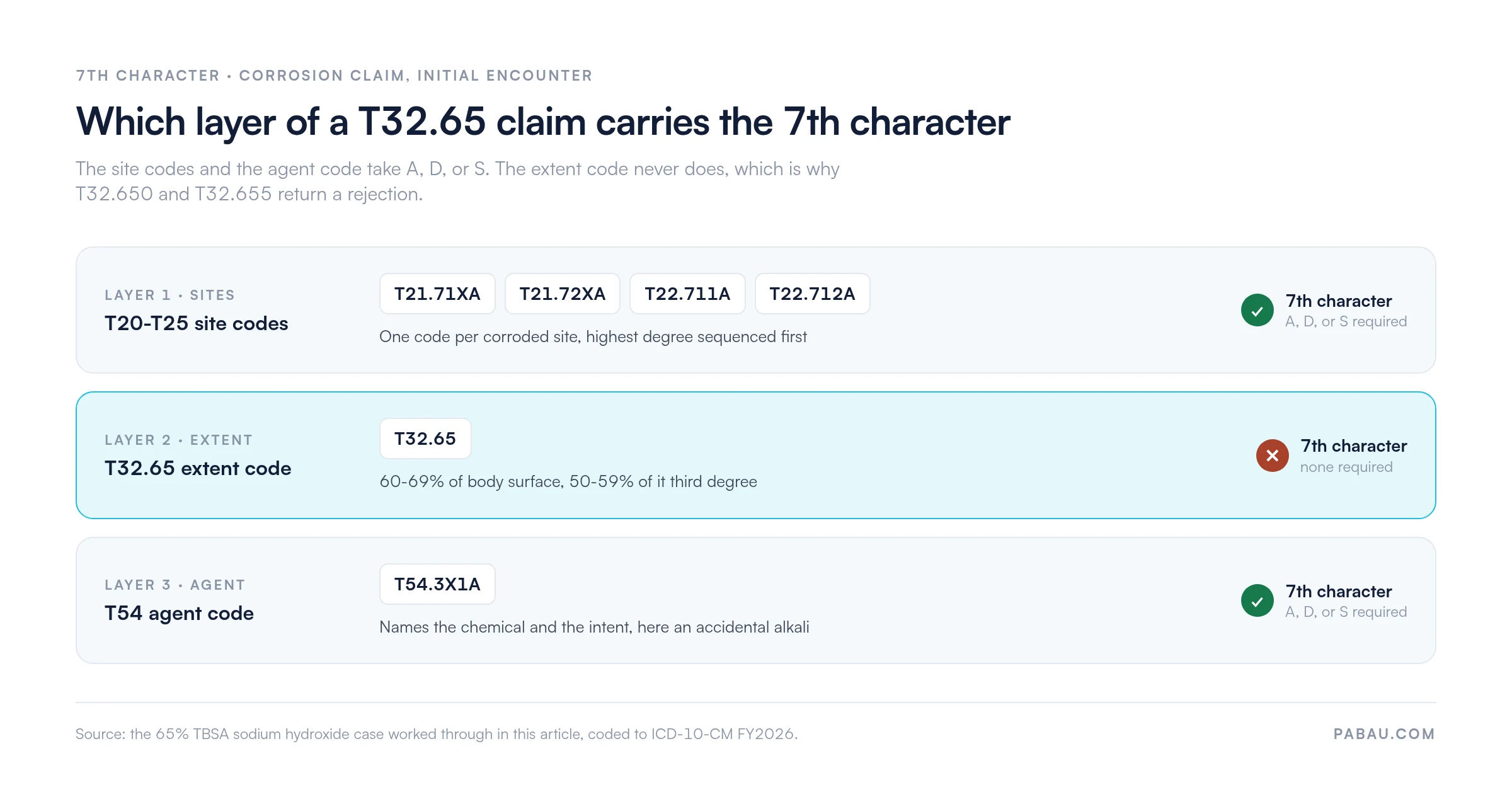
In this system, the initial, subsequent, or sequela character sits on the site-specific corrosion code from T20-T25, not on T32.65. Specifically, those site codes carry an A, D, or S in the seventh position. T32.65, by contrast, reports extent only, so it never needs one.
Under ICD-10-CM rules, the tabular note under T32 sets out the division of labor. Namely, T32 codes are the primary code only when the corrosion sites are unspecified. Otherwise, when the record names the sites, T32.65 becomes a supplementary code reported with the T20-T25 codes.
ICD-10-CM Official Guideline I.C.19.d also asks coders to sequence the highest degree of corrosion first. Furthermore, it recommends reporting the extent category whenever third-degree involvement reaches 20 percent or more of body surface. Consequently, a 60-69% case clears that threshold easily.
To illustrate, here is how the pieces fit for one worked case. For example, a worker takes a sodium hydroxide spill across the trunk and both forearms. In this scenario, the record documents 65% TBSA, 55% of it third degree, and this is the initial encounter.
In this case, four site codes carry the A extension. T32.65, however, carries none. Meanwhile, the T54 code carries both the agent and the intent, so a separate intent code is not needed for the chemical itself. Altogether, the three layers below show which of them takes the encounter character.
Broadly, T32 classifies corrosions on two axes. First, the fourth character sets the total body surface area involved. Then, the fifth character sets how much of that area reached full thickness, which ICD-10-CM calls third degree.
As noted, T32.65 sits in the T32.6 subcategory, which covers every corrosion involving 60-69% TBSA. Within that row, only the fifth character moves, and the row stops at T32.66. Therefore, there is no T32.67, T32.68, or T32.69, because third-degree involvement cannot exceed the total area affected.
For reference, the Centers for Medicare and Medicaid Services (CMS) maintains the ICD-10-CM Official Guidelines for Coding and Reporting with the National Center for Health Statistics. Together, they govern how every HIPAA-covered entity applies the T32 category.
In short, etiology decides the family. Specifically, a chemical agent produces a corrosion and sends you to T32, whereas heat, flame, electricity, or radiation produces a burn and sends you to T31. Consequently, choosing the wrong family is a standard audit finding, and it puts the whole code stack in question.
In every case, the operative question is always what caused the injury. Accordingly, clinician documentation has to name the agent. In that case, without that detail, a coder cannot confirm whether the chemical family or the thermal family applies.
To begin, picking the right code in the T32.6 row starts with an accurate TBSA estimate. Two methods, in particular, are standard in burn medicine.
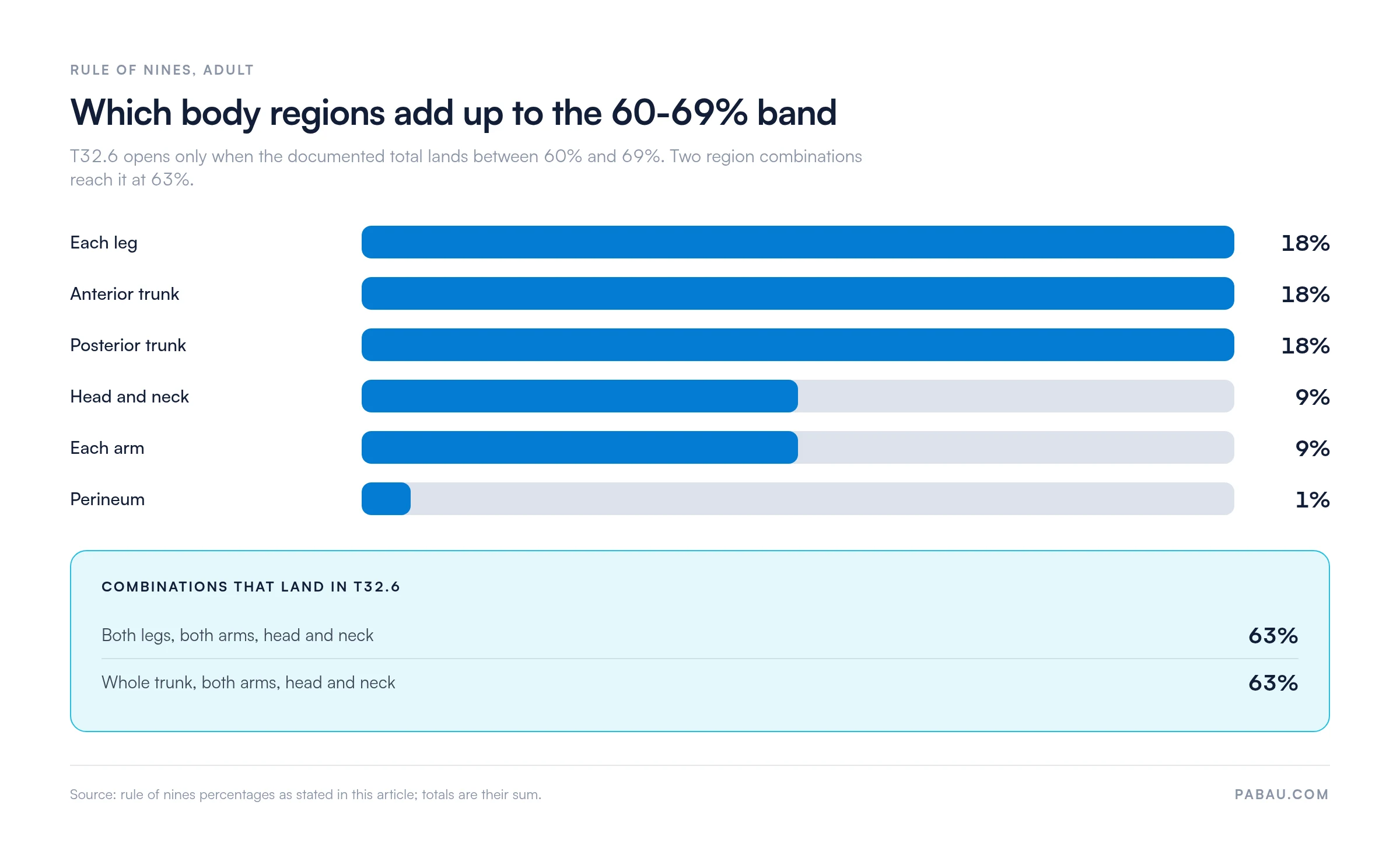
As one method, the rule of nines assigns set percentages to adult body regions. From there, a coder adds the corroded regions together to reach the figure that picks the T32 subcategory.
In practical terms, reaching 60-69% takes most of the body surface. For instance, both legs, both arms, and the head and neck come to 63%. Alternatively, swapping the legs for the whole trunk lands on the same figure.
The Lund-Browder method is more precise, especially for children, because it adjusts regional proportions for age. As a result, many burn units use the chart as their primary documentation tool.
Either way, the clinician has to write the estimated percentage into the record. Otherwise, a note reading only “extensive chemical burns” will not support code selection. Likewise, the third-degree proportion needs the same treatment, recorded as a percentage of total body surface rather than as a description.
For context, knowing where T32.65 sits helps coders navigate the tabular list without over-coding. Similarly, the wider ICD-10-CM code library nests the same way, from chapter down to a terminal code. Overall, the hierarchy runs from broadest to most specific:
As shown, the hierarchy stops at T32.65, and no child code sits below it. To verify this, the CDC ICD-10-CM web tool lets coders confirm that for the current fiscal year edition in a few clicks.
Typically, thin documentation is the main driver of denials on large-area corrosion claims. Before the code stack can be built, the record needs each of the elements below.
The Official Guidelines also tell coders to query the physician when the agent is undocumented, rather than defaulting to an unspecified code. Ultimately, getting all seven elements into the note is what supports clean claim submission on the first pass.
Build a four-field prompt into the intake note for large-area chemical injuries: TBSA percentage, third-degree percentage, named agent, and intent. That way, capturing those at first contact removes most of the back-end query cycle on T32.65 claims.
On most claims, T32.65 rarely appears alone. In fact, most large-area corrosion encounters draw codes from three or four categories at once. Accordingly, the table below covers the codes most often reported alongside it, or in its place.
The AAPC ICD-10-CM code lookup is useful when third-degree documentation lands on a boundary, such as 49% against 50%. After all, one percentage point moves the code.
T32.65 usually reaches the claim as an additional diagnosis, so it is not the code that drives the DRG on its own. Instead, inpatient corrosion cases group within MDC 22, the burn category, and the principal diagnosis is normally the highest-degree site code.
In total, MDC 22 holds six burn MS-DRGs. Within that set, assignment turns on whether a skin graft was performed and whether mechanical ventilation exceeded 96 hours. Additionally, documented inhalation injury and CC or MCC status also move the grouping.
Fundamentally, T32.65 is the code that carries the extent story onto the claim. Drop it, and the record no longer shows that 60-69% of body surface was involved. In turn, that detail supports severity review, burn registry reporting, and any medical review a payer opens later.
T32.65 can serve as the first-listed diagnosis in one situation only: when the record does not specify which sites were corroded. Even so, on a 65% TBSA case, that points to a documentation problem rather than a coding choice.
The failure patterns on this code are consistent, and most of them start in the note rather than in the billing system.
Large-area corrosion claims attract medical review more often than small ones. So, keep the rule of nines or Lund-Browder calculation in the chart, not just the final percentage. A records request can then be answered in one pass.
Typically, five questions catch nearly every avoidable edit on a large-area corrosion claim.
Working that list into the pre-submission review shortens the appeal cycle on these claims. Additionally, it gives the coder a defensible record if a payer requests the chart months later.
Coders who search the alphabetic index by clinical language rather than code number will reach T32.65 through terms like these.
None of these phrases confirms the code by itself. Instead, each still needs the two documented percentages behind it. For example, a note reading “severe chemical burns over most of the body” does not reach T32.65.
Accurate T32.65 coding depends on capturing TBSA, the third-degree share, the agent, and the intent before the claim ever leaves the practice. To that end, practice management software like Pabau keeps those fields and the coding step in one place.
Clinical note templates in Pabau can be configured to prompt for each element the code stack needs. Its built-in claims software for billers then carries the diagnoses and charges into the invoice, with no second system in the middle.

For US practices, Pabau submits and tracks claims electronically through its Claim.MD connection. Ultimately, structured capture at the point of care is what makes that submission clean, so the coder is not chasing a missing percentage a week after discharge.

Structured note templates and built-in ICD-10 search help teams record TBSA, third-degree percentage, and the causative agent at the point of care. The T32.65 code stack then reaches the claim complete.

T32.65 describes one precise scenario. Specifically, a chemical corrosion covers 60-69% of body surface, and 50-59% of that surface reached full thickness. Overall, the code is billable at five characters, takes no extension, and has no subcodes to choose between.
What it does need is company. Specifically, site codes from T20-T25 carry the encounter character, and a T54 code names the chemical and the intent. Once those three pieces are in the note at the point of care, the claim stops generating queries.
Pabau brings the documentation prompts, ICD-10 search, and claim submission into a single workflow, so coding accuracy stops depending on memory. Book a demo to see how that runs in a working practice.

Need to understand how claims move through a clearinghouse? Medical claims clearinghouse explained covers how electronic claim submission works from practice to payer.
Want to reduce denials on injury codes? Denial codes in medical billing breaks down the most common rejection reasons and how to work them.
Looking for the 837 file format requirements? 837 file guide explains the electronic claim format that carries a corrosion code stack to the payer.
In short, ICD-10 code T32.65 reports corrosions involving 60-69% of total body surface area with 50-59% third degree corrosion. In addition, it documents the extent of a chemical injury on the claim, alongside the site-specific T20-T25 codes and a T54 code naming the chemical agent.
Yes. Indeed, T32.65 is a complete, billable five-character code. Also, it is not a parent code, and it has no subcodes. Therefore, codes such as T32.650 or T32.655 do not exist in ICD-10-CM, so appending a character to T32.65 produces an invalid code.
No. In fact, T32.65 takes no 7th character. Instead, the initial, subsequent, or sequela character belongs on the site-specific T20-T25 corrosion codes reported with it. Likewise, the T54 agent code carries one too.
Overall, two methods are standard. First, the rule of nines assigns fixed percentages to body regions: the head takes 9%, each arm 9%, and each leg 18%, while the anterior and posterior trunk take 18% each and the perineum takes 1%. Alternatively, the Lund-Browder chart adjusts those proportions for age.
Specifically, the record needs a TBSA figure in the 60-69% band and a third-degree figure in the 50-59% band. It also needs the named chemical agent, the intent, the corroded regions with their depth, and the encounter type. Otherwise, missing detail normally triggers a physician query.
Only when the record does not specify which body sites were corroded. Once the sites are documented, the site-specific T20-T25 code carrying the highest degree is sequenced first and T32.65 becomes a supplementary code.
Specifically, the FY2026 edition of T32.65 took effect on October 1, 2025. Indeed, ICD-10-CM editions update annually, with each new edition starting on October 1. As such, code status and wording can be verified for any fiscal year using the CDC ICD-10-CM web tool.