ICD-10 Code S92.155P: Nondisplaced avulsion fracture of left talus with malunion
What is ICD-10 Code S92.155P? ICD-10 Code S92.155P is the billable ICD-10-CM cod...

Last Updated: Oct 22, 2026
Billable Code Specific Code
T31.65 is the billable ICD-10-CM code for burns involving 60-69% of body surface with 50-59% third degree burns.
It sits in the T31.6 subcategory, where the fifth character records the share of body surface with third-degree burns in 10-point bands. That is why it's most often confused with T31.64 and T31.66. Assignment needs both the total TBSA percentage and the third-degree percentage stated in the physician's documentation.
Let Pabau's smart automation suggest the right codes, reduce claim denials, and keep your practice compliant—effortlessly.
Automate repetitive tasks and focus on what matters most—your patients.
Reduce coding errors and ensure compliance with the latest regulations.
Clean claims, fewer denials, and faster reimbursements.
Powerful insights and reporting to help your practice thrive.
HIPAA compliant SOC 2 certified GDPR-compliant Trusted by 4,000+ clinics worldwide

T31.65 covers burns of 60-69% total body surface area (TBSA), with third-degree (full-thickness) burns over 50-59% of the body surface.
It’s a billable ICD-10-CM code, usually reported as an additional code after the site-specific T20-T25 codes on inpatient claims.
Documentation must record the total TBSA percentage, the third-degree percentage, the burn’s cause and the calculation method used.
T31.60 means 0-9% third degree, not unspecified, so a record with no third-degree percentage calls for a physician query.
Pabau, the practice management platform we build, connects to Claim.MD for real-time eligibility checks and electronic CMS-1500 claims to thousands of US payers.
ICD-10 code T31.65 is the billable code for burns covering 60-69% of total body surface area (TBSA) with 50-59% third degree.
It sits in Chapter 19 of ICD-10-CM (Injury, poisoning and certain other consequences of external causes), in category T31. On most inpatient claims it follows the site-specific T20-T25 burn codes as an additional code.
T31.65 takes no 7th character, so the five-character code is complete as written. Site-specific depth codes in the T20-T25 range do carry a 7th character for the encounter: A for initial, D for subsequent and S for sequela. Checking the character count before submission catches a formatting error that payer edits flag.
A patient with burns over 60 to 69 percent of total body surface area faces life-threatening systemic effects. They include massive fluid shifts, inhalation injury risk, sepsis and multi-organ stress.
At 50 to 59 percent third degree, most of the burned skin has lost both the epidermis and the dermis. Those areas need grafting because they can’t heal on their own.
These patients are almost always managed in a verified burn center. A 60 to 69 percent burn sits far above the American Burn Association’s threshold for a major burn. Care usually involves several surgical procedures, prolonged mechanical ventilation and specialized wound care. Each of those generates codes of its own alongside T31.65.
Accurate TBSA documentation is the foundation of every T31 code. The two accepted estimation methods are the Rule of Nines, which is standard for adults, and the Lund-Browder chart. Lund-Browder is preferred for children because it adjusts each body segment’s share for age.
Take a burn across both lower extremities (36%), the anterior trunk (18%) and the head and neck (9%). That totals 63%, inside the 60 to 69 percent band.
The attending physician or burn surgeon must record the calculation in the admission note or burn assessment form. Coders can’t estimate or back-calculate TBSA from nursing notes alone.
Auditors check that the TBSA figure appears in a physician-authored entry, not only on a nursing flowsheet.
Pediatric cases need the Lund-Browder chart, because a child’s head makes up a larger share of body surface and the legs a smaller one.
The adult Rule of Nines on a toddler underestimates head involvement and overestimates leg involvement. That error can move the total into a neighboring T31 subcategory, so the record should state which method was used.
Within the T31.6 subcategory, the fifth character records the third-degree percentage in 10-point bands. Picking the wrong fifth character is the most common upcoding or downcoding error on major burn claims. Between T31.64 and T31.65, the difference can be a single percentage point in the documentation.
T31.60 is not an unspecified code. It means third-degree burns cover 0 to 9 percent of the body surface. When the physician documents total TBSA but no third-degree percentage, query the attending before assigning any T31.6 code. Defaulting to T31.60 would understate a burn that is mostly full-thickness.
T31 codes classify burns caused by heat, flame, radiation or electricity. T32 codes classify corrosions caused by chemical agents. An industrial acid spill with 60 to 69 percent TBSA involvement and 50 to 59 percent third-degree injury is coded T32.65, not T31.65. That holds even when the wound looks clinically identical.
An incorrect T31 code on a chemical burn can surface in a commercial payer audit when the emergency department notes mention a corrosive substance.
The ICD-10-CM Official Guidelines for Coding and Reporting classify chemical injuries as corrosions. A T31 code on one is therefore a coding error, not a clinical judgment call.
The ICD-10-CM Official Guidelines (Section I.C.19.d) set the order. T31 and T32 codes are additional codes when site-specific depth codes from T20-T25 can be assigned. They aren’t the principal diagnosis when a site code exists. The diagram below runs that decision in order, from cause to external cause code.
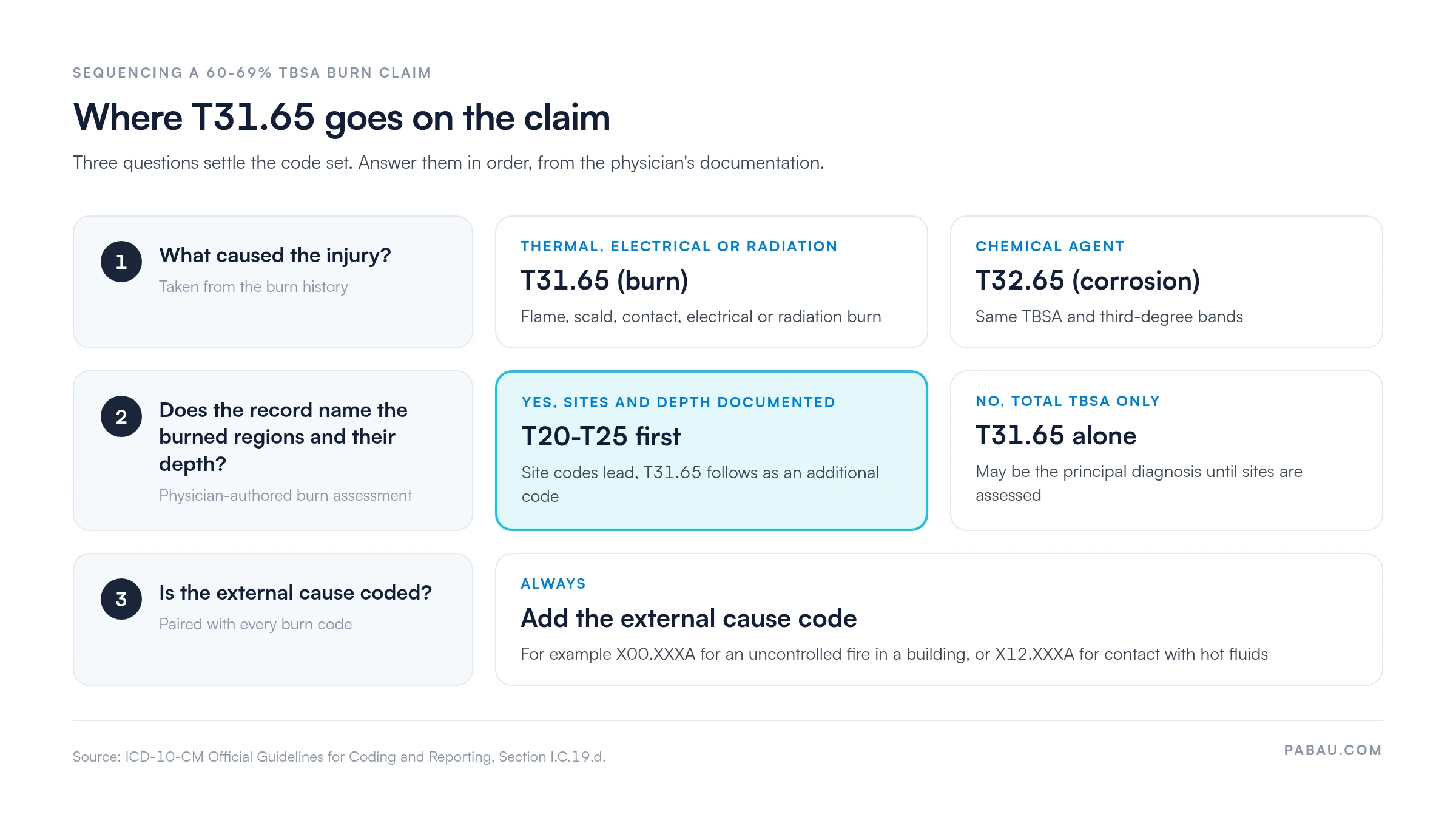
The same sequencing logic applies to outpatient and follow-up visits. If a patient presents for burn wound care and the record gives only total TBSA rather than named regions, T31.65 stands alone. Don’t assume site-specific coding was done elsewhere in the record without checking the physician’s documentation.
Payers and auditors look for specific elements before accepting T31.65 on a claim. A missing element can trigger a medical necessity denial or a post-payment recovery request. Checking burn admissions against medical billing compliance requirements before submission prevents the most common omissions.
AHIMA and AAPC both advise querying the attending physician when the record gives total TBSA but no third-degree percentage. A query beats a guess, because the fifth character moves the claim between bands with very different severity and reimbursement.
Making sure your superbill documentation captures every required burn element at discharge cuts down on retrospective queries. A clean claim needs the clinical record to support every character of the code at the time of submission.
Flag burn admission records for coder review before discharge. A same-day query to the attending about the third-degree percentage takes minutes. A post-claim denial means hours of rework, and a write-off if the appeal window closes.
Burn claims at T31.65 severity group to the extensive and full-thickness burn MS-DRGs under the Medicare Inpatient Prospective Payment System (IPPS). That group is DRGs 927, 928, 929, 933 and 934.
The five DRGs split on skin grafting, mechanical ventilation over 96 hours, inhalation injury and CC/MCC status. DRG 935 covers non-extensive burns and sits outside this group. Check assignments against the current fiscal year IPPS tables from CMS, because the groupings are updated annually.
Burn center level-of-care documentation carries its own payer requirement. Many commercial payers require admission to an ABA-verified burn center or a designated burn unit before they cover a major burn. The record must show that the facility meets the payer’s level-of-care criteria, not only that the burn is severe.
Teams handling burn claims at volume benefit from claims management software that flags these prerequisites before claims are batched.
Prior authorization is usually required for the burn reconstruction procedures that follow the acute admission, such as skin grafting, tissue expansion and scar revision.
These procedures carry their own CPT codes and may need an authorization separate from the acute stay. T31.65 appears on each related authorization as the burn severity reference.
Claims carrying ICD-10 code T31.65 draw heavy scrutiny, because auditors treat major burn admissions as high-value encounters.
Knowing the common denial triggers lets the billing team catch them before submission rather than during appeals. Reviewing denial management workflows for high-severity inpatient cases reduces avoidable write-offs.
When a denial arrives, the appeal should include the burn assessment showing the TBSA calculation method. Add the physician-authored note with both the total and third-degree percentages, plus the etiology narrative. If the denial reason is sequencing, cite Section I.C.19.d of the ICD-10-CM Official Guidelines in the appeal letter.
Knowing the common medical billing denial codes helps the team triage burn-related denials quickly.
Build a burn coding checklist with five checks: physician-documented TBSA, third-degree percentage, external cause code, T20-T25 site codes and sequencing order. Run it on every T31 claim before batch submission. One missed element can hold up payment on a high-value burn DRG for weeks.
These worked vignettes show correct code assignment under the ICD-10-CM Official Guidelines sequencing rules and payer documentation expectations.
A 34-year-old patient presents after a structural fire. The attending burn surgeon documents 63% TBSA burns across the anterior and posterior trunk, both upper extremities and the head, with about 55% third degree. The site-specific codes are T21.30XA (third-degree trunk), T22.391A and T22.392A (third-degree, multiple sites of each upper limb) and T20.30XA (third-degree head and neck).
Code sequence: T21.30XA (principal), then T22.391A, T22.392A and T20.30XA (additional), T31.65 (additional extent code) and X00.XXXA (exposure to uncontrolled fire in building, as external cause).
A patient arrives by transfer from a rural facility with scald burns. The transfer documentation states: “Burns covering approximately 62% TBSA, approximately 52% third-degree.” The transfer record has no site-specific depth documentation, and the receiving burn center hasn’t completed its own assessment yet.
Code sequence: T31.65 (principal, the only extent code supportable at this point in the encounter), then X12.XXXA (contact with other hot fluids, initial encounter). Add the site-specific codes once the burn center’s assessment is documented.
An industrial worker sustains acid burns from a chemical spill. The documentation records 61% TBSA involved and 51% full-thickness. The injury report confirms exposure to concentrated sulfuric acid.
Code sequence: T54.2X1A (toxic effect of corrosive acids, accidental, initial encounter) comes first to identify the chemical and intent. The site-specific T20-T25 corrosion codes follow, then T32.65 as the extent code. Reporting T31.65 here would be a coding error, because the agent is chemical.
On a manual workflow, a coder reads the burn assessment, keys the site codes and T31.65 into a claim form, and sends it. Eligibility problems and missing elements only come back once the payer rejects the claim, often after the patient has moved to rehab.
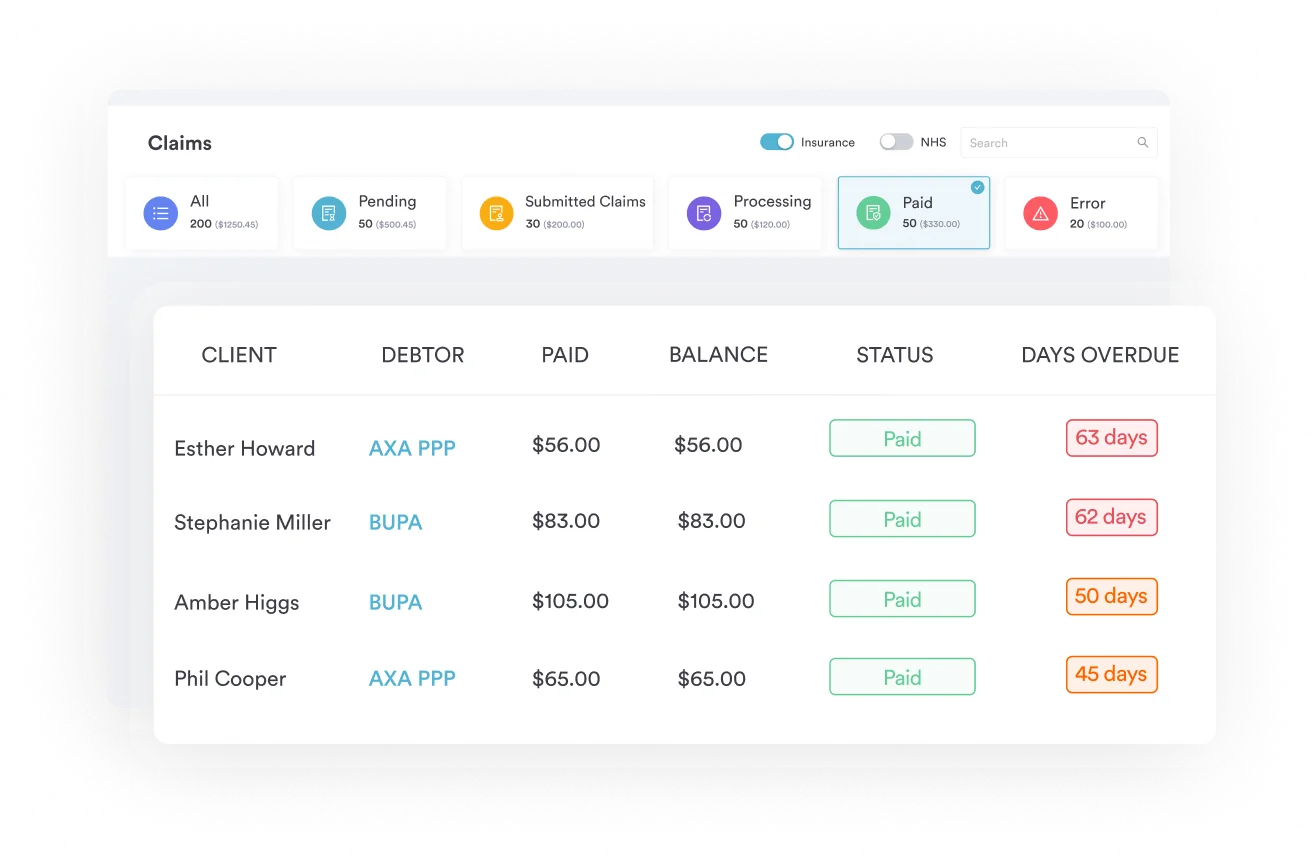
Pabau connects to Claim.MD for US billing. Patient eligibility is checked in real time, and the professional claim goes out as an electronic CMS-1500 to thousands of US payers. The claims dashboard then tracks each claim by status, so a rejected burn claim shows up in the Error view instead of an aging report.
The result is fewer burn claims bounced for eligibility, and more coder time for the physician queries that decide the fifth character. Seeing where those checks sit in the wider revenue cycle management picture helps the billing team decide where to add them first.

Pabau connects to Claim.MD to check patient eligibility in real time and submit CMS-1500 claims electronically to thousands of US payers. See how a burn coding workflow runs inside one platform.

T31.65 is won or lost in the burn assessment, not at the coding desk. When the burn surgeon records the total TBSA, the third-degree percentage, the method and the cause, the code choice is straightforward. When one of those is missing, the fix is a same-day physician query, never a default to T31.60.
Build that query into discharge for every major burn admission, and sequencing becomes the main risk left. The T20-T25 site codes lead, T31.65 follows, and the external cause code completes the set.
Pabau’s Claim.MD integration handles real-time eligibility checks and electronic claim submission to thousands of US payers, so your coders can spend their time on documentation. Book a demo to see how it handles high-severity burn claims from eligibility check to payment.

Capturing burn codes at discharge? What a superbill includes walks through the diagnosis, procedure and provider fields a claim is built from.
ICD-10 code T31.65 is a billable diagnosis code for burns involving 60 to 69 percent of total body surface area. Third-degree (full-thickness) burns cover 50 to 59 percent of the body surface. It belongs to the T31 category, which classifies burns by extent rather than by anatomical site. The physician must document both the total TBSA percentage and the third-degree percentage before the code can be assigned.
Yes, T31.65 is a billable, specific ICD-10-CM code, not a header or non-billable category code. It can be submitted on claims directly. In most inpatient burn cases, though, it serves as an additional code alongside site-specific depth codes from the T20-T25 range.
Both codes cover burns of 60 to 69 percent TBSA. T31.65 specifies third-degree burns over 50 to 59 percent of the body surface, while T31.66 specifies 60 to 69 percent. Use T31.66 only when the physician documents that 60 to 69 percent of the body surface is full-thickness.
T31 codes supplement T20-T25 codes rather than replace them. Under Section I.C.19.d of the ICD-10-CM Official Guidelines, T31 extent codes are additional codes when site-specific depth codes from T20-T25 are available. A T31 code stands alone as the principal diagnosis only when the record gives total body surface area but doesn’t name burn sites or depths.
T31 codes classify burns caused by heat, flame, radiation or electricity. T32 codes classify corrosions caused by chemical agents. A patient with 60 to 69 percent TBSA from a chemical acid exposure is coded T32.65, not T31.65. The documented injury mechanism decides it, so a confirmed corrosive chemical means the T32 series applies however the wound looks.
The most common reasons are a missing third-degree percentage, T31.65 listed as principal when a T20-T25 code should lead, and a missing external cause code. Using T31 when the agent is chemical, where T32 applies, is the fourth. Check every documentation element before submission to avoid these predictable triggers.