ICD-10 Code Y76.0: Diagnostic obstetric and gynecological devices
ICD-10 Code Y76.0: Definition and billable status ICD-10 Code Y76.0 is a valid, ...

Last Updated: Oct 23, 2026
Billable Code Specific Code
T32.54 is the billable ICD-10-CM code for corrosions involving 50-59% of body surface with 40-49% third degree corrosion.
One axis is the total body surface area (TBSA) affected. The other is the share of that surface that is third degree. Both figures have to come from the physician's note, and a claim carrying only one of them gets sent back.
Coders working with severe chemical injury cases meet T32.54 on inpatient and outpatient claims. Most rejections trace to two errors. One is a misread third-degree bracket. The other is the thermal burn T31 family used where T32 belongs. This page covers the code structure, its sibling codes, documentation requirements, coding guidelines, and the billing workflow.
Let Pabau's smart automation suggest the right codes, reduce claim denials, and keep your practice compliant—effortlessly.
Automate repetitive tasks and focus on what matters most—your patients.
Reduce coding errors and ensure compliance with the latest regulations.
Clean claims, fewer denials, and faster reimbursements.
Powerful insights and reporting to help your practice thrive.
HIPAA compliant SOC 2 certified GDPR-compliant Trusted by 4,000+ clinics worldwide

ICD-10 code T32.54 covers corrosions (chemical burns) of 50-59% total body surface area with 40-49% third-degree involvement.
Corrosions sit in the T32 family, and thermal burns of the same extent are coded from T31 instead.
Both axes have to appear in the physician’s note, the total TBSA affected and the third-degree percentage within it.
Site-specific corrosion codes from T20-T25 are added alongside T32.54 when the note names the body sites involved.
Practice management software like Pabau supports structured ICD-10-CM claim submission, which helps coders avoid the denial patterns common to T32 codes.
The table below summarizes the key attributes of ICD-10 code T32.54 at a glance. The CDC/NCHS ICD-10-CM web tool maintains the official tabular list, and it is where current-year code status gets confirmed before submission.
T32.54 encodes two simultaneous clinical measurements into a single code. The first measurement is total body surface area: 50-59% of the patient’s skin is involved in the corrosion. The second measurement is depth: of that affected surface, 40-49% is third-degree corrosion, meaning full-thickness destruction reaching through the dermis and into subcutaneous tissue.
Both figures must be documented by the treating physician before a coder can assign this code. A clinical note that records total TBSA but omits the third-degree percentage leaves the coder without the second axis. That forces a query back to the provider and delays the claim.
The clinical severity behind T32.54 is significant. A patient with 50-59% TBSA chemical burns, where nearly half of that surface is full-thickness, typically needs intensive care, surgical debridement, and grafting. Accurate assignment of the code influences DRG grouping, case mix index, and reimbursement adequacy for the facility.
Corrosions are chemical burns, and ICD-10-CM gives them their own code family. The causative agent decides which family applies. Corrosions classified by extent of body surface are coded from T32. Thermal burns of the same extent, caused by heat, flame, or scalding, are coded from T31.
Submitting a thermal burn code for a chemical injury, or the reverse, is a coding error that can trigger payer audits.
The clinical documentation must name the causative agent as a chemical to justify T32 coding. Per the CMS ICD-10-CM coding guidelines, an external cause code should accompany the corrosion code to identify the substance. Without it the claim may still pass, but a documentation audit can flag the record as incomplete.
The ICD-10-CM T32 category uses a grid structure. Rows represent total TBSA ranges in 10-percentage-point increments. Columns represent the percentage of that TBSA that is third degree. T32.54 occupies row 5 (50-59% total TBSA) and column 4 (40-49% third degree). The table below shows the full T32.5x row with T32.54 highlighted in context.
The full T32 grid extends from T32.0 (less than 10% TBSA) through T32.9x (90% or more of body surface). Each row follows the same column logic, and each row down the grid carries one more third-degree bracket than the row above it. The AAPC’s ICD-10-CM code range lookup gives the wider T20-T32 range context for coders cross-referencing adjacent code families.
The grid below holds all 55 T32 codes at once, with T32.54 marked in the 50-59% row.
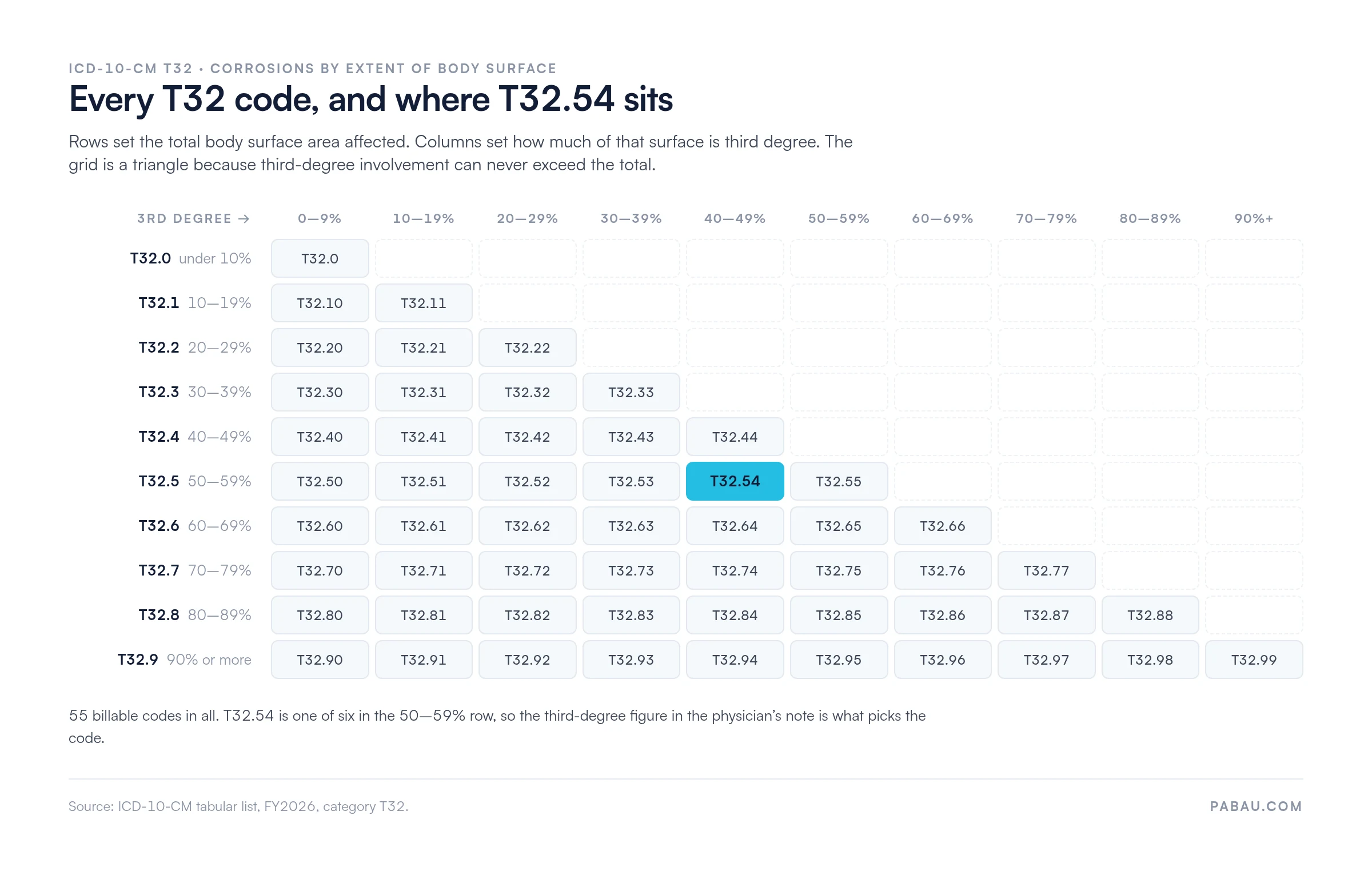
T32.54 sits within the T32.5x subcategory alongside five sibling codes. Each sibling differs only on the second axis, the percentage of third-degree involvement, while the first axis stays at 50-59% total TBSA. Picking the correct sibling takes the physician’s documented third-degree figure. Coders who default to T32.50 when that percentage is unstated are applying an incorrect code. The right action is a provider query.
Each row down the table moves the third-degree bracket by ten points. A chart documenting 10-19% third-degree involvement across the same 50-59% total surface therefore codes to T32.51.
T32.54 and T32.55 sit at the highest-severity end of the T32.5x family. Facilities treating T32.54-level injuries typically see complex DRG assignments that reflect the resources extensive chemical burns consume. Coders at burn centers and trauma facilities meet these codes most often.
T32.54 requires four specific documentation elements before a coder can assign it with confidence. All four must appear in the physician’s clinical documentation. Nursing notes and care plans are not primary coding sources under the ICD-10-CM Official Guidelines.
Practices managing complex injury billing need a workflow that captures both TBSA figures before the claim is built. Pabau’s claims software for coders supports ICD-10-CM code entry and claim preparation, which cuts the manual checks T32-family codes usually need.

Query the physician before coding T32.54 if the clinical note gives total TBSA but leaves out the third-degree percentage. Estimating or rounding to the nearest bracket is not acceptable, because the documentation has to support the exact range. A provider query is faster than a claim correction after denial.
The ICD-10-CM Official Guidelines for Coding and Reporting govern how corrosion codes are sequenced and supplemented. CMS and the National Center for Health Statistics (NCHS) maintain them jointly. Three rules are most relevant to T32.54 submissions.
The WHO ICD-10 browser gives international context for the T32 category, which helps clinicians working across healthcare systems. US coders should submit from the ICD-10-CM edition rather than the international ICD-10.
T32.54 appears on both inpatient and outpatient claims for patients with extensive chemical burns. On inpatient claims it feeds DRG assignment through the MS-DRG grouper, which affects reimbursement directly. On outpatient claims it supports medical necessity for debridement, wound care, and skin grafting. The code therefore carries revenue weight well beyond the coding department.
Practices submitting T32.54 claims should confirm HIPAA compliance at the claim level. The code is valid for HIPAA-covered transactions in FY2026, so it can be transmitted on standard 837P and 837I electronic claim formats. A clearinghouse that checks ICD-10-CM validity before transmission catches bracket errors while they are still cheap to fix.
Corrosion injuries at this extent often become workers’ compensation or liability cases, and outside counsel then asks CMS for the beneficiary’s claim history. CMS will not release those records without a signed Medicare consent to release on file.
Reimbursement for a T32.54 encounter is set by payer contract and DRG weight rather than by the diagnosis code itself. What the code does is signal severity to the grouper, which is why an understated bracket quietly costs the facility money.
T32.54 denials follow a predictable pattern. Four root causes account for most of them, and each one can be settled at the documentation stage, before the claim is built.
Coders who handle high volumes of T32-family claims benefit from a clean claim checklist with a T32 step that confirms both TBSA axes before submission. When a payer disputes ICD-10 specificity, the remittance usually cites CO-11, a medical billing denial code for a diagnosis inconsistent with the procedure. Specificity problems more often surface as documentation queries and audit findings than under any single adjustment reason code.
Run a periodic audit of T32.5x claims to confirm the third-degree bracket in submitted codes matches the physician’s documented TBSA assessment. A mismatch between the coded bracket and the clinical note is a compliance risk even when the claim pays. Payers can recover overpayments on retrospective audit.
In many practices the third-degree percentage gets chased after the fact. A coder opens the encounter, finds only the total TBSA figure, and queries the physician while the claim sits unbilled. Each round trip adds days to the account.
Pabau keeps the clinical note, the coded diagnosis, and the claim in one patient record. The coder reads the physician’s documentation beside the code being assigned, so a missing second axis shows up during charting rather than after submission.
Claims then leave through the Claim.MD clearinghouse integration, which validates ICD-10-CM codes against the current fiscal year catalog. Bracket and family errors on a corrosion claim surface before the payer sees them, which is where they cost the least to correct.

Pabau integrates with Claim.MD to validate ICD-10-CM codes before they reach the payer, reducing denials on complex injury claims including T32-family corrosion codes. See how structured claim workflows support accurate billing.

The work that decides a T32.54 claim happens before the coder opens it. Where the physician records both the total TBSA and the third-degree percentage in the same note, the code falls straight out of the grid. Where only one figure appears, no amount of coding judgment supplies the second axis.
So the change worth making sits upstream of coding. Agree a note template with the burn team that records both figures every time. The query rate on T32 claims then drops without anyone learning a new code. The trade-off is a slightly longer note for a claim that pays first time.
Pabau’s claims workflow supports pre-submission ICD-10-CM validation, so complex corrosion codes reach payers correctly the first time. Book a demo to see how structured claim submission works for injury coding.

Need guidance on managing healthcare billing compliance? Medical billing compliance for clinics covers the documentation and audit-readiness requirements that support clean ICD-10-CM submissions.
Want to understand how the full revenue cycle connects to ICD-10 coding? Revenue cycle management explained walks through how diagnosis codes flow from clinical documentation to reimbursement.
Handling high denial volumes on injury claims? Denial management in healthcare outlines the systematic approach to tracking, correcting, and preventing adjustment reason code patterns.
ICD-10 code T32.54 is a billable ICD-10-CM diagnosis code for corrosions involving 50-59% of total body surface area with 40-49% third degree corrosion. It is valid for FY2026 HIPAA-covered claim submission. The code carries two clinical measurements at once, the total TBSA affected and the percentage of that surface that is full-thickness third degree.
Corrosions are chemical burns. Classified by extent of body surface, they are coded from T32, while thermal burns of the same extent are coded from T31. The ICD-10-CM Official Guidelines separate the two by causative agent, so chemical agents take corrosion codes and thermal sources take burn codes. Submitting the wrong code family creates an inconsistency with the external cause code and may trigger a payer audit.
Yes, T32.54 is a billable, specific ICD-10-CM code. No additional digits or sub-codes are required for submission. It is valid for HIPAA-covered transactions in fiscal year 2026 on both 837P outpatient and 837I inpatient electronic claim formats.
Match two physician-documented figures. The total TBSA affected sets the row, and the percentage of that TBSA that is third degree sets the column. T32.54 corresponds to row 5 (50-59% total TBSA) and column 4 (40-49% third degree). Add site-specific codes from T20-T25 to capture body location, and an external cause code to identify the corrosive substance.
Physician documentation must confirm total TBSA in the 50-59% range and third-degree involvement in the 40-49% range. It must also name the causative chemical agent and the body sites affected. All four elements must appear in the physician’s note. Nursing notes or care plans alone are not sufficient under ICD-10-CM Official Guidelines.
The T32.5x family covers corrosions involving 50-59% of total body surface area. Its six codes, T32.50 through T32.55, differ only in the percentage of that surface that is third degree. Coders pick the sibling that matches the physician’s documented third-degree figure. The family is used for severe chemical burn cases requiring intensive and often surgical management.
Yes. Corrosions in ICD-10-CM terminology are chemical burns. T32.54 is the correct code where the injury meets the 50-59% total TBSA and 40-49% third-degree criteria. Thermal burns of equivalent extent are coded from the T31 family, not T32.