ICD-10 code S61.201A: Open wound of left index finger without nail damage
ICD-10 code S61.201A covers a left index finger wound of unstated type ICD-10 co...

Last Updated: Oct 16, 2026
Billable Code Specific Code
T32.33 is the billable ICD-10-CM code for corrosions involving 30-39% of body surface with 30-39% third degree corrosion.
Code-lookup pages stamp every current code with a line reading "2026 ICD-10-CM, effective October 1, 2025." That line dates the annual edition, not the code. T32.33 was neither added nor revised for FY2026, so the way you report it has not changed.
Let Pabau's smart automation suggest the right codes, reduce claim denials, and keep your practice compliant—effortlessly.
Automate repetitive tasks and focus on what matters most—your patients.
Reduce coding errors and ensure compliance with the latest regulations.
Clean claims, fewer denials, and faster reimbursements.
Powerful insights and reporting to help your practice thrive.
HIPAA compliant SOC 2 certified GDPR-compliant Trusted by 4,000+ clinics worldwide

T32.33 is a billable ICD-10-CM code for corrosions involving 30-39% of body surface with 30-39% third degree corrosion
The code is not new. It has been valid for HIPAA-covered transactions since October 1, 2015, and the FY2026 edition left it unchanged
T32.3 (parent) is non-billable, so the fifth character is what makes the claim payable
Report the corrosive agent and intent with a T54 code, not with WHO codes such as X46 or X86, which ICD-10-CM does not use
Practice management software like Pabau keeps corrosion code sets together, with an ICD-10-CM catalogue and Claim.MD clearinghouse submission
The Centers for Medicare and Medicaid Services (CMS) and the National Center for Health Statistics (NCHS) co-maintain ICD-10-CM. They update the code set each October 1. T32.33 carries no Type 1 Excludes notes and no retirement flag for FY2026.
T32.33 sits at the fifth character of the ICD-10-CM hierarchy. Coders who stop at a higher level submit a non-billable code and face claim rejection.
The parent code T32.3 is non-billable because ICD-10-CM requires a fifth character to specify the proportion of third-degree involvement. Specificity at the final character is what makes a code eligible for reimbursement, and the same rule runs through our other ICD-10-CM code guides.
All four T32.3x codes cover corrosions involving 30-39% of total body surface area. The fifth character specifies what percentage of that total involves third-degree (full-thickness) corrosion. Choosing incorrectly among these subcodes changes both the clinical severity picture and the reimbursement pathway.
According to the AAPC’s ICD-10-CM code reference, T32.3 is non-billable, so one of the four specific subcodes below must be used instead.
T32.33 represents the highest documented third-degree burden within the T32.3x group. A patient with 35% total body surface area involvement, all of it full thickness, is coded T32.33. A patient with the same total but only 15% third degree uses T32.31 instead. A total of 25% with no full thickness documented falls outside T32.3x and belongs in T32.20.
Corrosions differ from burns in their cause. Burns arise from thermal sources, while corrosions result from chemical agents such as acids, alkalis, or other caustic substances. ICD-10-CM classifies them separately for that reason. Third degree corrosion means the chemical injury has destroyed the full thickness of the skin, reaching or penetrating the subcutaneous layer.
Calculating the 30-39% TBSA figure uses the Rule of Nines or the Lund-Browder chart. Clinicians should document the method used, since payers increasingly audit extent calculations on large-TBSA corrosion claims. The clinical notes must support both percentages separately.
T32.33 has carried the same description and the same billable flag in every annual ICD-10-CM edition since FY2016. It was not added, revised, or newly activated on October 1, 2025. That date belongs to the FY2026 edition as a whole, and the edition made no change to any T30-T32 code.
Commercial code-lookup pages label every entry in the current edition “2026 ICD-10-CM, effective October 1, 2025.” The same line appears on codes as long-standing as I10 for essential hypertension. Read it as the edition date rather than the code’s birthday.
The annual addenda file is the reliable test of whether a code moved. It lists every addition, deletion, and revision for the year. No T30-T32 code appears in the FY2026 addenda, which confirms T32.33 came through the update untouched.
This matters for older claims. A date of service in, say, June 2025 falls under the FY2025 edition, and T32.33 was billable then on exactly the same terms. There is no need to hold or re-date a claim because the code looks new.
The following approximate synonyms and clinical descriptions map to this chemical burn ICD-10 code. Coders who meet these terms in clinical documentation can assign T32.33 when the extent and severity criteria match. The CDC/NCHS official ICD-10-CM lookup tool lists them as approved alternate descriptors.
These phrasings turn up in operative reports, burn unit documentation, and emergency department notes. When the documentation uses any of them and the percentages fall within range, T32.33 is the correct billable code.
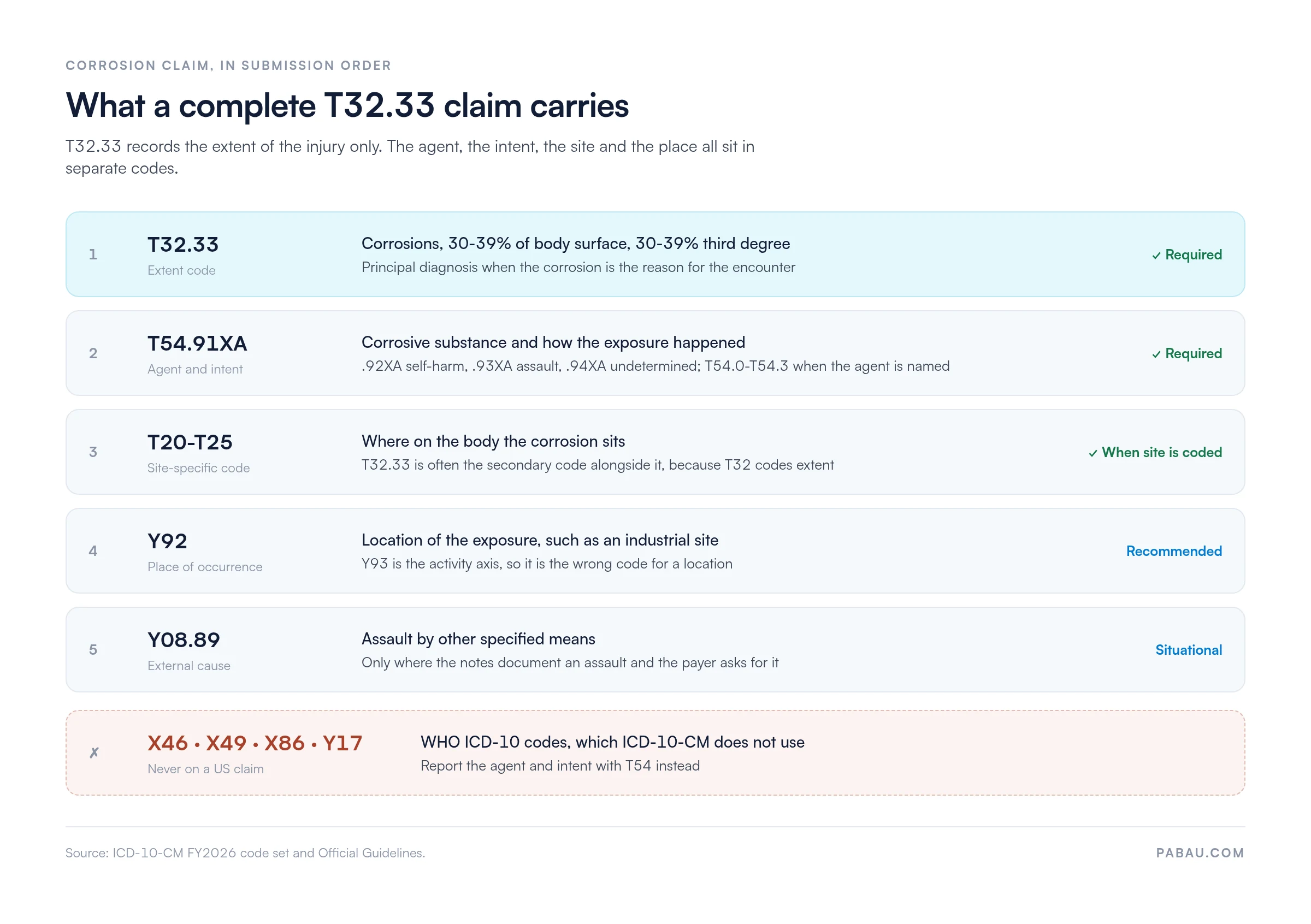
T32.33 needs a companion code that identifies the corrosive substance and the intent of the exposure. In ICD-10-CM that companion comes from category T54, the toxic-effect codes, which build intent into the code itself. Omitting it leaves the claim without a complete clinical picture, which is a common trigger for denial. Both codes belong on every T32.33 claim.
One correction is worth making explicitly here. Codes such as X46, X49, X86, and Y17 belong to the WHO version of ICD-10. ICD-10-CM does not use them, so they are not valid on a US claim. The T54 intent characters below replaced that structure.
Those four codes cover an unspecified corrosive substance. When the agent is documented, use the matching code from T54.0 to T54.3. Keep the same intent character, so accidental exposure to a corrosive acid becomes T54.2X1A. The seventh character records the encounter: A for initial, D for subsequent, S for sequela.
If an assault also needs an external cause code, ICD-10-CM uses Y08.89 (assault by other specified means). Place of occurrence comes from Y92. A common slip is to reach for Y93, which records activity rather than location. Y99 is available if the payer wants external cause status as well.
Sequence T32.33 first as the principal diagnosis when the corrosion is the reason for the encounter. Follow it with the T54 code and any codes for associated injuries or complications. The stack below shows every code a complete claim carries, in submission order.
Document TBSA calculations using the Rule of Nines or Lund-Browder chart in the clinical notes before coding T32.33. Payers auditing large-TBSA corrosion claims expect to see the calculation method and the supporting measurements, not just the percentage totals.
Accurate documentation is what gets a T32.33 claim paid on the first pass. Facilities billing large-TBSA corrosion injuries face heightened scrutiny, and thin records are the most common reason clean claim submission fails on these codes. A clearinghouse that validates ICD-10-CM codes at submission catches missing or invalid combinations before they reach the payer.
The ICD-10-CM Official Guidelines treat T31 and T32 as extent codes. They are reported as additional codes when the site-specific injury codes do not capture the full extent of the injury. T32.33 therefore often appears as a secondary code alongside a site-specific corrosion code from categories T20-T25.
Five errors account for most T32.33 rejections. Each one is visible in the chart before the claim goes out.
A sixth habit costs time rather than money. Teams sometimes treat T32.33 as a FY2026 addition and hold claims for earlier dates of service. The code was valid in every edition back to FY2016, so those claims can go out as normal.
A worker is splashed with a strong alkali across the trunk and both arms. The burn team documents 35% TBSA involvement, of which 32% is full thickness. Code T32.33 first, then T54.3X1A for accidental exposure to a corrosive alkali, then a Y92 code for the industrial setting.
A patient presents after an acid attack covering 30% of the body surface, with 10% recorded as third degree. The total TBSA sits in the T32.3x range, but the third-degree share points to T32.31 rather than T32.33. Add T54.2X3A for assault by a corrosive acid, plus Y08.89 if the payer wants an external cause code.
A biller finds an unsubmitted corrosion encounter from June 2025 and sees the FY2026 stamp on the code page. That stamp does not change how the claim is coded. T32.33 was billable under the FY2025 edition with the same description, so the claim goes out against that date of service.
The most frequent error on corrosion claims is reaching for T31, the burn extent codes, instead of T32. Both families classify injuries by body surface percentage and third-degree involvement, but the cause decides which family applies. Using T31 for a chemical corrosion is wrong however well the percentages match. The same cause-based separation runs across the ICD-10-CM injury chapters.
When a patient has both thermal burns and chemical corrosions from one incident, code T31 and T32 as appropriate. The WHO’s ICD-10 international reference keeps the same thermal and chemical distinction across its injury classifications.
Never substitute T31.33 for T32.33 just because the TBSA range matches. The causative agent decides the code family.
A T32.33 claim is never a single code. It travels with a T54 agent and intent code, often a Y92 place code, and usually a site-specific code from T20-T25. That pairing usually lives in a coder’s memory or on a laminated sheet by the desk. The omission surfaces later, when a remittance advice comes back short.
Practice management software like Pabau keeps the set together instead. Pabau’s medical claims management module carries a built-in ICD-10-CM catalogue, so coders pick T32.33 from the current code file instead of from memory. Validation rules flag an extent code that arrives without its companion, before the claim leaves the practice.
Claims reach the payer through the Claim.MD clearinghouse integration, and the remittance advice posts back against the original encounter. Your billers then spend the week working exceptions rather than rebuilding code sets by hand.

Pabau’s built-in ICD-10-CM catalogue and Claim.MD clearinghouse integration validate codes at submission, reducing denials on complex corrosion and burn claims.

T32.33 is an established billable code rather than a FY2026 arrival, and its description has not changed since October 1, 2015. What it demands is precision in the chart. Record the total TBSA, the third-degree share, the corrosive agent, and the matching intent code. Miss one element and the claim either fails clean-claim edits or invites an audit later.
Pabau’s ICD-10-CM catalogue and Claim.MD clearinghouse connection validate corrosion code sets at submission, which takes the manual review burden off your billing team. To see how the workflow handles complex injury code submissions, see how Pabau handles this.

Need to understand the full medical billing process? What is medical billing covers the end-to-end claims workflow from encounter to payment.
Want to reduce claim rejections on injury codes? Revenue cycle management fundamentals explains how to structure billing operations to catch coding errors before submission.
Looking for clearinghouse submission guidance? Superbill documentation covers what a complete billing package needs to include for clean ICD-10 claim submission.
ICD-10 code T32.33 documents and bills corrosions involving 30-39% of total body surface area where 30-39% of that surface is third degree, meaning full thickness. It is the correct billable code when the notes support both the total TBSA percentage and the third-degree proportion within the T32.3x range.
Yes. T32.33 is a billable ICD-10-CM code and has been valid for HIPAA-covered transactions since October 1, 2015, when ICD-10-CM took effect. The parent code T32.3 is non-billable and must not be submitted on a claim, so the fifth character is required.
T32.33 became effective on October 1, 2015, in the first ICD-10-CM code set, and it has appeared unchanged in every annual edition since. Code-lookup pages that show “2026 ICD-10-CM, effective October 1, 2025” are dating the current edition, not the code itself.
All four codes cover corrosions of 30-39% total body surface area, and the fifth character specifies what percentage is third degree. T32.30 is 0-9%, T32.31 is 10-19%, T32.32 is 20-29%, and T32.33 is 30-39% third degree corrosion. Choose the code that matches the documented third-degree proportion, not the total TBSA.
ICD-10-CM requires a code that identifies the corrosive agent and the intent of the exposure alongside T32.33. That code comes from category T54, for example T54.91XA for accidental exposure to an unspecified corrosive substance. A place of occurrence code from Y92 is also recommended.
No. X46, X49, X86, and Y17 belong to the WHO version of ICD-10, not to ICD-10-CM. A US claim carrying them will reject. ICD-10-CM builds intent into the T54 toxic-effect codes instead, and Y08.89 covers assault where an external cause code is also needed.
Yes. The ICD-10-CM Official Guidelines treat T31 and T32 as extent codes, reported in addition when site-specific injury codes do not capture the full extent. T32.33 therefore often sits alongside a site-specific corrosion code from categories T20-T25.