ICD-10 code S99.102P: Left metatarsal physeal fracture with malunion
ICD-10 code S99.102P flags a malunited growth plate fracture ICD-10 code S99.102...

Last Updated: Oct 28, 2026
Billable Code Specific Code
T31.33 is the billable ICD-10-CM code for burns involving 30-39% of body surface with 30-39% third degree burns. Nearly the whole burned area is full thickness, because 30-39% of the body is burned to third degree.
The fifth character carries that third-degree share. If the note understates it, the code drops to T31.30, T31.31, or T31.32. T31.33 also rarely goes first. When burn sites are documented, it follows the T20-T25 site codes as extra data. Getting both details right keeps a costly inpatient claim from bouncing back. The sections that follow cover the code ladder, a worked TBSA example, a pre-submission checklist, and the denials to avoid.
Let Pabau's smart automation suggest the right codes, reduce claim denials, and keep your practice compliant—effortlessly.
Automate repetitive tasks and focus on what matters most—your patients.
Reduce coding errors and ensure compliance with the latest regulations.
Clean claims, fewer denials, and faster reimbursements.
Powerful insights and reporting to help your practice thrive.
HIPAA compliant SOC 2 certified GDPR-compliant Trusted by 4,000+ clinics worldwide

T31.33 covers burns involving 30-39% of body surface, with 30-39% of the body burned to third degree.
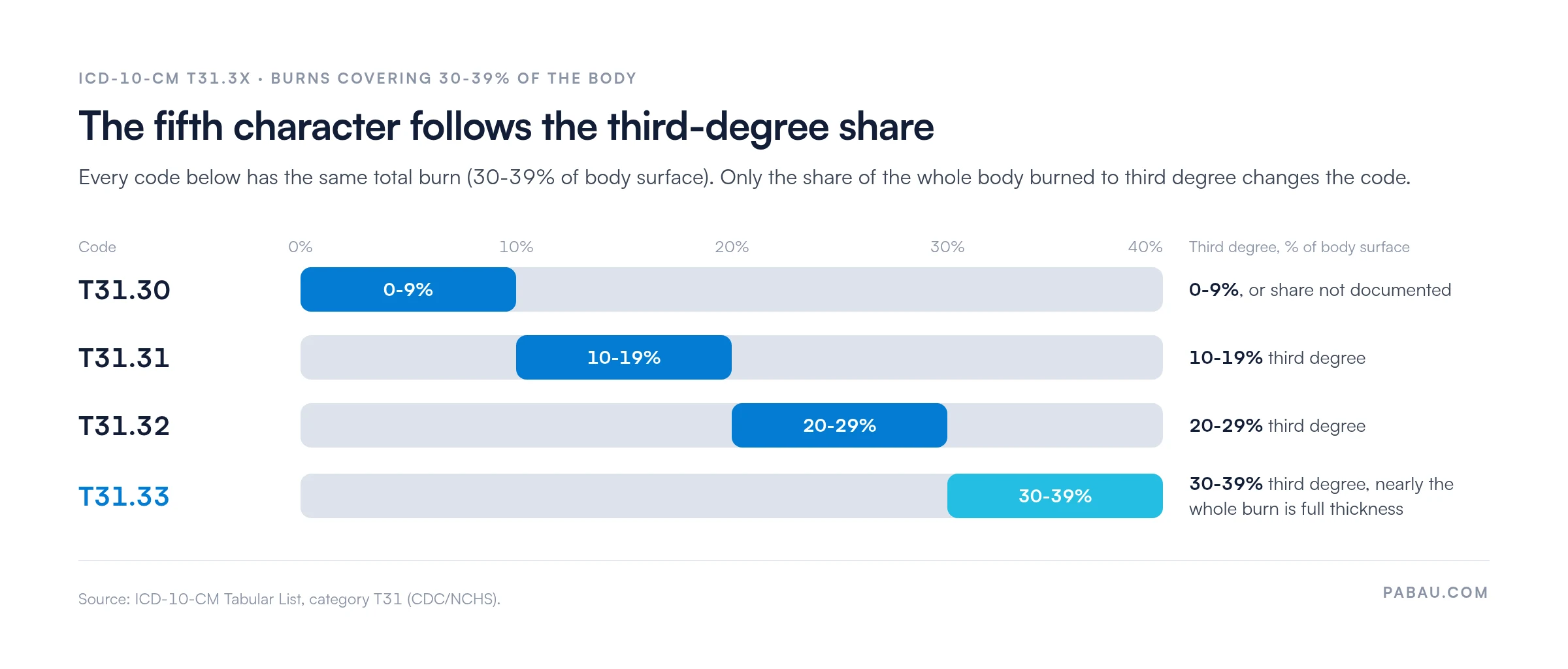
The fifth character tracks the third-degree share of the whole body: T31.30 is 0-9% or unspecified, T31.31 is 10-19%, and T31.32 is 20-29%.
T31.33 is the primary code only when the burn site is unspecified. Otherwise it follows the T20-T25 site codes as a supplementary code.
T31.33 takes no seventh character, so the encounter type (A, D or S) rides on the T20-T25 site codes.
External cause codes come from X00-X19 for fire and hot substances, or W85-W87 for electrical burns.
ICD-10 code T31.33 is the billable ICD-10-CM code for burns involving 30-39% of body surface with 30-39% third degree burns. Both numbers sit in the same band, so nearly the whole burned area is full thickness. It belongs to category T31, which sorts burns by extent rather than by body site.
In practice, you’ll see it on major burn admissions, usually beside site codes from T20-T25. The table holds the reference data, and you can browse neighboring codes in the ICD-10-CM code library.
In T31.3x, the fourth character fixes the total burn at 30-39% of body surface. The fifth character records how much of the whole body is burned to third degree: 0-9, 10-19, 20-29 or 30-39%. Both figures are measured against total body surface, never against the burned area alone.
The chart below shows the same ladder at a glance. Only the third-degree band moves, while the total burn stays put.
Depth has to come from the provider’s documentation. Coders shouldn’t infer it from nursing notes or wound care orders alone. If the record is unclear, query the provider.
A note stating 25% third degree belongs on T31.32, not T31.33. With no third-degree figure at all, T31.30 is the default.
The rule of nines is the standard way to estimate TBSA for burn coding. The percentages in the provider’s note decide which T31 code applies, as the CMS ICD-10 resources and official guidelines set out.
Here’s a worked example. A patient has burns to both arms (18%) and the front of the trunk (18%), so the total is 36%. The surgeon documents full thickness on both arms and half the anterior trunk.
That makes 18% plus 9%, or 27% third degree. The correct code is T31.32, not T31.33. T31.33 applies only once the third-degree share reaches 30% of the body.
For children, the Lund-Browder chart adjusts for a larger head. The official guidelines also let providers adjust the percentages for infants, children, and patients with large buttocks, thighs, or abdomen. Either way, the provider should name the method used in the note.
Category T31 carries one instructional note, and it settles sequencing. In the Tabular List, it reads:
“This category is to be used as the primary code only when the site of the burn is unspecified. It should be used as a supplementary code with categories T20-T25 when the site is specified.”
So a patient with documented third-degree burns of the trunk and arms gets the site codes first. Sequence the code for the highest-degree burn first, then add T31.33 for the overall extent. T31.33 adds data to the site codes, and it never replaces them.
Does T31.33 need a seventh character? No. This trips up coders who work across burn categories, because T20-T25 site codes always take one. A marks the initial encounter, D a subsequent one, and S a sequela.
Encounter type for a T31.33 claim lives on those companion site codes. Getting that split right is part of sound medical billing workflows for burn cases.
T31.33 rarely appears alone. A burn this size brings extra diagnoses and procedures, and each needs its own code.
When the record documents inhalation injury, code it separately, whatever the principal diagnosis. Grafts need the same care. A split-thickness autograft on the trunk, arms, or legs is reported with CPT code 15100 for the first 100 sq cm.
Build a companion code list from the admission and operative notes before you submit. A T31.33 claim without the external cause code or the T20-T25 site code is an easy denial. If the note doesn’t state how the burn happened, query the provider first.
A major burn claim passes through several hands. Here’s the usual path, step by step.
Five elements carry a T31.33 claim through review. Without them, nobody can defend the third-degree share, and the claim may stall or move to a lower T31.3x code. clean claim submission depends on the record capturing them before billing starts.
Run through this list before the claim leaves the building. Each line maps to a common reason burn claims come back.
Burns of this size and depth almost always mean an inpatient stay. Authorization rules differ by plan and change often, so confirm them early.
Most denials on extent-based burn claims trace back to documentation or sequencing. These are the slips worth catching first, and solid denial management strategies help with the rest.
Once the burn has healed, the coding structure changes. A sequela visit for scarring, contracture, or rehab leads with the residual condition. The T20-T25 site code follows with seventh character S.
The guidelines describe T31 for acute burns, so T31.33 usually drops off once the burn has healed. While a burn is still healing, it’s coded as acute.
A T31.33 admission can carry a long list of diagnosis codes, several graft procedures, and an authorization. Many teams still build that claim by hand and track it in a spreadsheet. A missing field then shows up weeks later as a rejection.
Pabau is the practice management platform we build, and its claims software for practices pre-fills each claim from the patient record. Coders search ICD-10-CM and CPT codes from built-in lookup libraries. Required fields are checked before the claim can be sent.
In the US, claims go out through Claim.MD, with real-time eligibility checks and ERA remittance posting. Your team spends less time re-keying codes and more time on the claims that need a person.
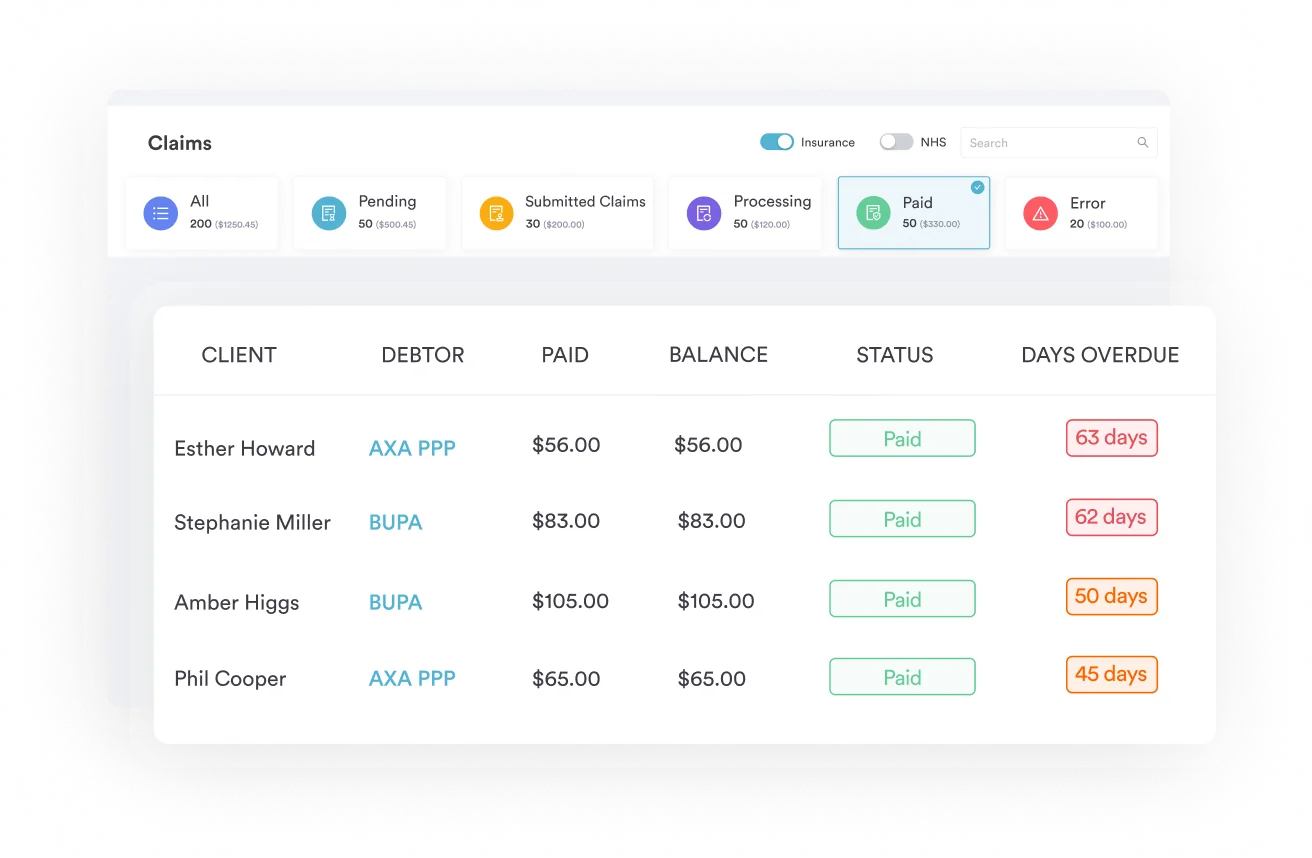

Pabau pre-fills claims from the patient record, checks required fields before sending, and tracks each claim to payment through Claim.MD.

T31.33 rests on two numbers in the provider’s note: the total burn and the third-degree share. When both sit in the 30-39% band, the code follows. When either is missing, query the provider before billing.
A one-line addendum costs far less than an appeal on an inpatient burn stay. Building the site, extent, and cause codes at admission feels slow on a busy unit. It’s still faster than reworking a denial weeks later.
Book a demo to see how Pabau pre-fills burn claims from the record and tracks each one to payment.

Managing claim denials on complex diagnosis codes? Denial management in healthcare covers the strategies high-complexity practices use to prevent and resolve denials before they age.
Need to understand the clearinghouse submission process? Claim.MD clearinghouse guide explains how Pabau’s clearinghouse integration routes 837P claims and returns ERA remittances.
Looking for clean claim best practices? Clean claim submission guidance outlines the data completeness checks that prevent front-end rejections.
Coding a smaller third-degree share? ICD-10 code T31.31 covers 30-39% burns where 10-19% of the body is third degree.
Working a larger burn? ICD-10 code T31.44 covers burns of 40-49% of body surface with 40-49% third degree.
No. Chemical burns are corrosions in ICD-10-CM. The extent code comes from category T32 instead, so a matching corrosion extent uses T32.33. Site codes for corrosions also sit in T20-T25, under their own fourth characters.
Keep the burn codes and add a separate code for the infection. The official guidelines ask for an additional infection code on any documented infected burn site.
Yes, while it stays acute. The guidelines code non-healing burns as acute burns. Necrosis of burned skin is also coded as a non-healed burn.
ICD-9-CM used 948.33. Category 948 also coded extent by total burn, with a fifth digit for the third-degree share. That makes old records easy to map.
Yes, when the burn is still acute and the extent is documented. Once active treatment ends, outpatient follow-up visits usually take seventh character D on the site codes.