ICD-10 Code Y76.0: Diagnostic obstetric and gynecological devices
ICD-10 Code Y76.0: Definition and billable status ICD-10 Code Y76.0 is a valid, ...

Last Updated: Oct 23, 2026
Billable Code Specific Code
T31.75 is the billable ICD-10-CM code for burns involving 70-79% of body surface with 50-59% third degree burns. It records burn extent rather than burn site, so it supplements a site-specific T20-T25 code whenever the site is documented.
This code is mostly seen in acute inpatient burn center settings. Denials commonly stem from two documentation failures. Either the record has no TBSA percentage, or the charted third-degree percentage does not match the fifth character selected.
Let Pabau's smart automation suggest the right codes, reduce claim denials, and keep your practice compliant—effortlessly.
Automate repetitive tasks and focus on what matters most—your patients.
Reduce coding errors and ensure compliance with the latest regulations.
Clean claims, fewer denials, and faster reimbursements.
Powerful insights and reporting to help your practice thrive.
HIPAA compliant SOC 2 certified GDPR-compliant Trusted by 4,000+ clinics worldwide

T31.75 codes burns covering 70-79% of body surface, with third-degree burns over 50-59% of body surface. Both percentages must be documented explicitly.
The T31 category captures burn extent only. When the burn site is documented, pair it with a site-specific T20-T25 code to capture location and depth on the same claim.
T31.75 is complete at five characters; the A, D and S 7th characters belong to the site-specific T20-T25 codes, not to T31 extent codes.
Pabau’s claims management software connects to the Claim.MD clearinghouse for real-time eligibility checks, CMS-1500 claim submission, claim status tracking and ERA matching.
ICD-10 Code T31.75 is the billable code for burns involving 70-79% of body surface, with third-degree burns covering 50-59% of body surface.
It is billable in the current ICD-10-CM code set. The table below gives the reference data coders check before assigning or crosswalking it, including chapter placement and the corrosion equivalent.
For how a diagnosis code travels from the chart to a paid claim, see our guide to what medical billing is.
ICD-10 Code T31.75 captures the extent of a burn injury when two documented thresholds are met at once. Burns cover 70-79% of total body surface area (TBSA), and third-degree (full-thickness) burns cover 50-59% of body surface. Neither threshold alone is sufficient. A patient with 75% TBSA burns but third-degree burns over only 30% of body surface codes to T31.73, not T31.75.
T31 codes are extent-only codes. They tell a payer how much of the body surface is burned. They do not tell a payer where the burns are located or how deep the worst areas are in clinical terms. That information comes from the T20-T25 site-specific codes, which capture anatomical location and burn depth. In nearly all inpatient burn admissions, the coder submits a site-specific T-code alongside the T31 extent code.
The clinical context for T31.75 is severe. Burns covering 70-79% TBSA, with full-thickness burns over half the body, are among the highest-acuity injury categories in ICD-10-CM. Patients typically require intensive care, fluid resuscitation, and staged surgical debridement and grafting. Under the CMS ICD-10 coding guidelines, the T31 category records extent for tracking and reimbursement. Site-specific codes alone don’t carry that figure.
The T31.7x subcategory groups all burns with 70-79% TBSA involvement. The fifth character (the digit after the decimal) encodes the share of total body surface that is third-degree, in 10-point steps. Third-degree burns can’t exceed the total burned area, so the subcategory ends at T31.77. The chart below plots each fifth character against that 70-79% band.
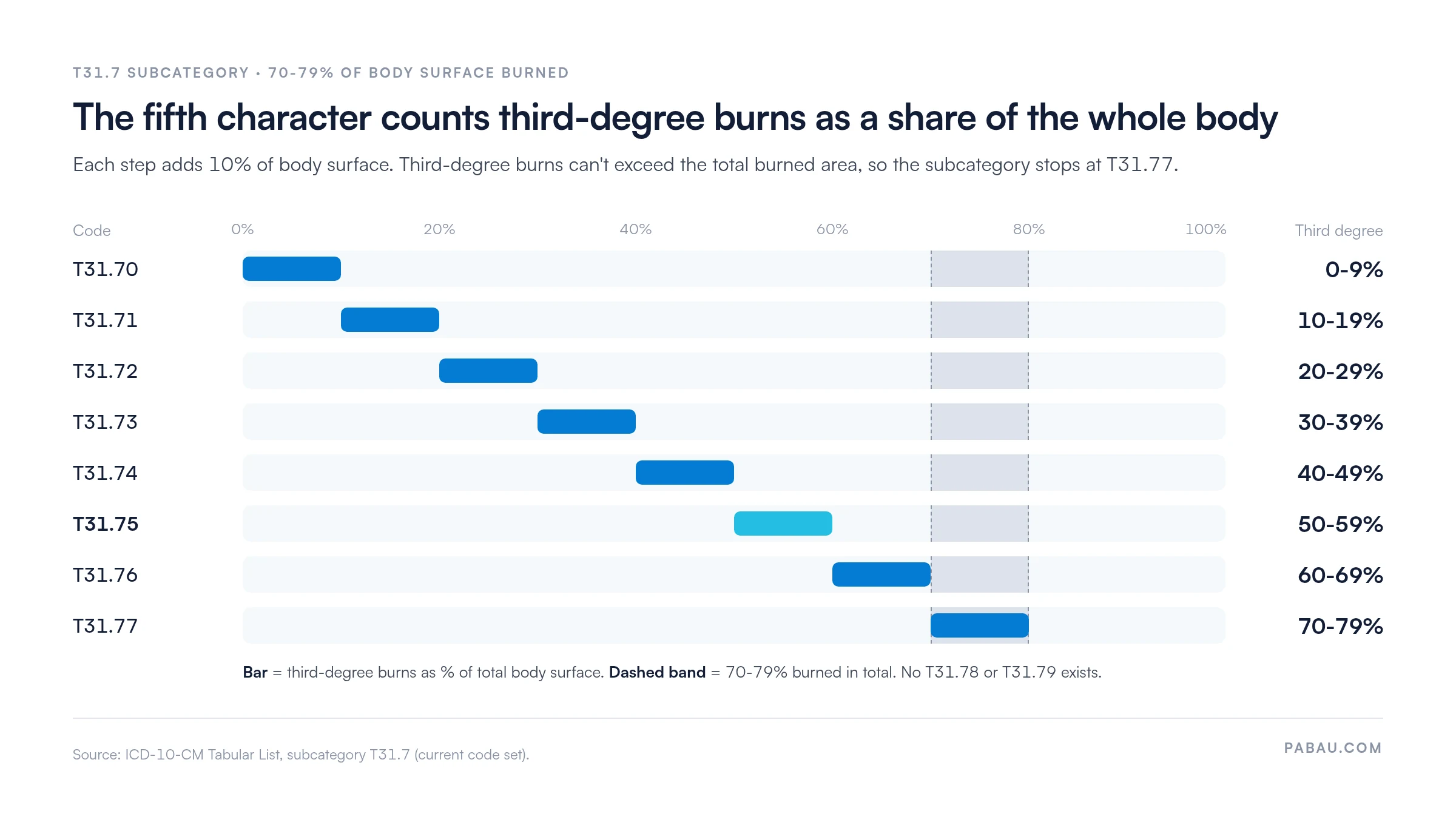
Miscoding tends to happen at this step. Coders either omit the fifth character entirely or select the wrong value when documentation is ambiguous. The table adds a clinical note for each code in the band.
T32 is the parallel category for corrosion injuries caused by chemical agents. T32.75 is the corrosion equivalent of T31.75 and uses the same digit structure. Never assign T32 for a thermal burn. The two categories split on cause of injury, and severity plays no part in the choice.
Two clinical measurement tools produce the TBSA and depth percentages coders need to assign T31.75. The physician must document both values explicitly.
When documentation states total TBSA but does not specify the third-degree percentage, the coder cannot assign T31.75. T31.70 (0-9% third degree, the unspecified default) is the correct fallback, but it triggers a significant DRG downgrade. A documentation query to the attending physician before claim submission is almost always worth the turnaround time.
Flag charts where the TBSA is documented but the third-degree percentage is missing. A single query to the attending physician can shift coding from T31.70 to T31.75 and prevent a costly DRG downgrade. Build this query into your burn center CDI workflow before the chart drops to the coding queue.
Within the T31.7x band, every code differs only in the documented third-degree percentage. The table below shows the most commonly confused sibling codes alongside the corrosion equivalent. It also includes T31.70, the code most often assigned by default when documentation is insufficient.
The ICD-10-CM Tabular List carries one instructional note and one exclusion at the T31 category level. Both apply to every code in the series, including T31.75.
Corrosions caused by chemical agents sit in their own category, T32. A chemical injury of this extent takes T32.75 rather than T31.75.
Inhalation injury carries no T31 note, but it is still coded when documented, following the Alphabetic Index. Smoke inhalation is T59.81-, with J70.5 for the resulting respiratory condition. Burns of the respiratory tract itself fall under T27.-.
The T31 category note sets the order. T31.75 is sequenced first only when the burn site is not specified. When sites are documented, T20-T25 codes lead and T31.75 supplements. In practice, that gives two scenarios.
T31.75 maps to the burn DRG family under the CMS MS-DRG system. DRG assignment depends on CC-level or MCC-level diagnoses (complications or comorbidities), skin graft procedures and, for MS-DRG 927, prolonged ventilation. Accurate coding decides which DRG fires. Undercoding, such as defaulting to T31.70 when T31.75 is warranted, can trigger a lower-weighted DRG with significantly reduced reimbursement.
CMS updates DRG groupings and relative weights each October. The table above reflects the general burn DRG family structure. Verify current DRG weights in the CMS ICD-10 coding and MS-DRG Definitions Manual for the applicable fiscal year. A documented CC or MCC moves a claim from MS-DRG 929 to MS-DRG 928, which is a meaningful reimbursement difference.
Tracking electronic remittance advice (ERAs) after adjudication shows which payers pay burn claims at a lower DRG than the one coded. That pattern can point back to secondary diagnoses missing from the claim.
Claims carrying T31.75 almost always involve inpatient acute care with high per-diem costs, which means payer scrutiny is elevated. The following requirements appear consistently across Medicare, Medicaid, and commercial payer policies. Local coverage determinations (LCDs) issued by Medicare Administrative Contractors (MACs) still vary by jurisdiction.
T31.75 denial patterns follow predictable causes. Most are preventable at the documentation and pre-submission review stage. The denial management workflow for major burn claims should flag each of the following before submission.
Our reference to denial codes in billing lists the codes payers attach to burn claim rejections. Reviewing claim adjustment reason codes (CARCs) from ERA files after adjudication shows which denial pattern dominates a given payer mix.
Run a pre-submission edit check on every T31.75 claim. When burn sites are documented, confirm a T20-T25 code is sequenced first and T31.75 follows as the extent code. Then check for any additional codes for inhalation injury or wound infection. Submitting a clean claim the first time avoids the appeal cycle.
This checklist captures the pre-submission verification steps that reduce T31.75 denials. Work through every item before the claim drops.
Our guide to submitting a clean claim covers the claim-level checks that apply to every diagnosis code category. Applying them to T31.75 claims cuts rework from the denials described above.
A T31.75 claim carries two documented percentages, plus a site code and an extent code. Billing teams often still check eligibility and chase claim status by hand across payer portals, one burn claim at a time.
Pabau, the practice management platform we build, connects to the Claim.MD clearinghouse for professional claims. Its streamlined claims management runs real-time eligibility checks, submits CMS-1500 claims electronically, tracks claim status and matches ERAs to the claims they settle.

Once ERAs are matched, the team can see which burn claims came back short or denied, and which adjustment codes the payer used. That lets you fix the documentation pattern behind them instead of reworking claims one by one.

Pabau connects to the Claim.MD clearinghouse for real-time eligibility checks, electronic CMS-1500 submission, claim status tracking and ERA matching. See how it helps your team catch claim problems before a payer does.

T31.75 turns on two numbers, and the physician has to write both of them down. Build the CDI query into the burn workflow before the chart reaches coding, and ask for third-degree burns as a percentage of total body surface. That one query separates a T31.75 claim from a T31.70 downgrade.
The trade-off is turnaround time. A query holds the claim for a day or two, while a wrong fifth character can cost a lower-weighted DRG and an appeal. Book a demo to see how Pabau keeps eligibility checks, claim status and remittances in one place for your billing team.

Need guidance on managing claim denials systematically? Denial management in healthcare covers the end-to-end workflow for tracking, appealing, and preventing common claim rejections.
Looking for a reference on ERA and remittance processing? Electronic remittance advice explains how to read and act on ERA files after payer adjudication.
Want to understand the clearinghouse layer in US claims submission? Medical claims clearinghouse overview breaks down how clearinghouses validate and route claims before they reach the payer.
ICD-10 Code T31.75 is the billable diagnosis code for burns involving 70-79% of total body surface area (TBSA). In these burns, third-degree (full-thickness) burns cover 50-59% of body surface. It is an extent code from the T31 category and is complete at five characters, so no 7th character is added for claim submission.
Yes, T31.75 is billable in the current ICD-10-CM code set. It is complete at five characters, so no 7th character is needed or valid. The A, D and S extensions apply to site-specific burn codes such as T20-T25, and a code like T31.75A is invalid.
Both codes cover burns involving 70-79% TBSA, but they differ in the documented third-degree percentage. T31.70 applies when third-degree burns cover 0-9% of body surface, or when the percentage is unspecified. It is often assigned by default when documentation is incomplete. T31.75 requires explicit documentation that third-degree burns cover 50-59% of body surface. Assigning T31.70 when T31.75 is clinically appropriate causes a DRG downgrade and potential revenue loss.
Coders need physician documentation of two explicit values: total TBSA burned in the 70-79% range, and third-degree (full-thickness) burns covering 50-59% of body surface. A burn body diagram, fluid resuscitation records, and grafting operative notes all support the code. None of them can substitute for numeric physician documentation of both percentages.
T31.75 contributes to the burn DRG family. MS-DRG 927 covers extensive or full-thickness burns with ventilation over 96 hours and a skin graft. MS-DRG 928 covers full-thickness burns with skin graft or inhalation injury with CC/MCC, and MS-DRG 929 covers the same without CC/MCC. The specific DRG depends on CCs, MCCs, ventilation time and skin graft procedure codes. Verify current DRG weights in the CMS MS-DRG Definitions Manual for the applicable fiscal year.
T31 codes classify burns caused by thermal sources (flame, scald, radiation, electrical). T32 codes classify corrosions caused by chemical agents. Both series use the same digit structure, so T32.75 is the corrosion equivalent of T31.75. It covers chemical corrosions of 70-79% TBSA, with third-degree corrosion over 50-59% of body surface. Never assign T31.75 for a chemical injury; use T32.75 instead.