ICD-10 Code V91.84XS: Other burn due to burning watercraft
ICD-10 Code V91.84XS: overview and key facts ICD-10 Code V91.84XS identifies the...

Last Updated: Oct 30, 2026
Billable Code Specific Code
T31.55 is the billable ICD-10-CM code for burns involving 50-59% of body surface with 50-59% third degree burns.
It is the most severe code in the T31.5x subgroup, and it needs two physician-documented figures: total burn extent and the third-degree share. T31.55 is usually reported as an additional code after the site-specific T20-T25 burn codes, and it helps place the admission in the burn MS-DRGs.
Let Pabau's smart automation suggest the right codes, reduce claim denials, and keep your practice compliant—effortlessly.
Automate repetitive tasks and focus on what matters most—your patients.
Reduce coding errors and ensure compliance with the latest regulations.
Clean claims, fewer denials, and faster reimbursements.
Powerful insights and reporting to help your practice thrive.
HIPAA compliant SOC 2 certified GDPR-compliant Trusted by 4,000+ clinics worldwide

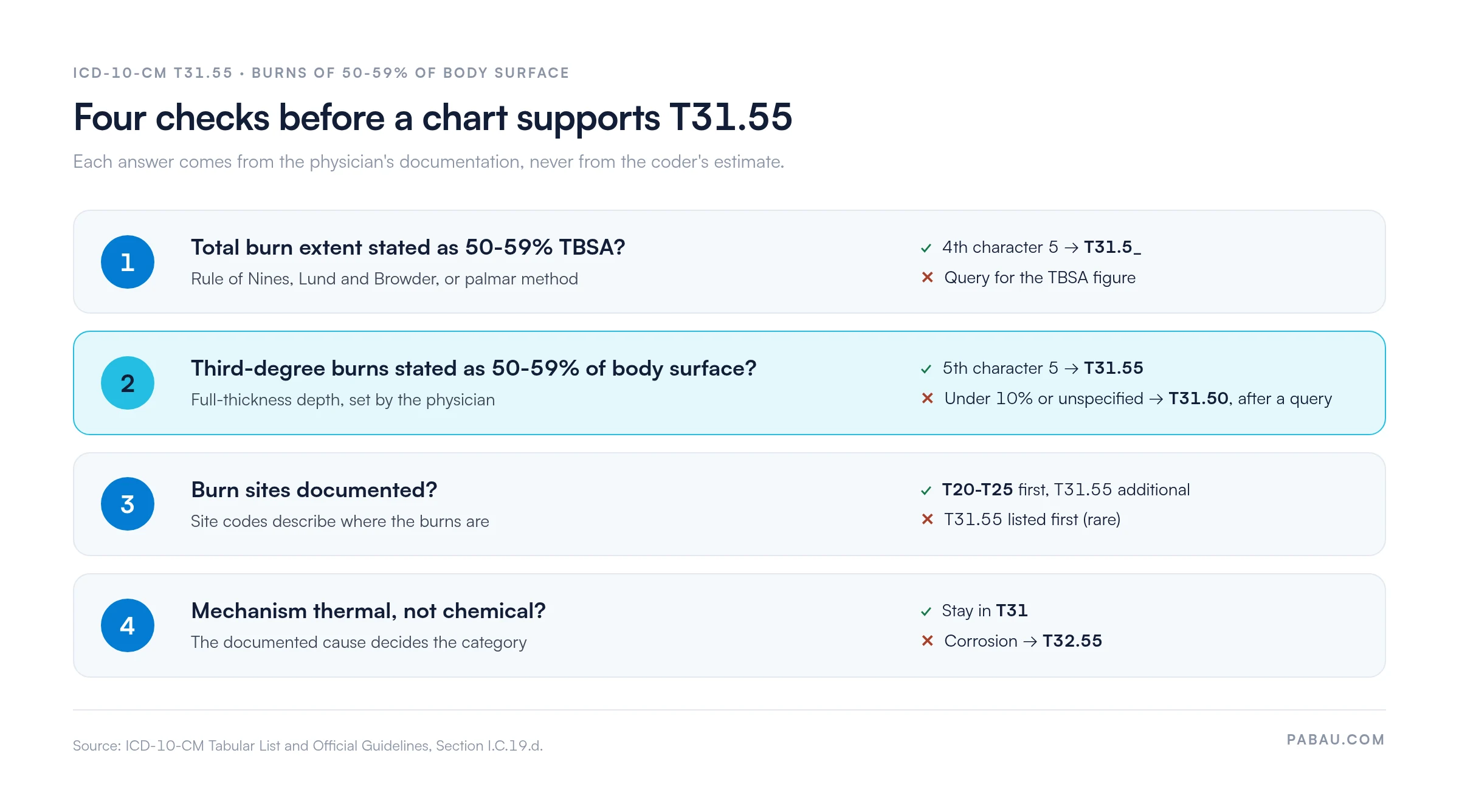
T31.55 applies only when the physician documents total burns of 50-59% TBSA and third-degree burns that also cover 50-59% of the body.
Coders cannot estimate TBSA, so the figure must come from the physician’s Rule of Nines, Lund and Browder, or palmar assessment.
T31.55 is usually an additional code, reported after the site-specific T20-T25 burn codes that say where the burns are.
Third-degree burns under 10%, or depth left unspecified, point to T31.50, so query the physician before settling on it.
In the burn MS-DRGs, ventilation over 96 hours, skin grafting, inhalation injury and CC/MCC status decide which DRG the admission groups to.
ICD-10 Code T31.55 is a valid, billable ICD-10-CM diagnosis code for burns involving 50-59% of body surface with 50-59% third degree burns. That is its official descriptor in the CDC/NCHS ICD-10-CM browser. The code belongs to category T31, which classifies burns by extent and sits apart from the site-specific burn codes T20 through T25.
The T31 category adds extent data to the anatomical burn codes. Under the CMS ICD-10-CM Official Guidelines for Coding and Reporting, Section I.C.19.d, a T31 code reports burn extent when T20-T25 codes already capture the site.
The guidelines also call for a T31 code when third-degree burns cover 20% or more of the body surface. Every T31.55 case clears that threshold.
T31.55 requires two clinical thresholds at once. Total burns must cover 50-59% of total body surface area (TBSA), and full-thickness (third-degree) burns must also cover 50-59% of the body. The physician has to document both figures explicitly, and the four checks below take a chart from burn assessment to a supported code.
Clinicians use three accepted assessment tools to calculate the TBSA percentage behind the first check:
Third-degree burns destroy the full dermis, including hair follicles, sweat glands, and nerve endings. Clinically, the wound is dry, leathery and insensate, and it may look white, brown, or black. The physician makes the depth determination. Code assignment rests on provider documentation, so a coder cannot assign burn depth from descriptions in nursing notes alone.
The T31.5x group covers all burns with a total extent of 50-59% TBSA. The fifth character specifies how much of that total extent is third-degree. T31.55 sits at the most severe end of the subgroup.
A frequent fifth-character error is defaulting to T31.50 when depth is undocumented. That code covers 0-9% third degree, and the tabular list also files 50-59% burns with no further detail under it. Query the physician for a depth determination first. A record with skin grafts or a burn ICU stay usually points to more full-thickness involvement than T31.50 reports.
T31.55 does not cover corrosions, sunburn, or erythema ab igne. Each has its own classification, so none of them is coded to T31.
T31.55 is almost always sequenced as an additional code, after a site-specific principal diagnosis. Inpatient burn admissions follow the UHDDS sequencing rules together with the burn guidelines.
Per CMS ICD-10-CM Official Guidelines Section I.C.19.d, the standard sequencing pattern for an inpatient burn admission is:
T31.55 goes first only when the burn site is unspecified, which is uncommon on a burn admission.
Inpatient and outpatient rules also differ. Under UHDDS rules, the inpatient principal diagnosis is the condition established after study. Outpatient encounters are coded to the highest degree of certainty. T31.55 on an outpatient record without a site-specific code needs strong clinical justification and tends to draw audit attention.
A clean claim submission for T31.55 depends on physician documentation that explicitly captures each element below. Missing any one of them gives the payer grounds for a medical necessity denial.
Query the physician before falling back to T31.50. That code covers 0-9% third degree or unspecified depth, so it understates a record with extensive full-thickness burns. A T31.50 next to skin grafts or a burn ICU stay invites audit scrutiny.
Burn admissions group to the burn MS-DRGs in MDC 22, and T31.55 documents the extent that marks the case as an extensive burn. Within that family, mechanical ventilation over 96 hours, skin grafting, inhalation injury and CC/MCC status decide the DRG.
MS-DRG relative weights change annually. Facilities should verify current weights from the CMS ICD-10 updates page before budgeting reimbursement for T31.55 encounters. Sound revenue cycle management pairs accurate T31.55 assignment with timely graft procedure coding. A missed graft code moves the admission to a lower-weighted DRG such as 933 or 934.
T31.55 claims are denied for a predictable set of reasons. Understanding each one reduces avoidable rework and supports denial management workflows for burn center billing teams.
Reviewing the common denial codes next to these T31.55 audit patterns helps billing teams build targeted edits before submission.
Four codes are most often confused with T31.55, including T32.55 for corrosions of the same extent. The table below shows the deciding difference for each.
Burns at the T31.55 severity level are major hospitalizations. Commercial payers and some Medicaid programs often require authorization or concurrent review for these admissions, while Medicare applies medical-necessity review. Documentation thresholds vary by payer. Meeting medical billing compliance standards for burn center encounters means anticipating those requirements before the claim is submitted.
Claims management software with payer-specific edits flags a missing TBSA figure or site code before submission. That cuts the number of ADRs a burn billing team has to answer.
Burn surgeons and the practices that follow up burn patients bill professional claims, and T31.55 rides on those claims next to the site codes. Without a connected billing system, staff often key them into a payer portal by hand, where a missing site code is easy to overlook.
Pabau, the practice management platform we build, creates CMS-1500 claims from the visit invoice and sends them through its Claim.MD clearinghouse integration. Real-time eligibility checks run from the patient record, so coverage is confirmed before the follow-up visit.

Claim status updates and electronic remittance advice flow back into Pabau, matched to the claims they settle. Your team sees a rejected burn claim as soon as it returns and can correct the code while the filing window is still open.

Pabau creates CMS-1500 claims from each visit, checks eligibility in real time, and sends claims through Claim.MD to thousands of US payers. Remittance advice comes back matched to each claim.

T31.55 rests on two physician-stated numbers, and the code should not go on a claim until both are in the chart. When either figure is missing, query the physician before you code. A query delays the claim, but a wrong fifth character can move the whole admission to a different DRG.
Sequence the T20-T25 site codes first, add T31.55 for extent, and confirm the mechanism is thermal before the claim leaves. Those three habits head off the denial reasons covered above. Book a demo to see how Pabau turns each burn care visit into a clean professional claim, with eligibility checked up front.

Need to understand denial patterns for complex inpatient codes? Denial management in healthcare explains how to build systematic workflows that catch ICD-10 coding errors before they reach the payer.
Looking for the full burn billing picture? What is medical billing covers the end-to-end process from code assignment through payment posting for inpatient encounters.
Want to see how a clearinghouse handles your claims? Claim.MD clearinghouse overview details how electronic claims reach Medicare and commercial payers with real-time status tracking.
ICD-10 code T31.55 is the billable diagnosis code for burns covering 50-59% of total body surface area, with third-degree burns also covering 50-59%. It belongs to category T31, which classifies burns by extent rather than site. Coders report it alongside the site-specific T20-T25 codes.
T31.50 covers burns of 50-59% total body surface with 0-9% third degree, and the tabular list also places unspecified depth there. T31.55 covers the same total extent with 50-59% third-degree burns. Query the physician before using T31.50 for missing depth, because a documented full-thickness share calls for a higher fifth character.
Three methods are common. The Rule of Nines assigns 9% TBSA to each major body region and is standard for adults. The Lund and Browder chart adjusts proportions by age and suits pediatric patients. The palmar method treats the patient’s palm as about 1% TBSA for scattered burns. The physician documents the method and the resulting percentage, and the coder never estimates TBSA.
T31.55 is listed first only when no specific burn site is documented. On inpatient burn admissions, the site-specific T20-T25 code is almost always the principal diagnosis. T31.55 follows as an additional code under UHDDS rules and CMS Official Coding Guidelines Section I.C.19.d.
Burn admissions with T31.55 group to the MDC 22 burn MS-DRGs. DRG 927 covers extensive or full-thickness burns with ventilation over 96 hours and a skin graft. DRGs 928 and 929 cover full-thickness burns with a skin graft or inhalation injury, with and without CC/MCC. DRG 933 is ventilation over 96 hours without a graft, and DRG 934 is a full-thickness burn without a graft. Verify current weights in the CMS MS-DRG Definitions Manual.
Technically yes, but burns covering 50-59% TBSA with 50-59% third-degree involvement require inpatient care in nearly every case. T31.55 on an outpatient claim draws medical necessity scrutiny, because that severity is inconsistent with outpatient management. If you assign it in an outpatient context, document why that setting was appropriate.
The top denial reasons start with a missing numeric TBSA percentage in the physician documentation. Others are a missing companion T20-T25 site code and confusing thermal burns (T31) with corrosions (T32). Overcoding a 40-49% third-degree case that belongs in T31.54 is another. Outpatient use without clear justification for the care setting completes the list.
The Rule of Nines divides the adult body into regions of 9% TBSA or multiples of it. The head and neck count 9%, each arm 9%, the anterior and posterior trunk 18% each, and each leg 18%, leaving 1% for the perineum. For burn coding, it produces the TBSA percentage that sets the T31 code group. The physician documents the result, and the coder reads that figure instead of calculating it.