

CCSD code G5100: Bypass of duodenum billing guide
CCSD code G5100 bills a bypass that leaves the duodenum in place CCSD code G5100...

Last Updated: Oct 16, 2026
Billable Code Specific Code
T32.55 is the billable ICD-10-CM code for corrosions involving 50-59% of body surface with 50-59% third degree corrosion.
Let Pabau's smart automation suggest the right codes, reduce claim denials, and keep your practice compliant—effortlessly.
Automate repetitive tasks and focus on what matters most—your patients.
Reduce coding errors and ensure compliance with the latest regulations.
Clean claims, fewer denials, and faster reimbursements.
Powerful insights and reporting to help your practice thrive.
HIPAA compliant SOC 2 certified GDPR-compliant Trusted by 4,000+ clinics worldwide

T32.55 is a billable ICD-10-CM code for corrosions involving 50-59% of body surface with 50-59% third degree corrosion.
The code has been in ICD-10-CM since the code set took effect on October 1, 2015, and it remains valid in the FY2026 edition.
It requires two separate measurements: the total body surface affected by corrosion, and the share of that area which is third degree.
The legacy ICD-9-CM code 948.55 maps to both T31.55 and T32.55, so the reverse crosswalk is ambiguous rather than direct.
External cause codes for a chemical corrosion come from X40-X49, not from the thermal ranges used for burns.
The description for ICD-10 code T32.55 contains two separate body surface area measurements. Neither can be dropped or assumed from the other.
In practical terms, take a patient with 55% of body surface affected by chemical corrosion. If 52% of that affected area carries third-degree depth, the case maps to T32.55. Payers and clinical audit teams read the third-degree percentage to judge resource intensity and case complexity. Documenting the total TBSA without the third-degree extent leaves the claim under-coded.
The CDC/NCHS ICD-10-CM web tool carries the official tabular definition, including the exact wording of every code in the T32.5 subcategory.
In ICD-10-CM, “corrosion” has a technical meaning distinct from a thermal burn. The distinction decides which code family applies: T20-T31 for burns, or T30-T32 for corrosions.
Both types can present with a similar wound appearance at second- and third-degree depth. The question at coding time is the causative agent. A wound from spilled sulfuric acid is a corrosion. An equivalent wound from boiling water is a burn. Using the wrong code family misstates the external cause and distorts case-mix reporting.
Third-degree corrosion, as it appears in T32.55, means full-thickness chemical destruction of the skin. It involves the epidermis, the dermis, and potentially subcutaneous tissue. This is the most severe classification within the corrosion depth spectrum. Depth is a clinical assessment, so the coding team depends on what the clinician wrote down.
Verify the causative agent in the clinical notes before assigning a T32 corrosion code. If the attending documentation says ‘thermal injury’ or ‘burn’ but the mechanism was chemical, request clarification before submission. Misclassification between T30-T32 and T20-T31 affects the claim and the external cause reporting required under ICD-10-CM guidelines.
T32.55 sits within a five-level hierarchy. Reading it from the top confirms you have the most specific valid code, and shows which codes sit beside it. The ICD-10-CM code index lists the other categories in this chapter, including the burn codes that T32 is most often confused with.
The T32 category is maintained by the Centers for Medicare and Medicaid Services (CMS) and the National Center for Health Statistics (NCHS), which co-maintain ICD-10-CM. The code set updates each October 1. T32.55 has carried the same definition since ICD-10-CM took effect in 2015, and it is current in the FY2026 edition.
The 5th character is the element coders flag as confusing most often. It does not represent an additional body region. It specifies what share of the total corrosion area, already set at 50-59% by T32.5, is third degree.
The diagram below splits the code into its three working parts. It then puts every 5th-character band on one scale, so you can see where a documented percentage lands.
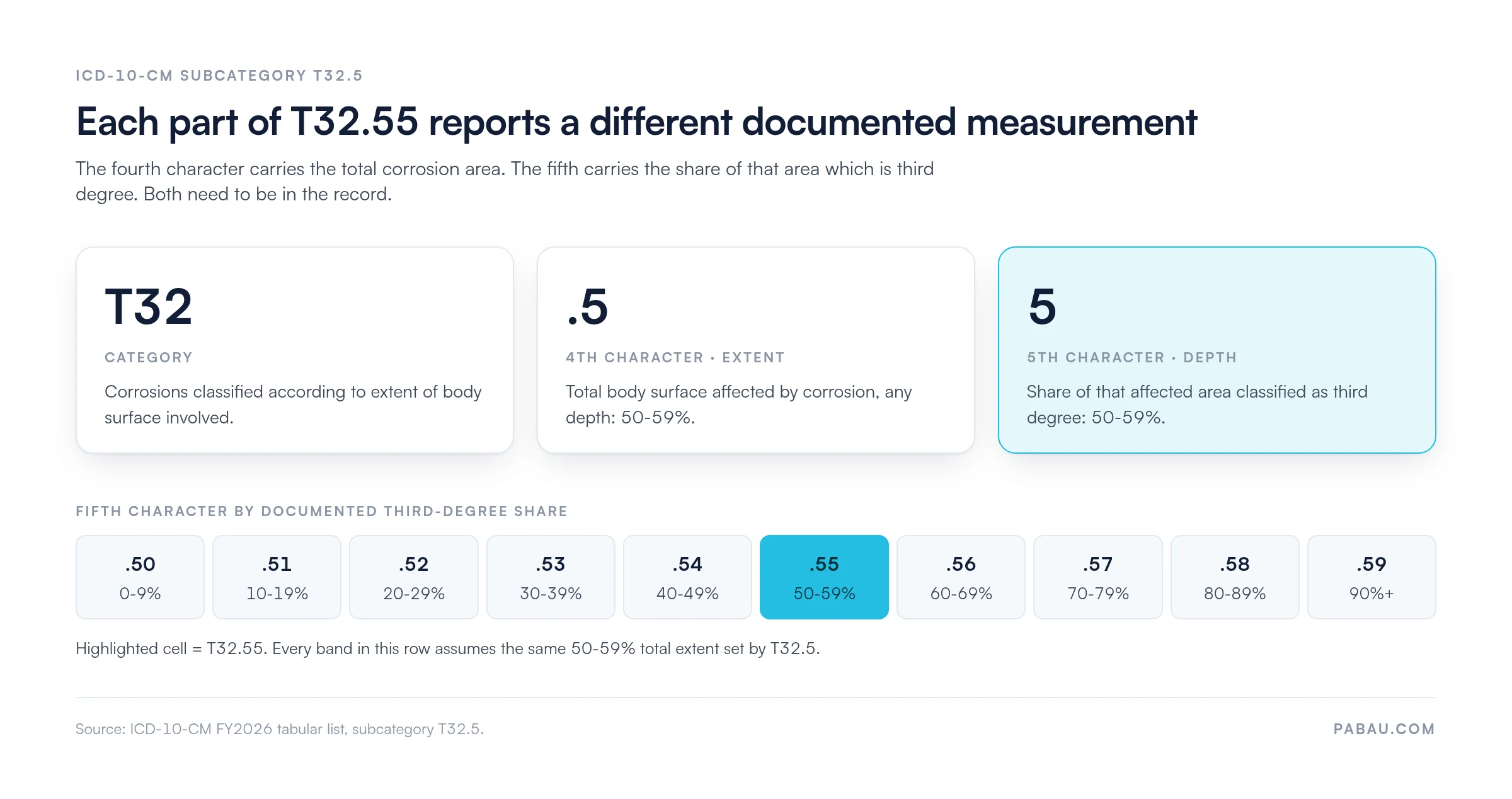
Here is how the 5th character works across the T32.5 subcategory:
T32.51 sits near the bottom of that same scale, covering a third-degree share of 10-19%. The total extent stays at 50-59% in both codes, so only the documented depth changes the 5th character.
Documentation must state both the total TBSA and the third-degree TBSA before a coder can assign T32.55. If the notes give the total affected area but no depth breakdown, query the attending clinician. Defaulting to T32.50, which caps third-degree involvement at 9%, under-codes a case where half the corrosion area is full thickness. That affects reimbursement and clinical quality reporting alike.
The following alternate clinical descriptions map to ICD-10 code T32.55 and may appear in physician documentation, operative reports, or referral letters. Confirm the TBSA percentages and the depth before you assign the code:
None of these synonyms are official ICD-10-CM terminology, but they reflect how clinicians describe corrosion injuries in documentation. The validation step is the same every time. Confirm the total percentage and the third-degree subset, then assign the code the documentation supports.
The ICD-10-CM Official Guidelines for Coding and Reporting carry the sequencing and documentation rules for T32 corrosion codes. These are the ones that matter most in daily practice:
When corrosion is the reason for the encounter, T32.55 is generally the principal diagnosis. When the corrosion is a complication of a procedure or an incidental finding, sequencing follows the general guidelines for that encounter type. Do not assume T32.55 leads the claim if the record establishes a different primary reason for the visit.
The Official Guidelines also ask for an external cause code describing how the corrosion happened. For a chemical injury, that code comes from the accidental exposure block X40-X49, most often X46-X49. The thermal ranges used for burns do not apply to a corrosion diagnosis. Codes for place of occurrence (Y92), activity (Y93), and external cause status (Y99) may also apply.
For T32.55 to be assigned, the medical record must support all of the following:
If any of these elements is absent from the documentation, a clinician query is the next step. Guessing at TBSA percentages or depth from a wound-appearance description does not support the code.
T32.55 is rarely the only code on the claim for an injury of this severity. Check whether additional codes apply for:
Whether the supporting external cause codes were included often decides how a T32 claim is handled after submission. Payers processing high-severity corrosion claims may hold one until the external cause reporting is complete. That makes denial management part of the coding job rather than a separate task downstream.
The ICD-9-CM equivalent of T32.55 is 948.55. ICD-9-CM was retired in the United States on October 1, 2015 and is no longer used for active billing. This crosswalk serves legacy reference only: historical record mapping, retrospective research, and legacy system queries.
The ICD List crosswalk tool converts codes in both directions for reference. Treat the result as approximate, because ICD-10-CM is more granular than ICD-9-CM, so one ICD-9 code can map to several ICD-10-CM codes.
T32.55 is one of those cases. Under the CMS General Equivalence Mappings, legacy 948.55 maps to both T31.55, the burn code, and T32.55, the corrosion code. Going forward from T32.55 to 948.55 is clean, but the reverse direction is ambiguous. Code 948.55 does not record whether the injury was thermal or chemical, so a legacy record needs the clinical note to settle it.
When pulling historical patient records that predate October 2015, you may encounter 948.55 in legacy EHR exports or research datasets. Do not use 948.55 on any current claim. If your EHR system still surfaces ICD-9 codes anywhere, contact your vendor. Confirm that ICD-10-CM is the active code set for all new encounters.
On a T32 claim, the documented percentages and the submitted code have to agree, and they usually live in different places. The depth assessment sits in the clinical note. The code sits in the billing screen. Reconciling the two by hand is where the specificity gets lost.
Practice management software like Pabau keeps both on one record. The clinician’s note, the TBSA figures, and the diagnosis code attach to the same patient file. The coder reads the documentation that supports the code without chasing an export. Pabau’s claims management software then validates the code before the claim is transmitted.

The outcome is fewer claims returned because a percentage was never written down. It also means less rework for a coding team already querying clinicians on depth.

Pabau holds the depth assessment, the TBSA figures and the diagnosis code on one record, then validates the code before submission. See how the workflow handles T32 and other multi-character injury codes.

T32.55 is only correct when the record carries two numbers, and the second one is usually the one that never gets written. A note that gives a total TBSA and calls the wound full thickness, without a percentage, does not support this code yet.
So the work that pays off sits upstream of coding. Ask for the third-degree percentage while the patient is still with the clinician who assessed the depth. A query raised four days later gets a slower and vaguer answer. Add the external cause code from X40-X49 in the same pass, and the claim leaves complete.
For practices handling burn and corrosion cases, that reconciliation is easier when the note and the claim sit on one record. Book a demo to see how Pabau keeps T32 documentation and coding in step.

Need to understand how clearinghouse claim validation works? Medical claims clearinghouse guide explains how claims are scrubbed and transmitted to payers for complex diagnoses.
Working through an ERA after a T32 claim denial? Electronic remittance advice (ERA) reference covers how to read 835 remittance files and identify denial reason codes.
Want to reduce coding errors at the documentation stage? Revenue cycle management overview covers how documentation, coding, and billing connect in a complete RCM workflow.
ICD-10 code T32.55 is a billable ICD-10-CM diagnosis code for corrosions involving 50-59% of body surface with 50-59% third degree corrosion. It has been in ICD-10-CM since the code set took effect on October 1, 2015, and it remains valid in the FY2026 edition.
Yes. T32.55 is a billable and specific ICD-10-CM code, so it can be submitted directly on claims without a more detailed child code. It is valid for HIPAA-covered electronic transactions in the FY2026 edition.
Burns (T20-T31) result from thermal sources such as heat, flame, electricity, or hot liquids. Corrosions (T30-T32) result from chemical agents such as acids or alkalis. The causative agent in the clinical documentation determines which code family applies.
The parent code is T32.5, which covers corrosions involving 50-59% of body surface without specifying the third-degree proportion. T32.5 is a non-billable header code. T32.55 is the billable five-character code with full specificity.
The ICD-9-CM equivalent is 948.55, which was retired in the US on October 1, 2015. Under the CMS General Equivalence Mappings, 948.55 maps to both T31.55 and T32.55, so use it for legacy record mapping only.
Of the total body surface affected by corrosion (50-59%), between 50% and 59% of that area is third degree. Third degree means full-thickness chemical injury. Both percentages must be documented separately to support the code.



