ICD-10 code S61.201A: Open wound of left index finger without nail damage
ICD-10 code S61.201A covers a left index finger wound of unstated type ICD-10 co...

Last Updated: Oct 16, 2026
Billable Code Specific Code
T25.732S is the billable ICD-10-CM code for corrosion of third degree of left toe(s) (nail), sequela.
It also covers the required additional codes, the sequela sequencing order, sibling codes, and the four errors coders make most often with T25.732. The rules below follow the CMS ICD-10-CM Official Guidelines and the 2026 edition of the ICD-10-CM tabular list.
Let Pabau's smart automation suggest the right codes, reduce claim denials, and keep your practice compliant—effortlessly.
Automate repetitive tasks and focus on what matters most—your patients.
Reduce coding errors and ensure compliance with the latest regulations.
Clean claims, fewer denials, and faster reimbursements.
Powerful insights and reporting to help your practice thrive.
HIPAA compliant SOC 2 certified GDPR-compliant Trusted by 4,000+ clinics worldwide

ICD-10 Code T25.732S covers corrosion of third degree of left toe(s) (nail), sequela. It is billable and valid for HIPAA-covered transactions from October 1, 2025.
The 7th character S marks a sequela encounter. T25.732A covers the initial encounter and T25.732D the subsequent one, and the wrong character is a common audit finding.
On a sequela claim, code the resulting condition first and T25.732S second. Leaving out the T51-T65 corrosive substance code is what triggers most denials.
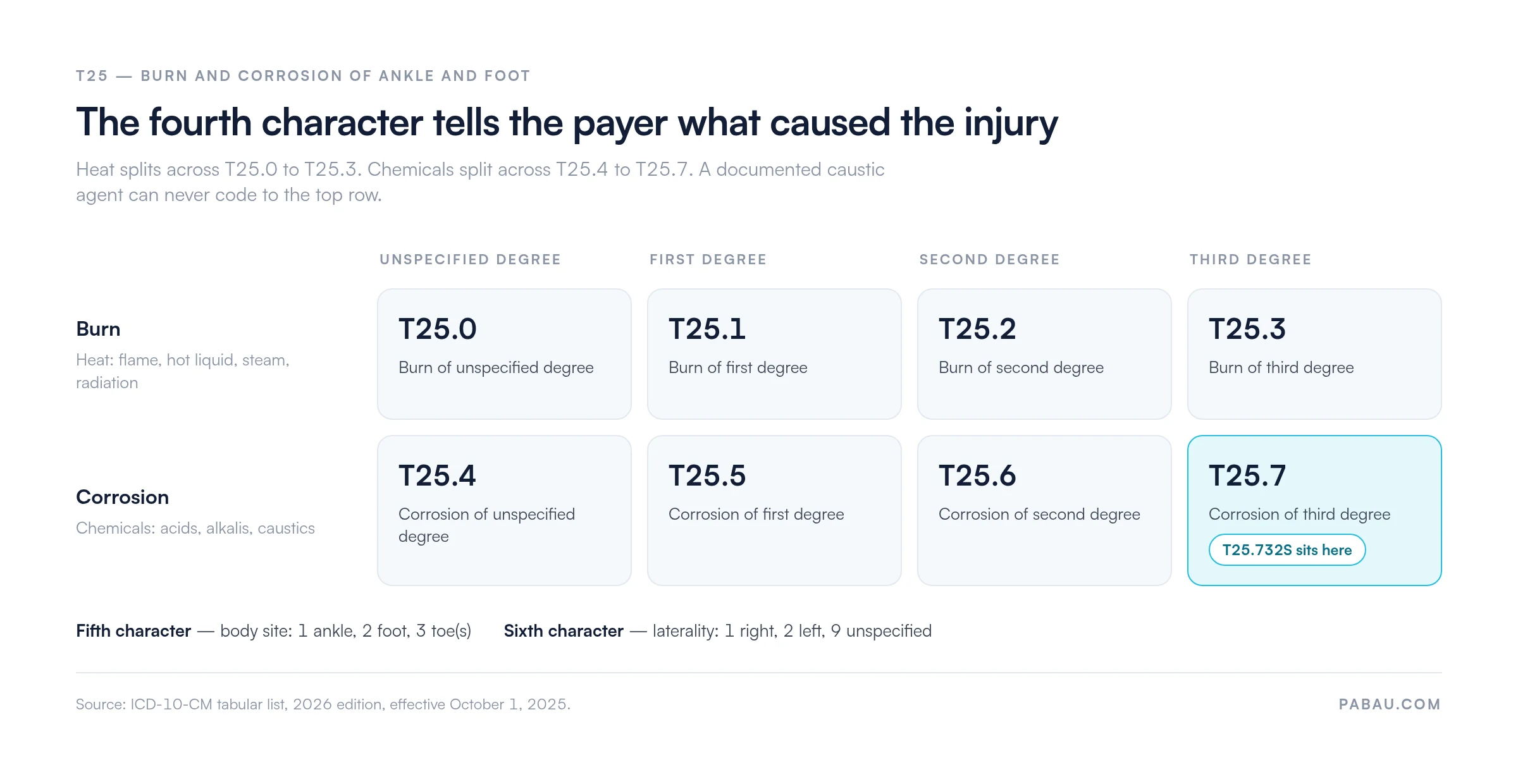
The fourth character carries the cause. Heat codes to T25.0 through T25.3, and chemicals code to T25.4 through T25.7.
Practice management software like Pabau puts diagnosis code selection inside the clinical note and the invoice. Required additional codes get captured at the point of care.
T25.732S is a billable, specific ICD-10-CM diagnosis code. It is valid for HIPAA-covered transactions and accepted for reimbursement in the 2026 edition, which took effect on October 1, 2025. Confirm that status before the claim leaves the practice, because a non-billable parent code is rejected at the front door.
Each character in T25.732S carries one piece of clinical and administrative meaning. Coders who know which character does what are far less likely to apply the wrong laterality or encounter type under pressure.
The “(nail)” in the official descriptor is an inclusion term, not a modifier you have to justify. It means the code already covers the toenail and the nail bed along with the toe. A corrosion that destroyed the nail needs no second code for it.
T25.73- offers no more granular option either. There is no separate code for the great toe or the fifth toe, so specificity in this family comes from laterality alone. Document left, right, or unspecified, and the code is as precise as ICD-10-CM allows. With the site at the ankle and no degree documented, the healed corrosion codes to T25.419S.
Burns come from a heat source and corrosions come from a chemical. The ICD-10-CM Official Guidelines keep the two in separate code families, and payers adjudicate them differently. Confusing them is the most common miscoding in the T20-T25 chapter, because the treatment context can look identical at the bedside.
If the note says “acid splash” or “chemical burn,” the corrosion half of the category applies. If it says “scalding water” or “flame injury,” code from T25.0 through T25.3. Auditors flag any mismatch between the documented agent and the code family. The map below lays out all eight T25 subcategories and shows where T25.732S lands.
T25.732S is one of three billable variants of T25.732. The 7th character is the only element that changes between them, but the sequencing rules differ sharply.
Use T25.732A while the patient is receiving active treatment for the corrosion injury. That covers emergency department presentations, first wound care appointments, surgical debridement, and any visit focused on managing the active injury.
Multiple visits for active treatment all carry the A designation. The 7th character reflects the treatment phase, not the visit count.
T25.732D applies to routine follow-up care during healing, including wound monitoring and dressing changes for a wound that is progressing normally.
The injury is still the focus of the visit, but active treatment has concluded. Take a burn unit follow-up four weeks after debridement. If the wound is healing and the visit only monitors progress, D is the right character.
T25.732S applies once the corrosion injury has healed and the patient presents for a late-effect complication. Scar contracture, chronic pain, reduced range of motion, and skin graft complications are the usual ones after third-degree corrosion of the toe.
The sequela condition, rather than the original corrosion, drives the visit. That changes the sequencing rules, as the section below sets out.
Ask one question to separate subsequent from sequela. Is the original injury still under active treatment, or has it healed and left a new condition behind? If it healed and a complication followed, use T25.732S. If it is still healing, use T25.732D.
Knowing where T25.732S sits in the ICD-10-CM structure makes the neighboring codes easy to find when documentation supports more or less specificity. Our verified ICD-10-CM code list maps the same structure across the other chapters.
The ICD-10-CM tabular list carries two kinds of instructional note for T25.732, and both apply at every encounter rather than only on the first one.
The T25.7- codes cover chemical burns from corrosive substances that contact the skin of the ankle and foot. Inclusion terms cover corrosion of the skin from acids, alkalis, and similar caustic agents. The note should name the causative agent, because that is what supports the corrosion classification.
The tabular list requires additional codes alongside T25.732S. A complete encounter record captures all of these at the time of service:
On a sequela encounter, the T51-T65 corrosive substance code takes the S 7th character to match. Place of occurrence, activity, and external cause status are reported only on the initial encounter.
External cause codes record how, where, and under what circumstances the corrosion happened. On a T25.732S sequela encounter, those codes carry the S 7th character too. Payers use that context to adjudicate injury claims, so an incomplete external cause set slows the claim down.
The most common external cause error on corrosion claims is a missing T51-T65 substance code. Remittance advice from the payer usually names it outright as the reason for the denial.
On a sequela claim, the resulting condition is the principal diagnosis and T25.732S is the additional code. ICD-10-CM Official Guideline Section I.C.19.d sets that order, and it reverses the habit most coders build on active-injury claims. The original injury code never leads on a sequela visit.
Follow these steps for every T25.732S sequela encounter:
Practice management software like Pabau integrates with Claim.MD, a US clearinghouse with thousands of payer connections. Submitting a sequela claim through a connected clearinghouse catches sequencing rejections before the payer ever sees them. Work through a clean claim checklist first, so the code pairings are verified before the file goes out.
T25.732S sits in a structured family. Coders cross-reference laterality, body site, and degree inside it constantly, and the neighbors below are the ones that get confused with it. Drop two degrees and shift the site to the foot, and a corrosion still healing with no documented laterality reports as T25.529D.
Use T25.739 only when laterality is genuinely undocumented. If the chart identifies the left side, T25.732 is the more specific code and the one to report. Defaulting to unspecified laterality when the documentation exists is a specificity error that audits pick up quickly.
Code lookup tools list the facts and stop there. These four errors are where T25 claims actually go wrong, drawn from the ICD-10-CM guidelines and from audit findings in the T20-T25 injury chapter.
The most frequent error applies T25.732D when the visit is a sequela encounter. If the corrosion has healed and the patient presents for scar treatment, neuropathy, or a contracture, T25.732S is correct. The distinction matters because sequela coding changes the sequencing rules entirely.
Coding T25.732S as the principal diagnosis is wrong. Section I.C.19.d puts the sequela condition, such as a scar contracture, in that position instead. T25.732S is always the additional code on a sequela claim. Reversing the order creates adjudication problems, because the principal code no longer matches the reason for the visit.
The T51-T65 corrosive substance code is required at every encounter type, sequela included. Coders often apply it on the initial encounter and then drop it on follow-up and sequela visits. Pabau builds software for cleaner claims, with diagnosis code templates that carry required additional codes across linked encounters.
Applying T25.332S when the note names a caustic agent is a code family mismatch. T25.332S is burn of third degree of left toe(s), sequela, so it puts heat on the claim instead of a chemical. Chemical exposure codes to T25.4 through T25.7, and heat exposure codes to T25.0 through T25.3.
The near miss to watch for is T25.532, which reads as corrosion of first degree of left toe(s) (nail) rather than any kind of burn. Auditors check the code family against the documented etiology, and a mismatch triggers a medical necessity query. The denial code most often attached to it is CO-11, diagnosis inconsistent with the procedure.
Before you submit a T25.732S claim, run a three-point check. Is the sequela condition coded first? Is the T51-T65 corrosive substance code included with the S 7th character? Are place of occurrence, activity, and external cause status all left off?
In many practices the diagnosis code gets picked after the encounter, from memory or from a lookup tab. That is where the 7th character slips and the T51-T65 substance code goes missing. By then the note is no longer in front of the coder.
Pabau puts code selection inside the clinical note itself. The coder picks the encounter type and the required additional codes while the documentation is open, and those codes flow straight onto the invoice. Linked encounters carry the substance code forward, so a sequela visit does not start from a blank field.
Claims then go out through Pabau’s clearinghouse connection with the sequencing already set. Denials that trace back to a wrong 7th character or a missing additional code stop being routine rework.

Pabau captures ICD-10 codes, encounter types, and required additional codes inside the clinical documentation workflow. Sequela claims go out complete on the first submission.

T25.732S is a narrow code with one wide trap. The descriptor is easy to match, but the sequencing reverses the habit most coders build on active-injury claims. Get the order right and the claim adjudicates. Get it backwards and the payer sees a principal diagnosis that does not explain the visit.
The durable fix is capturing the code while the note is still open, with the required additional codes attached to it. Practices that code from the documentation rather than from memory rework far fewer sequela claims. Book a demo to see how Pabau captures ICD-10 codes and encounter types at the point of care.

Chasing down why injury claims keep coming back? Denial management in healthcare covers the workflow for catching sequencing and specificity errors before a payer sees them.
Want to see how a claim actually reaches the payer? 837 file format guide explains the electronic transaction format used for HIPAA-covered claims, sequela codes included.
Auditing your injury claim submissions? Medical billing compliance guide covers audit readiness, documentation requirements, and the error patterns that show up in injury code families.
Reading a remittance that denied a corrosion claim? Electronic remittance advice explains how to read the codes a payer sends back and what each one asks you to fix.
T25.732S is a billable ICD-10-CM diagnosis code for corrosion of third degree of left toe(s) (nail), sequela. It applies when a patient presents for a late effect of a healed chemical corrosion injury to the left toe(s). Scarring and contracture are the common ones. The 7th character S is what marks the encounter as a sequela.
Burns come from heat sources such as flame, hot liquid, and steam, and they code to T25.0 through T25.3. Corrosions come from chemical exposure to acids, alkalis, and caustics, and they code to T25.4 through T25.7. The ICD-10-CM guidelines treat them as separate injury categories with different additional code requirements. Corrosion cases also require a corrosive substance code from T51-T65.
Use S when the patient presents for a late effect that resulted from a previously healed injury. The original injury must be healed. If it is still under active treatment, use A for the initial encounter or D for a subsequent one. Sequela encounters also change the sequence. Code the resulting condition first, then the injury code with S as the additional code.
T25.732S requires a corrosive substance code from T51-T65, also with 7th character S, naming the specific chemical agent. Place of occurrence (Y92), activity (Y93), and external cause status (Y99) are not reported on sequela encounters. Those three apply only to the initial encounter, T25.732A.
Yes. T25.732S is a billable, specific ICD-10-CM diagnosis code valid for HIPAA-covered transactions. It became effective on October 1, 2025 in the 2026 ICD-10-CM edition. Payers accept it for reimbursement when the documentation and the coding line up.
All three describe corrosion of third degree of left toe(s) (nail) and differ only by encounter type. T25.732A covers the initial encounter, while active treatment is being provided. T25.732D covers subsequent encounters during the healing phase. T25.732S applies once the injury has healed and the patient presents for a late effect such as scar contracture.