ICD-10 Code S53.013D: Anterior subluxation of unspecified radial head
ICD-10 Code S53.013D: Quick reference summary Use the table below as your first ...

Last Updated: Nov 6, 2026
Billable Code Specific Code
T23.732S is the billable ICD-10-CM code for corrosion of third degree of multiple left fingers (nail), not including thumb, sequela.
It applies when a full-thickness chemical injury to two or more left fingers has healed, with the thumb spared. The patient is seen now for a residual condition such as scarring, contracture or loss of grip. The seventh character S separates it from T23.732A and T23.732D, which cover the active injury. The residual condition is coded first, and T23.732S follows as its cause.
Let Pabau's smart automation suggest the right codes, reduce claim denials, and keep your practice compliant—effortlessly.
Automate repetitive tasks and focus on what matters most—your patients.
Reduce coding errors and ensure compliance with the latest regulations.
Clean claims, fewer denials, and faster reimbursements.
Powerful insights and reporting to help your practice thrive.
HIPAA compliant SOC 2 certified GDPR-compliant Trusted by 4,000+ clinics worldwide

T23.732S codes the sequela of a third-degree corrosion, or chemical burn, of two or more left fingers with the thumb not involved.
The fourth character 7 means corrosion of third degree, so a thermal third-degree burn of the same fingers takes T23.332S instead.
The residual condition, such as a scar or a contracture, is coded first, and T23.732S follows as its cause.
Corrosion codes carry a code-first note for T51–T65, which names the chemical and the intent behind the injury.
Side and thumb errors drive most denials. Right fingers take T23.731S, and an injury that includes the left thumb takes T23.742S.
ICD-10 code T23.732S is the billable ICD-10-CM code for corrosion of third degree of multiple left fingers (nail), not including thumb, sequela. It applies once a full-thickness chemical injury to two or more left fingers has healed, and the patient is seen for what it left behind.
The code is valid in the current ICD-10-CM code set and is listed in the CDC/NCHS ICD-10-CM web tool. It needs no further characters. The left thumb sits outside its scope, and so does the right hand.
Four facts decide whether T23.732S fits a claim. The injury was chemical rather than thermal, and it reached full thickness. It involved at least two left fingers, with the thumb spared. It has now healed.
Every character in T23.732S carries one piece of the clinical picture. Change any one of them and the code describes a different injury.
Within subcategory T23.7-, the fifth character names the site of the corrosion:
The seventh character “S” marks a sequela, the late effect of an injury that has already healed. Under ICD-10-CM Official Guidelines Section I.B.10, the visit treats the residual condition, and the injury code explains its cause.
Three seventh-character options apply to T23.732. Each one tells a different clinical story:
Aftercare Z codes are not used with injury codes. While the wound heals, the “D” character covers routine follow-up. Once it has healed, “S” takes over.
ICD-10-CM separates burns from corrosions. A burn comes from heat, electricity or radiation, while a corrosion comes from a chemical. In category T23, the fourth character records both the mechanism and the depth.
The chart has to name the agent. A note reading “chemical burn from drain cleaner” supports T23.732S. A note reading “burn from a hot pan” sends the claim to T23.332S, even when the depth and fingers match.
One character separates T23.732S from a long list of neighbors. The table shows the codes that sit closest to it, each confirmed against the ICD-10-CM code set.
Side and thumb are the two details auditors check first. The right-hand equivalent is T23.731S, with a 1 in the sixth position. If the documented injury also reached the left thumb, T23.742S replaces T23.732S. The same healed corrosion on the left toes moves to category T25 as T25.732S.
Five checks against the note rule each neighbor in or out. Each failed check points to the code that fits instead.
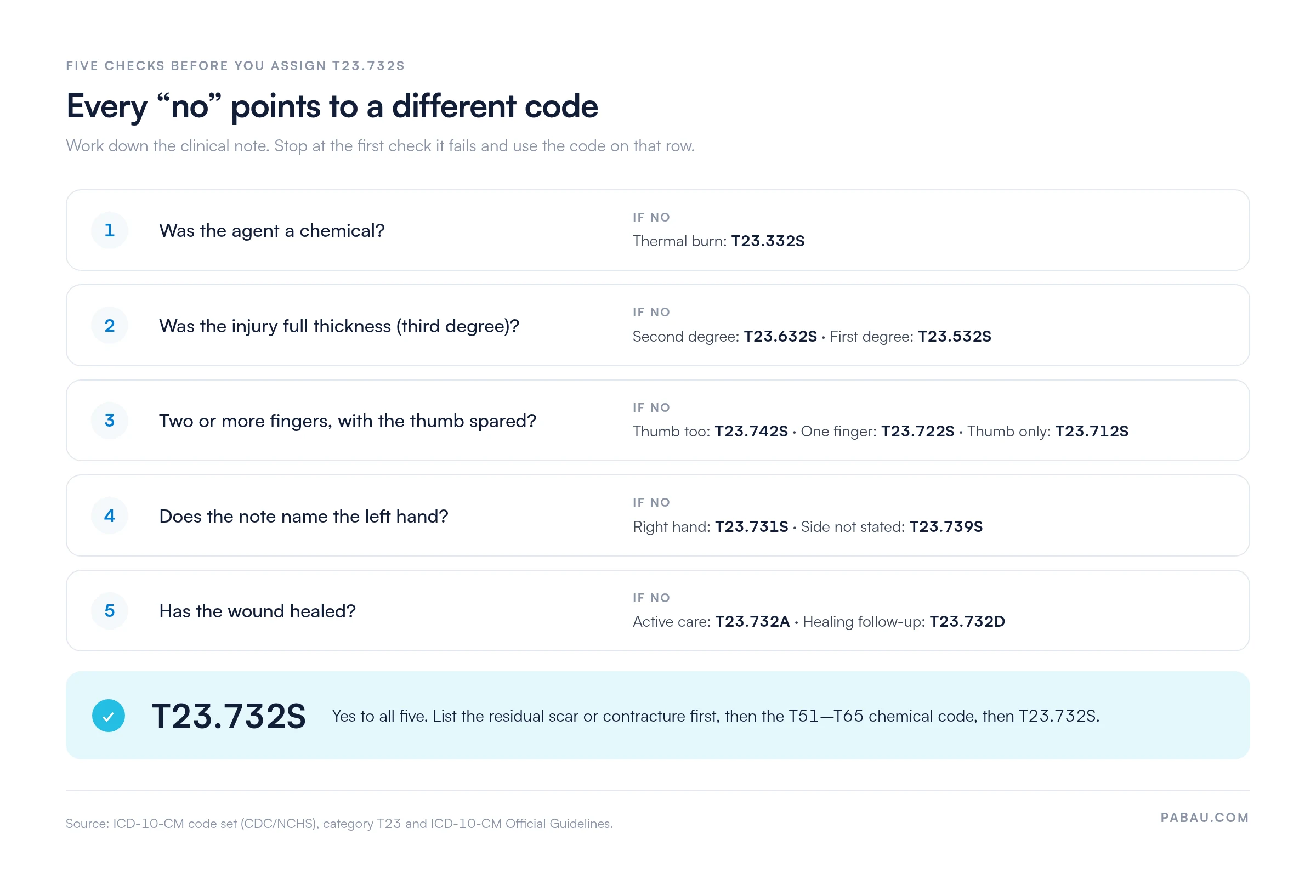
T23.732S supports any residual condition that is a direct late effect of a healed third-degree corrosion of two or more left fingers. The thumb must have been spared.
Corrosion codes in category T23 carry a “code first” instruction for T51–T65. That code identifies the chemical and the intent. On a sequela claim it takes the seventh character “S” as well.
Place of occurrence (Y92), activity (Y93) and external cause status (Y99) codes are reported only at the initial encounter. They do not return on a sequela claim.
Category T32 classifies corrosions by the body surface involved. The guidelines use it when the site is unspecified, or as an extra code when third-degree involvement reaches 20% or more of the body. A healed corrosion of several fingers rarely meets either test.
Sequencing is where most T23.732S errors start. The residual condition is the first-listed diagnosis. T23.732S explains its cause and never leads the claim.
The order on the claim has to match the reason for the visit in the clinical note. Submitting a clean claim for a corrosion sequela visit means the residual condition leads. Reversing that order is a common clearinghouse edit failure.
Pabau, the software we build for practice scheduling, notes and billing, submits electronic claims through the Claim.MD clearinghouse. Claim.MD runs its edit checks before the claim reaches the payer. A sequencing error then comes back to you, rather than to the payer as a denial.
Per ICD-10-CM Official Guidelines Section I.C.19, sequela coding needs two facts in the record. The original injury has healed, and a residual condition caused by it is being treated. T23.732S also needs the details that set it apart from its neighbors.
Practices that treat corrosion sequela in reconstructive or hand therapy settings benefit from building medical billing compliance requirements into the coding workflow. Missing details then surface before the claim goes out rather than after a denial.
Payers expect more than correct code selection. Medicare, Medicaid and commercial plans each set documentation expectations for sequela visits, especially when surgery or wound care is billed with T23.732S.
Knowing the medical billing denial codes payers return on sequela claims helps you build a pre-submission checklist. The CMS ICD-10 codes guidance lists the annual code updates that affect Medicare claims.
Denials on T23.732S claims cluster around a short list of repeat errors. Checking for them before submission is the cheapest way to cut rework.
Medical practice claims software with built-in edit checks catches side and sequencing errors before submission. The denial management workflows that work best pair those checks with a standard appeal template for disputed sequela claims.
Run a quarterly audit of every claim carrying T23.732S. Flag any where it is the first-listed diagnosis, and any where the note mentions the thumb. Both errors stay invisible at submission but show up as a denial pattern within a few months.
In many practices, a scar revision visit is coded days later from a free-text note. The coder then has to work out the chemical, the side, the fingers and whether the thumb was involved. Each of those choices changes the code.
Pabau keeps the treatment note, the injury history and the insurance claim in one patient record. Its claims management tools build the claim from that record, so the coder works from the same note the clinician signed.
You spend less time chasing returned claims, and appeals start from a complete record rather than a rebuilt one.

Pabau keeps treatment notes and insurance claims in one patient record. The side, fingers and chemical your clinician documents are the details your claim is built on.

T23.732S is narrow by design. Before you assign it, confirm four facts in the note. The agent was a chemical, and the injury was full thickness. Two or more left fingers were involved, with the thumb spared. The wound has healed.
If any of those is missing, query the clinician before the claim leaves. A one-line query costs far less than an appeal, and it protects the claim at audit as well as at payment.
Book a demo to see how Pabau keeps the clinical note and the corrosion sequela claim in step for your practice.

Need to understand how clearinghouse edits catch ICD-10 errors? Claim.MD clearinghouse overview explains how real-time edit checks intercept sequencing and character errors before payers see them.
Looking for a walkthrough of the ERA process after a sequela claim? Electronic remittance advice explained covers how to read ERA denial reason codes and action them efficiently.
Coding a corrosion sequela of the left foot? ICD-10 code T25.792S covers third-degree corrosion of multiple sites of the left ankle and foot, sequela.
ICD-10 code T23.732S is the billable code for corrosion of third degree of multiple left fingers (nail), not including thumb, sequela. It is used once a chemical injury to two or more left fingers has healed. The visit then treats a residual condition such as a scar or contracture.
T23.732S is a corrosion code, which means the injury was caused by a chemical. The fourth character 7 marks corrosion of third degree. A thermal third-degree burn of the same left fingers is coded T23.332S instead.
T23.732A covers active treatment of the corrosion, and T23.732D covers routine follow-up while the wound heals. T23.732S applies once the wound has healed and the visit treats a residual condition.
Use T23.742S, which covers third-degree corrosion of multiple left fingers including the thumb, sequela. If only the left thumb was injured, the code is T23.712S.
The residual condition comes first, such as L90.5 for a scar or M24.542 for a contracture of the left hand. Next comes the T51–T65 code for the chemical and intent, with the seventh character S. T23.732S follows as the cause.
Common denials come from using S on an unhealed wound and listing T23.732S first. Others include leaving out the residual condition code and confusing a corrosion with a thermal burn. A note that mentions the thumb or the right hand also causes mismatches.